Living
Corgi or Pomeranian, which is the better overall choice?
Depends on priorities: the Corgi scores higher with kids, other dogs, and strangers; the Pomeranian is cheaper, lives longer, and fits smaller spaces better.

Quick answer
Corgi or Pomeranian, which is the better overall choice?
Depends on priorities: the Corgi scores higher with kids, other dogs, and strangers; the Pomeranian is cheaper, lives longer, and fits smaller spaces better.
Pembroke Welsh Corgi or Pomeranian? On paper they differ most on exercise need, and on the scales Pembroke Welsh Corgi is the heavier at 24–30 lbs. Here is how the two compare on everything that shapes an ordinary week.
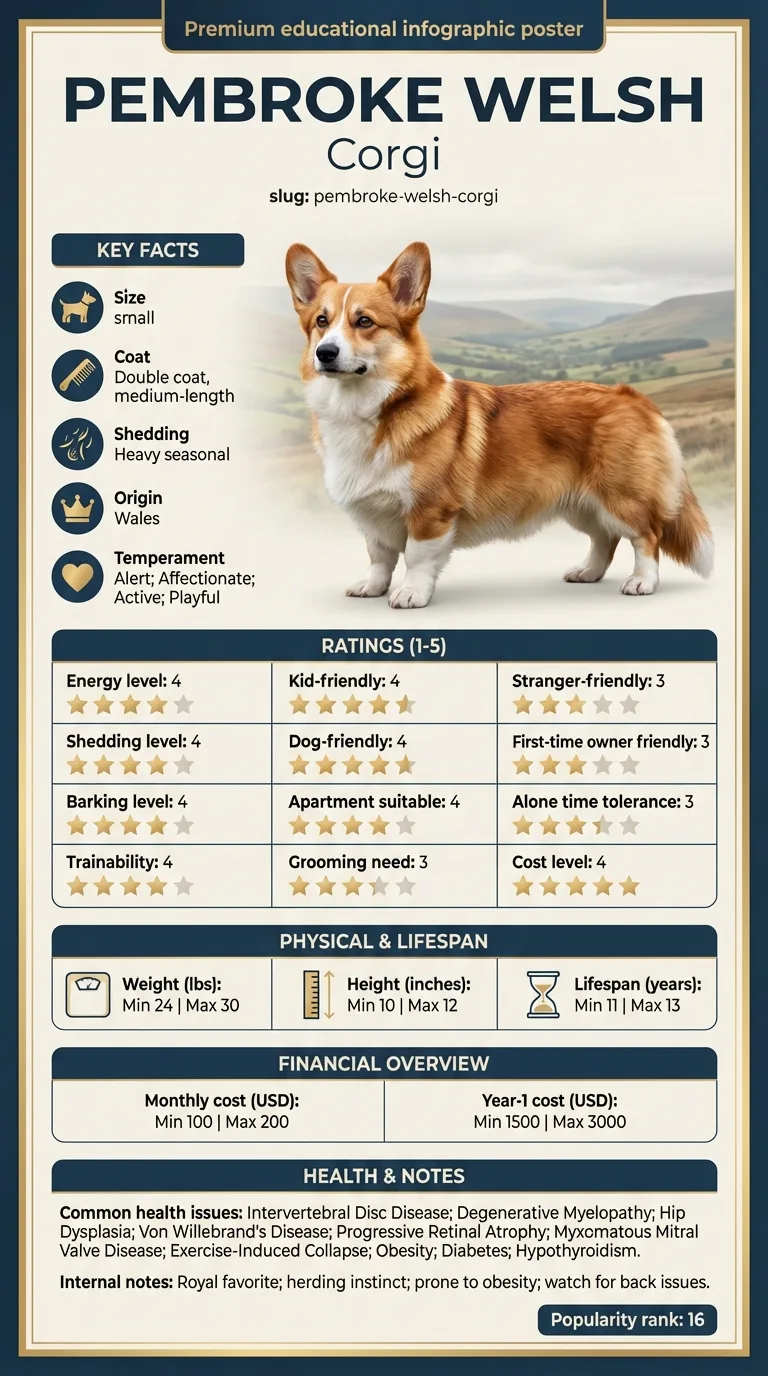
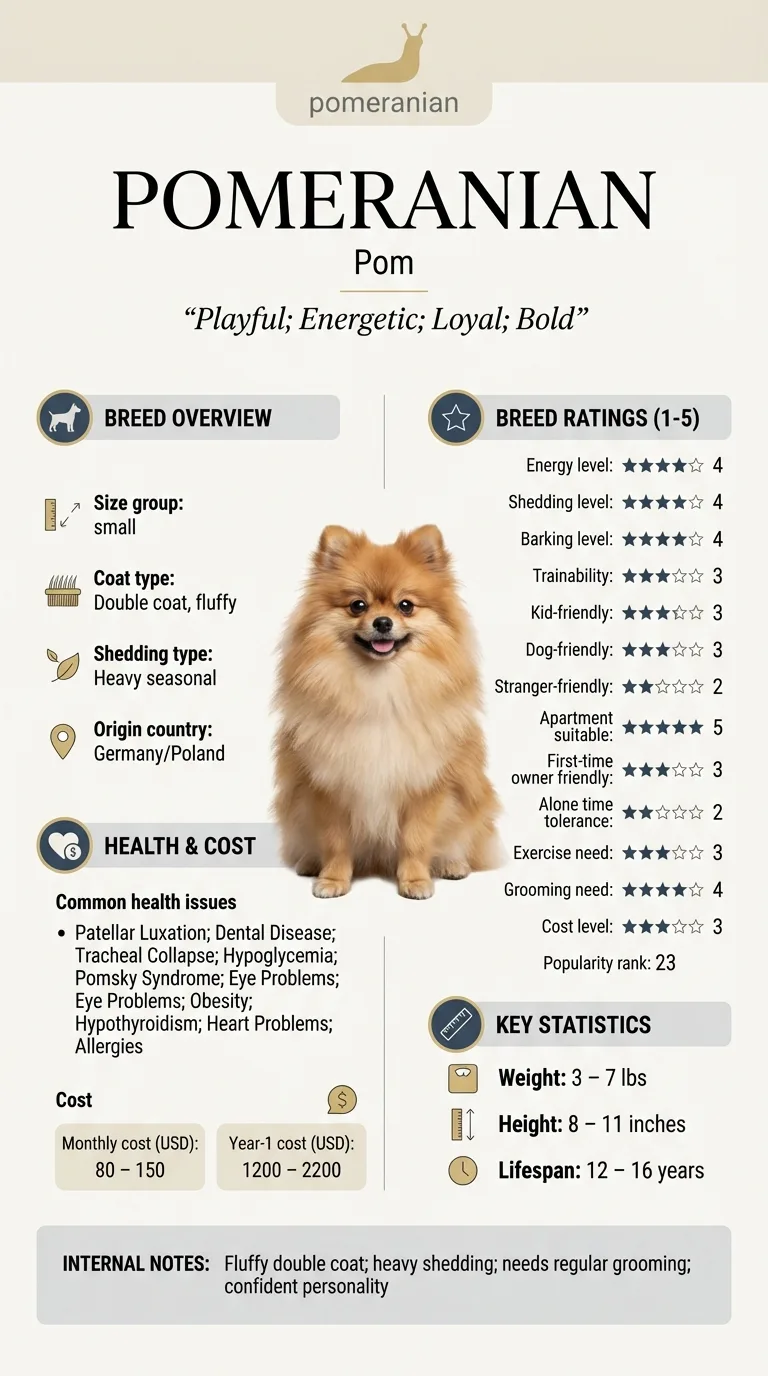
This is for someone already down to Pembroke Welsh Corgi and Pomeranian and deciding between them. Because the two are so evenly matched, the page works through every axis rather than leading with one. Anyone choosing from a flat has a clear answer here: Pomeranian rates 5/5 against 4/5. The focus throughout is on daily consequences rather than breed background.
Between Pembroke Welsh Corgi and Pomeranian, size is the honest dividing line; neither is the lower-effort dog overall.
Choose Pembroke Welsh Corgi if you do not want a standing grooming appointment, the dog will be alone during the working day and there are young children at home.
Choose Pomeranian if you are in a flat or a smaller home, your walking routine is modest and a smaller dog suits your car, your home or your back.
| Feature | pembroke welsh corgi | pomeranian | Winner |
|---|---|---|---|
| Size class | small | small | Equal |
| Weight | 24–30 lbs | 3–7 lbs | Equal |
| Height | 10–12 in | 8–11 in | Equal |
| Lifespan | 11–13 years | 12–16 years | pomeranian |
| Exercise need | High (4/5) | Moderate (3/5) | pomeranian |
| Grooming need | Moderate (3/5) | High (4/5) | pembroke welsh corgi |
| Shedding | High (4/5) | High (4/5) | Equal |
| Energy level | High (4/5) | High (4/5) | Equal |
| Barking | High (4/5) | High (4/5) | Equal |
| Apartment suitability | High (4/5) | Very high (5/5) | pomeranian |
| Good for first-time owners | Moderate (3/5) | Moderate (3/5) | Equal |
| Tolerates being alone | Moderate (3/5) | Low (2/5) | pembroke welsh corgi |
| Trainability | High (4/5) | Moderate (3/5) | pembroke welsh corgi |
| Good with kids | High (4/5) | Moderate (3/5) | pembroke welsh corgi |
| Good with other dogs | High (4/5) | Moderate (3/5) | pembroke welsh corgi |
| Friendly to strangers | Moderate (3/5) | Low (2/5) | pembroke welsh corgi |
| Cost level | High (4/5) | Moderate (3/5) | pomeranian |
| Coat | Double coat, medium-length | Double coat, fluffy | Equal |
| Origin | Wales | Germany/Poland | Equal |
| Typical monthly cost | $100–$200 | $80–$150 | Equal |
| Typical first-year cost | $1,500–$3,000 | $1,200–$2,200 | Equal |
Both breeds land in the small size class, but weight tells a different story: the Pembroke Welsh Corgi carries 24-30 lbs on a 10-12 inch frame, while the Pomeranian weighs just 3-7 lbs at a similar 8-11 inches. That's a Corgi four to eight times heavier than a Pomeranian standing at nearly the same height, a low, dense body versus a small, fluffy one.
The Pomeranian needs less daily exercise, moderate (3/5) against the Corgi's high (4/5), despite both breeds tying on raw energy level at 4/5. A Corgi's herding instincts want a job or at least a real walk; a Pomeranian burns its energy in shorter, closer-to-home bursts.
Grooming tips toward the Corgi, moderate (3/5) against the Pomeranian's high (4/5), that fluffy double coat needs more regular brushing to stay mat-free. Shedding, though, ties at high (4/5) for both; whichever you choose, expect fur on the furniture.
The Pomeranian rates 5/5 for apartment living, the ceiling of the scale, against the Corgi's still-solid 4/5. Barking ties at high (4/5) for both, so neither is the quiet option. Alone time favors the Corgi slightly, moderate (3/5) tolerance against the Pomeranian's low (2/5), worth noting if your schedule includes long stretches away from home.
Trainability favors the Corgi, 4/5 against the Pomeranian's 3/5, though first-time-owner suitability ties at moderate (3/5) for both, neither is rated an easy beginner breed outright. The Corgi's herding background tends to make it more responsive to structured training; the Pomeranian's bold streak can mean more repetition to get the same result.
The Corgi leads across the board here: 4/5 with kids against the Pomeranian's 3/5, 4/5 with other dogs against 3/5, and 3/5 with strangers against 2/5. The Corgi is described as affectionate and active, the Pomeranian as bold and loyal, which often translates to more reserve around people and animals outside its immediate circle.
The Pomeranian's 12-16 year lifespan runs ahead of the Corgi's 11-13. Both breeds carry lengthy health lists, ten conditions each, with obesity and hypothyroidism showing up on both. Beyond that overlap, the Corgi's risks lean toward spinal and joint issues (IVDD, degenerative myelopathy, hip dysplasia), while the Pomeranian's lean toward dental and tracheal issues (dental disease, tracheal collapse, hypoglycemia).
The Pomeranian is the cheaper breed to keep: cost level 3/5 against the Corgi's 4/5, monthly spend $80-150 versus $100-200, and first-year cost $1,200-2,200 versus $1,500-3,000. Some of that traces directly to size, a 30-pound dog eats and needs more than a 7-pound one, full stop.
Pembroke Welsh Corgi weighs 24–30 lbs and lives 11–13 years; Pomeranian weighs 3–7 lbs and lives 12–16 years. No rated axis separates them by more than a single point, which makes this one of the closer pairings on the site. They are level on barking, energy level and good for first-time owners, so those cannot decide it. The table below marks a winner only where one breed is genuinely easier for a typical owner; size and origin are facts rather than merits and stay level. Ratings come from one source applied to both breeds, so they are meaningful against each other rather than as absolute scores.

Not really, despite both being classed small. A Corgi weighs 24-30 lbs, a Pomeranian just 3-7 lbs, heights are closer (10-12 in vs 8-11 in), but the weight gap is large.
They tie, both are rated high (4/5) shedders, despite very different coat styles.
The Pomeranian, typically 12-16 years versus the Corgi's 11-13.
The Pomeranian, 5/5 versus the Corgi's 4/5, though both are workable in a smaller space, and both bark at a high rate (4/5), so neither guarantees quiet.
The Pomeranian, roughly $80-150 monthly against the Corgi's $100-200, and $1,200-2,200 versus $1,500-3,000 in year one.
Yes, obesity and hypothyroidism appear on both breeds' lists, though each also carries risks specific to its own body type, spinal issues for the Corgi, dental and tracheal issues for the Pomeranian.
The Corgi, on both counts, 4/5 with kids and 4/5 with other dogs, against the Pomeranian's 3/5 on each.
Depends on priorities: the Corgi scores higher with kids, other dogs, and strangers; the Pomeranian is cheaper, lives longer, and fits smaller spaces better.
$100-200 for the Corgi versus $80-150 for the Pomeranian.
The Corgi, rated high (4/5) versus the Pomeranian's moderate (3/5).
The Pomeranian, at 12-16 years versus the Corgi's 11-13.
Secure checkout on Stripe. We never see your card.
7-day money-back guarantee. Instant access.
Health information here is general and is not veterinary advice. If your dog shows pain, sudden behaviour change, or worsening symptoms, consult a licensed veterinarian.
Some links on this site are affiliate links. We may earn a commission at no extra cost to you, and we only suggest products we believe are helpful for dog owners.
We research and check what we publish, but we do not warrant that any figure, date, price, or statement is accurate, complete, or current, and we accept no liability for any loss, cost, injury, or other harm arising from the use of this site. Use it as one reference among several. You remain responsible for your own decisions and for your dog's care - confirm anything that matters with a licensed veterinarian or another qualified professional before you act on it. Full disclaimer.
Match your lifestyle to the right dog.
Take quizNot sure which breed is right for you? Take our 2-minute quiz to find out.
Take the quiz