Living
Bigger dog?
The German Wirehaired Pointer, by a wide margin -- 60-70 lbs versus 10-15 lbs.

Quick answer
Bigger dog?
The German Wirehaired Pointer, by a wide margin -- 60-70 lbs versus 10-15 lbs.
German Wirehaired Pointer or Poodle (Miniature)? On paper they differ most on apartment suitability, and on the scales German Wirehaired Pointer is the heavier at 60–70 lbs. Here is how the two compare on everything that shapes an ordinary week.
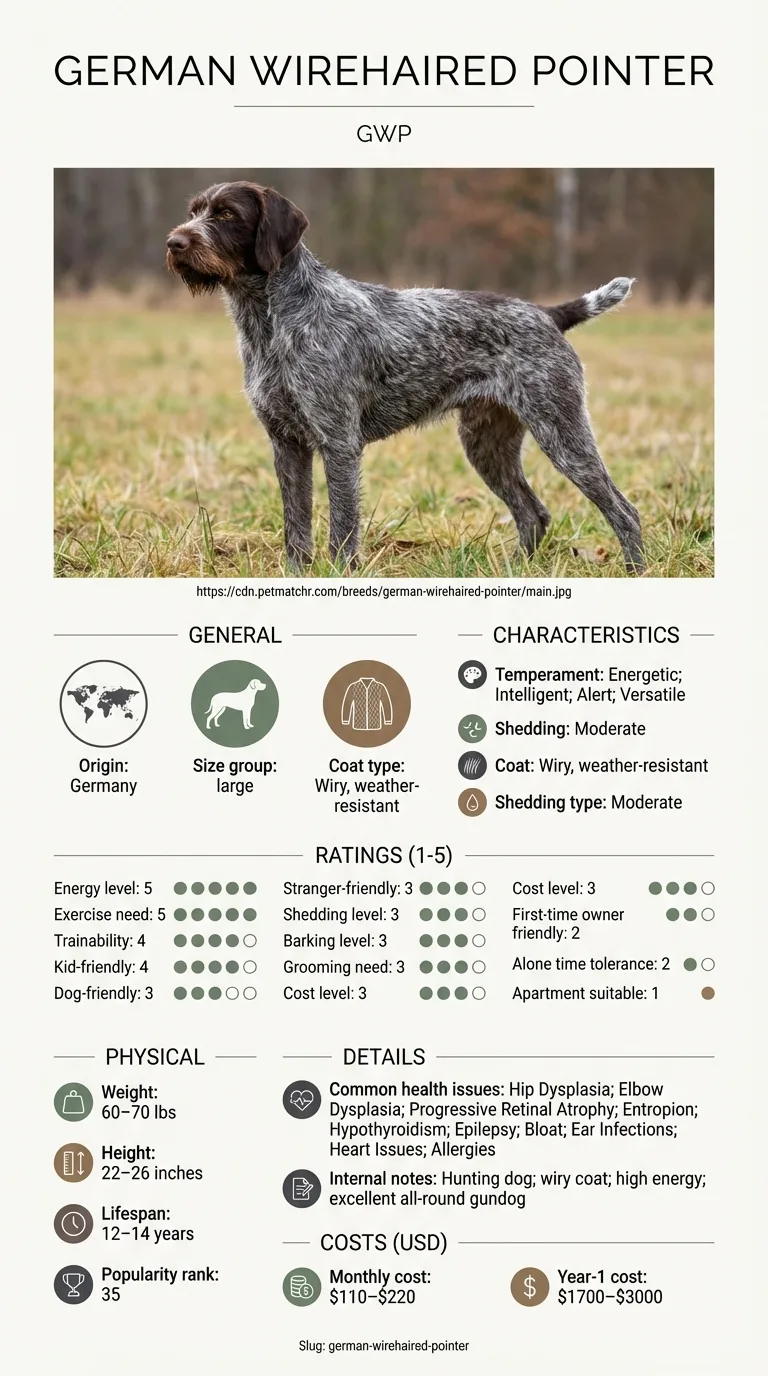
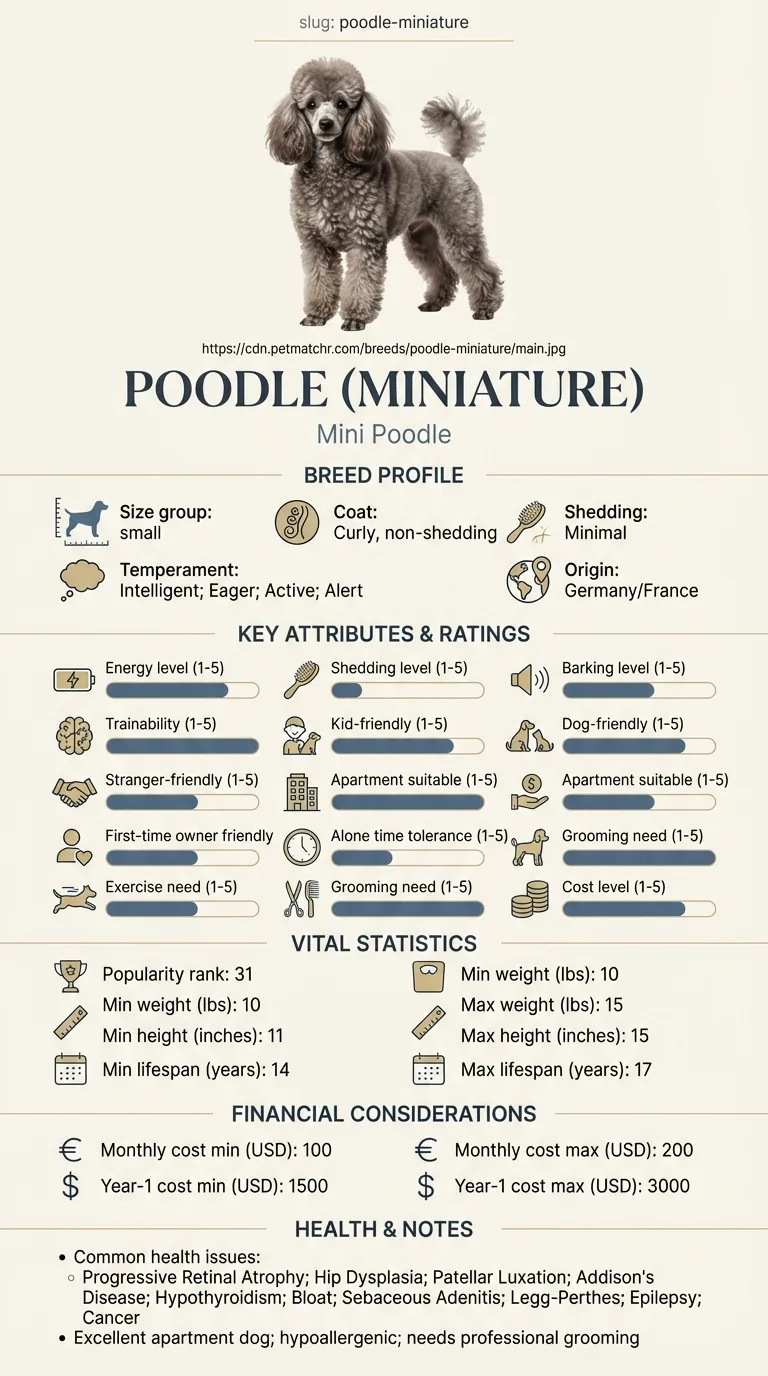
This is for someone already down to German Wirehaired Pointer and Poodle (Miniature) and deciding between them. For this pair the decision usually turns on apartment suitability and exercise need, so those are covered first and in most detail. Anyone choosing from a flat has a clear answer here: Poodle (Miniature) rates 5/5 against 1/5. Breed history is left out; what follows is what you will actually live with.
Between German Wirehaired Pointer and Poodle (Miniature), apartment suitability is what separates them, and Poodle (Miniature) is the lower-effort dog of the two to keep.
Choose German Wirehaired Pointer if you do not want a standing grooming appointment and you want a dog that can keep up with an active routine.
Choose Poodle (Miniature) if you are in a flat or a smaller home, this is your first dog and shedding is a problem in your house.
| Feature | german wirehaired pointer | poodle miniature | Winner |
|---|---|---|---|
| Size class | large | small | Equal |
| Weight | 60–70 lbs | 10–15 lbs | Equal |
| Height | 22–26 in | 11–15 in | Equal |
| Lifespan | 12–14 years | 14–17 years | poodle miniature |
| Exercise need | Very high (5/5) | Moderate (3/5) | poodle miniature |
| Grooming need | Moderate (3/5) | Very high (5/5) | german wirehaired pointer |
| Shedding | Moderate (3/5) | Very low (1/5) | poodle miniature |
| Energy level | Very high (5/5) | High (4/5) | Equal |
| Barking | Moderate (3/5) | Moderate (3/5) | Equal |
| Apartment suitability | Very low (1/5) | Very high (5/5) | poodle miniature |
| Good for first-time owners | Low (2/5) | Moderate (3/5) | poodle miniature |
| Tolerates being alone | Low (2/5) | Low (2/5) | Equal |
| Trainability | High (4/5) | Very high (5/5) | poodle miniature |
| Good with kids | High (4/5) | High (4/5) | Equal |
| Good with other dogs | Moderate (3/5) | High (4/5) | poodle miniature |
| Friendly to strangers | Moderate (3/5) | Moderate (3/5) | Equal |
| Cost level | Moderate (3/5) | High (4/5) | german wirehaired pointer |
| Coat | Wiry, weather-resistant | Curly, non-shedding | Equal |
| Origin | Germany | Germany/France | Equal |
| Typical monthly cost | $110–$220 | $100–$200 | Equal |
| Typical first-year cost | $1,700–$3,000 | $1,500–$3,000 | Equal |
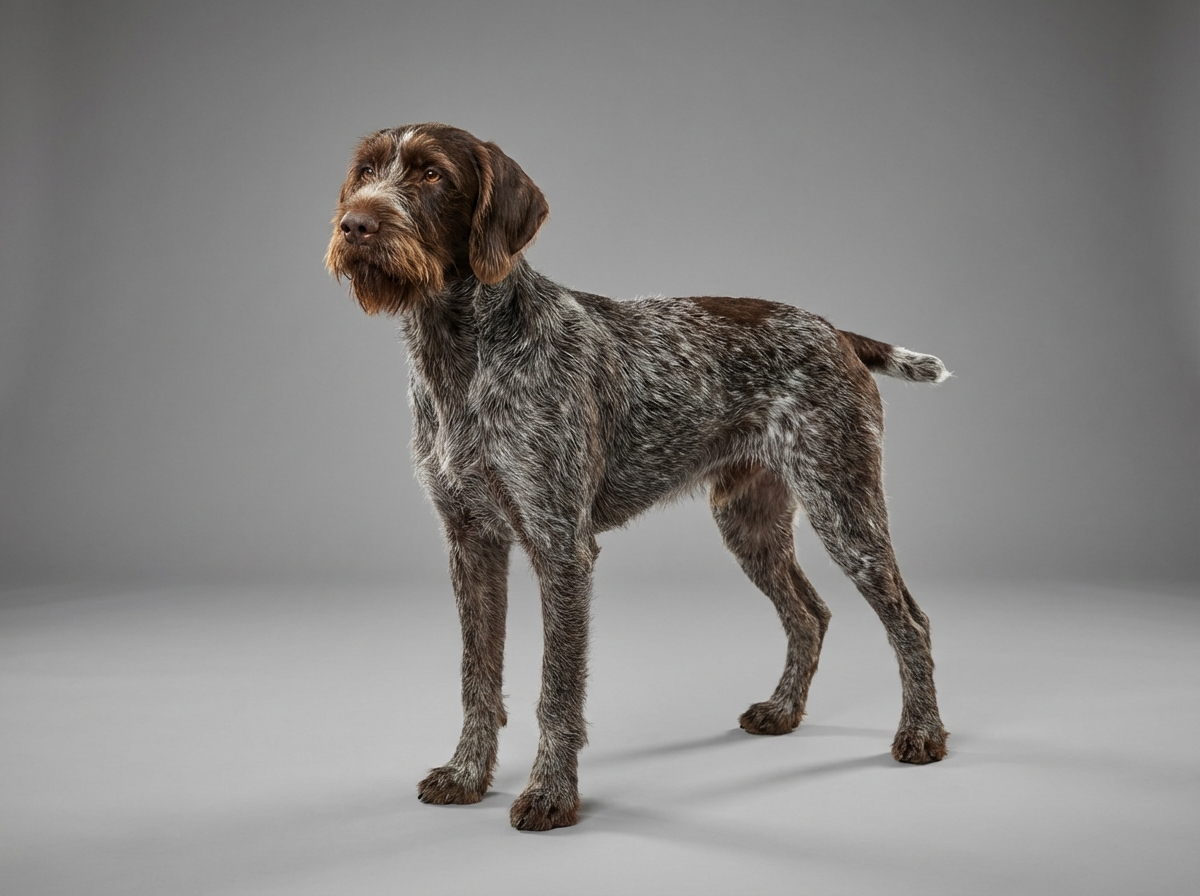
Line these two up and the scale tips hard toward the Pointer: 60-70 lbs and 22-26 inches at the shoulder against a Miniature Poodle's 10-15 lbs and 11-15 inches. A GWP could outweigh a Mini Poodle by 4-5 times and still have room to grow into a rugged, broad-chested hunting frame built for briars and cold water. The Poodle's compact body was bred for portability and elegance rather than endurance over rough terrain. Anyone picturing the two side by side in a yard should expect a genuine size mismatch -- rough play between them needs supervision, and gear (crates, harnesses, car space) will look nothing alike.
Exercise need splits at 5/5 for the Pointer versus 3/5 for the Mini Poodle, and that gap shows up daily. A GWP wants long runs, retrieving work, or field time to avoid restlessness, while the Poodle's high (4/5) energy level burns off with brisk walks and structured play. Both dogs are intelligent enough to need mental work alongside physical activity, but the Pointer's versatile hunting drive means a bored one gets destructive fast. Owners weighing these two should be honest about whether they can commit to 60-90 minutes of vigorous outdoor exercise, since the Poodle tolerates a lighter routine far better.
Coat care runs in opposite directions here. The GWP's wiry, weather-resistant coat needs only moderate grooming (3/5) but sheds moderately (3/5) year-round, shaking off mud and debris with a quick brush. The Miniature Poodle flips that: a curly, non-shedding coat rated very low (1/5) for shedding still demands very high (5/5) grooming -- regular professional clips, brushing to prevent matting, and upkeep between salon visits. Allergy-sensitive households often lean Poodle for the low shed count, but should budget real time or money for the trims; Pointer owners trade that expense for more vacuuming.
Apartment suitability could hardly be more different: very low (1/5) for the German Wirehaired Pointer against very high (5/5) for the Miniature Poodle. A GWP confined to a small unit without serious daily outlets tends to pace, bark, or chew, while the Poodle's moderate exercise needs and compact size let it settle into city living far more easily. Barking is moderate (3/5) for both, so neither is silent, but the real dealbreaker for close quarters is the Pointer's drive to move. Both dogs score low (2/5) on tolerating being alone, so neither is a natural pick for long solo workdays.
Trainability favors the Poodle at very high (5/5) against the Pointer's still-solid high (4/5), and that half-point gap matters more than it looks on paper. First-time owner suitability makes the difference clearer: the GWP rates low (2/5), reflecting its independent hunting instincts and need for an experienced, active handler, while the Miniature Poodle rates moderate (3/5), forgiving smaller training mistakes. Both breeds are genuinely intelligent and eager to work, but a Pointer's versatility was bred for field decisions made without a handler nearby, which can look like stubbornness in a novice household expecting quick obedience.
With kids, both breeds score high (4/5), making either a reasonable family choice once size differences are managed. The gap opens with other dogs: the Poodle rates high (4/5) for sociability while the GWP sits at moderate (3/5), a legacy of its focused hunting temperament. Friendliness to strangers is tied at moderate (3/5) for both, so neither breed is a natural greeter or a natural guardian. Households with a rowdy multi-dog pack or frequent dog-park visits may find the Poodle's temperament -- described as eager and active rather than the GWP's more alert, versatile drive -- the easier social fit.
The Miniature Poodle's 14-17 year lifespan outpaces the GWP's 12-14 years by a meaningful margin. Both share hip dysplasia, progressive retinal atrophy, hypothyroidism, bloat, and epilepsy on their health lists, so eye and joint screening matters for either breed. Past that overlap, their risk profiles diverge: the GWP carries elbow dysplasia, entropion, ear infections, heart issues, and allergies, while the Poodle's list adds patellar luxation, Addison's disease, sebaceous adenitis, Legg-Perthes, and cancer. Neither health list is short, so prospective owners of either breed should plan on regular vet checkups and ask breeders about relevant clearances before committing.
Day-to-day costs land close together -- $110-$220 a month for the GWP versus $100-$200 for the Miniature Poodle -- but the Poodle's overall cost level rates high (4/5) against the Pointer's moderate (3/5), driven almost entirely by grooming bills that a wiry-coated field dog simply doesn't incur. First-year costs reflect that too: $1,700-$3,000 for the Pointer compared with $1,500-$3,000 for the Poodle, a range that narrows once puppy shots and setup costs are added regardless of breed. Budget-conscious owners should weight recurring grooming appointments heavily when comparing these two rather than focusing on the sticker price alone.
German Wirehaired Pointer weighs 60–70 lbs and lives 12–14 years; Poodle (Miniature) weighs 10–15 lbs and lives 14–17 years. The two diverge most on apartment suitability, exercise need and grooming need and 1 other rated axes. They are level on tolerates being alone, barking and good with kids, so those cannot decide it. The comparison marks an easier option only where one exists. Facts like weight and country of origin are not scored. Both dogs are rated from the same dataset, which is what makes the numbers comparable with each other even though any individual dog sits somewhere inside its breed's range.

The Miniature Poodle is the clear pick, rating very high (5/5) for apartment suitability against the GWP's very low (1/5); a Pointer's very high exercise needs and hunting drive don't fit small-space living without serious daily outdoor time.
The Miniature Poodle sheds far less, rated very low (1/5) versus the GWP's moderate (3/5), though the Poodle demands very high (5/5) grooming to keep that curly coat from matting.
The Miniature Poodle is the more forgiving choice, rating moderate (3/5) for first-time owners against the GWP's low (2/5) -- the Pointer's hunting instincts and high exercise needs suit an experienced, active handler better.
The Miniature Poodle typically lives 14-17 years, two to three years longer on average than the German Wirehaired Pointer's 12-14 year lifespan.
Yes -- both score high (4/5) for compatibility with children, though the size gap (60-70 lbs vs 10-15 lbs) means supervision matters more with the sturdier GWP around small kids' play.
The Miniature Poodle rates high (4/5) on overall cost versus the GWP's moderate (3/5), mainly because of recurring professional grooming, even though monthly cash costs are similar ($100-200 vs $110-220).
Both are intelligent, but the Poodle edges ahead at very high (5/5) trainability compared to the GWP's high (4/5), reflecting the Pointer's more independent, versatile hunting drive.
The German Wirehaired Pointer, by a wide margin -- 60-70 lbs versus 10-15 lbs.
Neither -- both rate a moderate 3/5 for barking.
The Miniature Poodle, thanks to its very high apartment suitability rating.
The German Wirehaired Pointer, bred specifically as a versatile hunting dog.
Secure checkout on Stripe. We never see your card.
7-day money-back guarantee. Instant access.
Health information here is general and is not veterinary advice. If your dog shows pain, sudden behaviour change, or worsening symptoms, consult a licensed veterinarian.
Some links on this site are affiliate links. We may earn a commission at no extra cost to you, and we only suggest products we believe are helpful for dog owners.
We research and check what we publish, but we do not warrant that any figure, date, price, or statement is accurate, complete, or current, and we accept no liability for any loss, cost, injury, or other harm arising from the use of this site. Use it as one reference among several. You remain responsible for your own decisions and for your dog's care - confirm anything that matters with a licensed veterinarian or another qualified professional before you act on it. Full disclaimer.
Match your lifestyle to the right dog.
Take quizNot sure which breed is right for you? Take our 2-minute quiz to find out.
Take the quiz