Behavior
Which needs less grooming?
The GWP, rated Moderate (3/5) versus the OES's Very high (5/5).

Quick answer
Which needs less grooming?
The GWP, rated Moderate (3/5) versus the OES's Very high (5/5).
German Wirehaired Pointer or Old English Sheepdog? On paper they differ most on exercise need, and on the scales Old English Sheepdog is the heavier at 60–100 lbs. Here is how the two compare on everything that shapes an ordinary week.
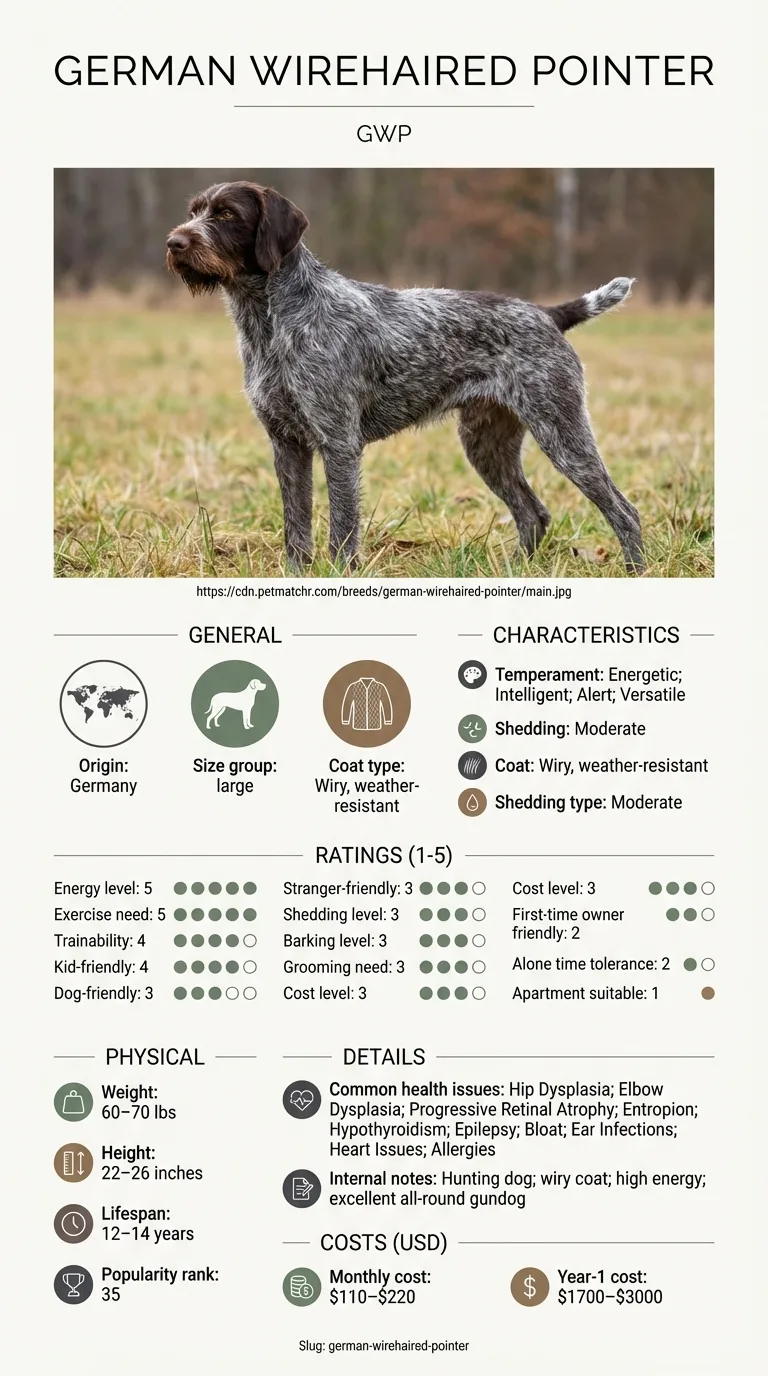
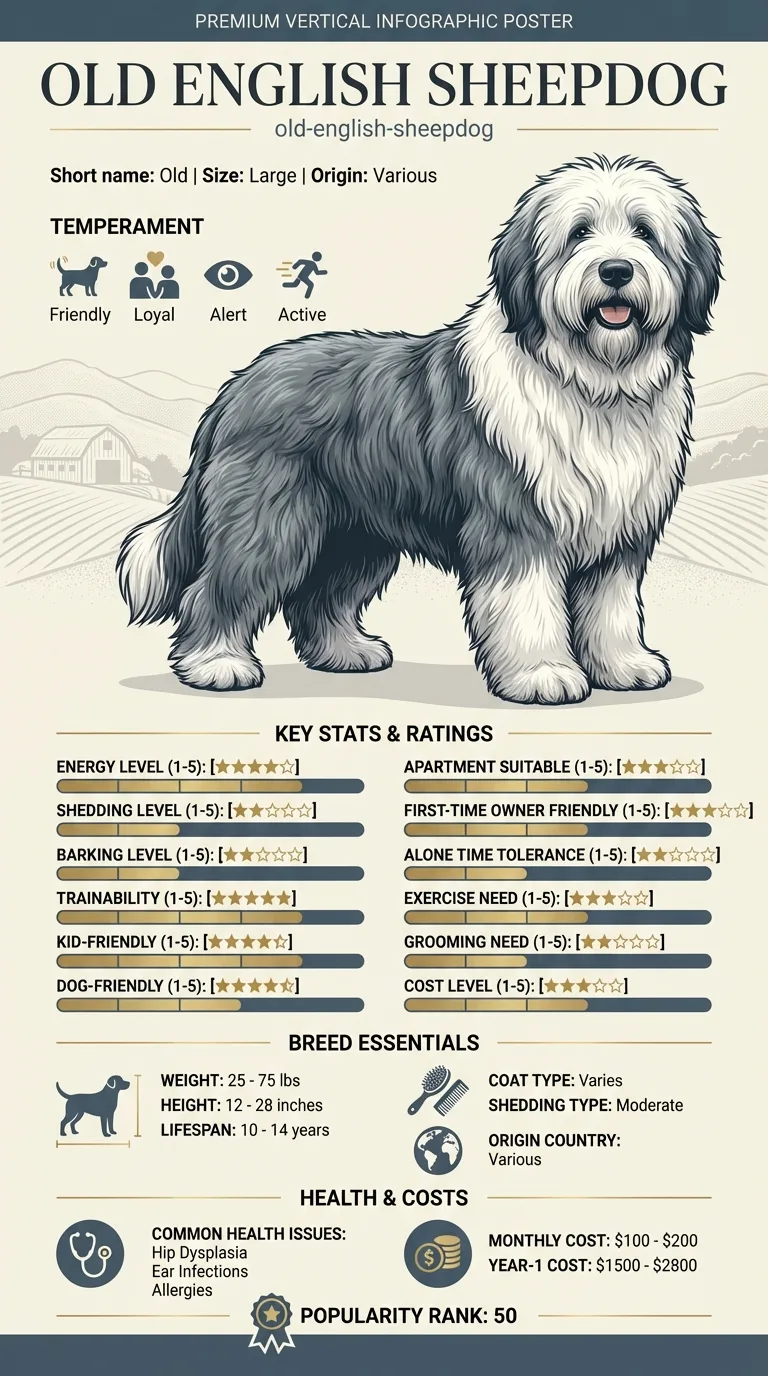
This is for someone already down to German Wirehaired Pointer and Old English Sheepdog and deciding between them. For this pair the decision usually turns on exercise need and grooming need, so those are covered first and in most detail. Anyone choosing from a flat has a clear answer here: Old English Sheepdog rates 2/5 against 1/5. Breed history is left out; what follows is what you will actually live with.
Between German Wirehaired Pointer and Old English Sheepdog, exercise need is what separates them, and Old English Sheepdog is the lower-effort dog of the two to keep.
Choose German Wirehaired Pointer if you do not want a standing grooming appointment, shedding is a problem in your house and you want a dog that picks up training quickly.
Choose Old English Sheepdog if your walking routine is modest, there are young children at home and you already have another dog.
| Feature | german wirehaired pointer | old english sheepdog | Winner |
|---|---|---|---|
| Size class | large | large | Equal |
| Weight | 60–70 lbs | 60–100 lbs | Equal |
| Height | 22–26 in | 20–24 in | Equal |
| Lifespan | 12–14 years | 10–12 years | german wirehaired pointer |
| Exercise need | Very high (5/5) | Moderate (3/5) | old english sheepdog |
| Grooming need | Moderate (3/5) | Very high (5/5) | german wirehaired pointer |
| Shedding | Moderate (3/5) | High (4/5) | german wirehaired pointer |
| Energy level | Very high (5/5) | Moderate (3/5) | Equal |
| Barking | Moderate (3/5) | Moderate (3/5) | Equal |
| Apartment suitability | Very low (1/5) | Low (2/5) | old english sheepdog |
| Good for first-time owners | Low (2/5) | Low (2/5) | Equal |
| Tolerates being alone | Low (2/5) | Low (2/5) | Equal |
| Trainability | High (4/5) | Moderate (3/5) | german wirehaired pointer |
| Good with kids | High (4/5) | Very high (5/5) | old english sheepdog |
| Good with other dogs | Moderate (3/5) | High (4/5) | old english sheepdog |
| Friendly to strangers | Moderate (3/5) | High (4/5) | old english sheepdog |
| Cost level | Moderate (3/5) | High (4/5) | german wirehaired pointer |
| Coat | Wiry, weather-resistant | Long, shaggy double coat | Equal |
| Origin | Germany | Various | Equal |
| Typical monthly cost | $110–$220 | $110–$240 | Equal |
| Typical first-year cost | $1,700–$3,000 | $1,700–$3,200 | Equal |
Both breeds land in the large class, but their weight ranges tell different stories: the GWP holds a tighter 60-70 pound band, while the Old English Sheepdog spans a wider 60-100 pounds, meaning a big OES can outweigh a GWP by 30 pounds or more. Height actually favors the GWP as taller, 22-26 inches versus 20-24 inches, so the OES's mass comes from a stockier, more heavily-coated frame rather than height. The coat contrast is stark: the GWP's wiry, weather-resistant coat is functional and low-profile, while the OES's long, shaggy double coat is the breed's defining -- and most labor-intensive -- feature.
Exercise need favors a real gap here: Very high (5/5) for the GWP against Moderate (3/5) for the Old English Sheepdog, a herding breed that's active but not built for the all-day fieldwork a GWP expects. Energy level is marked tie despite Very high versus Moderate underlying scores, worth flagging since the practical experience of living with each differs meaningfully. An OES enjoys herding games, moderate walks, and yard play; a GWP needs sustained, vigorous exercise -- runs, hikes, or retrieving work -- to avoid restlessness. Owners drawn to the OES's shaggy charm should know its activity needs, while real, are noticeably lighter than the GWP's.
This is the OES's defining challenge: grooming rates Very high (5/5) against the GWP's Moderate (3/5), and shedding rates High (4/5) against the GWP's Moderate (3/5). That long, shaggy double coat mats easily without near-daily brushing and typically needs professional grooming every 4-6 weeks to stay manageable. The GWP's wiry coat, by contrast, needs only occasional hand-stripping and produces noticeably less loose hair around the house. Anyone underestimating an Old English Sheepdog's grooming commitment often ends up either shaving the coat short or facing expensive de-matting sessions -- a cost and time burden the GWP simply doesn't carry.
Apartment suitability is Very low (1/5) for the GWP and only slightly better at Low (2/5) for the OES -- neither breed is a natural apartment fit, though the OES's lower exercise need gives it a marginal edge. Barking ties at Moderate (3/5) for both, so neither stands out as notably quiet or notably vocal. Tolerating time alone also ties, both rated Low (2/5), meaning separation anxiety is a real risk for either breed left alone for long stretches. A household considering either dog in a small space should plan for daily exercise and enrichment regardless of which one they pick.
Trainability favors the GWP, High (4/5) against the OES's Moderate (3/5), which tracks with temperament: energetic, intelligent, alert and versatile for the GWP versus adaptable, gentle, playful and watchful for the OES -- a herding dog whose watchful, sometimes independent streak can make obedience work slower going. Both breeds rate Low (2/5) for first-time owners, though, so neither is an easy beginner's pick: the GWP demands exercise commitment a novice may underestimate, while the OES demands grooming discipline and patience with a more independent-minded learner. Experienced owners willing to meet either breed's specific demands will likely find both trainable in practice.
The Old English Sheepdog outperforms the GWP across every family metric listed: Very high (5/5) with kids versus High (4/5), High (4/5) with other dogs versus Moderate (3/5), and High (4/5) friendly to strangers versus Moderate (3/5). Its adaptable, gentle, playful temperament suits busy households well, and the breed's herding instinct sometimes shows up as gentle "shepherding" of children rather than anything problematic. The GWP remains a solid family dog with a High kids rating, just more reserved with outsiders and other dogs by comparison. Families wanting an easygoing, universally social presence may lean OES; those wanting a more focused, athletic family companion may lean GWP.
Lifespan favors the GWP, 12-14 years against the OES's 10-12 years. Health lists differ in length and focus: the GWP's ten conditions span joints, eyes, thyroid, seizures, bloat, ears, heart and skin, while the OES's shorter list -- hip dysplasia, cataracts, hypothyroidism, primary ciliary dyskinesia, and bloat (GDV) -- still carries real weight, particularly primary ciliary dyskinesia, a less common respiratory condition worth screening for in the breed. Both share hip dysplasia, hypothyroidism, and bloat risk, so joint and thyroid monitoring plus bloat-prevention feeding practices apply to either dog. The OES's heavy coat can also mask early skin or weight changes that owners should watch for.
Cost level rates Moderate (3/5) for the GWP against High (4/5) for the OES, though the dollar ranges stay surprisingly close: $110-240 monthly and $1,700-3,200 first-year for the OES versus $110-220 monthly and $1,700-3,000 for the GWP. The OES's higher cost rating likely reflects its grooming burden more than food or vet costs, since professional grooming every few weeks adds up steadily over a year. The GWP's costs concentrate more in food volume and exercise-related gear. Anyone budgeting for an OES should weight grooming appointments heavily in their monthly estimate rather than assuming the modest sticker-price gap tells the full story.
German Wirehaired Pointer weighs 60–70 lbs and lives 12–14 years; Old English Sheepdog weighs 60–100 lbs and lives 10–12 years. The two diverge most on exercise need, grooming need and energy level. They are level on tolerates being alone, barking and good for first-time owners, so those cannot decide it. The comparison marks an easier option only where one exists. Facts like weight and country of origin are not scored. Both dogs are rated from the same dataset, which is what makes the numbers comparable with each other even though any individual dog sits somewhere inside its breed's range.

The Old English Sheepdog by a wide margin -- rated Very high (5/5) versus the GWP's Moderate (3/5) -- its long, shaggy coat typically needs professional grooming every 4-6 weeks.
The Old English Sheepdog, rated Very high (5/5) with kids versus the GWP's High (4/5), thanks to its gentle, playful, adaptable temperament.
The GWP, rated Very high (5/5) versus the OES's Moderate (3/5) exercise need.
Yes, quite close -- $1,700-3,200 for the OES versus $1,700-3,000 for the GWP.
The GWP, at 12-14 years versus the OES's 10-12 years.
Yes, both list bloat (GDV) as a health risk, so slow-feeding practices are worth adopting for either breed.
The Old English Sheepdog, rated High (4/5) versus the GWP's Moderate (3/5).
The GWP, rated Moderate (3/5) versus the OES's Very high (5/5).
The Old English Sheepdog, rated High (4/5) versus the GWP's Moderate (3/5).
The GWP, rated High (4/5) versus the OES's Moderate (3/5).
The GWP, at 12-14 years versus the OES's 10-12 years.
Secure checkout on Stripe. We never see your card.
7-day money-back guarantee. Instant access.
Health information here is general and is not veterinary advice. If your dog shows pain, sudden behaviour change, or worsening symptoms, consult a licensed veterinarian.
Some links on this site are affiliate links. We may earn a commission at no extra cost to you, and we only suggest products we believe are helpful for dog owners.
We research and check what we publish, but we do not warrant that any figure, date, price, or statement is accurate, complete, or current, and we accept no liability for any loss, cost, injury, or other harm arising from the use of this site. Use it as one reference among several. You remain responsible for your own decisions and for your dog's care - confirm anything that matters with a licensed veterinarian or another qualified professional before you act on it. Full disclaimer.
Match your lifestyle to the right dog.
Take quizNot sure which breed is right for you? Take our 2-minute quiz to find out.
Take the quiz