Behavior
Lower-maintenance coat?
The Doberman Pinscher, rated very low (1/5) for grooming, the easiest score on this comparison.

Quick answer
Lower-maintenance coat?
The Doberman Pinscher, rated very low (1/5) for grooming, the easiest score on this comparison.
Chinese Shar-Pei or Doberman Pinscher? On paper they differ most on exercise need, and on the scales Doberman Pinscher is the heavier at 60–100 lbs. Here is how the two compare on everything that shapes an ordinary week.
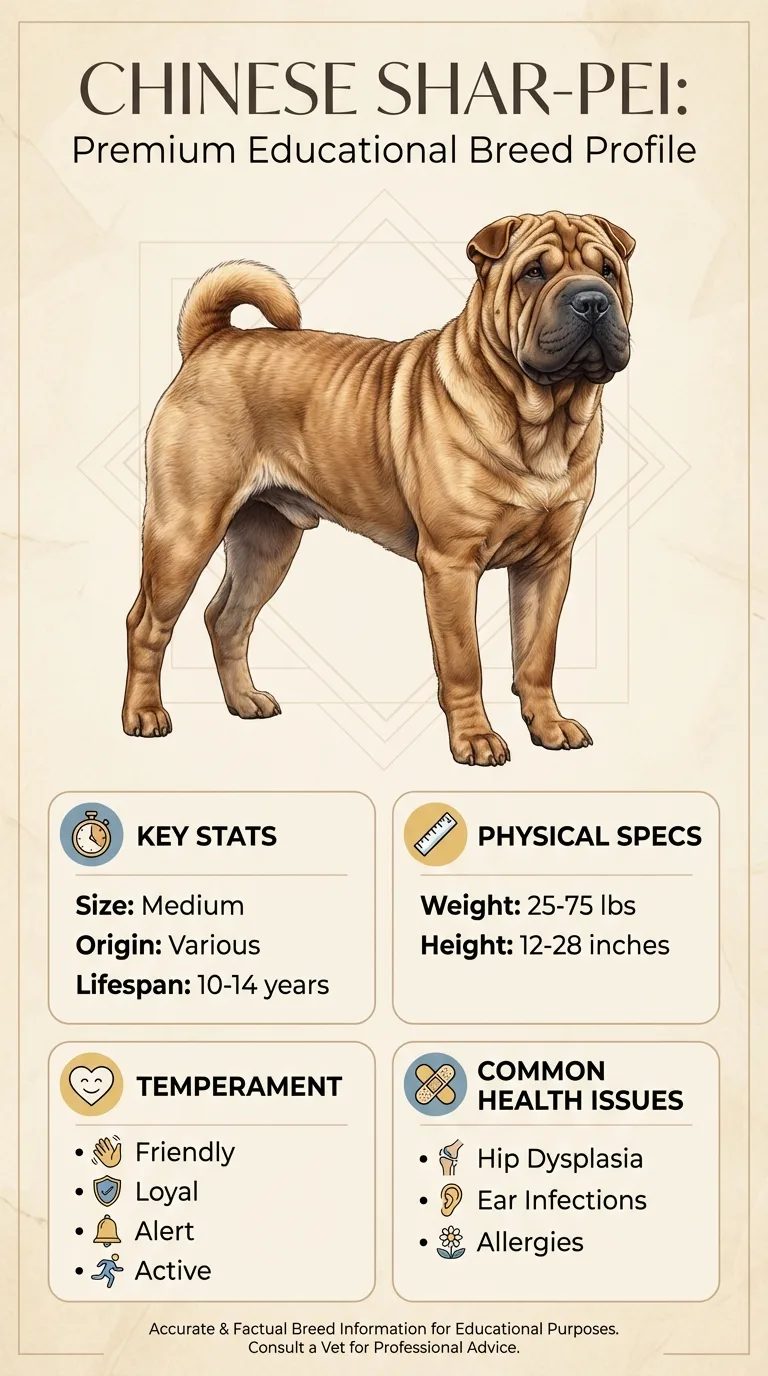
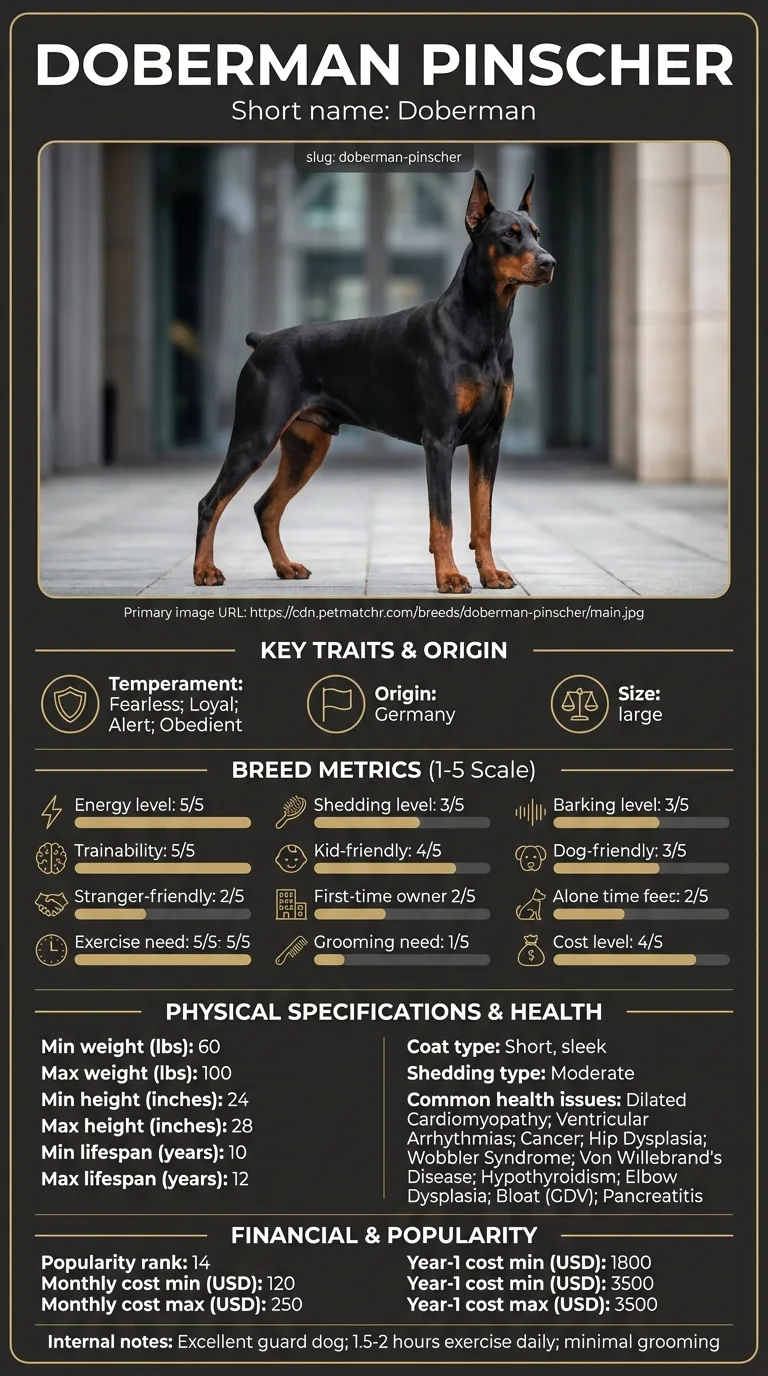
This is for someone already down to Chinese Shar-Pei and Doberman Pinscher and deciding between them. For this pair the decision usually turns on exercise need and energy level, so those are covered first and in most detail. Anyone choosing from a flat has a clear answer here: Chinese Shar-Pei rates 4/5 against 2/5. There is no origin story here — only what changes about your week.
Between Chinese Shar-Pei and Doberman Pinscher, exercise need is what separates them, and Chinese Shar-Pei is the lower-effort dog of the two to keep.
Choose Chinese Shar-Pei if you are in a flat or a smaller home, shedding is a problem in your house and your walking routine is modest.
Choose Doberman Pinscher if you do not want a standing grooming appointment, there are young children at home and you already have another dog.
| Feature | chinese shar pei | doberman pinscher | Winner |
|---|---|---|---|
| Size class | medium | large | Equal |
| Weight | 45–60 lbs | 60–100 lbs | Equal |
| Height | 18–20 in | 24–28 in | Equal |
| Lifespan | 8–12 years | 10–12 years | doberman pinscher |
| Exercise need | Low (2/5) | Very high (5/5) | chinese shar pei |
| Grooming need | Low (2/5) | Very low (1/5) | doberman pinscher |
| Shedding | Low (2/5) | Moderate (3/5) | chinese shar pei |
| Energy level | Low (2/5) | Very high (5/5) | Equal |
| Barking | Low (2/5) | Moderate (3/5) | chinese shar pei |
| Apartment suitability | High (4/5) | Low (2/5) | chinese shar pei |
| Good for first-time owners | Low (2/5) | Low (2/5) | Equal |
| Tolerates being alone | Moderate (3/5) | Low (2/5) | chinese shar pei |
| Trainability | Low (2/5) | Very high (5/5) | doberman pinscher |
| Good with kids | Moderate (3/5) | High (4/5) | doberman pinscher |
| Good with other dogs | Low (2/5) | Moderate (3/5) | doberman pinscher |
| Friendly to strangers | Low (2/5) | Low (2/5) | Equal |
| Cost level | High (4/5) | High (4/5) | Equal |
| Coat | Short and harsh | Short, sleek | Equal |
| Origin | Various | Germany | Equal |
| Typical monthly cost | $100–$200 | $120–$250 | Equal |
| Typical first-year cost | $1,400–$2,900 | $1,800–$3,500 | Equal |
The Doberman Pinscher is a genuinely large dog, 60 to 100 pounds and 24 to 28 inches tall, dwarfing the Chinese Shar-Pei's medium 45-to-60-pound, 18-to-20-inch frame by as much as 40 pounds at the top end. The Doberman's build is lean, muscular, and athletic — a guard-dog silhouette built for speed and power — while the Shar-Pei's low, dense, wrinkled body reads as an entirely different kind of dog. Even a large Shar-Pei would look modest standing next to a Doberman at full size. Anyone drawn to an imposing, athletic-looking dog will find that in the Doberman; anyone wanting a smaller, more compact household presence should look to the Shar-Pei.
This is one of the largest exercise gaps on the entire site: the Doberman Pinscher rates very high (5/5) for both exercise need and energy level, while the Chinese Shar-Pei sits at low (2/5) on both. The Doberman was bred as a working guard dog and genuinely needs vigorous daily activity — running, structured training, or real exertion — to stay balanced, while the Shar-Pei is content with a short walk and a nap. An under-exercised Doberman can become anxious or destructive given its high drive, a risk the low-key Shar-Pei simply doesn't carry. This comparison is really a test of how much daily physical commitment a household is prepared to make.
Grooming favors the Doberman Pinscher, rated very low (1/5) — the lowest, easiest score on this table — against the Chinese Shar-Pei's already-low (2/5). Shedding tells a different story, though: the Doberman's short, sleek coat still produces moderate (3/5) shedding, more than the Shar-Pei's low (2/5), since short-haired breeds often shed steadily year-round even without matting concerns. In practice, both breeds are wash-and-go compared to longer-coated dogs, but Shar-Pei owners face a coat-care trade-off the Doberman doesn't: managing the skin folds that come with its distinctive wrinkles. Someone who wants the single lowest-grooming breed on this comparison should lean Doberman; someone who wants the least shedding should lean Shar-Pei.
Neither breed is an obvious apartment pick, but the Chinese Shar-Pei comes out ahead at high (4/5) apartment suitability against the Doberman Pinscher's low (2/5), driven largely by the Doberman's size and very high exercise needs rather than noise. Barking is closer, moderate (3/5) for the Doberman versus low (2/5) for the Shar-Pei. The bigger practical issue for apartment dwellers is alone time: both breeds rate low (2/5) for tolerating solitude, so neither is well suited to long stretches without company, though the Doberman's high energy makes an under-stimulated day in a small space especially challenging. A Doberman really wants a house with room to move, not a studio apartment.
The Doberman Pinscher rates very high (5/5) for trainability, tied for the top score on this table, reflecting its obedient, alert temperament and history as a working and guard breed bred for responsiveness. Yet it rates low (2/5) for first-time-owner suitability — the same as the Chinese Shar-Pei — because its size, drive, and guarding instincts demand an experienced handler even if the dog itself learns quickly. The Shar-Pei's low (2/5) trainability score reflects a different challenge: its independent nature makes it slower to respond, not necessarily harder to manage day to day. Both breeds ultimately call for confident, consistent ownership rather than a beginner's first attempt at dog training.
The Doberman Pinscher rates high (4/5) with kids and moderate (3/5) with other dogs, both ahead of the Chinese Shar-Pei's moderate (3/5) with kids and low (2/5) with other dogs — a somewhat surprising result given the Doberman's guard-dog reputation, but consistent with its fearless-yet-loyal temperament toward its own family. Both breeds rate low (2/5) for friendliness toward strangers, so neither is the type to greet visitors with instant warmth; the Doberman's alert, protective instincts and the Shar-Pei's reserved nature both call for early socialization and controlled introductions. Households with frequent guests should plan structured introductions for either breed, while families focused mainly on their own kids and pets will find the Doberman scores somewhat better across the board.
The Chinese Shar-Pei and Doberman Pinscher have nearly matching lifespans, 8 to 12 years and 10 to 12 years respectively, but the Doberman's ten flagged conditions are notably serious: dilated cardiomyopathy and ventricular arrhythmias are cardiac issues specific to the breed, alongside cancer, hip dysplasia, wobbler syndrome, von Willebrand's disease, elbow dysplasia, bloat (GDV), and pancreatitis. The Shar-Pei's shorter five-item list — skin fold dermatitis, entropion, familial Shar-Pei fever, hypothyroidism, and ear infections — is comparatively more manageable day to day. Doberman owners should discuss cardiac screening with their veterinarian given how prominent heart conditions are on its list, while Shar-Pei owners should focus on consistent skin-fold hygiene as their primary preventive routine.
Both breeds carry a high (4/5) cost rating, but the Doberman Pinscher runs noticeably more expensive in real dollars: $120 to $250 monthly and $1,800 to $3,500 in year one, versus the Chinese Shar-Pei's $100 to $200 monthly and $1,400 to $2,900. The Doberman's larger size drives up food costs, and its list of ten health conditions — several of them serious, like dilated cardiomyopathy — can mean higher ongoing veterinary and screening expenses over its lifetime. The Shar-Pei is the more budget-friendly of the two on nearly every measure, even accounting for the specialized skin-fold care its wrinkled coat requires.
Chinese Shar-Pei weighs 45–60 lbs and lives 8–12 years; Doberman Pinscher weighs 60–100 lbs and lives 10–12 years. The two diverge most on exercise need, energy level and trainability and 1 other rated axes. They are level on cost level, good for first-time owners and friendly to strangers, so those cannot decide it. Where the table declares a winner it means less work for the owner, nothing more; descriptive rows are left as ties on purpose. The value here is in the differences between the two columns; treat any single score as approximate.

The Doberman Pinscher, by a huge margin — it rates very high (5/5) for exercise need and energy versus the Shar-Pei's low (2/5) on both.
Not really — it rates low (2/5) for apartment suitability due to its size and very high exercise needs, while the Shar-Pei rates high (4/5).
The Doberman Pinscher rates very high (5/5) for trainability versus the Shar-Pei's low (2/5), though the Doberman still isn't recommended for first-time owners due to its size and drive.
Cardiac issues top the list — dilated cardiomyopathy and ventricular arrhythmias — alongside cancer, hip dysplasia, wobbler syndrome, and bloat (GDV).
The Chinese Shar-Pei, rated low (2/5) versus the Doberman's moderate (3/5), even though the Doberman's grooming need itself is lower.
The Doberman Pinscher, at $1,800-$3,500 in year one versus $1,400-$2,900 for the Shar-Pei.
The Doberman Pinscher, rated high (4/5) versus the Shar-Pei's moderate (3/5).
The Doberman Pinscher, rated very low (1/5) for grooming, the easiest score on this comparison.
The Doberman Pinscher, rated very high (5/5) versus the Shar-Pei's low (2/5).
The Doberman Pinscher, up to 100 lbs versus the Shar-Pei's 60 lb max.
Neither — both rate low (2/5) for friendliness toward strangers.
Secure checkout on Stripe. We never see your card.
7-day money-back guarantee. Instant access.
Health information here is general and is not veterinary advice. If your dog shows pain, sudden behaviour change, or worsening symptoms, consult a licensed veterinarian.
Some links on this site are affiliate links. We may earn a commission at no extra cost to you, and we only suggest products we believe are helpful for dog owners.
We research and check what we publish, but we do not warrant that any figure, date, price, or statement is accurate, complete, or current, and we accept no liability for any loss, cost, injury, or other harm arising from the use of this site. Use it as one reference among several. You remain responsible for your own decisions and for your dog's care - confirm anything that matters with a licensed veterinarian or another qualified professional before you act on it. Full disclaimer.
Match your lifestyle to the right dog.
Take quizNot sure which breed is right for you? Take our 2-minute quiz to find out.
Take the quiz