Living
Griffon or Husky?
The Griffon for apartment or first-time living; the Husky only if you can give it serious daily exercise and secure fencing.

Quick answer
Griffon or Husky?
The Griffon for apartment or first-time living; the Husky only if you can give it serious daily exercise and secure fencing.
Brussels Griffon or Siberian Husky? On paper they differ most on apartment suitability, and on the scales Siberian Husky is the heavier at 45–60 lbs. Here is how the two compare on everything that shapes an ordinary week.
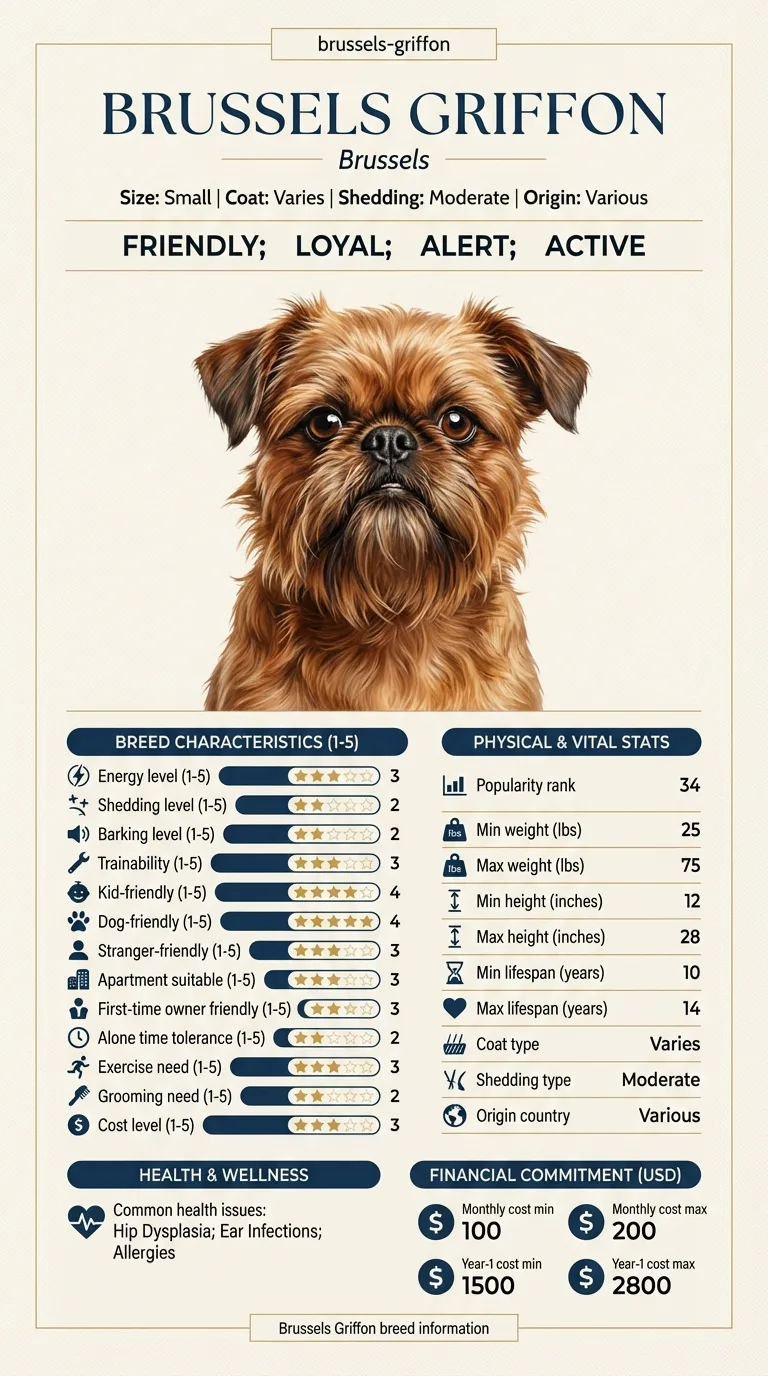
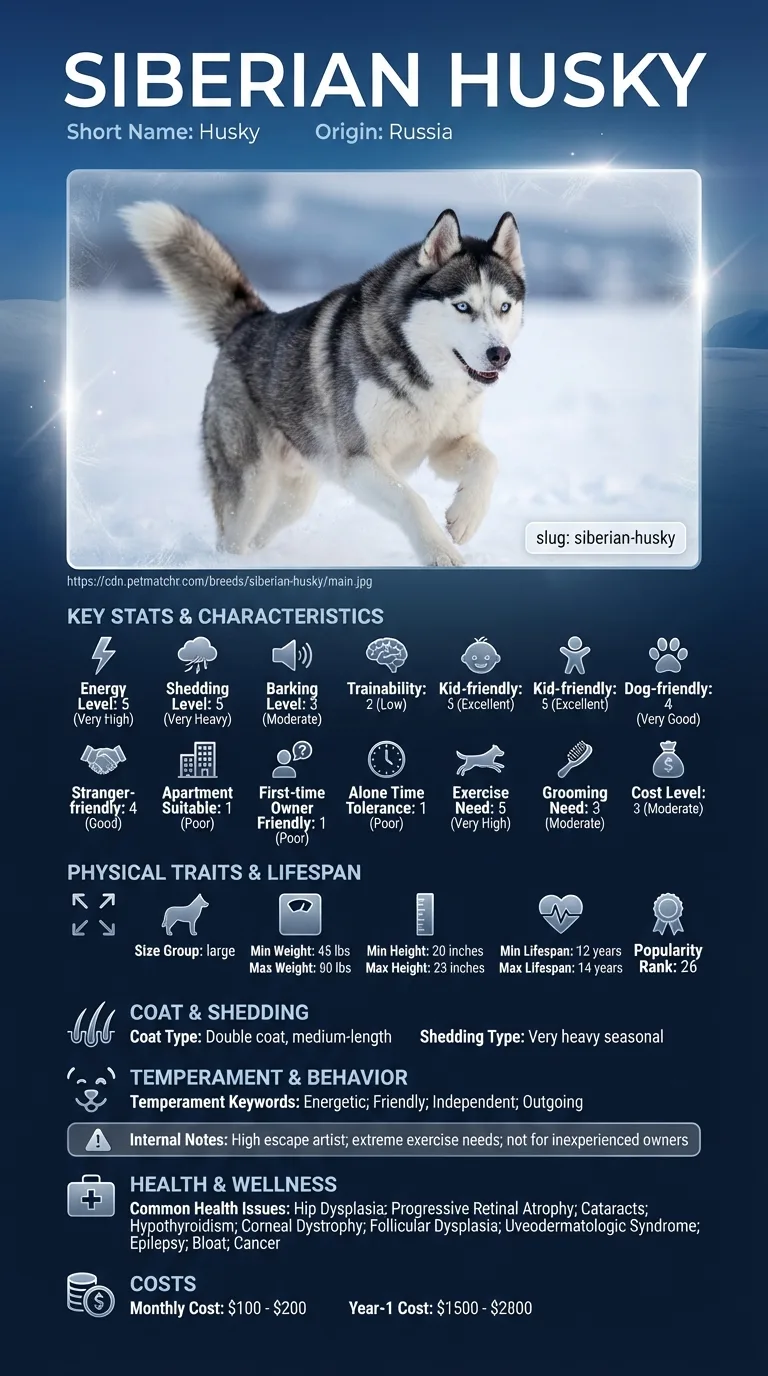
This is for someone already down to Brussels Griffon and Siberian Husky and deciding between them. For this pair the decision usually turns on apartment suitability and exercise need, so those are covered first and in most detail. Anyone choosing from a flat has a clear answer here: Brussels Griffon rates 5/5 against 1/5. Breed history is left out; what follows is what you will actually live with.
Between Brussels Griffon and Siberian Husky, apartment suitability is what separates them, and Brussels Griffon is the lower-effort dog of the two to keep.
Choose Brussels Griffon if you are in a flat or a smaller home, this is your first dog and shedding is a problem in your house.
Choose Siberian Husky if there are young children at home, you already have another dog and you want a dog that can keep up with an active routine.
| Feature | brussels griffon | siberian husky | Winner |
|---|---|---|---|
| Size class | small | large | Equal |
| Weight | 8–12 lbs | 45–60 lbs | Equal |
| Height | 7–10 in | 20–23 in | Equal |
| Lifespan | 12–15 years | 12–14 years | brussels griffon |
| Exercise need | Low (2/5) | Very high (5/5) | brussels griffon |
| Grooming need | Moderate (3/5) | Moderate (3/5) | Equal |
| Shedding | Low (2/5) | Very high (5/5) | brussels griffon |
| Energy level | Moderate (3/5) | Very high (5/5) | Equal |
| Barking | Moderate (3/5) | Moderate (3/5) | Equal |
| Apartment suitability | Very high (5/5) | Very low (1/5) | brussels griffon |
| Good for first-time owners | Moderate (3/5) | Very low (1/5) | brussels griffon |
| Tolerates being alone | Low (2/5) | Very low (1/5) | brussels griffon |
| Trainability | Moderate (3/5) | Low (2/5) | brussels griffon |
| Good with kids | Moderate (3/5) | Very high (5/5) | siberian husky |
| Good with other dogs | Moderate (3/5) | High (4/5) | siberian husky |
| Friendly to strangers | Moderate (3/5) | High (4/5) | siberian husky |
| Cost level | Moderate (3/5) | Moderate (3/5) | Equal |
| Coat | Rough or smooth | Double coat, medium-length | Equal |
| Origin | Various | Russia | Equal |
| Typical monthly cost | $80–$150 | $100–$200 | Equal |
| Typical first-year cost | $1,100–$2,300 | $1,500–$2,800 | Equal |
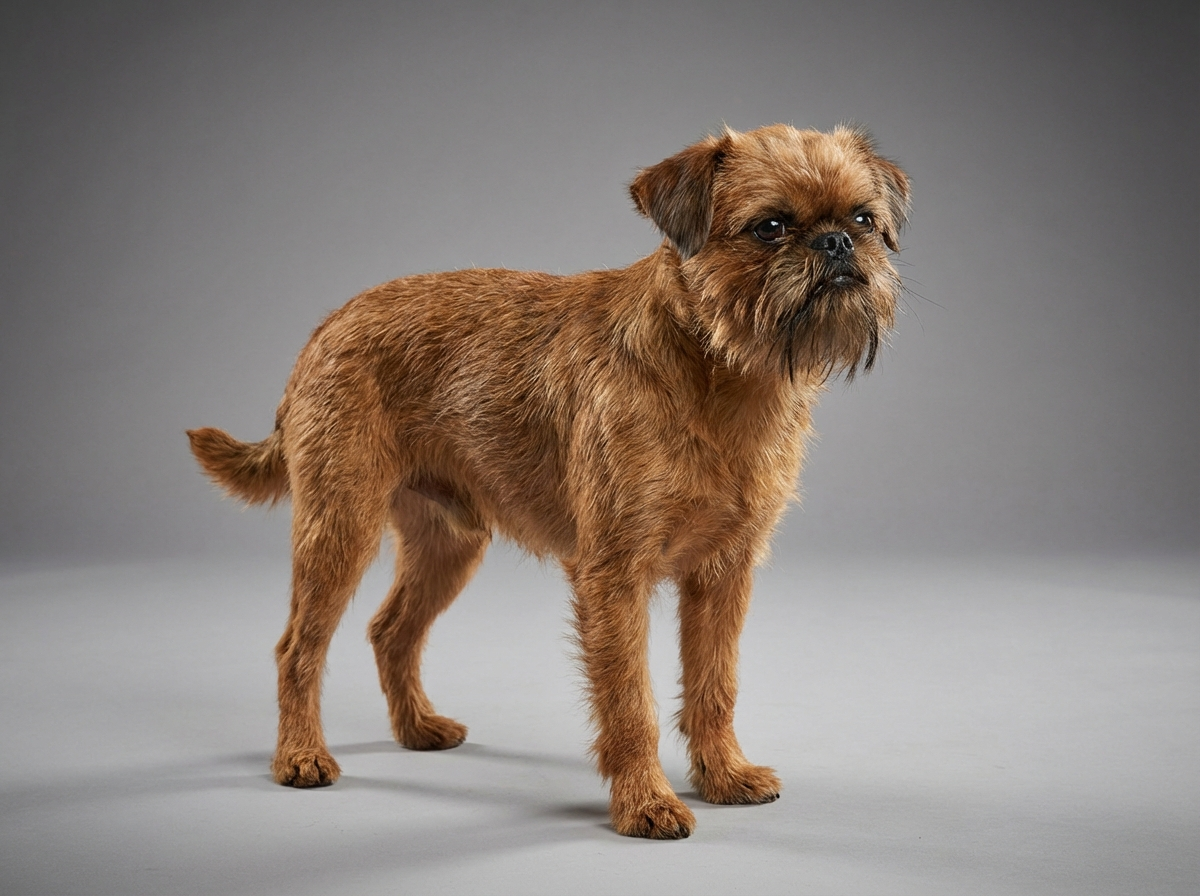
This pairing spans the size chart — the Griffon at 8–12 lbs and under 10 inches, the Husky at 45–60 lbs and up to 23 inches tall. A grown Husky can outweigh a Griffon fivefold. There's no real overlap in build here — this is toy breed next to sled dog, and picturing them side by side makes that obvious immediately.
The gap could hardly be wider: the Griffon needs a 2/5 amount of exercise, the Husky a 5/5. Huskies were bred to run for miles pulling sleds and need serious daily output — jogging, hiking, or a securely fenced yard to burn energy in, not a stroll around the block. Give a Husky the Griffon's activity level and expect a bored, destructive dog within days.
Grooming effort ties at moderate (3/5), but shedding does not — the Husky rates a 5/5, the maximum, thanks to a dense double coat that blows out twice a year in dramatic fashion. The Griffon sheds lightly at 2/5. If you're sensitive to dog hair on furniture, clothing, and every surface in the house, the Husky is a serious daily commitment the Griffon simply isn't.
The Griffon rates 5/5 for apartment living; the Husky rates 1/5, about as poor a fit as the chart allows. That's a combination of its exercise needs, its shedding, and its tendency toward vocal howling. Both dogs tolerate being alone poorly — 2/5 for the Griffon, a rock-bottom 1/5 for the Husky, which is prone to genuine separation distress.
First-time-owner suitability tells the story here: the Griffon rates 3/5, the Husky a mere 1/5. Huskies are intelligent but famously independent and escape-prone, with a prey drive that undermines recall even after training. Trainability itself favors the Griffon too (3/5 versus 2/5). This isn't a breed for someone learning the basics of dog ownership on the job.
The Husky actually scores better with kids (5/5 versus 3/5), other dogs (4/5 versus 3/5), and strangers (4/5 versus 3/5) — Huskies are famously non-aggressive and sociable, which is part of why they make poor guard dogs. The trade-off is everything else on this list: the temperament is friendly, but the exercise, escape risk, and shedding demands are a real household commitment.
The Griffon edges the lifespan comparison, 12–15 years versus the Husky's 12–14, and the two share only hip dysplasia as a common risk. The Husky's list is otherwise extensive — progressive retinal atrophy, cataracts, epilepsy, bloat, and cancer among them — reflecting a working breed with a broad genetic health profile. The Griffon's concerns center more narrowly on airway and skeletal issues typical of small, flat-faced dogs.
Both rate a moderate 3/5 cost level, but the dollar figures diverge: $80–$150 monthly and $1,100–$2,300 for year one with a Griffon, versus $100–$200 and $1,500–$2,800 for a Husky. That gap widens further in practice once you factor in a Husky's food intake for its size and the fencing many owners need to install to keep an escape artist contained.
Brussels Griffon weighs 8–12 lbs and lives 12–15 years; Siberian Husky weighs 45–60 lbs and lives 12–14 years. The two diverge most on apartment suitability, exercise need and shedding and 3 other rated axes. They are level on barking, cost level and grooming need, so those cannot decide it. The comparison marks an easier option only where one exists. Facts like weight and country of origin are not scored. Both dogs are rated from the same dataset, which is what makes the numbers comparable with each other even though any individual dog sits somewhere inside its breed's range.

Dramatically — the Griffon weighs 8-12 lbs, the Husky 45-60 lbs. This is a toy breed against a working sled dog.
The Husky, by the widest margin on the whole comparison — a 5/5 versus the Griffon's 2/5. Expect to run a Husky daily.
Not according to the data — it rates a 1/5 for first-time-owner suitability, the lowest score possible, versus the Griffon's 3/5.
The Griffon, decisively — 5/5 versus the Husky's 1/5. A Husky's exercise needs and shedding make small-space living genuinely hard.
The Husky runs a bit higher — $100-200 a month against the Griffon's $80-150 — largely from food volume and the fencing many owners need.
Only hip dysplasia overlaps. The Husky's list is otherwise much longer and includes cancer, bloat, and several eye conditions.
The Husky, somewhat surprisingly — 5/5 with kids and 4/5 with strangers, versus the Griffon's 3/5 on both. Huskies are known for being sociable rather than protective.
The Griffon for apartment or first-time living; the Husky only if you can give it serious daily exercise and secure fencing.
The Husky runs a bit higher, $100-200 versus the Griffon's $80-150.
Worlds apart — Husky 5/5, Griffon 2/5. This is the single biggest factor in this match-up.
Close — Griffon 12-15 years, Husky 12-14 years.
Secure checkout on Stripe. We never see your card.
7-day money-back guarantee. Instant access.
Health information here is general and is not veterinary advice. If your dog shows pain, sudden behaviour change, or worsening symptoms, consult a licensed veterinarian.
Some links on this site are affiliate links. We may earn a commission at no extra cost to you, and we only suggest products we believe are helpful for dog owners.
We research and check what we publish, but we do not warrant that any figure, date, price, or statement is accurate, complete, or current, and we accept no liability for any loss, cost, injury, or other harm arising from the use of this site. Use it as one reference among several. You remain responsible for your own decisions and for your dog's care - confirm anything that matters with a licensed veterinarian or another qualified professional before you act on it. Full disclaimer.
Match your lifestyle to the right dog.
Take quizNot sure which breed is right for you? Take our 2-minute quiz to find out.
Take the quiz