Living
Griffon or Collie, which is the better overall pick?
For families with space and kids, the Collie's scores are hard to beat. For apartment living or a lower-maintenance coat, the Griffon is the more practical choice.

Quick answer
Griffon or Collie, which is the better overall pick?
For families with space and kids, the Collie's scores are hard to beat. For apartment living or a lower-maintenance coat, the Griffon is the more practical choice.
Brussels Griffon or Collie (Rough Collie)? On paper they differ most on apartment suitability, and on the scales Collie (Rough Collie) is the heavier at 50–75 lbs. Here is how the two compare on everything that shapes an ordinary week.
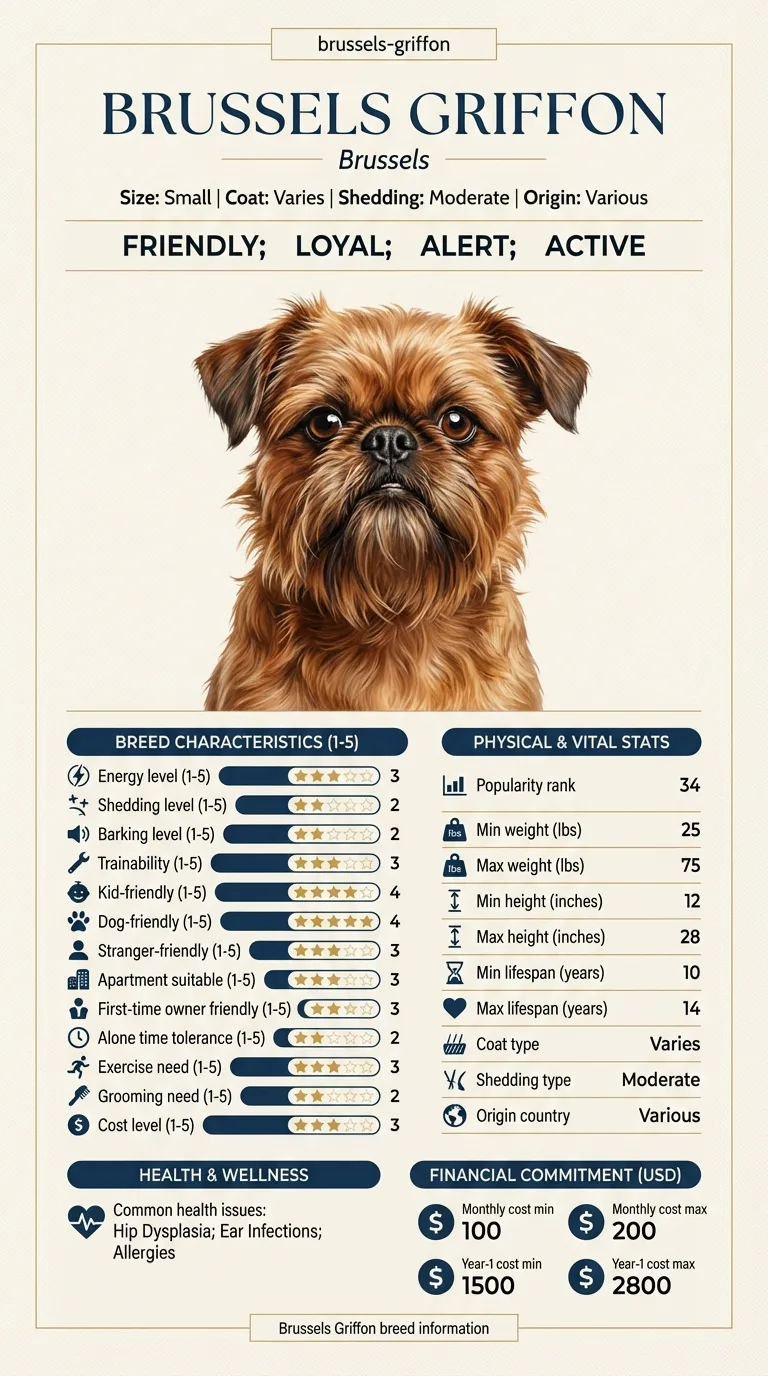
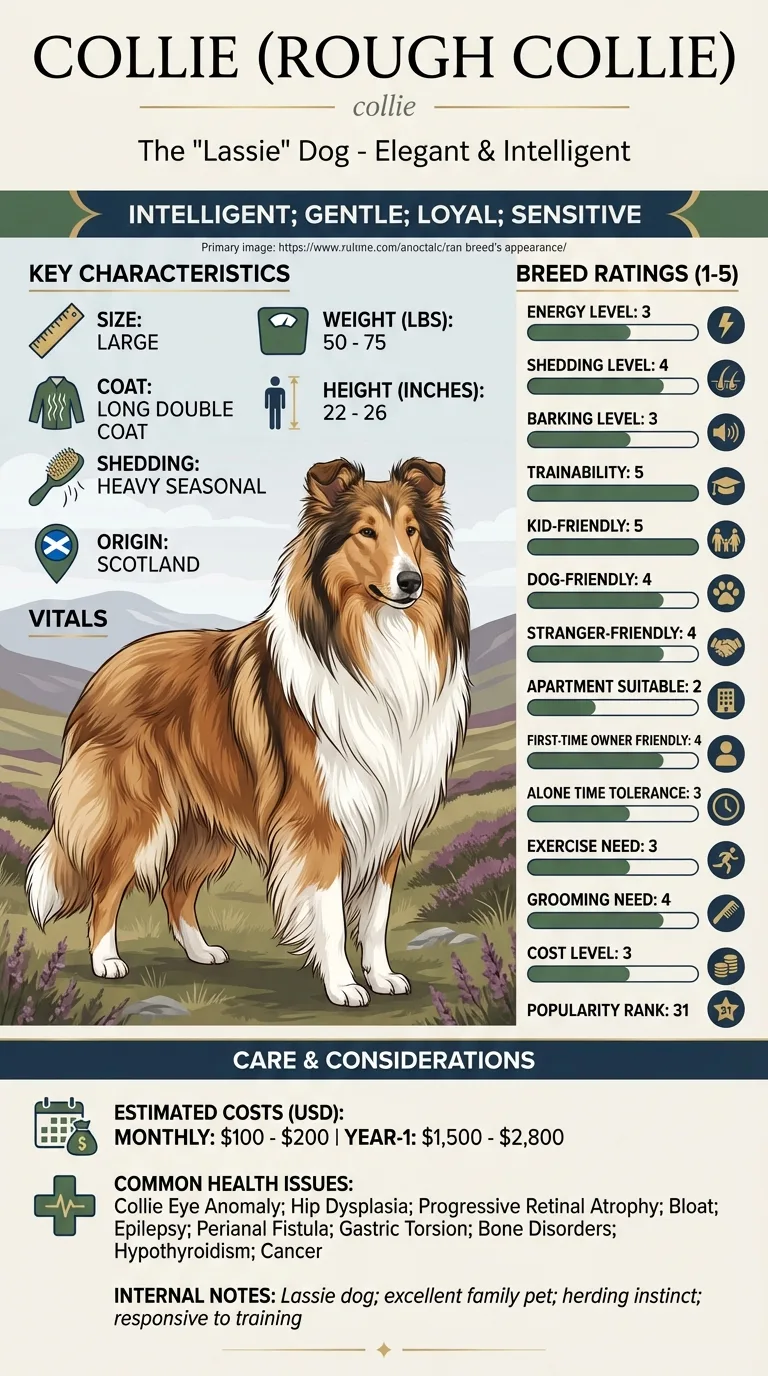
This is for someone already down to Brussels Griffon and Collie (Rough Collie) and deciding between them. For this pair the decision usually turns on apartment suitability and shedding, so those are covered first and in most detail. Anyone choosing from a flat has a clear answer here: Brussels Griffon rates 5/5 against 2/5. It is written for the decision rather than the breed history.
Between Brussels Griffon and Collie (Rough Collie), apartment suitability is what separates them, and Brussels Griffon is the lower-effort dog of the two to keep.
Choose Brussels Griffon if you are in a flat or a smaller home, you do not want a standing grooming appointment and shedding is a problem in your house.
Choose Collie (Rough Collie) if this is your first dog, the dog will be alone during the working day and there are young children at home.
| Feature | brussels griffon | collie | Winner |
|---|---|---|---|
| Size class | small | large | Equal |
| Weight | 8–12 lbs | 50–75 lbs | Equal |
| Height | 7–10 in | 22–26 in | Equal |
| Lifespan | 12–15 years | 11–14 years | brussels griffon |
| Exercise need | Low (2/5) | Moderate (3/5) | brussels griffon |
| Grooming need | Moderate (3/5) | High (4/5) | brussels griffon |
| Shedding | Low (2/5) | High (4/5) | brussels griffon |
| Energy level | Moderate (3/5) | Moderate (3/5) | Equal |
| Barking | Moderate (3/5) | Moderate (3/5) | Equal |
| Apartment suitability | Very high (5/5) | Low (2/5) | brussels griffon |
| Good for first-time owners | Moderate (3/5) | High (4/5) | collie |
| Tolerates being alone | Low (2/5) | Moderate (3/5) | collie |
| Trainability | Moderate (3/5) | Very high (5/5) | collie |
| Good with kids | Moderate (3/5) | Very high (5/5) | collie |
| Good with other dogs | Moderate (3/5) | High (4/5) | collie |
| Friendly to strangers | Moderate (3/5) | High (4/5) | collie |
| Cost level | Moderate (3/5) | Moderate (3/5) | Equal |
| Coat | Rough or smooth | Long double coat | Equal |
| Origin | Various | Scotland | Equal |
| Typical monthly cost | $80–$150 | $100–$200 | Equal |
| Typical first-year cost | $1,100–$2,300 | $1,500–$2,800 | Equal |
This is a large size gap, the Collie stands 22 to 26 inches and weighs 50 to 75 pounds, dwarfing the Griffon's 7-to-10-inch, 8-to-12-pound frame. You're comparing a lapdog to a dog bred to herd sheep across open ground, and that difference shapes nearly every other number in this comparison, from exercise needs to living-space requirements to how much the two dogs eat in a month.
The Collie needs more daily exercise, rating moderate (3/5) against the Griffon's low (2/5), which tracks with its herding-dog background even though its energy level otherwise ties with the Griffon at moderate on paper. A Collie benefits from a proper walk or run most days, not just a stroll around the block, and does best with a job or purpose to occupy its mind.
The Collie's long double coat is a real commitment: grooming rates high (4/5) against the Griffon's moderate (3/5), and shedding is high (4/5) versus the Griffon's low (2/5). Expect regular brushing sessions and noticeably heavier shedding during seasonal coat blows if you go with the Collie over the Griffon, especially in spring and fall.
The Griffon is far better suited to small spaces, 5 out of 5 for apartment living against the Collie's low 2 out of 5. Barking ties at moderate for both, so it's really about square footage and exercise access, not noise. The Collie also tolerates alone time slightly better, 3 out of 5 against the Griffon's 2, despite its larger size.
The Collie is the easier dog to train, rating very high (5/5) against the Griffon's moderate (3/5), and it's also friendlier to first-time owners, 4 out of 5 versus 3 out of 5. Its intelligent, gentle temperament, bred over generations for close cooperation with a handler, shows up directly in both of these numbers and in how quickly most Collies pick up new commands.
The Collie scores higher everywhere in this section: very high with kids (5 vs 3), high with other dogs (4 vs 3), and high with strangers (4 vs 3). This is one of the more lopsided household-fit comparisons on the site, if family and social compatibility are the priority, the Collie's numbers are hard to argue with regardless of the size difference.
Lifespans are close, 12 to 15 years for the Griffon against 11 to 14 for the Collie. Hip dysplasia is their shared risk. The Collie's list runs longer and includes some serious conditions, bloat, gastric torsion, and epilepsy among them, plus a breed-specific eye condition, Collie Eye Anomaly, that reputable breeders screen breeding stock for before pairing dogs.
The Collie costs more to keep: $100 to $200 a month versus $80 to $150 for the Griffon, and $1,500 to $2,800 in year one against $1,100 to $2,300. The gap is moderate rather than extreme, but a bigger dog with a demanding coat adds up steadily over a full year of ownership, mostly through food and grooming.
Brussels Griffon weighs 8–12 lbs and lives 12–15 years; Collie (Rough Collie) weighs 50–75 lbs and lives 11–14 years. The two diverge most on apartment suitability, shedding and good with kids and 1 other rated axes. They are level on barking, cost level and energy level, so those cannot decide it. In the table, a "winner" means easier for an ordinary household — not better. Size, coat and origin are recorded without a verdict. Because both breeds are scored the same way, the gaps are reliable even where the absolute numbers are rough.

A lot, the Collie weighs 50 to 75 pounds and stands 22 to 26 inches, against the Griffon's 8 to 12 pounds and 7 to 10 inches. It's a large breed next to a toy one.
Yes, it rates high, 4 out of 5, against the Griffon's low 2 out of 5, and its grooming need is high too. The Collie's long double coat needs regular brushing, especially during seasonal shedding.
Yes, it rates high (4/5) against the Griffon's moderate (3/5), and it also trains more easily, 5/5 versus 3/5. Collies are known for being cooperative and eager to work with their handler.
Not ideally, it rates low, 2 out of 5, for apartment suitability, against the Griffon's 5 out of 5. A Collie's size and exercise needs are better suited to a house with yard access.
The Collie: $100 to $200 a month versus $80 to $150 for the Griffon, and up to $500 more in the first year. Larger size and coat care both add to the bill.
Hip dysplasia is the one shared item. The Collie's list is otherwise longer and includes bloat, gastric torsion, and a breed-specific eye condition called Collie Eye Anomaly, while the Griffon's risks center on its flat face and spine.
The Collie, rated very high (5/5) against the Griffon's moderate (3/5). Its gentle, patient reputation with children is well documented and reflected clearly in the data here.
For families with space and kids, the Collie's scores are hard to beat. For apartment living or a lower-maintenance coat, the Griffon is the more practical choice.
$80 to $150 for the Griffon versus $100 to $200 for the Collie.
The Collie needs more, moderate (3/5) against the Griffon's low (2/5), reflecting its herding background.
It's close: Griffon 12 to 15 years, Collie 11 to 14 years.
Secure checkout on Stripe. We never see your card.
7-day money-back guarantee. Instant access.
Health information here is general and is not veterinary advice. If your dog shows pain, sudden behaviour change, or worsening symptoms, consult a licensed veterinarian.
Some links on this site are affiliate links. We may earn a commission at no extra cost to you, and we only suggest products we believe are helpful for dog owners.
We research and check what we publish, but we do not warrant that any figure, date, price, or statement is accurate, complete, or current, and we accept no liability for any loss, cost, injury, or other harm arising from the use of this site. Use it as one reference among several. You remain responsible for your own decisions and for your dog's care - confirm anything that matters with a licensed veterinarian or another qualified professional before you act on it. Full disclaimer.
Match your lifestyle to the right dog.
Take quizNot sure which breed is right for you? Take our 2-minute quiz to find out.
Take the quiz