Behavior
Bloodhound or Poodle — which is the easier overall choice?
The Poodle, across trainability, apartment fit, shedding and lifespan — though its grooming bills and longer health-risk list are real tradeoffs.

Quick answer
Bloodhound or Poodle — which is the easier overall choice?
The Poodle, across trainability, apartment fit, shedding and lifespan — though its grooming bills and longer health-risk list are real tradeoffs.
Bloodhound or Poodle (All Sizes)? On paper they differ most on grooming need, and on the scales Bloodhound is the heavier at 90–110 lbs. Here is how the two compare on everything that shapes an ordinary week.
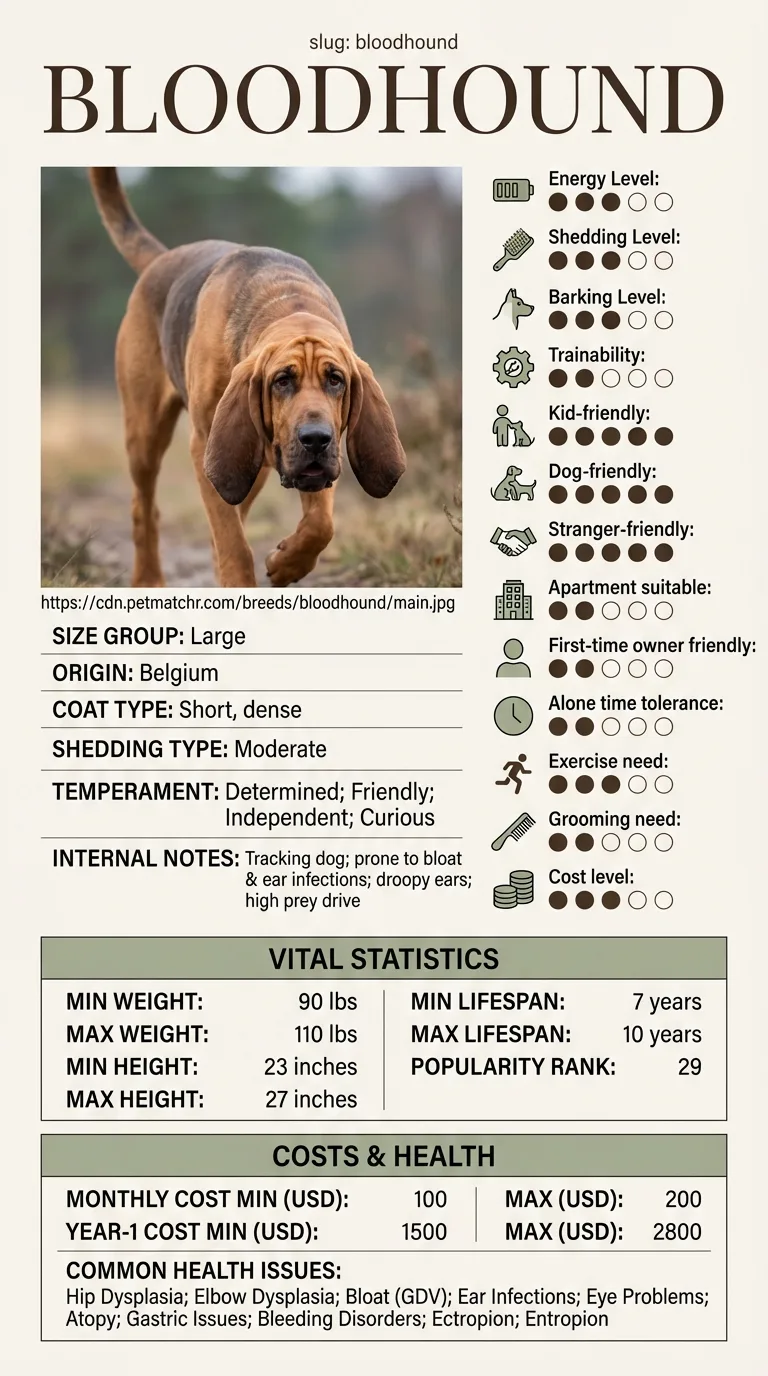
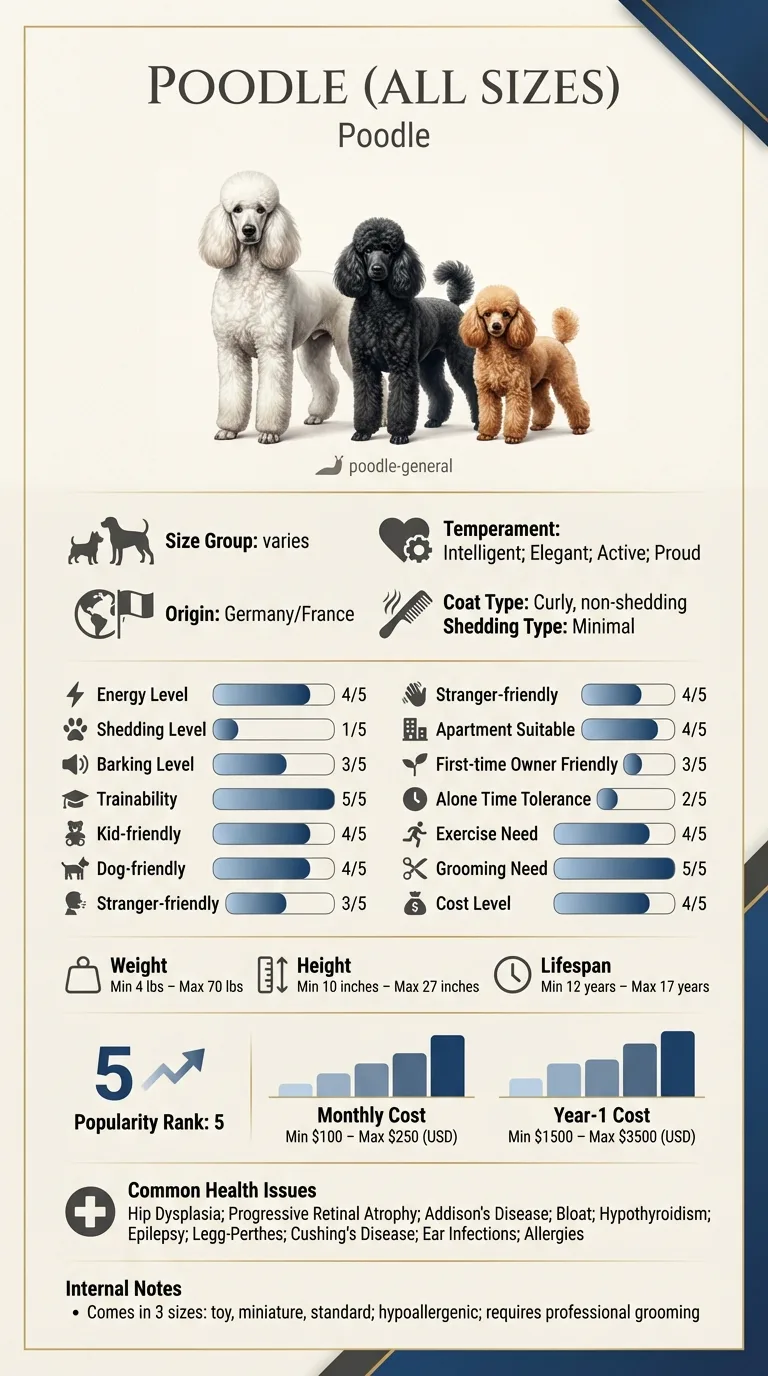
This is for someone already down to Bloodhound and Poodle (All Sizes) and deciding between them. For this pair the decision usually turns on grooming need and trainability, so those are covered first and in most detail. Anyone choosing from a flat has a clear answer here: Poodle (All Sizes) rates 4/5 against 2/5. There is no origin story here — only what changes about your week.
Between Bloodhound and Poodle (All Sizes), grooming need is what separates them, and Bloodhound is the lower-effort dog of the two to keep.
Choose Bloodhound if you do not want a standing grooming appointment and your walking routine is modest.
Choose Poodle (All Sizes) if you are in a flat or a smaller home, this is your first dog and shedding is a problem in your house.
| Feature | bloodhound | poodle general | Winner |
|---|---|---|---|
| Size class | large | varies | Equal |
| Weight | 90–110 lbs | 4–70 lbs | Equal |
| Height | 23–27 in | 10–27 in | Equal |
| Lifespan | 7–10 years | 12–17 years | poodle general |
| Exercise need | Moderate (3/5) | High (4/5) | bloodhound |
| Grooming need | Low (2/5) | Very high (5/5) | bloodhound |
| Shedding | Moderate (3/5) | Very low (1/5) | poodle general |
| Energy level | Moderate (3/5) | High (4/5) | Equal |
| Barking | Moderate (3/5) | Moderate (3/5) | Equal |
| Apartment suitability | Low (2/5) | High (4/5) | poodle general |
| Good for first-time owners | Low (2/5) | Moderate (3/5) | poodle general |
| Tolerates being alone | Low (2/5) | Low (2/5) | Equal |
| Trainability | Low (2/5) | Very high (5/5) | poodle general |
| Good with kids | High (4/5) | High (4/5) | Equal |
| Good with other dogs | High (4/5) | High (4/5) | Equal |
| Friendly to strangers | High (4/5) | Moderate (3/5) | bloodhound |
| Cost level | Moderate (3/5) | High (4/5) | bloodhound |
| Coat | Short, dense | Curly, non-shedding | Equal |
| Origin | Belgium | Germany/France | Equal |
| Typical monthly cost | $100–$200 | $100–$250 | Equal |
| Typical first-year cost | $1,500–$2,800 | $1,500–$3,500 | Equal |
The Bloodhound is a single, consistent large breed at 90-110 lbs and 23-27 inches. Poodles, covered here across all sizes, span 4-70 lbs and 10-27 inches — meaning a Toy Poodle could be one-twentieth the Bloodhound's weight, while a Standard Poodle approaches its height. That range is the whole story of this comparison: "Poodle" isn't one size decision, it's three, and each lands in a different relationship to the Bloodhound's bulk.
Poodles rate higher on exercise need, high (4/5) against the Bloodhound's moderate (3/5), and were originally bred as active water retrievers — that heritage shows in how much engagement they want. The Bloodhound's moderate need leans toward long, nose-led walks rather than fast or repetitive activity. Both rate high (4/5) on energy level, but a Poodle typically needs that energy directed into structured activity, while a Bloodhound is content following its nose at its own pace.
Poodles need very high (5/5) grooming against the Bloodhound's low (2/5), but they shed far less — very low (1/5) versus the Bloodhound's moderate (3/5). That tradeoff matters for allergy-sensitive households: a Poodle's curly, low-shed coat is often more tolerable for allergy sufferers, but it demands regular professional trims to keep from matting, a recurring cost the Bloodhound's coat simply doesn't have.
Poodles handle apartment living better, high (4/5) against the Bloodhound's low (2/5), which fits given how many Poodles are Toy or Miniature sized. Barking is rated moderate (3/5) for both, so neither has a clear noise advantage. Tolerance for being alone is low (2/5) for both breeds too — neither is naturally suited to long stretches without company, regardless of how much floor space you have.
Poodles are rated very high (5/5) on trainability, one of the highest scores you'll see on this site, against the Bloodhound's low (2/5). First-time-owner suitability follows the same pattern, moderate (3/5) versus low (2/5). Poodles are working retrievers by origin and were bred to take direction closely; a Bloodhound's whole job description is to ignore you and follow a scent instead.
Both breeds rate high (4/5) with kids and other dogs, an even match there. The Bloodhound edges ahead with strangers, high (4/5) against the Poodle's moderate (3/5) — Poodles can be a touch more reserved with unfamiliar people, a trait that shows up across the size range from Toy to Standard. Neither difference is dramatic, but it's worth noting if you entertain often.
Poodles live substantially longer, 12-17 years against the Bloodhound's 7-10. Their health-risk list is long, ten conditions including Addison's disease, epilepsy, Cushing's disease and progressive retinal atrophy. Three conditions overlap with the Bloodhound's list: hip dysplasia, bloat, and ear infections. Given how differently sized Poodles are bred, some of these risks concentrate more in specific size varieties — worth checking a size-specific page for detail.
The Poodle costs more overall, high (4/5) against the Bloodhound's moderate (3/5). Monthly costs run $100-250 for the Poodle versus $100-200 for the Bloodhound, with a wider first-year gap of $1,500-3,500 versus $1,500-2,800. Grooming is the biggest line item driving that difference — professional trims add up over a year in a way a Bloodhound's coat never asks of you.
Bloodhound weighs 90–110 lbs and lives 7–10 years; Poodle (All Sizes) weighs 4–70 lbs and lives 12–17 years. The two diverge most on grooming need, trainability and apartment suitability and 1 other rated axes. They are level on tolerates being alone, barking and good with other dogs, so those cannot decide it. Where the table declares a winner it means less work for the owner, nothing more; descriptive rows are left as ties on purpose. The value here is in the differences between the two columns; treat any single score as approximate.

This listing covers Poodles across all recognized sizes — Toy, Miniature, and Standard — which together span 4-70 lbs. If you want figures for one specific size, this site has separate pages for Standard and Miniature comparisons.
The Bloodhound, rated moderate (3/5) against the Poodle's very low (1/5). Poodles are frequently chosen by allergy-sensitive households for this reason, even though their grooming needs run very high (5/5) in exchange.
Yes — moderate (3/5) first-time-owner suitability and very high (5/5) trainability, both well ahead of the Bloodhound's low (2/5) scores on each. Poodles are consistently ranked among the easiest breeds to train.
The Poodle, rated high (4/5) on apartment suitability against the Bloodhound's low (2/5), largely because the smaller Poodle sizes are common and apartment-friendly by nature.
$100-250 for the Poodle and $100-200 for the Bloodhound. The Poodle's grooming needs push its costs higher despite a similar starting range, especially over a full year.
Yes, three overlap: hip dysplasia, bloat, and ear infections. The Poodle's list is longer overall, including Addison's disease, epilepsy and Cushing's disease, conditions not present in the Bloodhound's profile.
The Poodle, by a wide margin — 12-17 years compared to the Bloodhound's 7-10 years.
The Poodle, across trainability, apartment fit, shedding and lifespan — though its grooming bills and longer health-risk list are real tradeoffs.
$100-250 for the Poodle versus $100-200 for the Bloodhound, with grooming driving most of the Poodle's higher end.
The Poodle, rated high (4/5) against the Bloodhound's moderate (3/5) — its retriever heritage means it wants more structured activity.
The Poodle, at 12-17 years versus the Bloodhound's 7-10 years.
Secure checkout on Stripe. We never see your card.
7-day money-back guarantee. Instant access.
Health information here is general and is not veterinary advice. If your dog shows pain, sudden behaviour change, or worsening symptoms, consult a licensed veterinarian.
Some links on this site are affiliate links. We may earn a commission at no extra cost to you, and we only suggest products we believe are helpful for dog owners.
We research and check what we publish, but we do not warrant that any figure, date, price, or statement is accurate, complete, or current, and we accept no liability for any loss, cost, injury, or other harm arising from the use of this site. Use it as one reference among several. You remain responsible for your own decisions and for your dog's care - confirm anything that matters with a licensed veterinarian or another qualified professional before you act on it. Full disclaimer.
Match your lifestyle to the right dog.
Take quizNot sure which breed is right for you? Take our 2-minute quiz to find out.
Take the quiz