Living
Which is the better overall choice?
The Bernedoodle is the more trainable, sociable, first-time-owner-friendly dog by a wide margin; the Shiba Inu suits an experienced owner who wants a smaller, more independent dog.

Quick answer
Which is the better overall choice?
The Bernedoodle is the more trainable, sociable, first-time-owner-friendly dog by a wide margin; the Shiba Inu suits an experienced owner who wants a smaller, more independent dog.
Bernedoodle or Shiba Inu? On paper they differ most on trainability, and on the scales Bernedoodle is the heavier at 20–90 lbs. Here is how the two compare on everything that shapes an ordinary week.
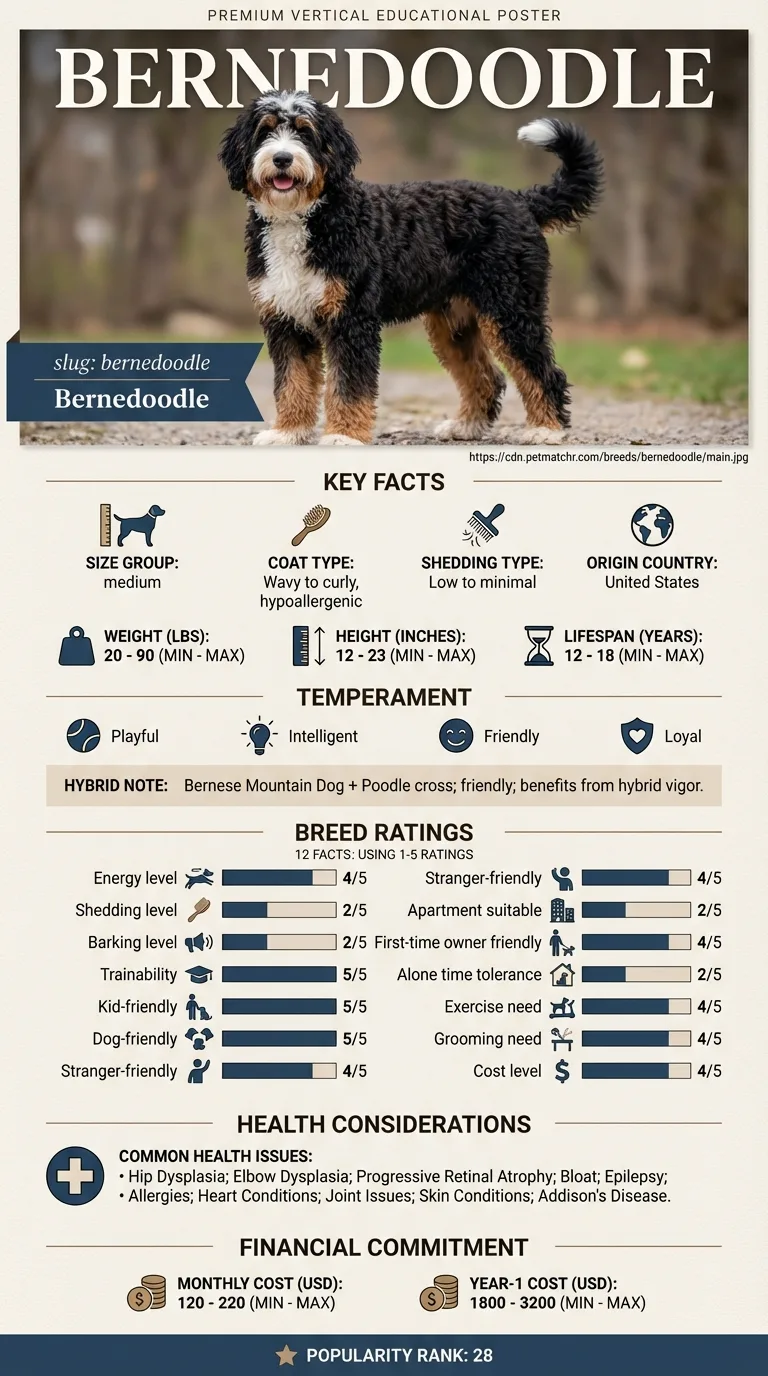
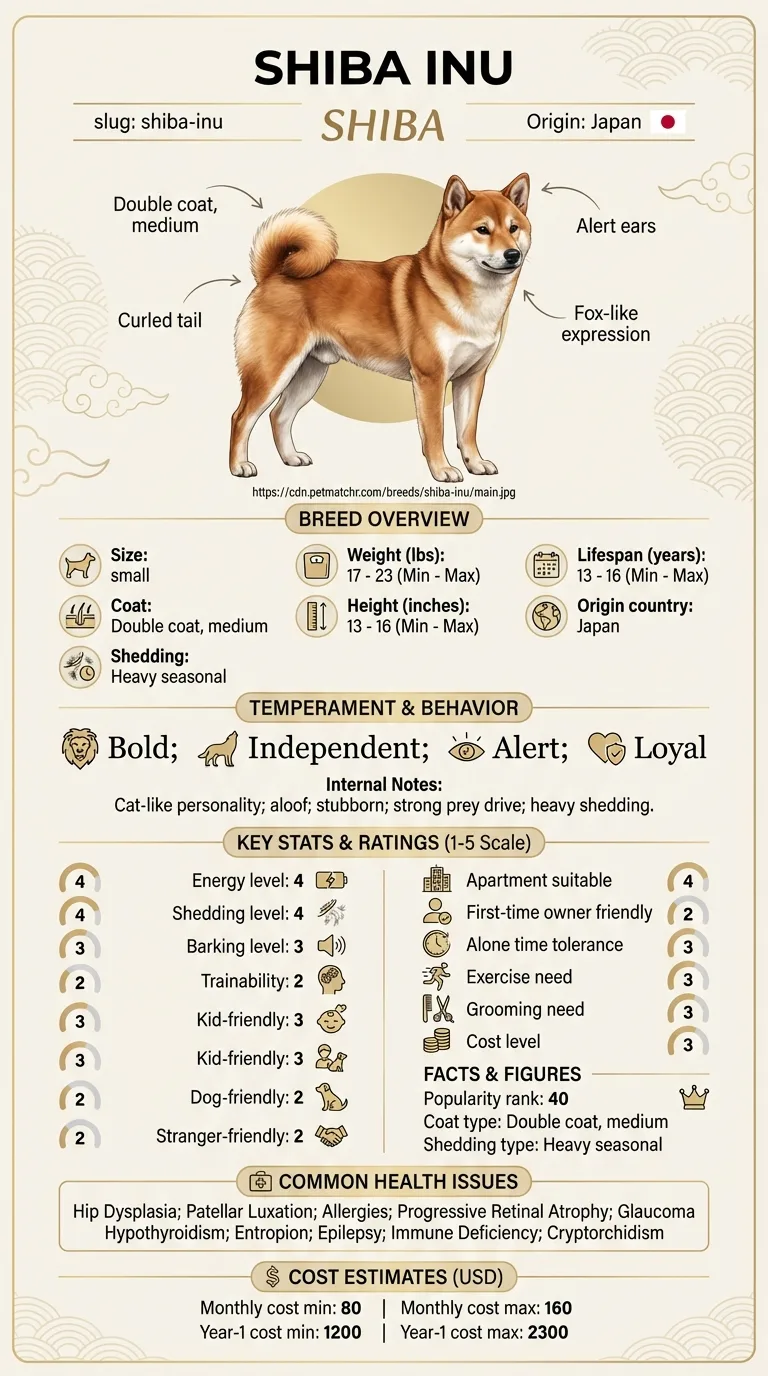
This is for someone already down to Bernedoodle and Shiba Inu and deciding between them. For this pair the decision usually turns on trainability and good with other dogs, so those are covered first and in most detail. Anyone choosing from a flat has a clear answer here: Shiba Inu rates 4/5 against 2/5. It is written for the decision rather than the breed history.
Between Bernedoodle and Shiba Inu, trainability is what separates them, and Shiba Inu is the lower-effort dog of the two to keep.
Choose Bernedoodle if this is your first dog, shedding is a problem in your house and there are young children at home.
Choose Shiba Inu if you are in a flat or a smaller home, you do not want a standing grooming appointment and your walking routine is modest.
| Feature | bernedoodle | shiba inu | Winner |
|---|---|---|---|
| Size class | medium | small | Equal |
| Weight | 20–90 lbs | 17–23 lbs | Equal |
| Height | 12–23 in | 13–16 in | Equal |
| Lifespan | 12–18 years | 13–16 years | bernedoodle |
| Exercise need | High (4/5) | Moderate (3/5) | shiba inu |
| Grooming need | High (4/5) | Moderate (3/5) | shiba inu |
| Shedding | Low (2/5) | High (4/5) | bernedoodle |
| Energy level | High (4/5) | High (4/5) | Equal |
| Barking | Low (2/5) | Moderate (3/5) | bernedoodle |
| Apartment suitability | Low (2/5) | High (4/5) | shiba inu |
| Good for first-time owners | High (4/5) | Low (2/5) | bernedoodle |
| Tolerates being alone | Low (2/5) | Moderate (3/5) | shiba inu |
| Trainability | Very high (5/5) | Low (2/5) | bernedoodle |
| Good with kids | Very high (5/5) | Moderate (3/5) | bernedoodle |
| Good with other dogs | Very high (5/5) | Low (2/5) | bernedoodle |
| Friendly to strangers | High (4/5) | Low (2/5) | bernedoodle |
| Cost level | High (4/5) | Moderate (3/5) | shiba inu |
| Coat | Wavy to curly, hypoallergenic | Double coat, medium | Equal |
| Origin | United States | Japan | Equal |
| Typical monthly cost | $120–$220 | $80–$160 | Equal |
| Typical first-year cost | $1,800–$3,200 | $1,200–$2,300 | Equal |
A Shiba Inu is a compact dog — 17-23 lbs and 13-16 inches — next to a Bernedoodle's much wider 20-90 lb, up to 23-inch range. Fully grown, a small or mini Bernedoodle might approach Shiba Inu territory, but a standard one will dwarf it. Both breeds are muscular for their size rather than delicate, so don't expect either one to feel fragile underfoot.
The Bernedoodle asks more of you physically, rated 4/5 for exercise against the Shiba Inu's moderate 3/5. Shibas are alert and quick in bursts rather than built for long endurance sessions, so shorter, higher-intensity activity tends to suit them better than the marathon walks a Bernedoodle might want. Both still need daily structured activity — a Shiba left under-stimulated will find its own entertainment, usually somewhere you didn't intend.
Don't let the Shiba's short coat fool you on shedding — it rates a high 4/5, double the Bernedoodle's 2/5, because that dense double coat blows out heavily a couple of times a year. Grooming effort actually favors the Shiba slightly (3/5 vs the Bernedoodle's 4/5), since brushing is quicker even if the shedding is worse.
The Shiba Inu is the better fit for small spaces on paper, rating 4/5 for apartment suitability against the Bernedoodle's 2/5, and it tolerates alone time slightly better too (3/5 vs 2/5). It does bark a bit more (3/5 vs 2/5), though Shibas are also known for a distinctive shriek-like vocalization that a raw number doesn't fully capture.
This is the widest trainability gap in the batch: 5/5 for the Bernedoodle against just 2/5 for the Shiba Inu, whose independent, almost cat-like temperament makes it notoriously resistant to conventional obedience training. First-time-owner suitability follows the same pattern — 4/5 versus a low 2/5 — so a Shiba is generally recommended for owners who've handled a strong-willed dog before.
The Bernedoodle is the more sociable dog across every household metric here: 5/5 with kids against the Shiba's moderate 3/5, 5/5 with other dogs against a low 2/5, and 4/5 with strangers against 2/5. Shibas can do well in the right home, but they tend to bond tightly with one household and stay aloof otherwise.
Lifespan favors neither dog dramatically — 12-18 years for the Bernedoodle, 13-16 for the Shiba Inu, both respectable for their sizes. The two share several risks: hip dysplasia, progressive retinal atrophy, epilepsy, and allergies all appear on both lists, so eye and joint screening is worth asking about regardless of which one you pick.
The Shiba Inu costs noticeably less to keep — $80-160 a month against the Bernedoodle's $120-220, and $1,200-2,300 in the first year compared to $1,800-3,200. Smaller size and lower grooming-service needs, despite the shedding, both push the Shiba's cost rating down to 3/5. Budget extra for a vacuum built for pet hair either way, but especially for the twice-yearly shed season with a Shiba.
Bernedoodle weighs 20–90 lbs and lives 12–18 years; Shiba Inu weighs 17–23 lbs and lives 13–16 years. The two diverge most on trainability, good with other dogs and apartment suitability and 4 other rated axes. Almost every rated axis separates them at least slightly. In the table, a "winner" means easier for an ordinary household — not better. Size, coat and origin are recorded without a verdict. Because both breeds are scored the same way, the gaps are reliable even where the absolute numbers are rough.

Much smaller — 17-23 lbs and 13-16 inches, against the Bernedoodle's 20-90 lbs and up to 23 inches.
No — it's the lowest trainability score in this batch, 2/5, against the Bernedoodle's 5/5. Shibas have an independent, self-directed temperament that resists conventional obedience methods.
Yes — 4/5, double the Bernedoodle's 2/5, thanks to a dense double coat that blows out seasonally despite being short.
Generally not recommended — it rates a low 2/5 for first-time owners, versus the Bernedoodle's 4/5, due to its stubborn, independent nature.
$80-160 monthly and $1,200-2,300 in year one, against the Bernedoodle's $120-220 and $1,800-3,200.
Several — hip dysplasia, progressive retinal atrophy, epilepsy, and allergies appear on both lists, so joint and eye screening applies either way.
Not particularly — it rates a low 2/5, well below the Bernedoodle's 5/5, consistent with its more aloof, one-household temperament.
The Bernedoodle is the more trainable, sociable, first-time-owner-friendly dog by a wide margin; the Shiba Inu suits an experienced owner who wants a smaller, more independent dog.
$80-160 for the Shiba Inu, $120-220 for the Bernedoodle.
The Bernedoodle needs more — 4/5 against the Shiba's moderate 3/5.
They're close — 13-16 years for the Shiba Inu, 12-18 for the Bernedoodle.
Secure checkout on Stripe. We never see your card.
7-day money-back guarantee. Instant access.
Health information here is general and is not veterinary advice. If your dog shows pain, sudden behaviour change, or worsening symptoms, consult a licensed veterinarian.
Some links on this site are affiliate links. We may earn a commission at no extra cost to you, and we only suggest products we believe are helpful for dog owners.
We research and check what we publish, but we do not warrant that any figure, date, price, or statement is accurate, complete, or current, and we accept no liability for any loss, cost, injury, or other harm arising from the use of this site. Use it as one reference among several. You remain responsible for your own decisions and for your dog's care - confirm anything that matters with a licensed veterinarian or another qualified professional before you act on it. Full disclaimer.
Match your lifestyle to the right dog.
Take quizNot sure which breed is right for you? Take our 2-minute quiz to find out.
Take the quiz