Living
Which is the better overall choice?
The Bernedoodle scores slightly ahead across most categories, but the French Spaniel is the more budget-friendly, longer-established field breed for an active owner.

Quick answer
Which is the better overall choice?
The Bernedoodle scores slightly ahead across most categories, but the French Spaniel is the more budget-friendly, longer-established field breed for an active owner.
Bernedoodle or French Spaniel? On paper they differ most on exercise need, and on the scales Bernedoodle is the heavier at 20–90 lbs. Here is how the two compare on everything that shapes an ordinary week.
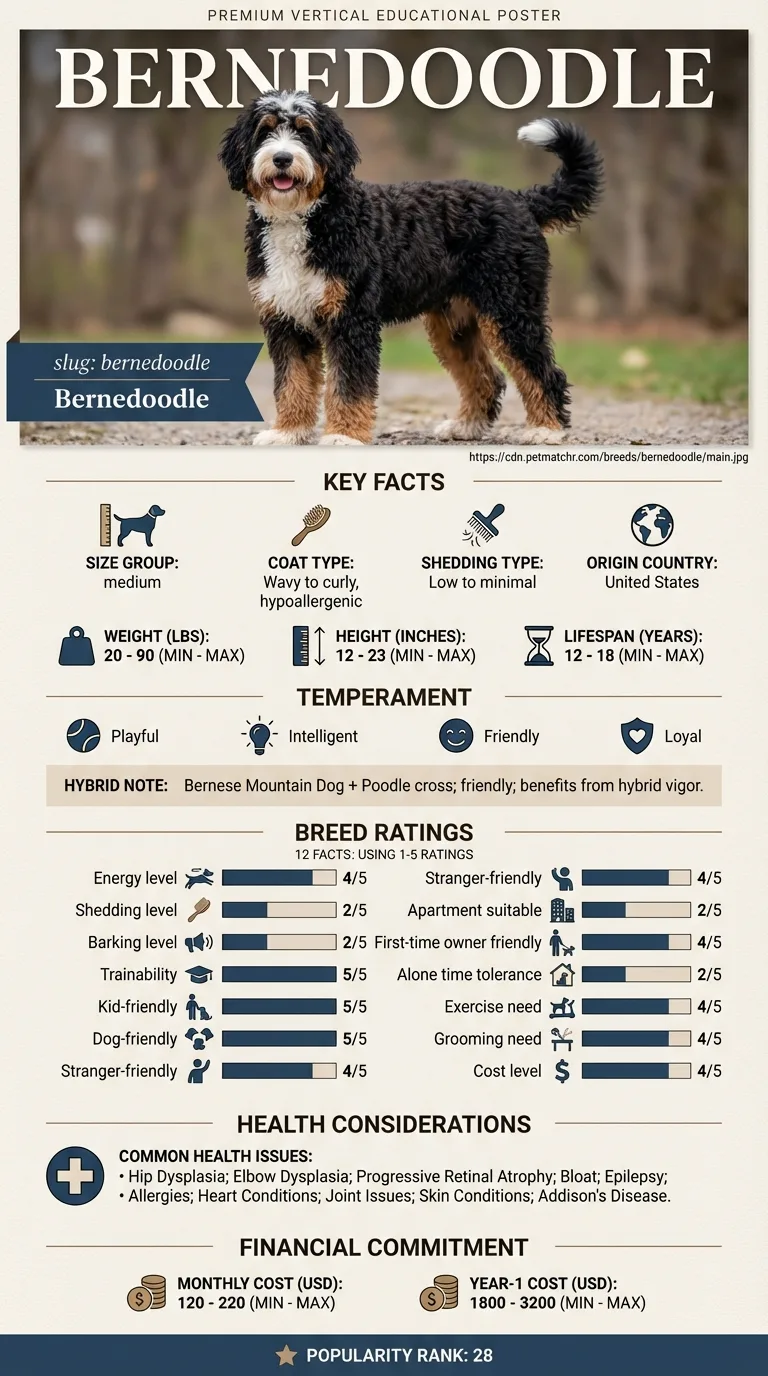
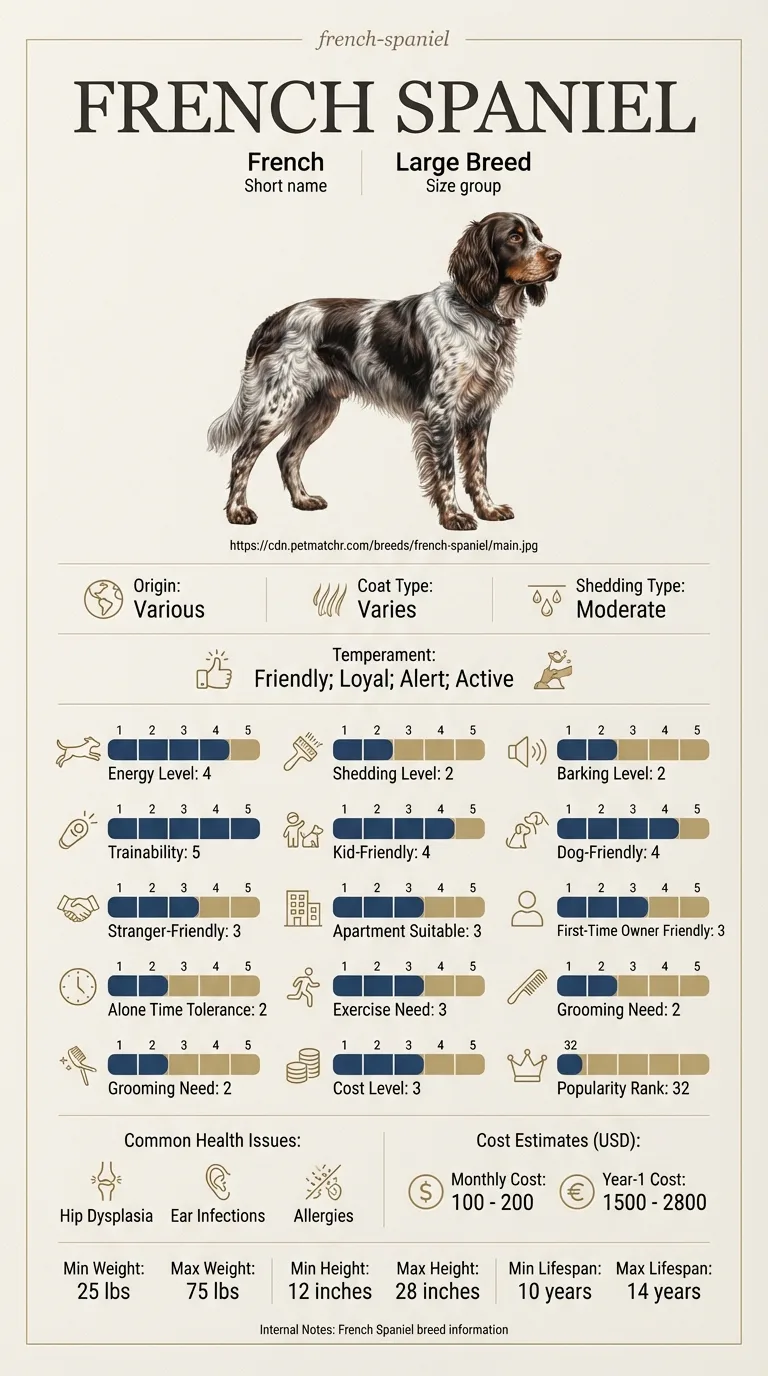
This is for someone already down to Bernedoodle and French Spaniel and deciding between them. Because the two are so evenly matched, the page works through every axis rather than leading with one. Both rate 2/5 for flats, so housing does not settle this one. The focus throughout is on daily consequences rather than breed background.
Between Bernedoodle and French Spaniel, they are closer than most pairings, and the choice comes down to temperament, and Bernedoodle is the lower-effort dog of the two to keep.
Choose Bernedoodle if this is your first dog, shedding is a problem in your house and your walking routine is modest.
Choose French Spaniel if you do not want a standing grooming appointment, a smaller dog suits your car, your home or your back and you want a dog that can keep up with an active routine.
| Feature | bernedoodle | french spaniel | Winner |
|---|---|---|---|
| Size class | medium | medium | Equal |
| Weight | 20–90 lbs | 45–60 lbs | Equal |
| Height | 12–23 in | 21–24 in | Equal |
| Lifespan | 12–18 years | 10–12 years | bernedoodle |
| Exercise need | High (4/5) | Very high (5/5) | bernedoodle |
| Grooming need | High (4/5) | Moderate (3/5) | french spaniel |
| Shedding | Low (2/5) | Moderate (3/5) | bernedoodle |
| Energy level | High (4/5) | High (4/5) | Equal |
| Barking | Low (2/5) | Low (2/5) | Equal |
| Apartment suitability | Low (2/5) | Low (2/5) | Equal |
| Good for first-time owners | High (4/5) | Moderate (3/5) | bernedoodle |
| Tolerates being alone | Low (2/5) | Low (2/5) | Equal |
| Trainability | Very high (5/5) | High (4/5) | bernedoodle |
| Good with kids | Very high (5/5) | High (4/5) | bernedoodle |
| Good with other dogs | Very high (5/5) | High (4/5) | bernedoodle |
| Friendly to strangers | High (4/5) | High (4/5) | Equal |
| Cost level | High (4/5) | Moderate (3/5) | french spaniel |
| Coat | Wavy to curly, hypoallergenic | Medium, flat and feathered | Equal |
| Origin | United States | Various | Equal |
| Typical monthly cost | $120–$220 | $100–$200 | Equal |
| Typical first-year cost | $1,800–$3,200 | $1,400–$2,900 | Equal |
The French Spaniel is a solidly built medium-to-large dog at 45-60 lbs and 21-24 inches. The Bernedoodle's 20-90 lb range can undercut or exceed that depending on size line, but a medium or standard Bernedoodle lands in roughly the same weight class as the French Spaniel. If you specifically want a dog closer to the French Spaniel's build, ask your Bernedoodle breeder about the medium or standard size line.
The French Spaniel rates very high (5/5) for exercise need, a step above the Bernedoodle's high (4/5). It's a versatile hunting breed developed to work all day in the field, and that stamina carries over into pet life - this is not a dog that's satisfied with a short walk. Either dog will need more than a leash walk around the block to stay content long-term.
The Bernedoodle needs more grooming time (4/5) than the French Spaniel's moderate (3/5) requirement, but the French Spaniel sheds more - moderate (3/5) versus the Bernedoodle's low (2/5). Neither breed is wash-and-go, but the Bernedoodle trades more time in the grooming chair for less hair around the house. Set aside regular brushing time either way, since both coats mat if left unattended for long stretches.
Both breeds rate low (2/5) for apartment suitability, and both are low (2/5) on barking, so noise isn't the deciding issue in tight quarters - space and exercise access are. Both also rate low (2/5) for tolerating being left alone, meaning neither is a good match for a household that's regularly empty for long stretches. A house with room to move and someone home regularly suits either dog far better than a flat.
The Bernedoodle rates very high (5/5) for trainability against the French Spaniel's high (4/5), and high (4/5) versus moderate (3/5) for first-time-owner suitability. The gap isn't large, but if this is your first dog, the Bernedoodle's numbers suggest a slightly gentler learning curve. Either dog responds well to consistent, reward-based work started early rather than left until problems show up.
The Bernedoodle edges ahead in every category here - very high with kids and other dogs against the French Spaniel's high (4/5) on both. The French Spaniel's temperament is described as gentle and calm indoors, so this isn't about temperament being a problem, just a modest numerical gap across the board. Neither breed's numbers suggest a real concern for a typical family household with kids and other pets.
The Bernedoodle's 12-18 year lifespan is notably longer than the French Spaniel's 10-12. Hip dysplasia and epilepsy appear on both lists, but the French Spaniel's list is shorter overall - five conditions, including a genetic condition specific to the breed, acral mutilation syndrome, alongside more common issues like ear infections and eye conditions. Ask a breeder specifically about acral mutilation syndrome testing, since it's a condition unique to the French Spaniel on this list.
The French Spaniel is cheaper to keep: $100-200 monthly versus the Bernedoodle's $120-220, and $1,400-2,900 against $1,800-3,200 for the first year. This is a lesser-known breed in the US, so factor in that finding a breeder, or a vet familiar with the breed, may take more effort than the dollar figures alone suggest. Budget some extra time, if not money, into locating a breeder given how uncommon the French Spaniel still is in the US.
Bernedoodle weighs 20–90 lbs and lives 12–18 years; French Spaniel weighs 45–60 lbs and lives 10–12 years. No rated axis separates them by more than a single point, which makes this one of the closer pairings on the site. They are level on tolerates being alone, apartment suitability and barking, so those cannot decide it. The table below marks a winner only where one breed is genuinely easier for a typical owner; size and origin are facts rather than merits and stay level. Ratings come from one source applied to both breeds, so they are meaningful against each other rather than as absolute scores.

It's a solidly built medium-large dog at 45-60 lbs and 21-24 inches - roughly in line with a medium or standard Bernedoodle, though the Bernedoodle's range extends well below and above that.
The French Spaniel, rated very high (5/5) against the Bernedoodle's high (4/5) - it's a versatile field breed built for stamina.
The Bernedoodle rates slightly better for first-timers (high, 4/5, versus moderate, 3/5), though both are reasonably trainable.
Neither is a strong fit - both rate low (2/5) for apartment suitability and low (2/5) for tolerating time alone.
$100-200 for the French Spaniel, $120-220 for the Bernedoodle.
Partially - hip dysplasia and epilepsy appear on both lists. The French Spaniel's list is shorter overall and includes a breed-specific condition, acral mutilation syndrome.
It's a less common breed here than most on this site, which the health and cost data don't capture - expect a longer breeder search and possibly a vet less familiar with the breed's specific needs.
The Bernedoodle scores slightly ahead across most categories, but the French Spaniel is the more budget-friendly, longer-established field breed for an active owner.
$100-200 for the French Spaniel versus $120-220 for the Bernedoodle.
The French Spaniel is very high (5/5); the Bernedoodle high (4/5) - both are active breeds.
12-18 years for the Bernedoodle versus 10-12 for the French Spaniel.
Secure checkout on Stripe. We never see your card.
7-day money-back guarantee. Instant access.
Health information here is general and is not veterinary advice. If your dog shows pain, sudden behaviour change, or worsening symptoms, consult a licensed veterinarian.
Some links on this site are affiliate links. We may earn a commission at no extra cost to you, and we only suggest products we believe are helpful for dog owners.
We research and check what we publish, but we do not warrant that any figure, date, price, or statement is accurate, complete, or current, and we accept no liability for any loss, cost, injury, or other harm arising from the use of this site. Use it as one reference among several. You remain responsible for your own decisions and for your dog's care - confirm anything that matters with a licensed veterinarian or another qualified professional before you act on it. Full disclaimer.
Match your lifestyle to the right dog.
Take quizNot sure which breed is right for you? Take our 2-minute quiz to find out.
Take the quiz