Australian Shepherd vs Shiba Inu: Which Suits Your Home?
Quick answer
Which breed should most people pick between these two?
If you have space and time for real exercise, the Aussie's trainability and kid-friendliness win out; if you're in a smaller home with a lighter schedule, the Shiba's apartment score and lower exercise need make more sense.
Australian Shepherd or Shiba Inu? On paper they differ most on apartment suitability, and on the scales Australian Shepherd is the heavier at 40–65 lbs. Here is how the two compare on everything that shapes an ordinary week.
This is for someone already down to Australian Shepherd and Shiba Inu and deciding between them. For this pair the decision usually turns on apartment suitability and trainability, so those are covered first and in most detail. Anyone choosing from a flat has a clear answer here: Shiba Inu rates 4/5 against 1/5. There is no origin story here — only what changes about your week.
Quick verdict
Between Australian Shepherd and Shiba Inu, apartment suitability is what separates them, and Shiba Inu is the lower-effort dog of the two to keep.
Choose australian shepherd if...
Choose Australian Shepherd if there are young children at home, you already have another dog and you want a dog that picks up training quickly.
Choose shiba inu if...
Choose Shiba Inu if you are in a flat or a smaller home, your walking routine is modest and the dog will be alone during the working day.
Head-to-head comparison
Feature
australian shepherd
shiba inu
Winner
Size class
medium
small
Equal
Weight
40–65 lbs
17–23 lbs
Equal
Height
18–23 in
13–16 in
Equal
Lifespan
12–15 years
13–16 years
shiba inu
Exercise need
Very high (5/5)
Moderate (3/5)
shiba inu
Grooming need
Moderate (3/5)
Moderate (3/5)
Equal
Shedding
High (4/5)
High (4/5)
Equal
Energy level
Very high (5/5)
High (4/5)
Equal
Barking
Moderate (3/5)
Moderate (3/5)
Equal
Apartment suitability
Very low (1/5)
High (4/5)
shiba inu
Good for first-time owners
Low (2/5)
Low (2/5)
Equal
Tolerates being alone
Low (2/5)
Moderate (3/5)
shiba inu
Trainability
Very high (5/5)
Low (2/5)
australian shepherd
Good with kids
High (4/5)
Moderate (3/5)
australian shepherd
Good with other dogs
High (4/5)
Low (2/5)
australian shepherd
Friendly to strangers
Low (2/5)
Low (2/5)
Equal
Cost level
Moderate (3/5)
Moderate (3/5)
Equal
Coat
Medium-length double coat
Double coat, medium
Equal
Origin
United States
Japan
Equal
Typical monthly cost
$100–$200
$80–$160
Equal
Typical first-year cost
$1,500–$2,800
$1,200–$2,300
Equal
Deep dive
Size and build
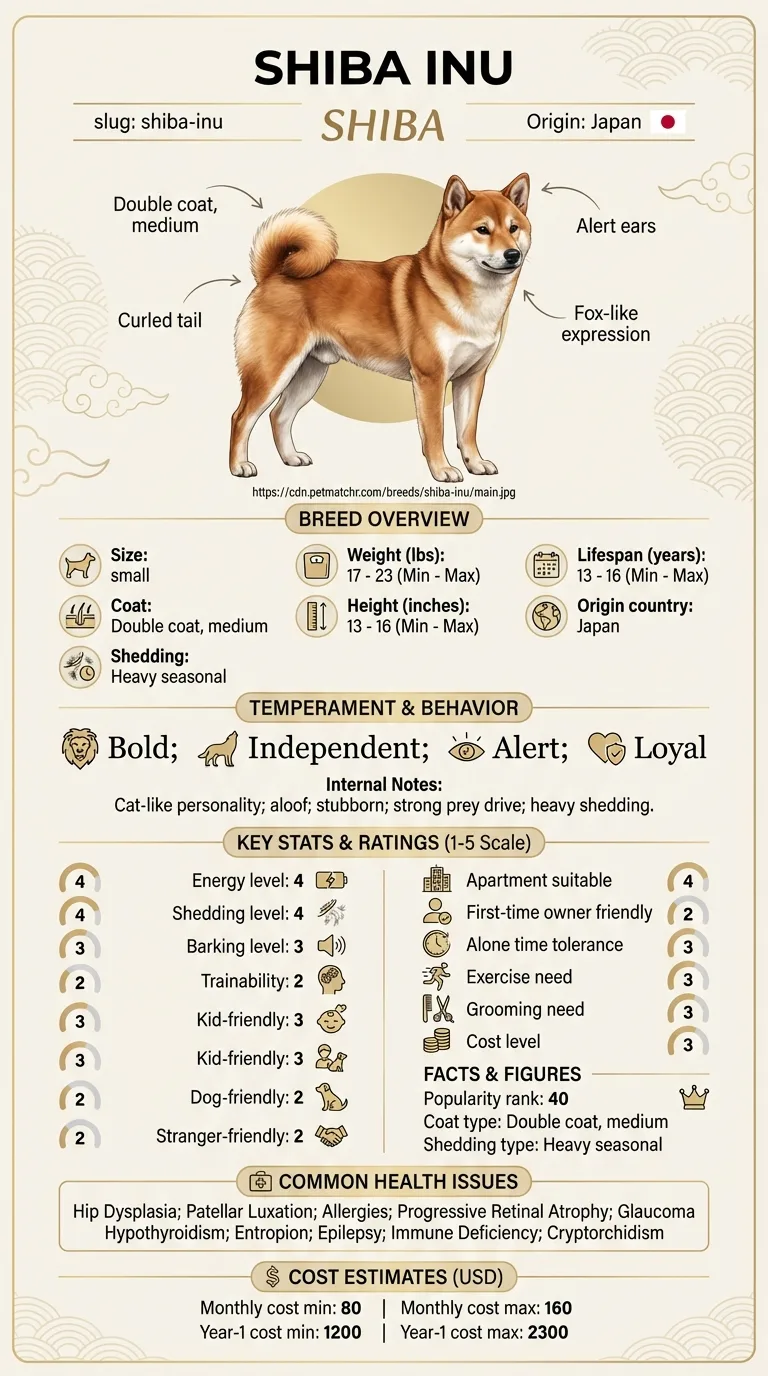
These two aren't playing in the same weight class. The Australian Shepherd runs 40-65 lbs and stands 18-23 inches at the shoulder, a solid medium-size herding dog built for covering ground. The Shiba Inu tops out around 23 lbs and 16 inches, closer to a small fox-shaped dog than a working breed. If you want something you can pick up and carry to the vet, that's the Shiba, not the Aussie.
Energy and exercise
The Aussie rates a full 5/5 on exercise need, the ceiling of the scale, and it's the kind of dog that wants a job, not just a walk. The Shiba sits at a moderate 3/5 and is content with regular but shorter outings. A tired Aussie is a good Aussie; an under-exercised one gets destructive. The Shiba is far more forgiving of a lighter routine.
Grooming and shedding
Both carry a medium-length double coat and both shed heavily, rated 4/5 on the shedding scale. Grooming effort is tied at moderate (3/5) for each. Expect a brush a few times a week year-round and daily during coat blow twice a year, regardless of which one you pick. Neither is a low-maintenance coat despite the different body sizes.
Apartment living, noise and time alone
This is where the two really split. The Aussie scores just 1/5 for apartment suitability and 2/5 for tolerating time alone - it wants space and company. The Shiba scores 4/5 for apartments and 3/5 for being left alone, making it the far more realistic choice for a smaller home or a longer workday. Barking is moderate and equal for both, so noise isn't the differentiator here.
Training and owner experience
The Aussie is a trainability powerhouse at 5/5, one of the most responsive breeds you'll work with, though its own 2/5 first-time-owner rating means that intelligence needs direction or it turns into mischief. The Shiba trains at just 2/5 and independence is baked into its personality - it will decide for itself whether your recall command is worth obeying. Both share the same low 2/5 score for first-time owners, so neither is a gentle introduction to dog ownership.
Kids, other dogs and visitors
The Aussie edges ahead with kids (4/5 vs 3/5) and other dogs (4/5 vs 2/5), reflecting its herding-group sociability. Neither breed is particularly warm to strangers - both sit at a low 2/5 there, so don't expect either to greet guests like a golden retriever. If you have a multi-dog household already, the Aussie is the safer add.
Health and lifespan
The Shiba edges out a longer lifespan at 13-16 years versus the Aussie's 12-15. Both breed lists include hip dysplasia, progressive retinal atrophy, hypothyroidism, epilepsy and allergies, so eye and joint screening matters for either dog. The Aussie's list adds elbow dysplasia and cancer risk, along with an ivermectin sensitivity worth flagging to any vet before medication.
Cost to keep
Monthly costs run close: $100-$200 for the Aussie against $80-$160 for the Shiba. First-year totals follow the same pattern, $1,500-$2,800 versus $1,200-$2,300. Both land in the moderate cost bracket (3/5), so budget isn't the deciding factor between these two - lifestyle fit is. Food costs likely tilt higher for the Aussie given its larger frame, while the Shiba's grooming needs stay modest enough that neither breed will surprise you with a specialty coat-care bill each month.
Australian Shepherd vs Shiba Inu at a glance
Australian Shepherd weighs 40–65 lbs and lives 12–15 years; Shiba Inu weighs 17–23 lbs and lives 13–16 years. The two diverge most on apartment suitability, trainability and exercise need and 1 other rated axes. They are level on barking, cost level and good for first-time owners, so those cannot decide it. Where the table declares a winner it means less work for the owner, nothing more; descriptive rows are left as ties on purpose. The value here is in the differences between the two columns; treat any single score as approximate.
Australian Shepherd vs Shiba Inu: Which Suits Your Home? - Australian Shepherd vs Shiba Inu at a glance
Frequently asked questions
Which is bigger, the Australian Shepherd or the Shiba Inu?
The Australian Shepherd, by a wide margin. It weighs 40-65 lbs and stands up to 23 inches, while the Shiba Inu tops out near 23 lbs and 16 inches. They're not a realistic size comparison for someone choosing based on space.
Do Australian Shepherds and Shiba Inus shed a lot?
Yes, both are rated 4/5 for shedding thanks to their double coats. Expect fur year-round with heavier seasonal blowouts twice a year from each breed.
Is either breed good for a first-time dog owner?
Not really - both score a low 2/5 on that measure. The Aussie needs a job and firm structure, and the Shiba's independence makes obedience work slower going, even though it trains at only 2/5 compared to the Aussie's 5/5.
Which is better suited to apartment living?
The Shiba Inu, clearly. It rates 4/5 for apartment suitability against the Aussie's 1/5. The Aussie's high exercise needs and low tolerance for being alone make small-space living genuinely hard on the dog.
How much should I budget monthly for either breed?
Plan on $80-$160 a month for a Shiba Inu and $100-$200 for an Australian Shepherd. First-year costs run $1,200-$2,300 and $1,500-$2,800 respectively, both landing in the moderate cost tier.
Do these breeds share any health risks?
Several - hip dysplasia, progressive retinal atrophy, hypothyroidism, epilepsy and allergies show up on both lists. The Aussie carries added risks for elbow dysplasia, cancer and a known sensitivity to ivermectin.
Which is friendlier with other dogs?
The Aussie, rated 4/5 for compatibility with other dogs against the Shiba's 2/5. Shibas can be genuinely scrappy with unfamiliar dogs, so multi-dog households usually do better with the Aussie.
Which breed should most people pick between these two?
If you have space and time for real exercise, the Aussie's trainability and kid-friendliness win out; if you're in a smaller home with a lighter schedule, the Shiba's apartment score and lower exercise need make more sense.
Costs
What will monthly costs look like?
Roughly $100-$200 for an Aussie and $80-$160 for a Shiba - both moderate, with the Aussie running slightly higher.
Training
How much exercise does each dog need?
The Aussie needs a 5/5, near-daily hard exercise; the Shiba is moderate at 3/5 and satisfied with regular but shorter sessions.
Health
Which breed lives longer?
The Shiba Inu, at 13-16 years, edges out the Aussie's 12-15 year range.
Related DogBreedCompass guides
Australian Shepherd breed guide – Readers comparing the two usually want the full profile of Australian Shepherd before deciding.
Shiba Inu breed guide – The same for Shiba Inu, so the comparison can be checked against the detail.
Australian Shepherd vs German Shorthaired Pointer – German Shorthaired Pointer is the closest breed to Australian Shepherd on the measured axes, so it is the natural next comparison.
Shiba Inu vs Pomeranian – Pomeranian sits closest to Shiba Inu, which makes it the alternative worth ruling out.
Australian Shepherd vs Pomeranian – Pomeranian is the other breed Shiba Inu is most often weighed against.
Shiba Inu health problems – The health pages set out what each breed is actually screened for.
Health information here is general and is not veterinary advice. If your dog shows pain, sudden behaviour change, or worsening symptoms, consult a licensed veterinarian.
Some links on this site are affiliate links. We may earn a commission at no extra cost to you, and we only suggest products we believe are helpful for dog owners.
We research and check what we publish, but we do not warrant that any figure, date, price, or statement is accurate, complete, or current, and we accept no liability for any loss, cost, injury, or other harm arising from the use of this site. Use it as one reference among several. You remain responsible for your own decisions and for your dog's care - confirm anything that matters with a licensed veterinarian or another qualified professional before you act on it. Full disclaimer.