About $93 to $186 a month and $1,302 to $2,697 in year one, modestly below average. The Indianapolis-specific adjustment is surface rather than distance: a flat, heavily paved city defaults to concrete, and rotating half the mileage onto dirt costs nothing.
A Welsh Springer Spaniel in Indianapolis costs roughly $93 to $186 a month, and $1,302 to $2,697 across year one — a little under the national average, which is about what a genuinely middle-of-the-road Midwestern metro should look like. The local variable for this breed is not the weather or the price. It is what the dog's feet land on for most of its life.
Why costs vary
Of the five conditions documented in this breed, the orthopaedic one carries the highest lifetime ceiling and is the one most influenced by ordinary daily habits. The rest are managed; this one is lived with, and how it is lived with matters.
Cost summary
Central Indiana's modestly below-average pricing applied to a medium sporting dog, with an eight-month prevention window and no unusual local surcharges.
Estimate · source: estimation · confidence: medium · updated 2026-09-06 · not a quote
First year
$1302 - $2697
Ongoing monthly
$93 - $186
First-year expenses
Item
Cost range
One-time setup: first exam, spay or neuter, grooming tools
Includes a slicker brush and comb for feathering that mats rather than sheds.
$380 - $640
Monthly expenses
Item
Cost range
Food for a 35-to-55-pound active dog
Portioned to keep the dog lean, which matters more to a marginal joint than the walking surface does.
$44 - $74
How these numbers are estimated
Each range starts from a national baseline for this breed's size class and is then adjusted for local cost of living and veterinary pricing. The baselines, and the source each one came from, are listed on our sources page (dataset 2026.09). Two inputs, the purchase price and the emergency reserve, have no published national figure we could verify, so we leave them to you rather than invent them.
These are planning estimates, not quotes. Your own numbers will move with the individual dog, your vet and your insurer. Build a budget with your own figures.
Is pet insurance worth it?
Indianapolis prices below average across the board, so the insurance case here is built on the size of the orthopaedic ceiling rather than on everyday costs.
When insurance makes sense
Quote it before any lameness or gait comment appears in the record, since a hip note in a young dog's file is the classic route to an exclusion covering exactly what you wanted insured.
When you might skip it
Routine care is genuinely inexpensive here, so an owner with a reserve large enough to absorb a surgical year can reasonably self-insure.
Ways to save without cutting essentials
The Indianapolis savings are behavioural rather than commercial — the city is already cheap, so the value is in where you walk.
Rotate at least half the week's distance onto dirt at Eagle Creek or Fort Harrison rather than pavement.
Keep the dog genuinely lean; body weight loads a marginal hip on every single step.
Ask for a gait assessment at every annual visit rather than waiting for a visible limp.
Brush the feathering weekly so professional grooming is a tidy-up rather than a rescue.
Set prevention to Indiana's eight-month season instead of defaulting to year-round.
Indianapolis Cost Factors: A Flat City Paves Its Way to Distance
Indianapolis is one of the flatter large metros in the country, which is genuinely convenient — a dog rated 4 out of 5 on exercise need can rack up distance without hills getting in the way. The consequence is that distance is exactly what owners rack up, and they do it on sidewalk, street and paved trail, because that is what the city provides in abundance.
A young, sound dog will not complain, and for most dogs the surface never becomes an issue at all. But the arithmetic is worth seeing plainly: a five-mile evening walk on concrete is roughly ten thousand impacts through each front leg with nothing yielding underneath. For a Welsh Springer that has drawn the wrong side of the genetic hand on hips, that is the difference between comfort at eight and stiffness at eight.
The fix costs nothing and does not reduce the mileage. It changes where the mileage happens. The Monon Trail runs north from downtown as a rail-trail with soft-surface sections alongside the pavement in places; Eagle Creek Park covers close to four thousand acres on the northwest side with genuine dirt trail and a large reservoir; Fort Harrison State Park on the northeast side offers wooded footing. Rotating even half the week's distance onto earth rather than concrete is the cheapest orthopaedic decision available in this city.
Average Pricing, an Eight-Month Window, and Where Referral Goes
The financial picture here is refreshingly unremarkable. Food, grooming, boarding and routine veterinary care price modestly below the national average, and Indiana's real winters keep flea and tick prevention to about eight months rather than the full twelve. Nothing in this city inflates the running cost of a medium sporting dog.
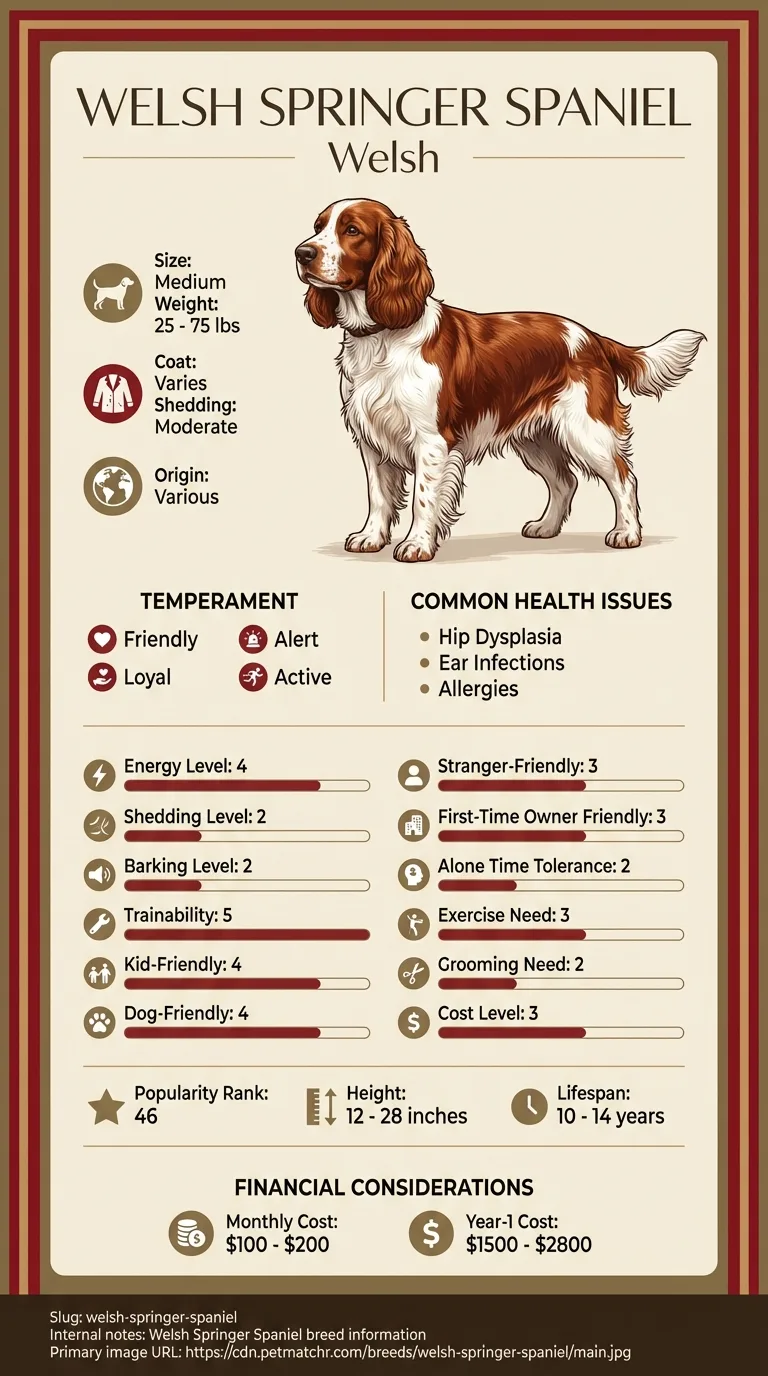
Grooming deserves a line of its own. This breed sits at 3 out of 5 for both shedding and grooming need, and the maintenance that gets skipped is the feathering — the ears, the backs of the legs, the chest — which mats rather than sheds. A brush-out habit costs nothing and takes the sting out of the professional grooming line.
For advanced work, Purdue University's veterinary teaching hospital sits about sixty-five miles northwest in West Lafayette, and Indianapolis itself supports private specialty practice. That is a comfortable position for orthopaedic assessment, which is the referral this page's advice is most likely to lead toward — worth knowing before a limp turns up rather than after.
Welsh Springer Spaniel Cost in Indianapolis - Average Pricing, an Eight-Month Window, and Where Referral Goes
Four Miles a Night on the Same Sidewalk
A Welsh Springer in a north-side neighbourhood had an enviable routine: four miles every evening on the neighbourhood sidewalks and the paved stretch of the Monon, in all weather, for years. He was fit, lean and never once appeared uncomfortable doing it.
At seven he started taking a moment to get going in the mornings. Imaging showed hip changes his veterinarian described as consistent with underlying laxity, which was nobody's fault. The advice that followed was not to walk less but to walk elsewhere — the same distance, moved onto the dirt trails at Eagle Creek, and the mornings improved noticeably within a couple of months.
Key takeaway: In a flat, paved city the useful adjustment for this breed is the surface rather than the mileage, and Indianapolis has enough soft trail to make the swap free.
Frequently asked questions
How much does a Welsh Springer Spaniel cost per month in Indianapolis?
Roughly $93 to $186, a little below the national average, in line with central Indiana's general cost of living.
What does the first year cost here?
About $1,302 to $2,697, covering the initial exam, vaccinations, spay or neuter if needed, and starting gear on top of monthly running costs.
Does walking on concrete cause hip dysplasia?
No. The condition is inherited. What a hard surface changes is how a joint with existing laxity feels after years of high mileage, since concrete returns impact rather than absorbing it.
Where can I find softer footing in Indianapolis?
Eagle Creek Park on the northwest side has genuine dirt trail across close to four thousand acres, Fort Harrison State Park offers wooded footing northeast, and parts of the Monon Trail run soft surface alongside the pavement.
How long is the prevention season in central Indiana?
About eight months. Winters here genuinely interrupt flea and tick activity, so a full year-round schedule is more than most local dogs require.
What emergency fund should an Indianapolis owner keep?
Around $650 covers a significant unplanned visit at local pricing, which is a sensible floor given the orthopaedic ceiling in this breed.
About $93 to $186 a month and $1,302 to $2,697 in year one, modestly below average. The Indianapolis-specific adjustment is surface rather than distance: a flat, heavily paved city defaults to concrete, and rotating half the mileage onto dirt costs nothing.
Welsh Springer Spaniel compared with other sporting breeds – Useful for weighing this breed's orthopaedic profile against another mid-sized sporting dog.
This guide is not medical advice. If your dog shows pain, sudden behavior change, or worsening symptoms, consult a licensed veterinarian.
Some links may be affiliate links. We may earn a commission at no extra cost to you. We only suggest products we believe are helpful for dog owners.
We research and check what we publish, but we do not warrant that any figure, date, price, or statement is accurate, complete, or current, and we accept no liability for any loss, cost, injury, or other harm arising from the use of this site. Use it as one reference among several. You remain responsible for your own decisions and for your dog's care - confirm anything that matters with a licensed veterinarian or another qualified professional before you act on it. Full disclaimer.