Costs
Bernese Mountain Dog cost in Charleston
About $148–$282/month, $2,150–$3,800 for year one — near-average, though confirming reliable central air matters more here than for most breeds.

See Bernese Mountain Dog price across all cities →
Quick answer
Bernese Mountain Dog cost in Charleston
About $148–$282/month, $2,150–$3,800 for year one — near-average, though confirming reliable central air matters more here than for most breeds.
A Bernese Mountain Dog in Charleston costs about $148–$282 a month, with the first year around $2,150–$3,800 — close to the national average for this cost tier, with one housing-specific detail worth checking before move-in.
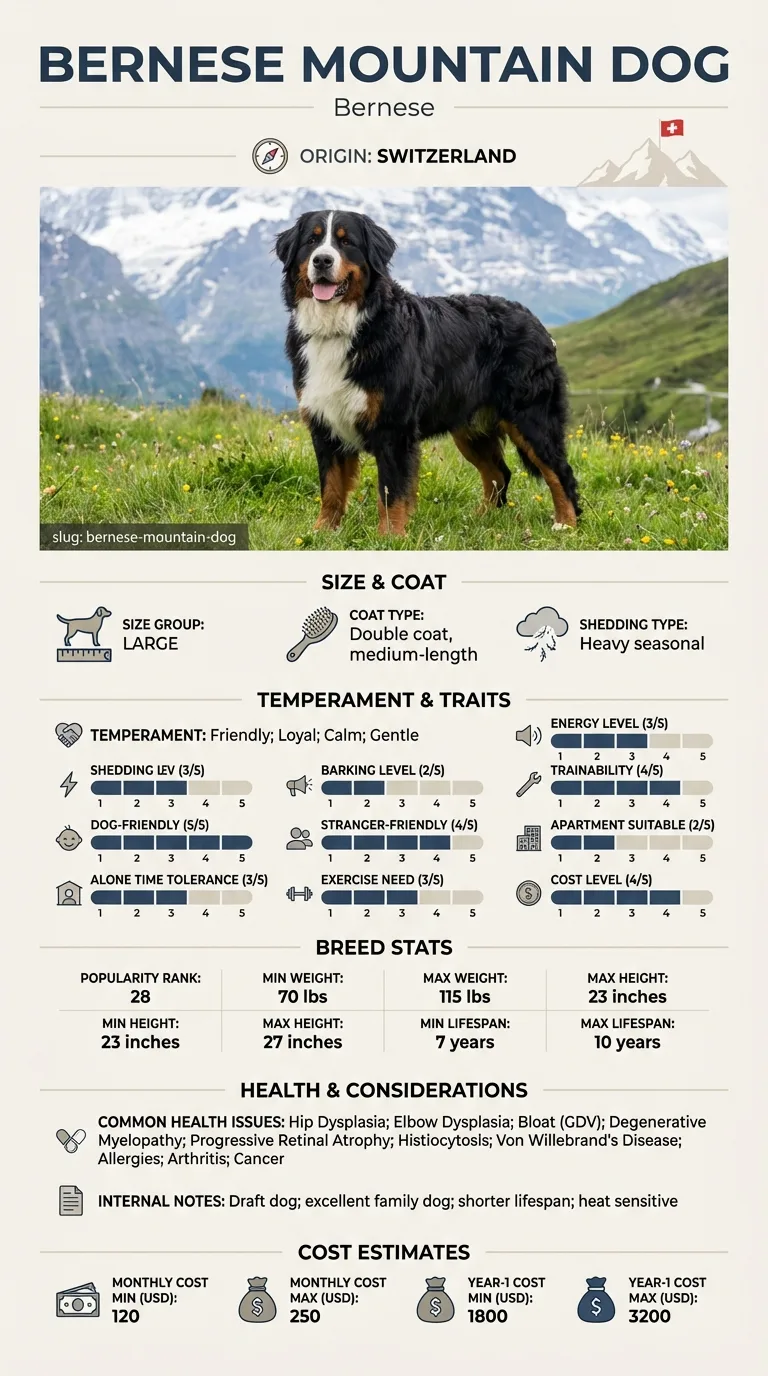
Hip and elbow dysplasia are common large-breed risks, but this breed's more consequential concern is its documented elevated cancer risk, including histiocytosis, contributing to a shorter typical lifespan than most large breeds. Bloat (GDV) is a separate, sudden true emergency this breed also carries elevated risk for.
These figures reflect Charleston's near-South-Carolina-average general pricing, with cooling-related costs priced up given how demanding the coastal Lowcountry's humid heat is for this breed, and a note on confirming a property's cooling infrastructure.
Estimate · source: estimation · confidence: medium · updated 2026-10-06 · not a quote
| Item | Cost range |
|---|---|
One-time setup (initial vet visit, spay/neuter, large-breed gear) Covers the first exam, vaccinations, spay/neuter if needed, and gear sized for the breed's substantial adult weight. | $445 - $755 |
| Item | Cost range |
|---|---|
Food Close to the national average for a large breed with substantial food needs. | $63 - $99 |
Grooming The heavy seasonal-shedding double coat needs regular brushing; coastal humidity makes at-home consistency valuable. | $17 - $33 |
Cooling gear (mat, vest) and added AC use A genuinely relevant added cost given the coastal Lowcountry's humid heat and the common lack of central air in Charleston's older historic housing stock. | $9 - $19 |
Flea & tick prevention Close to year-round given the Lowcountry's long, humid warm season. | $16 - $29 |
Each range starts from a national baseline for this breed's size class and is then adjusted for local cost of living and veterinary pricing. The baselines, and the source each one came from, are listed on our sources page (dataset 2026.09). Two inputs, the purchase price and the emergency reserve, have no published national figure we could verify, so we leave them to you rather than invent them.
These are planning estimates, not quotes. Your own numbers will move with the individual dog, your vet and your insurer. Build a budget with your own figures.
For a Bernese Mountain Dog in Charleston, insurance is especially worth taking seriously given the breed's well-documented elevated cancer risk, which can mean substantial and sometimes ongoing treatment costs.
Given how commonly cancer, including histiocytosis, affects this breed and how significant treatment costs can become, insurance purchased while the dog is young and healthy is one of the higher-value purchases an owner of this breed can make anywhere.
Owners who've built a genuinely large emergency fund, discussed a realistic financial plan with their vet given the breed's known risks, and are comfortable managing a serious case's cost themselves can reasonably self-insure instead.
Charleston's routine costs stay near the national average; the real planning lever specific to this city is confirming reliable home cooling before committing to a property.
Many of Charleston's most desirable historic homes, especially in the downtown peninsula, predate central air conditioning entirely, originally designed with high ceilings, tall windows and deep porches to manage heat passively — a genuinely clever historic solution, but not one that reliably matches modern central air's consistency. For most breeds, a window unit or two is a fine workaround. For a Bernese Mountain Dog, whose dense double coat and Alpine heritage make it genuinely heat-sensitive, confirming that a specific property has reliable, whole-home cooling, not just a bedroom window unit, is worth doing before signing a lease or making an offer, not after moving in during a Charleston summer.
Coastal humidity compounds the concern: Charleston's warm season is long and genuinely humid, which impairs a dog's panting-based cooling more than a dry heat would, making consistent indoor cooling access more consequential here than in a drier climate with the same temperature.
Charleston's general cost of living tracks close to the South Carolina state average, and the coastal Lowcountry's long, humid warm season keeps flea-and-tick prevention close to year-round, one of the longer active seasons this site covers.

A Charleston Bernese Mountain Dog owner fell in love with a historic downtown rental with high ceilings and original windows, only realizing after move-in that the property's cooling relied entirely on two window units that struggled to keep the whole home comfortable during peak summer humidity. The dog showed clear signs of heat discomfort during the hottest weeks, prompting the family to invest in an additional cooling unit and rework the dog's daily schedule around the coolest rooms and hours.
Key takeaway: In a city full of beautiful historic housing like Charleston, confirming a property's actual cooling capacity before committing is a genuinely important step for this specific breed — charm and adequate climate control aren't always the same thing.
About $148–$282, close to the national average for this cost tier, reflecting Charleston's generally typical South Carolina pricing.
Roughly $2,150–$3,800, including the initial vet exam, spay/neuter if needed, and large-breed gear on top of ongoing monthly costs.
Many of Charleston's historic homes, especially downtown, predate central air conditioning, relying on window units or passive design instead. For a breed this heat-sensitive, confirming reliable whole-home cooling before moving in matters more than for most breeds, especially given the coastal humidity.
Yes — humidity impairs a dog's panting-based cooling system more than dry heat does, making Charleston's long, humid warm season a genuinely harder test for this breed than an equally hot but drier climate.
Worth pricing out seriously given the breed's elevated cancer risk and bloat risk, bought while the dog is young and before anything is on record.
Around $850 covers a typical significant vet visit in this market. Given the breed's cancer risk, it's worth discussing a broader financial plan with your vet beyond a single emergency fund figure.
About $148–$282/month, $2,150–$3,800 for year one — near-average, though confirming reliable central air matters more here than for most breeds.
This guide is not medical advice. If your dog shows pain, sudden behavior change, or worsening symptoms, consult a licensed veterinarian.
Some links may be affiliate links. We may earn a commission at no extra cost to you. We only suggest products we believe are helpful for dog owners.
We research and check what we publish, but we do not warrant that any figure, date, price, or statement is accurate, complete, or current, and we accept no liability for any loss, cost, injury, or other harm arising from the use of this site. Use it as one reference among several. You remain responsible for your own decisions and for your dog's care - confirm anything that matters with a licensed veterinarian or another qualified professional before you act on it. Full disclaimer.
One sheet with every line item, the emergency fund and when insurance pays off - unlocks on this page.
You get: 12-month budget sheet
No spam. One-click unsubscribe. See our privacy policy.
See a sample page before you decide.