Costs
Bernese Mountain Dog cost in Austin
About $158–$300/month, $2,250–$4,000 for year one — above the Texas average, with real heat-management needs for this Alpine breed.

See Bernese Mountain Dog price across all cities →
Quick answer
Bernese Mountain Dog cost in Austin
About $158–$300/month, $2,250–$4,000 for year one — above the Texas average, with real heat-management needs for this Alpine breed.
A Bernese Mountain Dog in Austin costs about $158–$300 a month, with the first year around $2,250–$4,000 — above the national average, driven by both Austin's rapid growth and this breed's real heat-management needs.
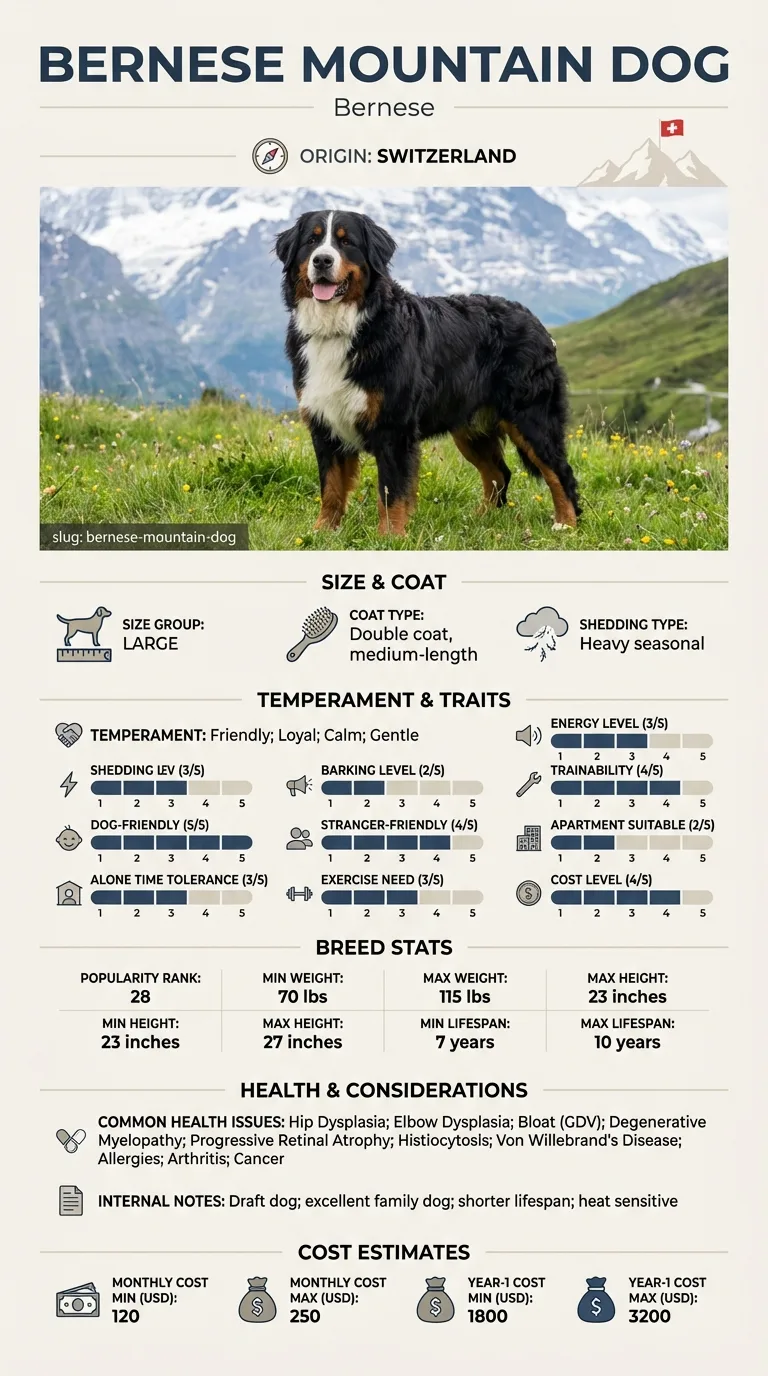
Hip and elbow dysplasia are common large-breed risks, but this breed's more consequential concern is its documented elevated cancer risk, including histiocytosis, contributing to a shorter typical lifespan than most large breeds. Bloat (GDV) is a separate, sudden true emergency this breed also carries elevated risk for.
These figures reflect Austin's above-Texas-average pricing driven by rapid population growth, with cooling-related costs priced up given how demanding central Texas's long, hot, humid summer is for this Alpine breed.
Estimate · source: estimation · confidence: medium · updated 2026-09-05 · not a quote
| Item | Cost range |
|---|---|
One-time setup (initial vet visit, spay/neuter, large-breed gear) Covers the first exam, vaccinations, spay/neuter if needed, and gear sized for the breed's substantial adult weight — priced above the state average given the city's growth. | $465 - $790 |
| Item | Cost range |
|---|---|
Food Above the national average for a large breed with substantial food needs, tracking Austin's broader cost-of-living growth. | $65 - $102 |
Grooming The heavy seasonal-shedding double coat needs regular brushing; humidity makes at-home consistency more important than in a drier climate. | $18 - $35 |
Cooling gear (mat, vest) and added AC use A genuinely relevant added cost given how demanding central Texas's long, hot, humid summer is for this breed's cooling. | $9 - $19 |
Flea & tick prevention Close to year-round given central Texas's long, hot warm season. | $17 - $30 |
Each range starts from a national baseline for this breed's size class and is then adjusted for local cost of living and veterinary pricing. The baselines, and the source each one came from, are listed on our sources page (dataset 2026.09). Two inputs, the purchase price and the emergency reserve, have no published national figure we could verify, so we leave them to you rather than invent them.
These are planning estimates, not quotes. Your own numbers will move with the individual dog, your vet and your insurer. Build a budget with your own figures.
For a Bernese Mountain Dog in Austin, insurance matters more than in the rest of Texas because the city's above-average vet pricing makes both the breed's cancer risk and bloat risk more expensive here specifically.
Given how commonly cancer affects this breed and Austin's above-average local pricing, insurance purchased while the dog is young and healthy is worth pricing out seriously rather than relying on an emergency fund alone.
Owners who've built a genuinely solid emergency fund, sized for Austin's above-average local pricing rather than the state average, and discussed a realistic financial plan with their vet can reasonably self-insure instead.
Austin's above-average pricing is largely a function of the city's growth; the real lever specific to this breed is disciplined heat management through the long summer.
Austin's population has grown faster than almost any other major U.S. metro over the past decade, and that growth has pulled general service pricing, including veterinary care, up well above both the Texas state average and the national average in many categories, independent of anything specific to this breed. Texas's lack of a state income tax helps the broader household budget, but it doesn't offset the city-specific price growth showing up in local vet services.
Layered on top of that pricing story is a genuine climate consideration: central Texas's summer is long, hot and humid, and a Bernese Mountain Dog's dense double coat, built for the cool Swiss Alps rather than a Texas summer, makes heat management a real, ongoing part of ownership here rather than an occasional concern. Reliable air conditioning, strictly limited midday activity through the hottest months, and close attention to early heat-stress signs all matter more here than in a milder climate.
Austin's active outdoor culture, appealing for many breeds, needs real adjustment for this one — trail time and outdoor activities are best scheduled for the cooler morning hours through summer rather than the mid-afternoon heat many Austin outdoor spaces see regularly.

An Austin Bernese Mountain Dog owner, drawn to the city's active outdoor culture, initially planned regular afternoon greenbelt hikes as part of the dog's routine. After the dog struggled visibly on an early-summer hike that hadn't seemed unusually hot to the owner, a vet visit confirmed mild heat stress and recommended shifting all outdoor activity to early morning for the rest of the season. The change resolved the issue completely, and the dog's energy on morning hikes stayed consistently strong through the rest of summer.
Key takeaway: Austin's outdoor culture is a genuine asset for many breeds, but this one needs its exercise schedule built around the heat from the start rather than adjusted only after a scare.
About $158–$300, above both the Texas state average and the national average, driven by the city's rapid population growth and rising service pricing.
Roughly $2,250–$4,000, including the initial vet exam, spay/neuter if needed, and large-breed gear on top of ongoing monthly costs.
It requires real caution — central Texas's long, hot, humid summer is a genuine test for a breed built for the cool Swiss Alps, and reliable air conditioning plus careful exercise timing matter more here than in a milder climate.
The city's population has grown faster than almost any other major U.S. metro over the past decade, pulling local service pricing, including veterinary care, well above the state average, independent of Texas's lack of a state income tax.
Worth pricing out seriously given the breed's elevated cancer risk and bloat risk — Austin's above-average vet pricing makes either of these more expensive here than in a typical Texas market.
Around $950 covers a typical significant vet visit in this market, reflecting Austin's above-average local pricing relative to the rest of Texas.
About $158–$300/month, $2,250–$4,000 for year one — above the Texas average, with real heat-management needs for this Alpine breed.
This guide is not medical advice. If your dog shows pain, sudden behavior change, or worsening symptoms, consult a licensed veterinarian.
Some links may be affiliate links. We may earn a commission at no extra cost to you. We only suggest products we believe are helpful for dog owners.
We research and check what we publish, but we do not warrant that any figure, date, price, or statement is accurate, complete, or current, and we accept no liability for any loss, cost, injury, or other harm arising from the use of this site. Use it as one reference among several. You remain responsible for your own decisions and for your dog's care - confirm anything that matters with a licensed veterinarian or another qualified professional before you act on it. Full disclaimer.
One sheet with every line item, the emergency fund and when insurance pays off - unlocks on this page.
You get: 12-month budget sheet
No spam. One-click unsubscribe. See our privacy policy.
Preview page 1 before you decide.