Behavior
Which sheds less?
The Poodle, rated Very low (1/5) versus the GWP's Moderate (3/5).

Quick answer
Which sheds less?
The Poodle, rated Very low (1/5) versus the GWP's Moderate (3/5).
German Wirehaired Pointer or Poodle (All Sizes)? On paper they differ most on apartment suitability, and on the scales German Wirehaired Pointer is the heavier at 60–70 lbs. Here is how the two compare on everything that shapes an ordinary week.
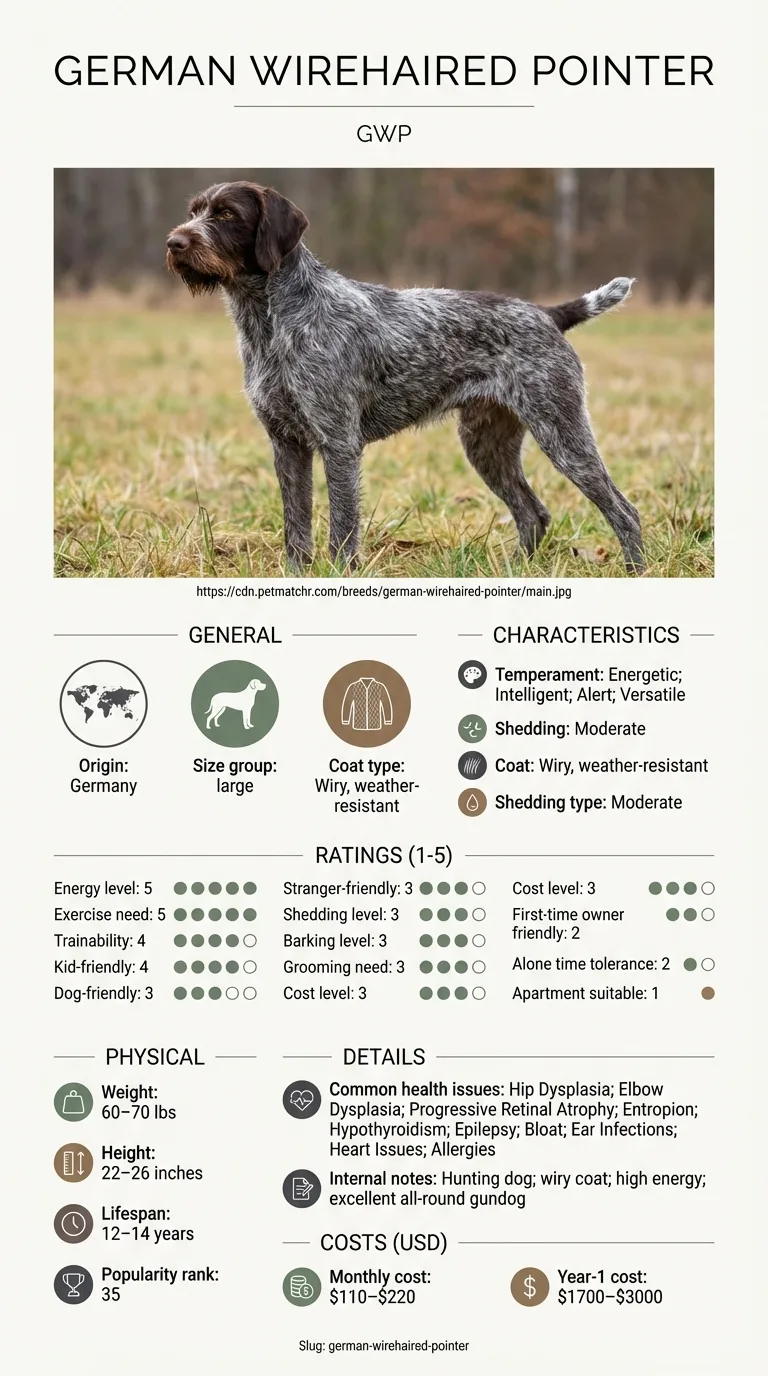
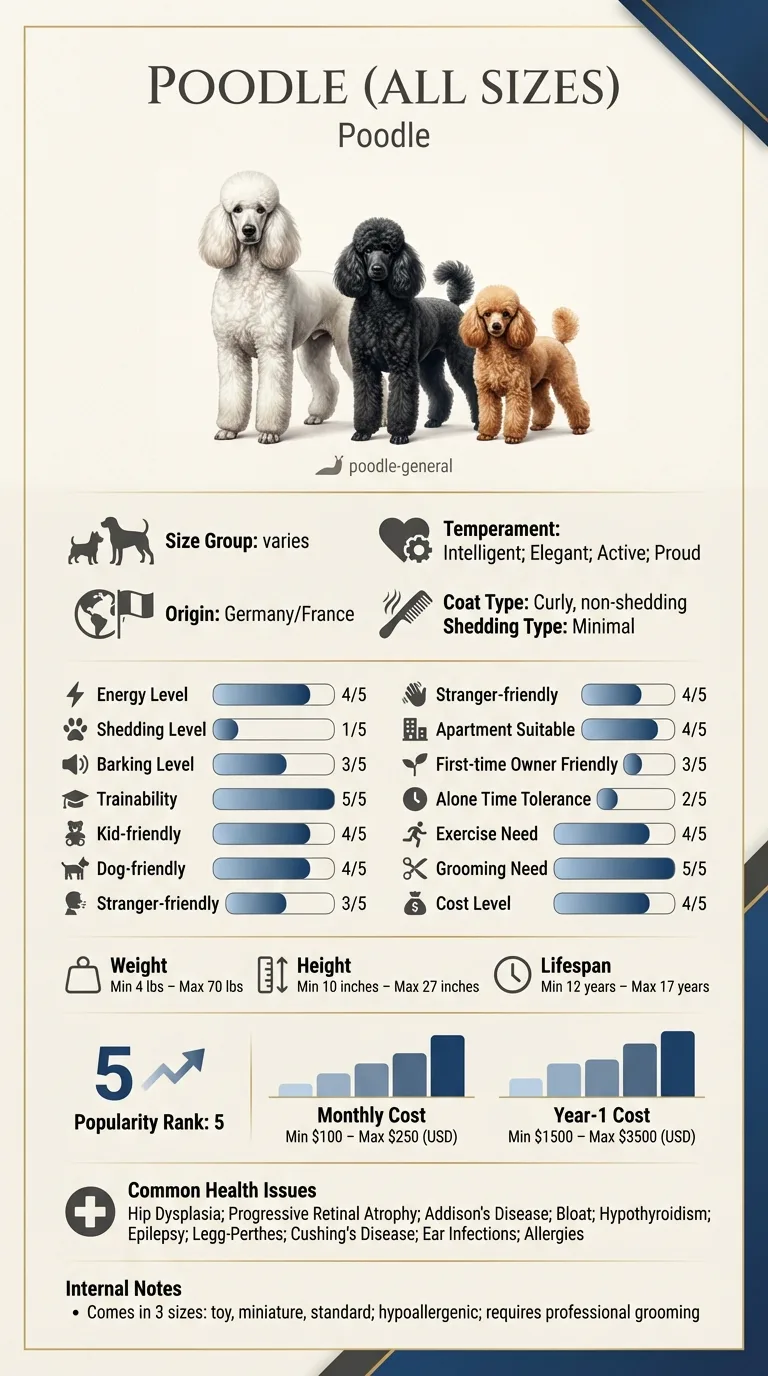
This is for someone already down to German Wirehaired Pointer and Poodle (All Sizes) and deciding between them. For this pair the decision usually turns on apartment suitability and grooming need, so those are covered first and in most detail. Anyone choosing from a flat has a clear answer here: Poodle (All Sizes) rates 4/5 against 1/5. Breed history is left out; what follows is what you will actually live with.
Between German Wirehaired Pointer and Poodle (All Sizes), apartment suitability is what separates them, and Poodle (All Sizes) is the lower-effort dog of the two to keep.
Choose German Wirehaired Pointer if you do not want a standing grooming appointment and you want a dog that can keep up with an active routine.
Choose Poodle (All Sizes) if you are in a flat or a smaller home, this is your first dog and shedding is a problem in your house.
| Feature | german wirehaired pointer | poodle general | Winner |
|---|---|---|---|
| Size class | large | varies | Equal |
| Weight | 60–70 lbs | 4–70 lbs | Equal |
| Height | 22–26 in | 10–27 in | Equal |
| Lifespan | 12–14 years | 12–17 years | poodle general |
| Exercise need | Very high (5/5) | High (4/5) | poodle general |
| Grooming need | Moderate (3/5) | Very high (5/5) | german wirehaired pointer |
| Shedding | Moderate (3/5) | Very low (1/5) | poodle general |
| Energy level | Very high (5/5) | High (4/5) | Equal |
| Barking | Moderate (3/5) | Moderate (3/5) | Equal |
| Apartment suitability | Very low (1/5) | High (4/5) | poodle general |
| Good for first-time owners | Low (2/5) | Moderate (3/5) | poodle general |
| Tolerates being alone | Low (2/5) | Low (2/5) | Equal |
| Trainability | High (4/5) | Very high (5/5) | poodle general |
| Good with kids | High (4/5) | High (4/5) | Equal |
| Good with other dogs | Moderate (3/5) | High (4/5) | poodle general |
| Friendly to strangers | Moderate (3/5) | Moderate (3/5) | Equal |
| Cost level | Moderate (3/5) | High (4/5) | german wirehaired pointer |
| Coat | Wiry, weather-resistant | Curly, non-shedding | Equal |
| Origin | Germany | Germany/France | Equal |
| Typical monthly cost | $110–$220 | $100–$250 | Equal |
| Typical first-year cost | $1,700–$3,000 | $1,500–$3,500 | Equal |
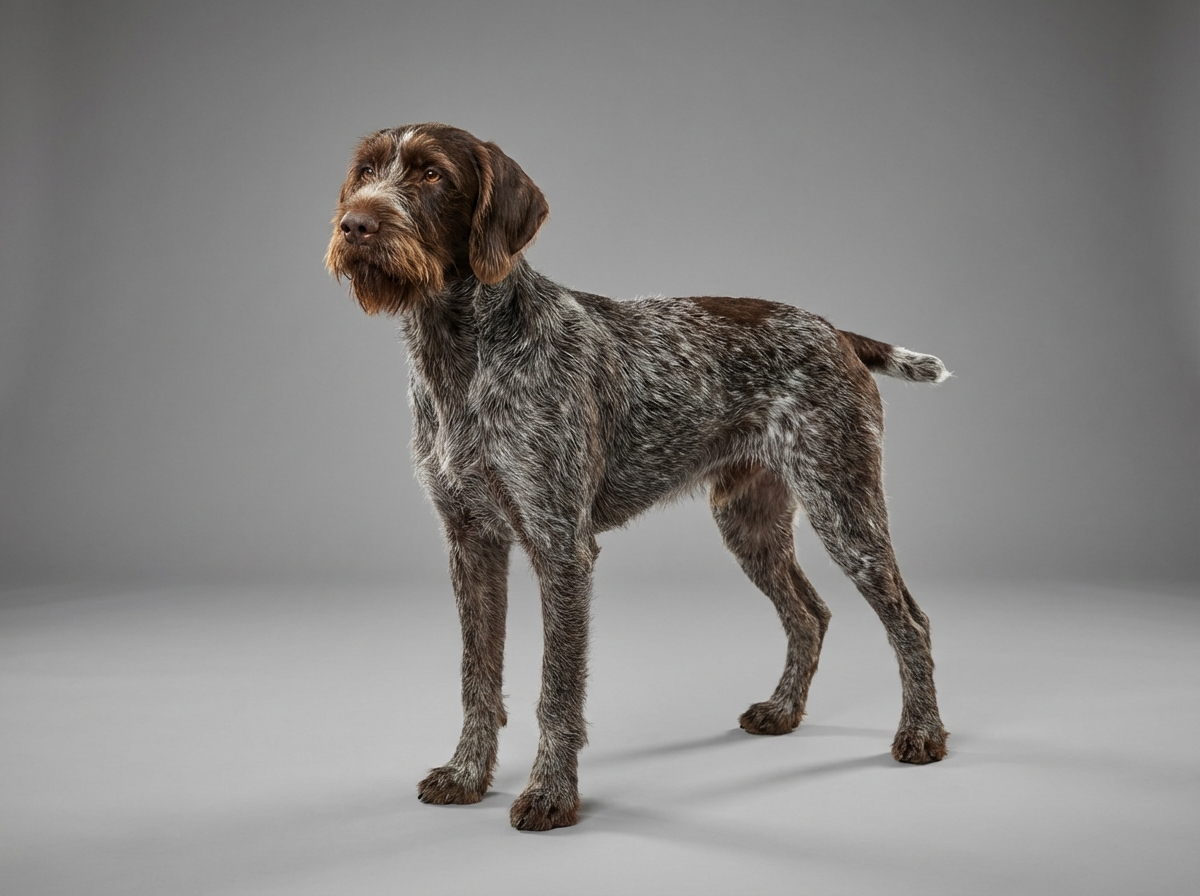
Unlike the single-entry Poodle record, this comparison covers Poodles of all sizes -- Toy, Miniature and Standard -- spanning 4-70 pounds and 10-27 inches, against the GWP's consistent 60-70 pound, 22-26 inch frame. That means a Standard Poodle at the top of the range sits close to the GWP in size, while a Toy Poodle at the bottom is a small fraction of it -- size class itself is simply listed as "varies." Both share curly-versus-wiry coat textures suited to very different purposes: the Poodle's curly, non-shedding coat for water retrieving, the GWP's wiry coat for upland fieldwork in rough cover.
Exercise need favors the GWP by a narrow margin, Very high (5/5) against the Poodle's High (4/5), and energy level ties at essentially the same elevated range for both. This is a genuinely close pairing on activity level -- Poodles across all sizes are more athletic than their elegant reputation suggests, historically bred as capable retrievers. A GWP still edges out as needing marginally more sustained exercise, particularly at the Standard Poodle's upper size range where energy expectations run highest. Owners choosing between them for an active lifestyle will find either breed a reasonably strong match, with the GWP holding only a slight edge in raw exercise demand.
Grooming need clearly favors the GWP, Moderate (3/5) against the Poodle's Very high (5/5) -- that curly coat needs professional clipping every few weeks across all Poodle sizes to prevent painful matting. Shedding flips the advantage to the Poodle, though: Very low (1/5) against the GWP's Moderate (3/5), since the Poodle's coat behaves more like hair than fur and rarely sheds around the house. This is a genuine tradeoff rather than a clear winner: the Poodle demands far more grooming-appointment time and expense, while the GWP demands more tolerance for loose hair on furniture and clothing.
Apartment suitability favors the Poodle, High (4/5) against the GWP's Very low (1/5) -- thanks to the size flexibility across Toy, Miniature and Standard varieties, a Poodle can be matched to almost any living space. Barking ties at Moderate (3/5) for both breeds, so neither stands out as notably quiet or vocal. Tolerating time alone also ties, both rated Low (2/5), meaning separation anxiety is a real concern for either breed regardless of the apartment-suitability gap. A Poodle-friendly household in a smaller space should still plan for enrichment and companionship during work hours, just as a GWP household would.
Trainability favors the Poodle, Very high (5/5) against the GWP's High (4/5), and first-time-owner suitability follows the same pattern, Moderate (3/5) versus Low (2/5). Poodles are consistently ranked among the most trainable breeds in the world, and their intelligent, elegant, active, proud temperament reflects a dog that thrives on mental engagement as much as physical exercise. The GWP's energetic, versatile nature makes it plenty trainable too -- High (4/5) is a strong score -- but its Very high exercise requirement remains the bigger hurdle for a first-time owner than any deficit in learning capacity.
Good with kids ties at High (4/5) for both breeds, and friendly to strangers ties at Moderate (3/5) as well, making this a closely matched pairing on family fit. Good with other dogs favors the Poodle, High (4/5) against the GWP's Moderate (3/5). Both temperament lists lean toward alert, active dispositions -- energetic, intelligent, alert, versatile for the GWP and intelligent, elegant, active, proud for the Poodle -- suggesting neither breed is a passive household presence. Families weighing multi-dog households specifically may find the Poodle the marginally easier addition, given its stronger compatibility rating with other dogs.
The Poodle holds a clear lifespan edge, 12-17 years against the GWP's 12-14, with smaller Poodle varieties often living toward the top of that range. Health lists overlap substantially: both share hip dysplasia, progressive retinal atrophy, bloat, hypothyroidism, epilepsy, ear infections and allergies. The Poodle's list adds Addison's disease, Legg-Perthes, and Cushing's disease, while the GWP's adds elbow dysplasia, entropion and heart issues. That's a genuinely overlapping risk profile for two otherwise very different-looking breeds, meaning routine screening for joint, thyroid, and eye conditions is worthwhile for either dog rather than one clearly outranking the other on health.
Cost level favors the GWP, Moderate (3/5) against the Poodle's High (4/5), though the dollar ranges land close: $100-250 monthly and $1,500-3,500 first-year for the Poodle versus $110-220 monthly and $1,700-3,000 for the GWP. The Poodle's higher cost rating almost certainly reflects its Very high grooming need -- professional clipping every few weeks adds up steadily across a year regardless of which size variety you choose. The GWP's costs concentrate more in food volume and field-related gear. Anyone comparing total cost of ownership should weight grooming frequency heavily for the Poodle rather than relying on the modest sticker-price gap alone.
German Wirehaired Pointer weighs 60–70 lbs and lives 12–14 years; Poodle (All Sizes) weighs 4–70 lbs and lives 12–17 years. The two diverge most on apartment suitability, grooming need and shedding. They are level on tolerates being alone, barking and good with kids, so those cannot decide it. The comparison marks an easier option only where one exists. Facts like weight and country of origin are not scored. Both dogs are rated from the same dataset, which is what makes the numbers comparable with each other even though any individual dog sits somewhere inside its breed's range.

The Poodle, rated Very low (1/5) shedding versus the GWP's Moderate (3/5) -- its curly coat behaves more like hair than fur.
The Poodle, rated Very high (5/5) versus the GWP's High (4/5) -- Poodles rank among the most trainable breeds worldwide.
The Poodle, rated High (4/5) apartment suitability versus the GWP's Very low (1/5), thanks to its size flexibility from Toy to Standard.
Yes, substantially -- both list hip dysplasia, progressive retinal atrophy, bloat, hypothyroidism, epilepsy, ear infections and allergies.
The Poodle, at 12-17 years versus the GWP's 12-14 years.
The GWP, rated Very high (5/5) versus the Poodle's High (4/5), though it's a narrow gap.
The Poodle, rated High (4/5) cost level versus the GWP's Moderate (3/5), largely driven by its Very high grooming needs.
The Poodle, rated Very low (1/5) versus the GWP's Moderate (3/5).
The Poodle, rated Very high (5/5) versus the GWP's High (4/5).
The Poodle, at 12-17 years versus the GWP's 12-14 years.
The Poodle, rated Very high (5/5) versus the GWP's Moderate (3/5).
Secure checkout on Stripe. We never see your card.
7-day money-back guarantee. Instant access.
Health information here is general and is not veterinary advice. If your dog shows pain, sudden behaviour change, or worsening symptoms, consult a licensed veterinarian.
Some links on this site are affiliate links. We may earn a commission at no extra cost to you, and we only suggest products we believe are helpful for dog owners.
We research and check what we publish, but we do not warrant that any figure, date, price, or statement is accurate, complete, or current, and we accept no liability for any loss, cost, injury, or other harm arising from the use of this site. Use it as one reference among several. You remain responsible for your own decisions and for your dog's care - confirm anything that matters with a licensed veterinarian or another qualified professional before you act on it. Full disclaimer.
Match your lifestyle to the right dog.
Take quizNot sure which breed is right for you? Take our 2-minute quiz to find out.
Take the quiz