Living
Which should you pick overall?
The Frenchie for low-exercise, apartment-friendly living; the Welsh Springer if you're active outdoors and want a working gun-dog temperament.

Quick answer
Which should you pick overall?
The Frenchie for low-exercise, apartment-friendly living; the Welsh Springer if you're active outdoors and want a working gun-dog temperament.
French Bulldog or Welsh Springer Spaniel? On paper they differ most on apartment suitability, and on the scales Welsh Springer Spaniel is the heavier at 35–55 lbs. Here is how the two compare on everything that shapes an ordinary week.
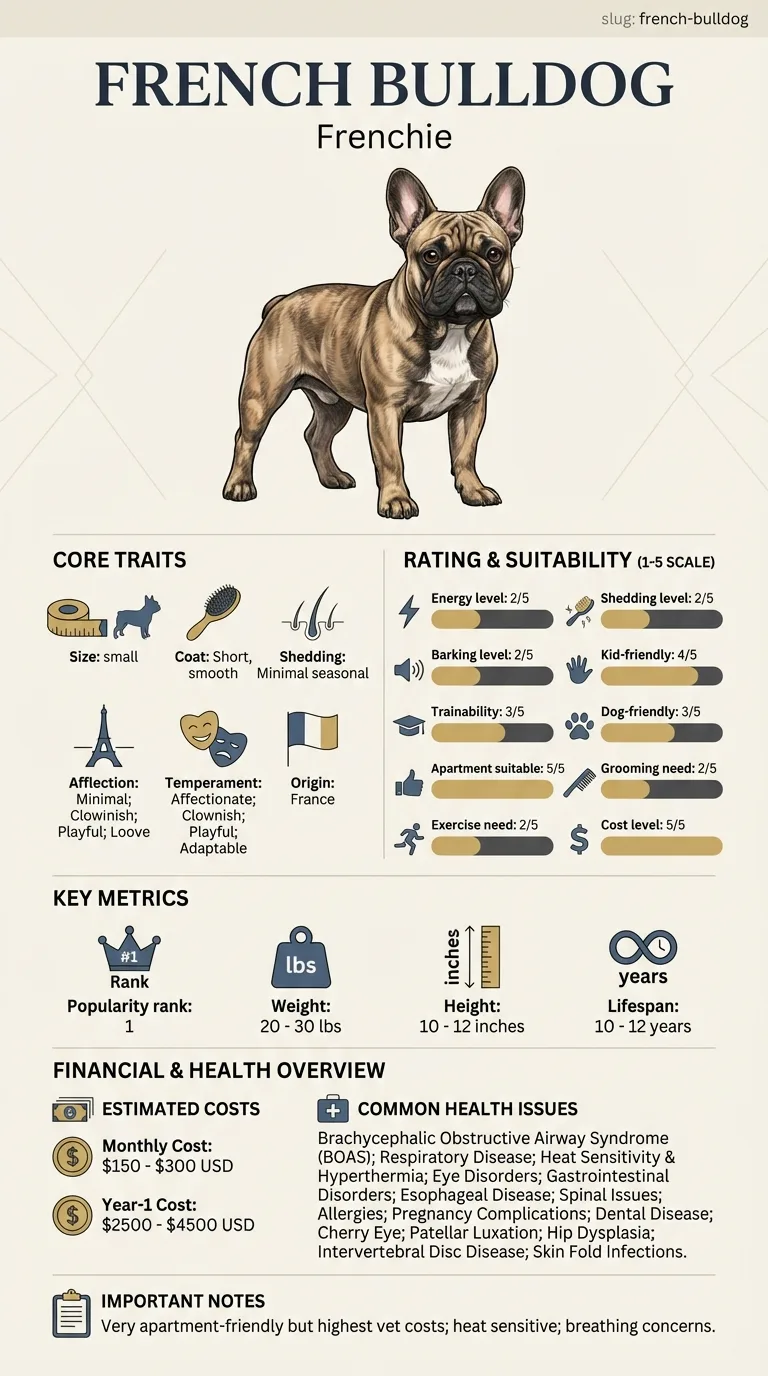
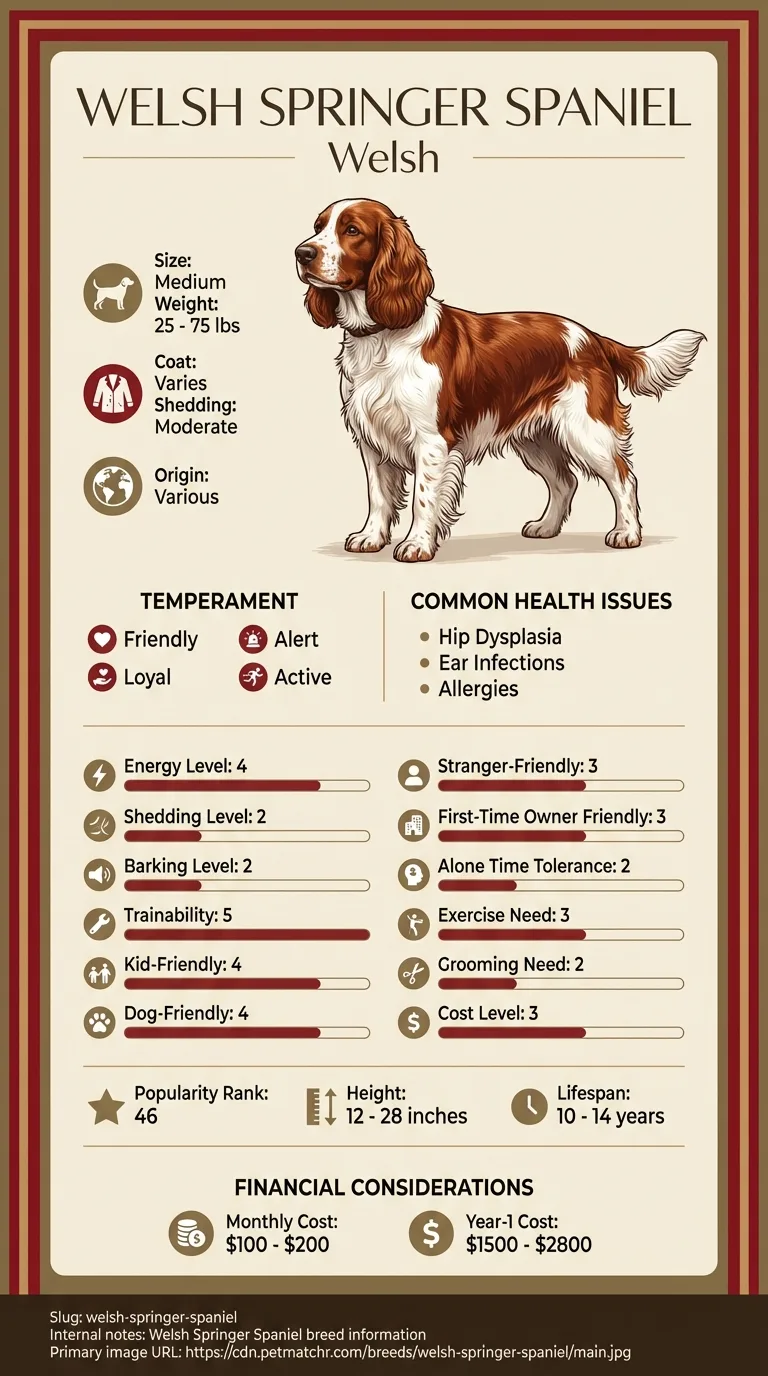
This is for someone already down to French Bulldog and Welsh Springer Spaniel and deciding between them. For this pair the decision usually turns on apartment suitability and tolerates being alone, so those are covered first and in most detail. Anyone choosing from a flat has a clear answer here: French Bulldog rates 5/5 against 2/5. Breed history is left out; what follows is what you will actually live with.
Between French Bulldog and Welsh Springer Spaniel, apartment suitability is what separates them, and French Bulldog is the lower-effort dog of the two to keep.
Choose French Bulldog if you are in a flat or a smaller home, this is your first dog and you do not want a standing grooming appointment.
Choose Welsh Springer Spaniel if you already have another dog, you want a dog that picks up training quickly and you want a dog that can keep up with an active routine.
| Feature | french bulldog | welsh springer spaniel | Winner |
|---|---|---|---|
| Size class | small | medium | Equal |
| Weight | 20–30 lbs | 35–55 lbs | Equal |
| Height | 10–12 in | 17–19 in | Equal |
| Lifespan | 10–12 years | 12–15 years | welsh springer spaniel |
| Exercise need | Low (2/5) | High (4/5) | french bulldog |
| Grooming need | Low (2/5) | Moderate (3/5) | french bulldog |
| Shedding | Low (2/5) | Moderate (3/5) | french bulldog |
| Energy level | Low (2/5) | High (4/5) | Equal |
| Barking | Low (2/5) | Moderate (3/5) | french bulldog |
| Apartment suitability | Very high (5/5) | Low (2/5) | french bulldog |
| Good for first-time owners | Very high (5/5) | Moderate (3/5) | french bulldog |
| Tolerates being alone | Very high (5/5) | Low (2/5) | french bulldog |
| Trainability | Moderate (3/5) | High (4/5) | welsh springer spaniel |
| Good with kids | High (4/5) | High (4/5) | Equal |
| Good with other dogs | Moderate (3/5) | High (4/5) | welsh springer spaniel |
| Friendly to strangers | Moderate (3/5) | Moderate (3/5) | Equal |
| Cost level | Very high (5/5) | Moderate (3/5) | welsh springer spaniel |
| Coat | Short, smooth | Medium, straight and water-resistant | Equal |
| Origin | France | Various | Equal |
| Typical monthly cost | $150–$300 | $100–$200 | Equal |
| Typical first-year cost | $2,500–$4,500 | $1,400–$2,900 | Equal |
A 35-55 lb Welsh Springer Spaniel splits the difference between compact and large, landing solidly in medium territory the Frenchie never visits. Standing 17-19 in against the Frenchie's 10-12 in, it's built as a working gun dog — leaner and longer-legged, suited to covering ground in the field rather than lounging on a couch. That build translates to real stamina in the field, which is exactly the point of the breed and exactly what a Frenchie's compact frame was never designed for.
The Welsh Springer rates high (4/5) for exercise need against the Frenchie's low (2/5), with a matching high (4/5) energy level. As a gun dog bred to work all day in the field, it wants real daily activity — a fenced yard to putter in isn't quite the same as the structured exercise it actually needs. A long daily walk plus some off-leash time to run is closer to the minimum than the maximum for keeping this breed content.
Grooming need is low (2/5) for the Frenchie against moderate (3/5) for the Welsh Springer, whose medium, water-resistant coat needs regular brushing to stay tangle-free. Shedding follows the same pattern — low (2/5) versus moderate (3/5) — a manageable but noticeably higher hair load than the Frenchie's. A weekly brushing session, with more attention to the feathering on the legs and ears, keeps a Welsh Springer's coat from matting between grooming appointments.
Barking favors the Frenchie, low (2/5) against moderate (3/5) for the Welsh Springer. Apartment suitability is 5/5 for the Frenchie against a low 2/5 for the Springer — its exercise needs make small spaces a poor fit. Alone tolerance follows the same direction, 5/5 versus a low 2/5, worth noting given the breed's description as reserved with strangers, which can compound isolation stress. A dog walker or midday check-in makes a real difference here if your workday runs long, more so than it would for a Frenchie.
First-time-owner suitability favors the Frenchie, 5/5 against the Welsh Springer's moderate 3/5. Trainability runs the other way — high (4/5) for the Springer against moderate (3/5) for the Frenchie. It's a genuinely capable working dog to train, provided its exercise needs are being met alongside the training itself. Gun dog training methods, built around structure and repetition, tend to suit this breed particularly well if you're up for that kind of consistent routine.
Kids tie at high (4/5) for both. The Welsh Springer edges ahead with other dogs, high (4/5) against the Frenchie's moderate (3/5), but ties at moderate (3/5) for strangers — worth flagging given its temperament is specifically described as reserved with strangers, a trait numerically invisible here but relevant if you entertain often. Early, consistent socialization with visitors can soften that reserve considerably, but it's a trait to plan for rather than assume away based on the numeric score alone.
The Welsh Springer's 12-15 year lifespan beats the Frenchie's 10-12 by up to five years. Its five-item health list is the shortest in this entire batch and notably cancer-free among the conditions listed: hip dysplasia, ear infections, epilepsy, glaucoma, and hypothyroidism. The Frenchie's fifteen-item list, by contrast, is heavily weighted toward its flat face and spine. No conditions overlap between the two.
The Welsh Springer is cheaper to keep: $100-200 monthly and $1,400-2,900 in year one, against the Frenchie's $150-300 and $2,500-4,500. Cost level reflects it directly — moderate (3/5) for the Springer, very high (5/5) for the Frenchie. That gap is driven almost entirely by the Frenchie's higher ongoing vet costs, since the Welsh Springer's short health list translates to fewer expensive surprises over its lifetime.
French Bulldog weighs 20–30 lbs and lives 10–12 years; Welsh Springer Spaniel weighs 35–55 lbs and lives 12–15 years. The two diverge most on apartment suitability, tolerates being alone and exercise need and 3 other rated axes. They are level on good with kids and friendly to strangers, so those cannot decide it. The comparison marks an easier option only where one exists. Facts like weight and country of origin are not scored. Both dogs are rated from the same dataset, which is what makes the numbers comparable with each other even though any individual dog sits somewhere inside its breed's range.

35-55 lbs and 17-19 in tall — solidly medium-sized, well above the Frenchie's 20-30 lbs and 10-12 in.
It ties with the Frenchie at a moderate 3/5 numerically, but its temperament is specifically described as reserved with strangers — worth knowing if you host guests often, since the number alone doesn't fully capture that trait.
The Frenchie, low (2/5) against moderate (3/5) for the Welsh Springer, whose medium, water-resistant coat sheds a bit more.
Not especially — a low 2/5 rating against the Frenchie's 5/5, driven mostly by its higher exercise needs.
The Welsh Springer, at $1,400-2,900 in year one against the Frenchie's $2,500-4,500.
No overlap. The Welsh Springer's five-item list — hip dysplasia, ear infections, epilepsy, glaucoma, hypothyroidism — is the shortest and only list in this batch with no cancer-related condition listed at all.
The Welsh Springer, at 12-15 years against the Frenchie's 10-12.
The Frenchie for low-exercise, apartment-friendly living; the Welsh Springer if you're active outdoors and want a working gun-dog temperament.
The Welsh Springer is cheaper at $100-200 versus the Frenchie's $150-300.
The Welsh Springer, rated high (4/5) need against the Frenchie's low (2/5).
The Welsh Springer, typically 12-15 years against the Frenchie's 10-12.
Secure checkout on Stripe. We never see your card.
7-day money-back guarantee. Instant access.

Health information here is general and is not veterinary advice. If your dog shows pain, sudden behaviour change, or worsening symptoms, consult a licensed veterinarian.
Some links on this site are affiliate links. We may earn a commission at no extra cost to you, and we only suggest products we believe are helpful for dog owners.
We research and check what we publish, but we do not warrant that any figure, date, price, or statement is accurate, complete, or current, and we accept no liability for any loss, cost, injury, or other harm arising from the use of this site. Use it as one reference among several. You remain responsible for your own decisions and for your dog's care - confirm anything that matters with a licensed veterinarian or another qualified professional before you act on it. Full disclaimer.
Match your lifestyle to the right dog.
Take quizNot sure which breed is right for you? Take our 2-minute quiz to find out.
Take the quiz