Behavior
Springer or Shiba Inu - which should you pick?
Pick the Springer if you want a biddable dog that's easy to train and great with kids and other dogs; pick the Shiba if you're in an apartment and want a lower-exercise, more independent dog.

Quick answer
Springer or Shiba Inu - which should you pick?
Pick the Springer if you want a biddable dog that's easy to train and great with kids and other dogs; pick the Shiba if you're in an apartment and want a lower-exercise, more independent dog.
English Springer Spaniel or Shiba Inu? On paper they differ most on trainability, and on the scales English Springer Spaniel is the heavier at 40–50 lbs. Here is how the two compare on everything that shapes an ordinary week.
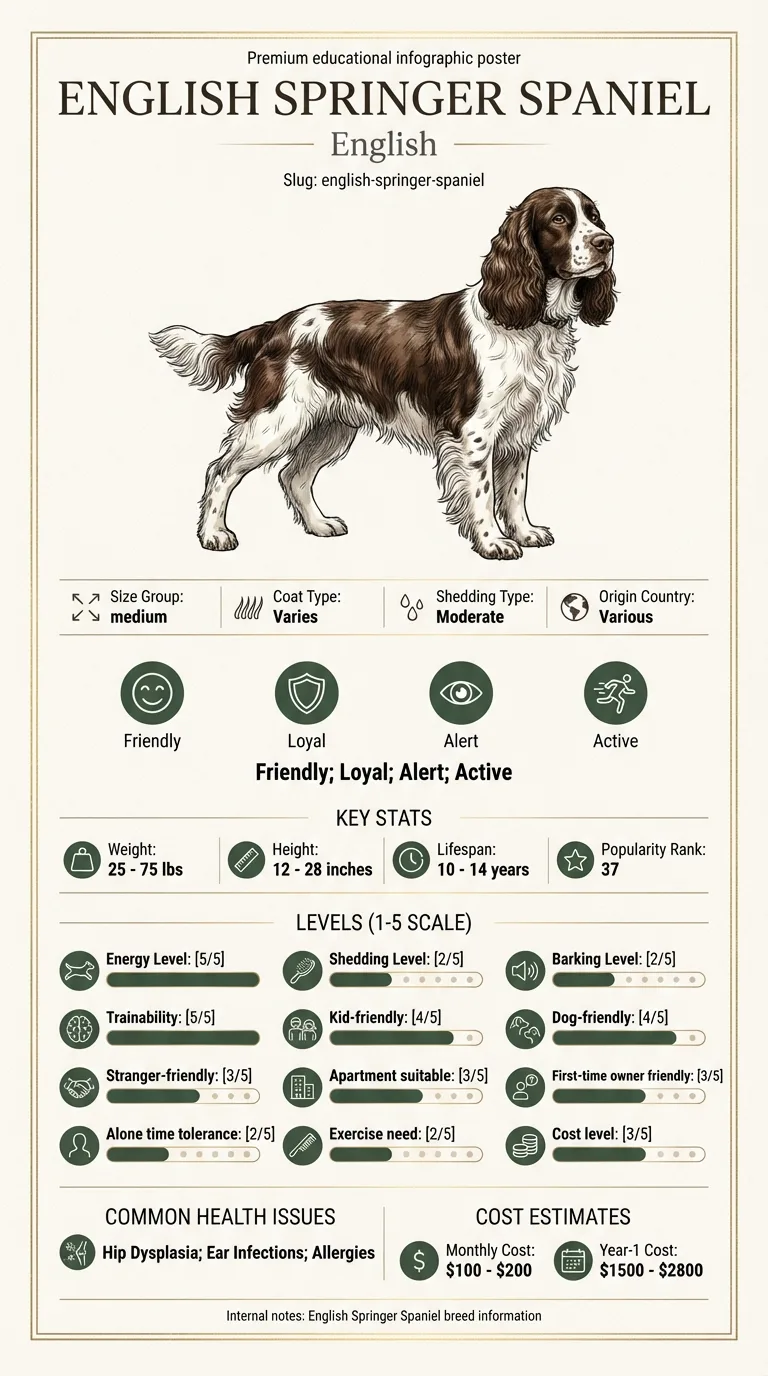
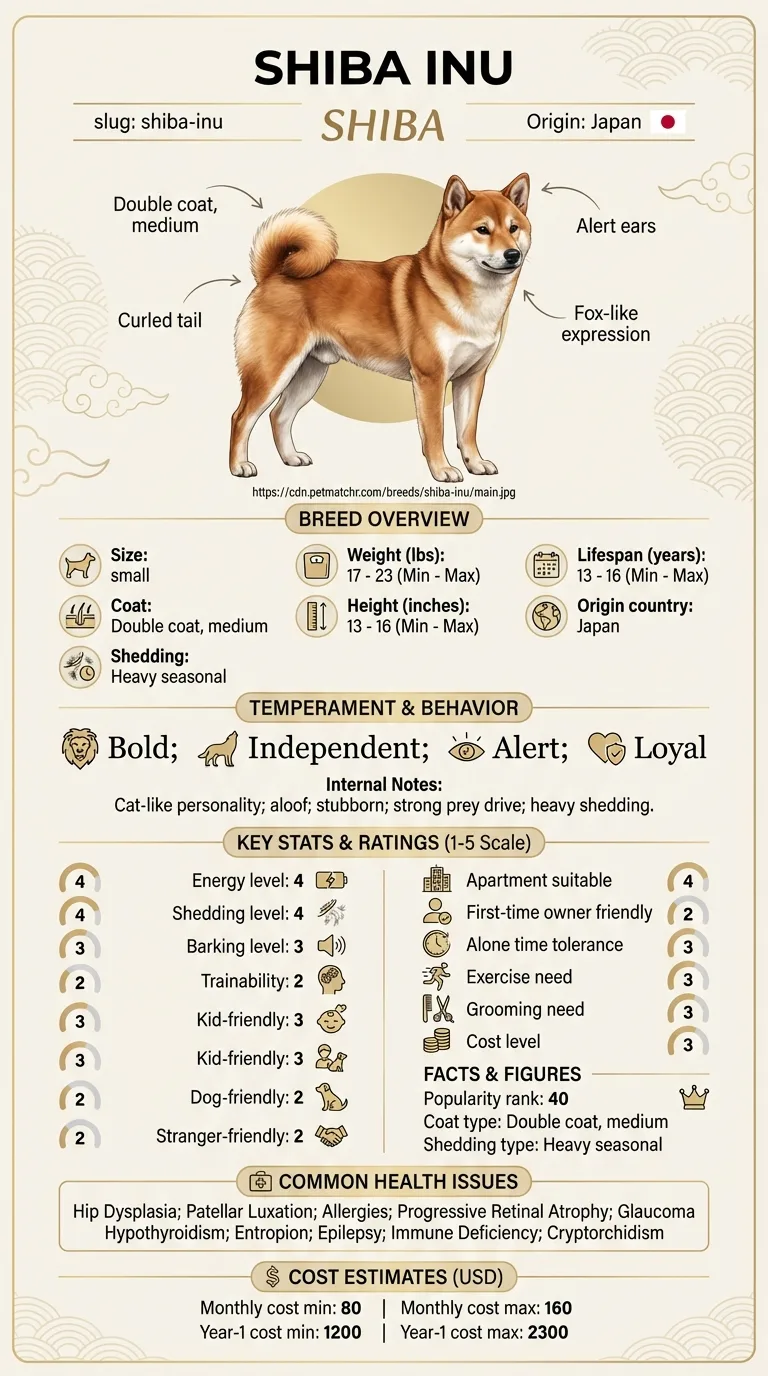
This is for someone already down to English Springer Spaniel and Shiba Inu and deciding between them. For this pair the decision usually turns on trainability and exercise need, so those are covered first and in most detail. Anyone choosing from a flat has a clear answer here: Shiba Inu rates 4/5 against 2/5. There is no origin story here — only what changes about your week.
Between English Springer Spaniel and Shiba Inu, trainability is what separates them, and Shiba Inu is the lower-effort dog of the two to keep.
Choose English Springer Spaniel if this is your first dog, shedding is a problem in your house and there are young children at home.
Choose Shiba Inu if you are in a flat or a smaller home, you do not want a standing grooming appointment and your walking routine is modest.
| Feature | english springer spaniel | shiba inu | Winner |
|---|---|---|---|
| Size class | medium | small | Equal |
| Weight | 40–50 lbs | 17–23 lbs | Equal |
| Height | 19–20 in | 13–16 in | Equal |
| Lifespan | 12–14 years | 13–16 years | shiba inu |
| Exercise need | Very high (5/5) | Moderate (3/5) | shiba inu |
| Grooming need | High (4/5) | Moderate (3/5) | shiba inu |
| Shedding | Moderate (3/5) | High (4/5) | english springer spaniel |
| Energy level | Very high (5/5) | High (4/5) | Equal |
| Barking | Moderate (3/5) | Moderate (3/5) | Equal |
| Apartment suitability | Low (2/5) | High (4/5) | shiba inu |
| Good for first-time owners | Moderate (3/5) | Low (2/5) | english springer spaniel |
| Tolerates being alone | Low (2/5) | Moderate (3/5) | shiba inu |
| Trainability | Very high (5/5) | Low (2/5) | english springer spaniel |
| Good with kids | Very high (5/5) | Moderate (3/5) | english springer spaniel |
| Good with other dogs | High (4/5) | Low (2/5) | english springer spaniel |
| Friendly to strangers | High (4/5) | Low (2/5) | english springer spaniel |
| Cost level | Moderate (3/5) | Moderate (3/5) | Equal |
| Coat | Medium, feathered double coat | Double coat, medium | Equal |
| Origin | Various | Japan | Equal |
| Typical monthly cost | $100–$200 | $80–$160 | Equal |
| Typical first-year cost | $1,400–$2,900 | $1,200–$2,300 | Equal |
The Springer roughly doubles the Shiba's weight - 40-50 lbs against 17-23 lbs - and stands several inches taller at the shoulder, 19-20 inches versus 13-16. Both breeds carry a double coat and a sturdy, athletic build for their size class, but the Springer's larger frame means more strength needed on leash and more room needed to stretch out indoors. The Shiba's compact size fits smaller homes, smaller cars, and smaller food budgets without much adjustment.
The Springer rates 5/5 on exercise need against the Shiba's 3/5, and that gap shows up every single day - the Springer wants a serious run or field time, while the Shiba is content with a solid walk and some yard time to burn off its 4/5 energy level. Both score high on general energy, so neither is a couch dog by any stretch, but the Springer needs the harder physical outlet to stay settled indoors afterward.
Springer grooming sits higher at 4/5 versus the Shiba's 3/5, driven by a feathered coat around the ears, legs, and chest that mats if it isn't brushed regularly. Shedding flips the other way, though - the Shiba sheds more at 4/5 against the Springer's 3/5, blowing its dense double coat seasonally in a way that can carpet a floor in fur for a week or two each spring and fall.
Apartment suitability favors the Shiba clearly, 4/5 against the Springer's 2/5, and alone tolerance follows the same pattern, 3/5 versus 2/5. Barking is a wash at moderate for both, so don't expect either breed to be silent through the day. If you're in a small unit without a yard and long stretches away from home, the Shiba's numbers fit that life considerably better than the Springer's do.
This is the widest gap in the whole comparison - Springer trainability sits at 5/5, the Shiba's at just 2/5. Shiba Inus are famously independent thinkers, and food or praise only motivates so much cooperation from a dog that wasn't bred to take orders from anyone. First-time owners get a somewhat better score with the Springer, 3/5 against 2/5, largely a direct consequence of this trainability gap rather than any difference in size or energy.
The Springer wins every social category here - good with kids at 5/5 versus 3/5, good with other dogs at 4/5 versus 2/5, and friendly to strangers at 4/5 versus 2/5. The Shiba's own temperament list of bold, independent, alert, and loyal explains those numbers well: it bonds tightly with its own household but doesn't extend that warmth automatically to visiting kids, unfamiliar dogs, or strangers at the door.
The Shiba is expected to outlive the Springer by one to three years on average, 13-16 versus 12-14, but it carries a longer documented list of conditions - ten in total, including glaucoma, epilepsy, and immune deficiency, on top of the hip dysplasia and progressive retinal atrophy both breeds share. The Springer's shorter five-condition list still includes a breed-specific metabolic issue worth screening for. Neither list guarantees problems; both are worth raising with a vet.
Both breeds land at moderate cost, 3/5, and the dollar ranges sit close together - the Springer runs $100-200 a month against the Shiba's $80-160, with first-year totals of $1,400-2,900 versus $1,200-2,300. The Shiba's smaller size keeps food portions and most medication dosing a bit cheaper even though its grooming needs aren't dramatically lower than the Springer's, so the savings show up mostly in the feeding bill.
English Springer Spaniel weighs 40–50 lbs and lives 12–14 years; Shiba Inu weighs 17–23 lbs and lives 13–16 years. The two diverge most on trainability, exercise need and apartment suitability and 3 other rated axes. They are level on barking and cost level, so those cannot decide it. Where the table declares a winner it means less work for the owner, nothing more; descriptive rows are left as ties on purpose. The value here is in the differences between the two columns; treat any single score as approximate.

The Springer weighs 40-50 lbs and stands 19-20 inches; the Shiba weighs 17-23 lbs and stands 13-16 inches. That's roughly double the weight and several inches of height difference.
The Shiba, despite being the smaller dog - it rates 4/5 on shedding against the Springer's 3/5, thanks to a dense double coat that blows out seasonally.
The Springer scores 3/5 for first-time owners and the Shiba 2/5. Neither is a beginner's easiest option, but the Shiba's independence and low interest in obedience work makes it the harder of the two to start with.
The Shiba, by a clear margin - 4/5 on apartment suitability against the Springer's 2/5, plus better tolerance for being left alone (3/5 vs 2/5).
Close. The Springer runs $100-200 a month, the Shiba $80-160. First-year costs follow the same pattern: $1,400-2,900 versus $1,200-2,300.
Both breeds are listed for hip dysplasia and progressive retinal atrophy. The Shiba's list is longer overall, including glaucoma, epilepsy and hypothyroidism, but a longer list partly reflects more conditions tracked for the breed, not necessarily higher risk per condition.
The Springer, decisively - 5/5 on trainability against the Shiba's 2/5. Shiba Inus are bred to think independently, and that shows up at every stage of training.
Pick the Springer if you want a biddable dog that's easy to train and great with kids and other dogs; pick the Shiba if you're in an apartment and want a lower-exercise, more independent dog.
The Springer, at $100-200 versus the Shiba's $80-160 - close, but the Shiba's smaller size keeps costs a touch lower.
The Springer, rated 5/5 versus the Shiba's 3/5. It wants a hard daily outlet; the Shiba is satisfied with a solid walk.
The Shiba, typically 13-16 years against the Springer's 12-14.
Secure checkout on Stripe. We never see your card.
7-day money-back guarantee. Instant access.
Health information here is general and is not veterinary advice. If your dog shows pain, sudden behaviour change, or worsening symptoms, consult a licensed veterinarian.
Some links on this site are affiliate links. We may earn a commission at no extra cost to you, and we only suggest products we believe are helpful for dog owners.
We research and check what we publish, but we do not warrant that any figure, date, price, or statement is accurate, complete, or current, and we accept no liability for any loss, cost, injury, or other harm arising from the use of this site. Use it as one reference among several. You remain responsible for your own decisions and for your dog's care - confirm anything that matters with a licensed veterinarian or another qualified professional before you act on it. Full disclaimer.
Match your lifestyle to the right dog.
Take quizNot sure which breed is right for you? Take our 2-minute quiz to find out.
Take the quiz