Living
Which is the better overall choice?
The Schnauzer costs less and sheds almost nothing; the Bernedoodle is quieter and slightly easier for a first-time owner. It comes down to whether barking or grooming bothers you more.

Quick answer
Which is the better overall choice?
The Schnauzer costs less and sheds almost nothing; the Bernedoodle is quieter and slightly easier for a first-time owner. It comes down to whether barking or grooming bothers you more.
Bernedoodle or Schnauzer (Standard)? On paper they differ most on apartment suitability, and on the scales Bernedoodle is the heavier at 20–90 lbs. Here is how the two compare on everything that shapes an ordinary week.
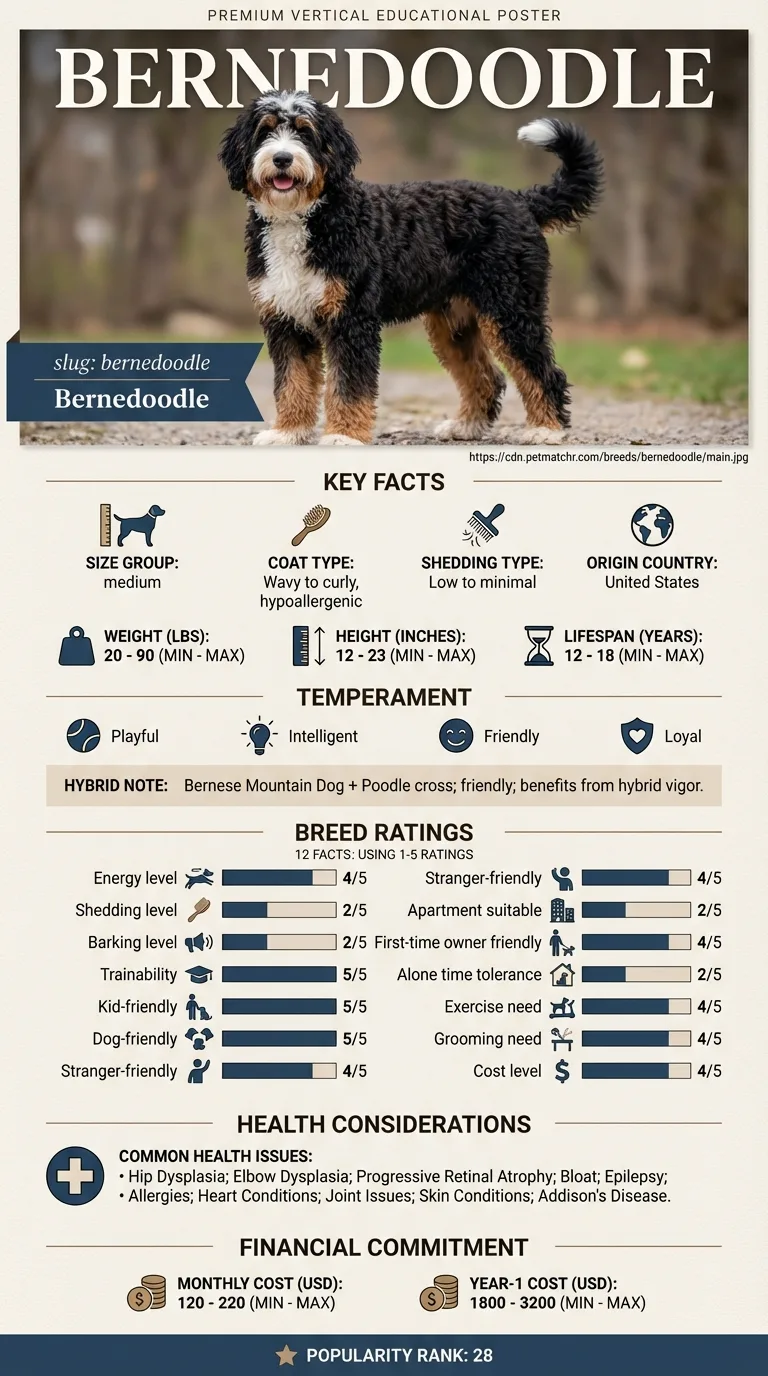
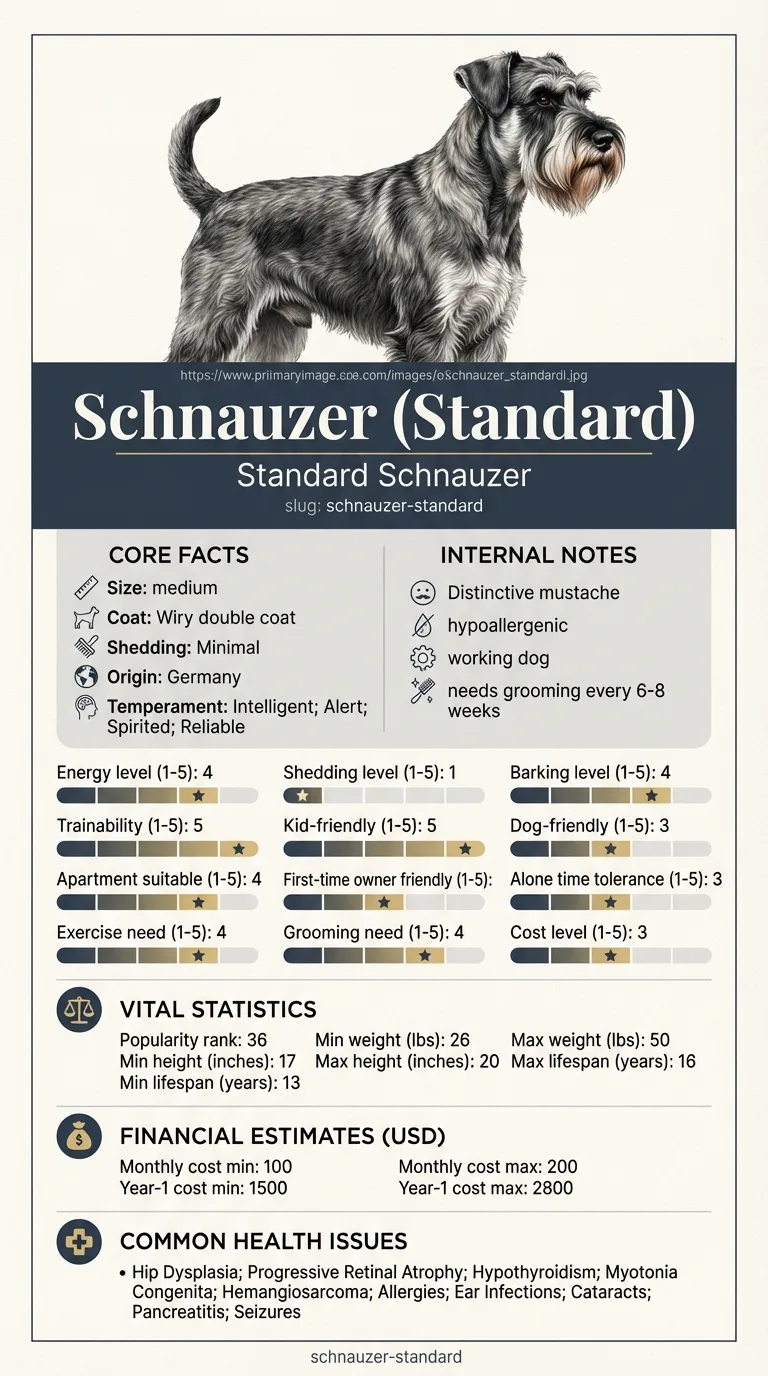
This is for someone already down to Bernedoodle and Schnauzer (Standard) and deciding between them. For this pair the decision usually turns on apartment suitability and barking, so those are covered first and in most detail. Anyone choosing from a flat has a clear answer here: Schnauzer (Standard) rates 4/5 against 2/5. The focus throughout is on daily consequences rather than breed background.
Between Bernedoodle and Schnauzer (Standard), apartment suitability is what separates them, and Schnauzer (Standard) is the lower-effort dog of the two to keep.
Choose Bernedoodle if this is your first dog and you already have another dog.
Choose Schnauzer (Standard) if you are in a flat or a smaller home, shedding is a problem in your house and the dog will be alone during the working day.
| Feature | bernedoodle | schnauzer standard | Winner |
|---|---|---|---|
| Size class | medium | medium | Equal |
| Weight | 20–90 lbs | 26–50 lbs | Equal |
| Height | 12–23 in | 17–20 in | Equal |
| Lifespan | 12–18 years | 13–16 years | bernedoodle |
| Exercise need | High (4/5) | High (4/5) | Equal |
| Grooming need | High (4/5) | High (4/5) | Equal |
| Shedding | Low (2/5) | Very low (1/5) | schnauzer standard |
| Energy level | High (4/5) | High (4/5) | Equal |
| Barking | Low (2/5) | High (4/5) | bernedoodle |
| Apartment suitability | Low (2/5) | High (4/5) | schnauzer standard |
| Good for first-time owners | High (4/5) | Moderate (3/5) | bernedoodle |
| Tolerates being alone | Low (2/5) | Moderate (3/5) | schnauzer standard |
| Trainability | Very high (5/5) | Very high (5/5) | Equal |
| Good with kids | Very high (5/5) | Very high (5/5) | Equal |
| Good with other dogs | Very high (5/5) | Moderate (3/5) | bernedoodle |
| Friendly to strangers | High (4/5) | Moderate (3/5) | bernedoodle |
| Cost level | High (4/5) | Moderate (3/5) | schnauzer standard |
| Coat | Wavy to curly, hypoallergenic | Wiry double coat | Equal |
| Origin | United States | Germany | Equal |
| Typical monthly cost | $120–$220 | $100–$200 | Equal |
| Typical first-year cost | $1,800–$3,200 | $1,500–$2,800 | Equal |
Both dogs sit in the medium size class, but the comparison stops being close once you look at the ranges: a Bernedoodle can weigh anywhere from 20 to 90 lbs depending on generation, while a Standard Schnauzer holds a tighter 26-50 lb band and stands 17-20 inches. If predictability matters more to you than the exact number, the Schnauzer is the safer bet.
Exercise needs match here — both breeds rate 4/5, so plan for a similar daily commitment whichever you choose. The Schnauzer tends to want a job — agility, tracking, or at minimum a demanding fetch session — more than free-form energy burn, while the Bernedoodle is happier with varied play and long walks.
Grooming needs are identical at 4/5, so neither dog saves you a trip to the groomer. Shedding is where the Schnauzer pulls ahead, rating a very low 1/5 against the Bernedoodle's already-low 2/5 — its wiry double coat, kept in trim, sheds close to nothing. Both coats need a professional clip every six to eight weeks to stay manageable, so factor that recurring cost into either choice.
The numbers here seem to contradict each other but don't: the Standard Schnauzer barks more (4/5 vs the Bernedoodle's 2/5) yet still rates better for apartment living (4/5 vs 2/5), because its smaller, tighter frame and moderate exercise needs fit compact spaces more easily than a Bernedoodle's size and energy do. If your neighbors are noise-sensitive, though, weigh that barking score seriously.
Trainability ties at the top of the scale, 5/5 for both, so neither breed will fight you on obedience work. The gap shows up in first-time-owner suitability instead — 4/5 for the Bernedoodle against a moderate 3/5 for the Schnauzer, whose alertness and independent streak can surprise an owner expecting a purely eager-to-please dog.
Both breeds are rated a full 5/5 with kids, so that's not a deciding factor. The Bernedoodle is friendlier across the board otherwise — 5/5 with other dogs versus the Schnauzer's moderate 3/5, and 4/5 with strangers against the Schnauzer's 3/5, which tracks with the Schnauzer's more watchful, alert-first temperament.
Lifespan is close by comparison to most pairings on this site — 12-18 years for the Bernedoodle against 13-16 for the Standard Schnauzer, both solid numbers for a medium dog. The Schnauzer's health list runs long, though: ten conditions including hemangiosarcoma and seizures alongside more routine issues like ear infections and pancreatitis, worth discussing with a breeder about family health history.
The Schnauzer is the cheaper dog to keep, rated a moderate 3/5 on cost against the Bernedoodle's high 4/5. Monthly spending runs $100-200 versus $120-220, and first-year costs land at $1,500-2,800 compared to $1,800-3,200 — a gap that adds up if budget is the deciding factor. Over a decade of ownership, that monthly difference alone can amount to thousands of dollars saved with the Schnauzer.
Bernedoodle weighs 20–90 lbs and lives 12–18 years; Schnauzer (Standard) weighs 26–50 lbs and lives 13–16 years. The two diverge most on apartment suitability, barking and good with other dogs. They are level on energy level, exercise need and grooming need, so those cannot decide it. The table below marks a winner only where one breed is genuinely easier for a typical owner; size and origin are facts rather than merits and stay level. Ratings come from one source applied to both breeds, so they are meaningful against each other rather than as absolute scores.

Roughly, though the Schnauzer is more consistent — 26-50 lbs and 17-20 inches, versus the Bernedoodle's wider 20-90 lb range depending on generation.
The Schnauzer, rated a very low 1/5 versus the Bernedoodle's 2/5, thanks to its wiry double coat.
Yes — it rates 4/5 for barking against the Bernedoodle's 2/5, and Standard Schnauzers are known for sounding an alarm at anything unfamiliar.
According to the ratings, yes — 4/5 for apartment suitability against the Bernedoodle's 2/5, largely due to its compact size and moderate space needs, though noise-sensitive buildings should weigh the barking score too.
The Schnauzer, at $100-200 monthly and $1,500-2,800 in year one, compared to the Bernedoodle's $120-220 and $1,800-3,200.
A long list — hip dysplasia, progressive retinal atrophy, hypothyroidism, myotonia congenita, hemangiosarcoma, allergies, ear infections, cataracts, pancreatitis, and seizures. Ask a breeder about family history on the more serious items.
The Bernedoodle, rated 4/5 versus the Schnauzer's moderate 3/5 — trainability ties at 5/5 for both, but the Schnauzer's alertness and independence take more handling experience.
The Schnauzer costs less and sheds almost nothing; the Bernedoodle is quieter and slightly easier for a first-time owner. It comes down to whether barking or grooming bothers you more.
$100-200 for the Schnauzer, $120-220 for the Bernedoodle.
The same — both rate 4/5, so budget for a real daily workout with either breed.
The ranges overlap, but the Bernedoodle's ceiling is higher — up to 18 years versus 16 for the Schnauzer.
Secure checkout on Stripe. We never see your card.
7-day money-back guarantee. Instant access.
Health information here is general and is not veterinary advice. If your dog shows pain, sudden behaviour change, or worsening symptoms, consult a licensed veterinarian.
Some links on this site are affiliate links. We may earn a commission at no extra cost to you, and we only suggest products we believe are helpful for dog owners.
We research and check what we publish, but we do not warrant that any figure, date, price, or statement is accurate, complete, or current, and we accept no liability for any loss, cost, injury, or other harm arising from the use of this site. Use it as one reference among several. You remain responsible for your own decisions and for your dog's care - confirm anything that matters with a licensed veterinarian or another qualified professional before you act on it. Full disclaimer.
Match your lifestyle to the right dog.
Take quizNot sure which breed is right for you? Take our 2-minute quiz to find out.
Take the quiz