Living
Which is the better overall pick?
The Bernedoodle is the more predictable, sociable choice across nearly every category; the mix's main strengths are calmer energy and better alone-tolerance.

Quick answer
Which is the better overall pick?
The Bernedoodle is the more predictable, sociable choice across nearly every category; the mix's main strengths are calmer energy and better alone-tolerance.
Bernedoodle or Rottweiler Mix? On paper they differ most on good with other dogs, and on the scales Rottweiler Mix is the heavier at 80–135 lbs. Here is how the two compare on everything that shapes an ordinary week.
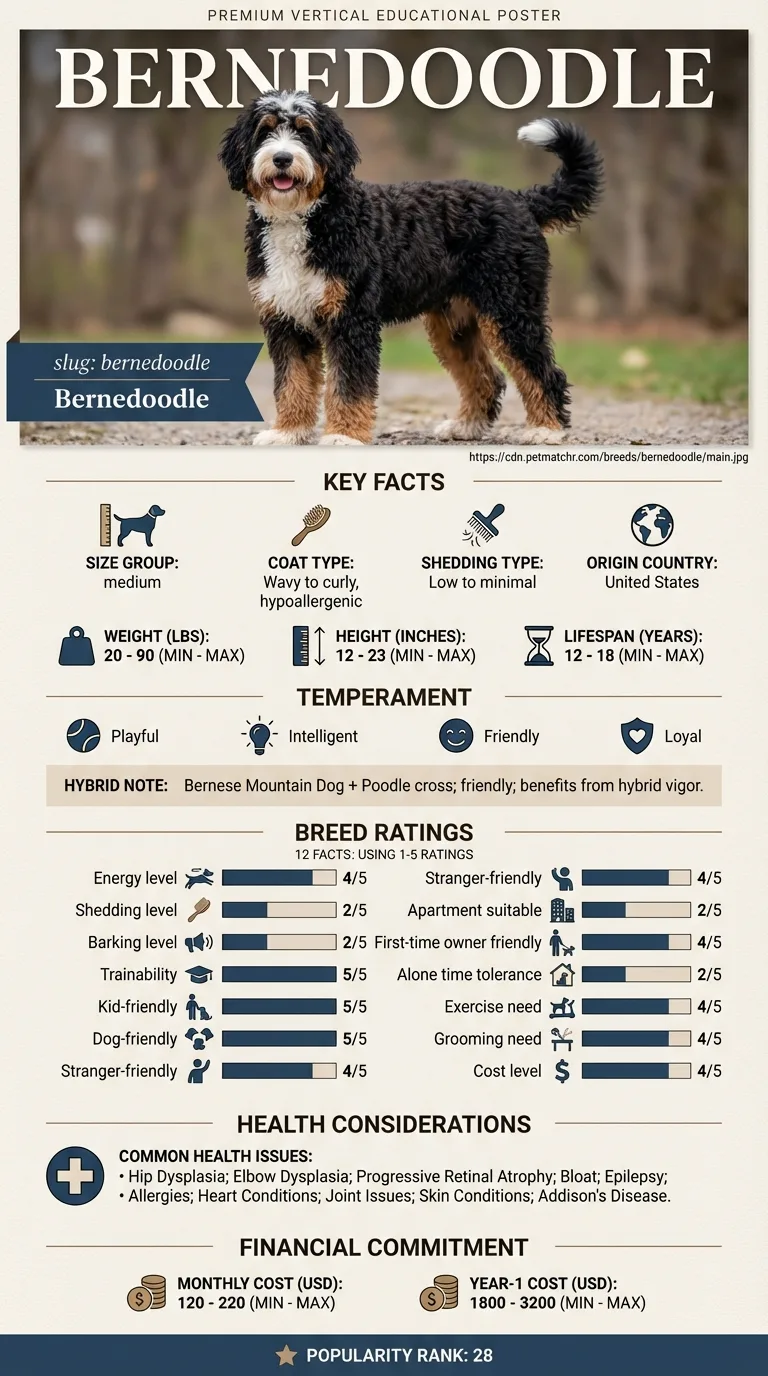
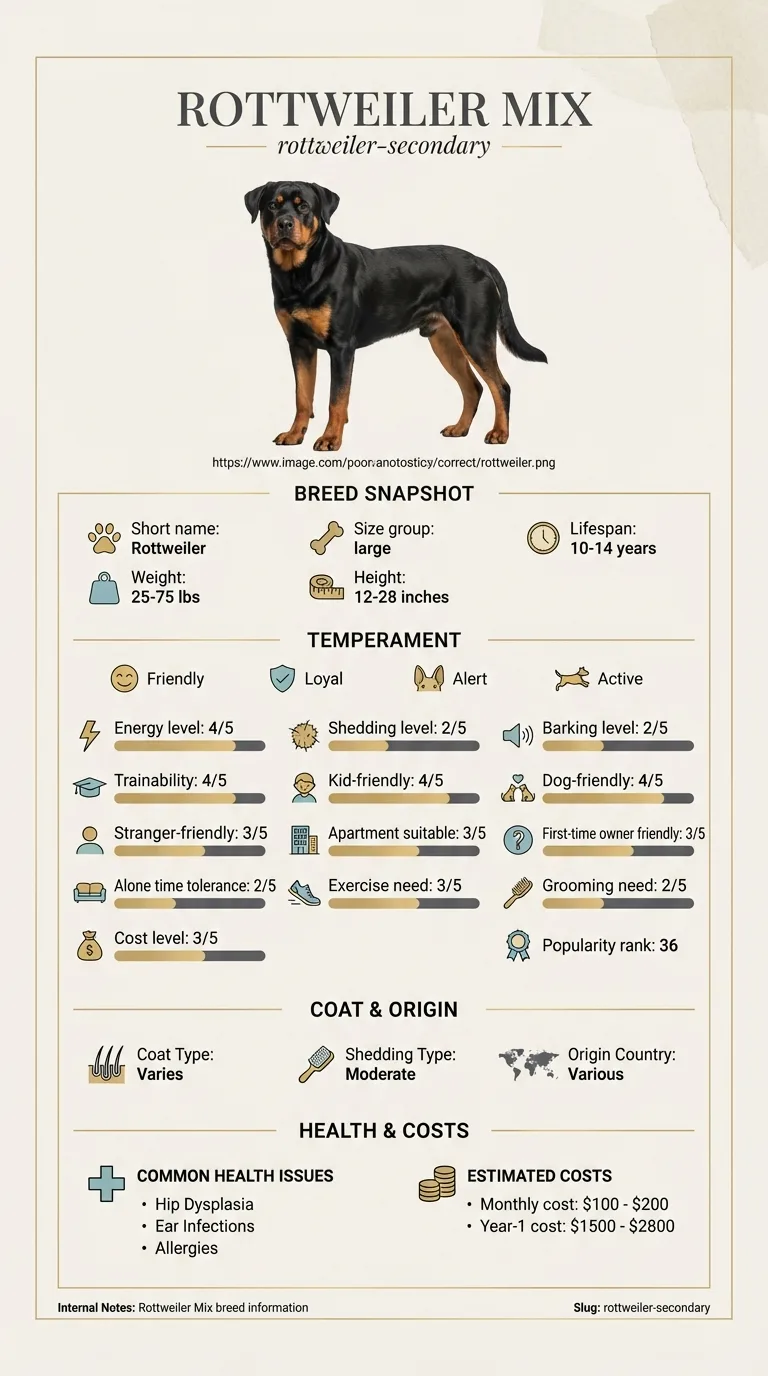
This is for someone already down to Bernedoodle and Rottweiler Mix and deciding between them. For this pair the decision usually turns on good with other dogs and grooming need, so those are covered first and in most detail. Both rate 2/5 for flats, so housing does not settle this one. It is written for the decision rather than the breed history.
Between Bernedoodle and Rottweiler Mix, good with other dogs is what separates them, and Rottweiler Mix is the lower-effort dog of the two to keep.
Choose Bernedoodle if this is your first dog, shedding is a problem in your house and there are young children at home.
Choose Rottweiler Mix if you do not want a standing grooming appointment, the dog will be alone during the working day and you want a dog that is more watchful with visitors.
| Feature | bernedoodle | rottweiler secondary | Winner |
|---|---|---|---|
| Size class | medium | large | Equal |
| Weight | 20–90 lbs | 80–135 lbs | Equal |
| Height | 12–23 in | 22–27 in | Equal |
| Lifespan | 12–18 years | 9–10 years | bernedoodle |
| Exercise need | High (4/5) | High (4/5) | Equal |
| Grooming need | High (4/5) | Low (2/5) | rottweiler secondary |
| Shedding | Low (2/5) | Moderate (3/5) | bernedoodle |
| Energy level | High (4/5) | Moderate (3/5) | Equal |
| Barking | Low (2/5) | Low (2/5) | Equal |
| Apartment suitability | Low (2/5) | Low (2/5) | Equal |
| Good for first-time owners | High (4/5) | Low (2/5) | bernedoodle |
| Tolerates being alone | Low (2/5) | Moderate (3/5) | rottweiler secondary |
| Trainability | Very high (5/5) | High (4/5) | bernedoodle |
| Good with kids | Very high (5/5) | Moderate (3/5) | bernedoodle |
| Good with other dogs | Very high (5/5) | Low (2/5) | bernedoodle |
| Friendly to strangers | High (4/5) | Low (2/5) | bernedoodle |
| Cost level | High (4/5) | High (4/5) | Equal |
| Coat | Wavy to curly, hypoallergenic | Short, dense double coat | Equal |
| Origin | United States | Various | Equal |
| Typical monthly cost | $120–$220 | $110–$240 | Equal |
| Typical first-year cost | $1,800–$3,200 | $1,700–$3,200 | Equal |
Don't assume "mix" means smaller. This Rottweiler mix still carries 80-135 lbs on a 22-27 inch frame, essentially matching a purebred Rottweiler's footprint, while the Bernedoodle tops out lighter at 20-90 lbs and 23 inches. Mixed parentage hasn't softened the size here — you're still bringing home a large, heavy-bodied dog if you choose the mix over the Bernedoodle.
The mix asks less of you than a purebred Rottweiler would: 3/5 for both exercise need and energy level, a notch below the Bernedoodle's 4/5 across the board. That's a real difference day to day — a brisk 30-minute walk plus some yard time will satisfy the mix, where the Bernedoodle wants more sustained activity to burn off its energy.
Grooming duties fall harder on the Bernedoodle owner: 4/5 versus the mix's 2/5, since that curly coat needs regular brushing to avoid mats. Shedding runs the other way but less dramatically than you'd expect from a Rottweiler cross — the mix rates a moderate 3/5, lighter than a purebred Rottweiler's heavy shed, while the Bernedoodle sits at a low 2/5.
Apartment suitability ties at 2/5 for both, so neither is an easy fit for compact living, and barking levels also tie at a quiet 2/5. Where the mix pulls ahead is tolerance for solitude — a 3/5 versus the Bernedoodle's 2/5 — suggesting a calmer temperament blend is doing some work here. If your schedule leaves a dog alone for stretches, that gap matters.
On paper the mix is still rated low (2/5) for first-time owners despite a strong 4/5 trainability score, mirroring the caution that comes with any Rottweiler ancestry. The Bernedoodle scores 4/5 for first-timers and edges the trainability scale further to 5/5. Neither dog is untrainable — the mix just needs a handler who won't be intimidated by size and drive early on.
The gap with other dogs is the widest line in this pairing: 5/5 for the Bernedoodle against just 2/5 for the mix, so plan carefully before adding a second dog to a household with this Rottweiler mix. Kids fare better (5/5 vs a moderate 3/5) but strangers see the same caution as a purebred Rottweiler, at 2/5 versus the Bernedoodle's 4/5.
A 12-18 year lifespan for the Bernedoodle dwarfs the mix's 9-10 years — slightly better than a purebred Rottweiler's 8-11 but still short for a large dog. The mix's listed health risks are fewer in number (hip and elbow dysplasia, osteosarcoma, subaortic stenosis, and cruciate ligament tears) than the Bernedoodle's ten-item list, though a shorter published list doesn't guarantee a healthier dog — mixed breeds are simply harder to generalize about.
Cost lands as a near wash. Both rate 4/5 on the cost scale, and the monthly ranges overlap heavily — $120-220 for the Bernedoodle, $110-240 for the mix — with first-year totals of $1,800-3,200 versus $1,700-3,200. Whichever way the mix's genetics lean will swing actual food and vet bills more than the breed label does.
Bernedoodle weighs 20–90 lbs and lives 12–18 years; Rottweiler Mix weighs 80–135 lbs and lives 9–10 years. The two diverge most on good with other dogs, grooming need and good for first-time owners and 2 other rated axes. They are level on apartment suitability, barking and cost level, so those cannot decide it. In the table, a "winner" means easier for an ordinary household — not better. Size, coat and origin are recorded without a verdict. Because both breeds are scored the same way, the gaps are reliable even where the absolute numbers are rough.

Barely at all — it still weighs 80-135 lbs and stands 22-27 inches, matching a purebred's footprint almost exactly, while the Bernedoodle stays lighter at 20-90 lbs.
Somewhat — the mix rates a moderate 3/5 for shedding, lighter than a purebred Rottweiler's heavy 4/5, though still more than the Bernedoodle's low 2/5.
Not really — it's rated 2/5 for first-time owners despite a strong 4/5 trainability score, the same caution that applies to purebred Rottweilers. The Bernedoodle rates 4/5 for first-timers.
Slightly — it rates 3/5 for tolerating time alone against a purebred Rottweiler's 2/5, and even edges out the Bernedoodle's 2/5 on that specific measure.
Minimal. $120-220 monthly for the Bernedoodle versus $110-240 for the mix, with first-year costs of $1,800-3,200 against $1,700-3,200.
A shorter, four-item list: hip dysplasia, elbow dysplasia, osteosarcoma, subaortic stenosis, and cruciate ligament tears. That's fewer named risks than the Bernedoodle's ten, though mixed breeds are harder to predict overall.
Not necessarily — it rates just 2/5 for compatibility with other dogs, well below the Bernedoodle's 5/5, so introductions to a multi-dog household need care.
The Bernedoodle is the more predictable, sociable choice across nearly every category; the mix's main strengths are calmer energy and better alone-tolerance.
$120-220 for the Bernedoodle, $110-240 for the mix — essentially a tie.
Less — a moderate 3/5 against the Bernedoodle's 4/5, so a 30-minute walk plus yard time is usually enough.
The Bernedoodle, at 12-18 years versus 9-10 for the mix.
Secure checkout on Stripe. We never see your card.
7-day money-back guarantee. Instant access.
Health information here is general and is not veterinary advice. If your dog shows pain, sudden behaviour change, or worsening symptoms, consult a licensed veterinarian.
Some links on this site are affiliate links. We may earn a commission at no extra cost to you, and we only suggest products we believe are helpful for dog owners.
We research and check what we publish, but we do not warrant that any figure, date, price, or statement is accurate, complete, or current, and we accept no liability for any loss, cost, injury, or other harm arising from the use of this site. Use it as one reference among several. You remain responsible for your own decisions and for your dog's care - confirm anything that matters with a licensed veterinarian or another qualified professional before you act on it. Full disclaimer.
Match your lifestyle to the right dog.
Take quizNot sure which breed is right for you? Take our 2-minute quiz to find out.
Take the quiz