Behavior
Bernedoodle or Golden Retriever -- which should you get?
Pick the Bernedoodle if you want lower shedding and a longer expected lifespan; pick the Golden if you want a more predictable, beginner-tested temperament.

Quick answer
Bernedoodle or Golden Retriever -- which should you get?
Pick the Bernedoodle if you want lower shedding and a longer expected lifespan; pick the Golden if you want a more predictable, beginner-tested temperament.
Bernedoodle or Golden Retriever? On paper they differ most on shedding, and on the scales Golden Retriever is the heavier at 55–75 lbs. Here is how the two compare on everything that shapes an ordinary week.
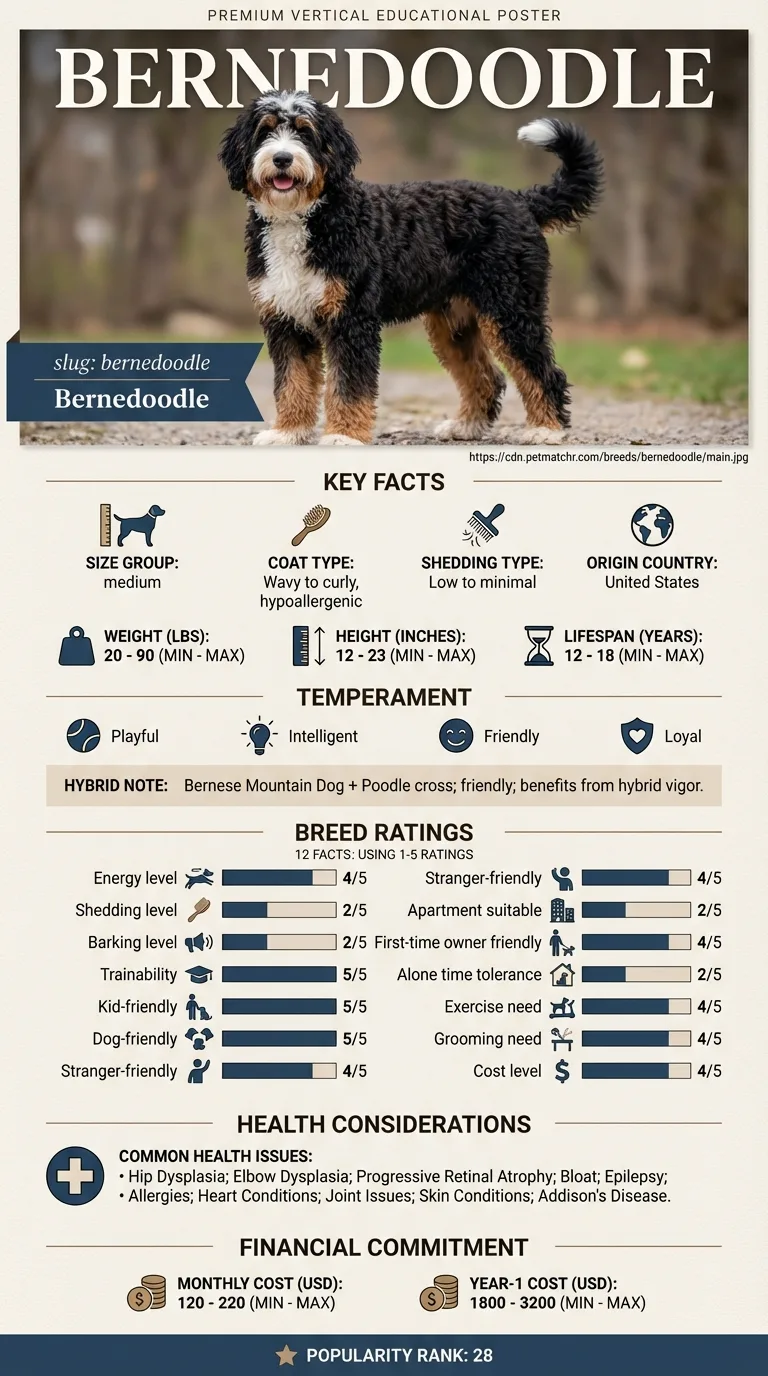
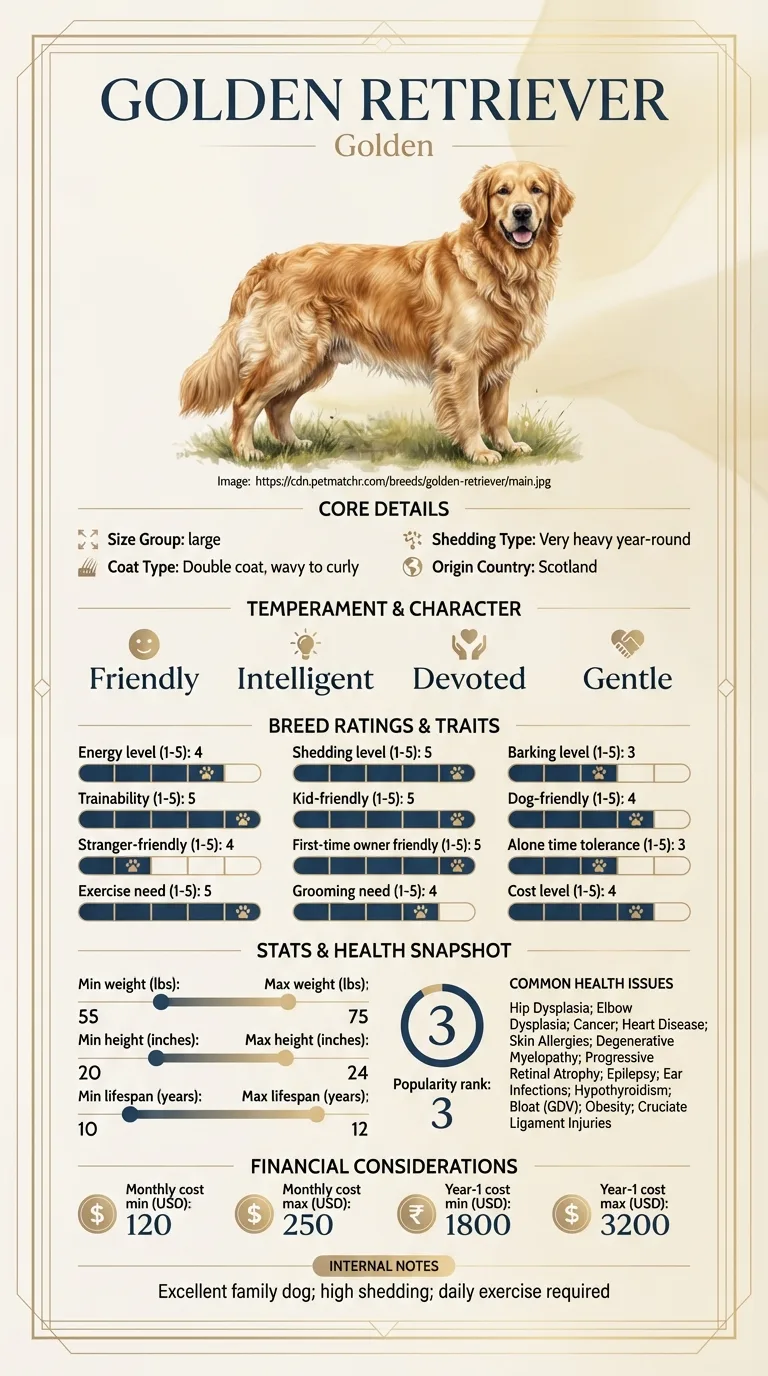
This is for someone already down to Bernedoodle and Golden Retriever and deciding between them. For this pair the decision usually turns on shedding, so those are covered first and in most detail. Both rate 2/5 for flats, so housing does not settle this one. It is written for the decision rather than the breed history.
Between Bernedoodle and Golden Retriever, shedding is what separates them, and Golden Retriever is the lower-effort dog of the two to keep.
Choose Bernedoodle if shedding is a problem in your house, your walking routine is modest and you already have another dog.
Choose Golden Retriever if this is your first dog, the dog will be alone during the working day and you want a dog that can keep up with an active routine.
| Feature | bernedoodle | golden retriever | Winner |
|---|---|---|---|
| Size class | medium | large | Equal |
| Weight | 20–90 lbs | 55–75 lbs | Equal |
| Height | 12–23 in | 20–24 in | Equal |
| Lifespan | 12–18 years | 10–12 years | bernedoodle |
| Exercise need | High (4/5) | Very high (5/5) | bernedoodle |
| Grooming need | High (4/5) | High (4/5) | Equal |
| Shedding | Low (2/5) | Very high (5/5) | bernedoodle |
| Energy level | High (4/5) | High (4/5) | Equal |
| Barking | Low (2/5) | Moderate (3/5) | bernedoodle |
| Apartment suitability | Low (2/5) | Low (2/5) | Equal |
| Good for first-time owners | High (4/5) | Very high (5/5) | golden retriever |
| Tolerates being alone | Low (2/5) | Moderate (3/5) | golden retriever |
| Trainability | Very high (5/5) | Very high (5/5) | Equal |
| Good with kids | Very high (5/5) | Very high (5/5) | Equal |
| Good with other dogs | Very high (5/5) | High (4/5) | bernedoodle |
| Friendly to strangers | High (4/5) | High (4/5) | Equal |
| Cost level | High (4/5) | High (4/5) | Equal |
| Coat | Wavy to curly, hypoallergenic | Double coat, wavy to curly | Equal |
| Origin | United States | Scotland | Equal |
| Typical monthly cost | $120–$220 | $120–$250 | Equal |
| Typical first-year cost | $1,800–$3,200 | $1,800–$3,200 | Equal |
Golden Retrievers run a tight range, 55 to 75 pounds and 20 to 24 inches at the shoulder, so you know pretty much what you're getting before the dog is grown. Bernedoodles are the opposite story: breeders offer standard, mini, and toy lines that span 20 to 90 pounds and 12 to 23 inches, meaning two dogs sold under the same name can differ by 70 pounds. If predictability matters to you, that's a real point in the Golden's favor -- with a Bernedoodle, ask the breeder which size line you're actually buying.
Both dogs want to move, but the Golden edges out the Bernedoodle at a full 5 out of 5 versus 4 out of 5 for exercise need -- in practice that's the difference between a long daily walk and something closer to a working dog's schedule, including swimming or retrieving most days. Energy levels are rated equal at 4/5. Neither breed suits a sedentary household; the Golden just asks for a bit more of your calendar.
Grooming need is identical on paper, both rated high at 4/5, but what that grooming looks like differs. The Bernedoodle's wavy-to-curly coat is labeled hypoallergenic and sheds low (2/5), so the work is mostly brushing and periodic clipping to prevent mats. The Golden carries a double coat that sheds very high (5/5) -- expect fur on the couch year-round and heavier blowouts twice a year, on top of the same regular brushing.
Neither is really an apartment dog -- both score low, 2/5, on apartment suitability, so a small unit without daily outdoor time is a stretch for either breed. Barking runs low for the Bernedoodle (2/5) versus moderate for the Golden (3/5), a modest edge if noise complaints from neighbors are a concern. Alone-time tolerance also favors the Golden slightly, moderate (3/5) against the Bernedoodle's low (2/5) -- if you're out of the house long hours, that gap matters more than the barking difference.
Trainability ties at 5/5 for both, so obedience work won't be the deciding factor. The real split is in the first-time-owner rating: Golden Retrievers score very high (5/5) here, Bernedoodles high (4/5) -- not a huge gap, but Goldens have a century-long track record as a beginner-friendly breed while Bernedoodle temperament can vary more by generation and breeder. Either will train well with consistent, reward-based sessions.
Both score a perfect 5/5 with kids, so that's a wash. Bernedoodles edge ahead with other dogs, very high (5/5) against the Golden's high (4/5), while both are rated high (4/5) for friendliness with strangers. If you're building a multi-dog household, the Bernedoodle's slightly higher other-dog rating is worth noting, though a 4 is still a good outcome for the Golden.
This is where the two breeds really separate. Bernedoodles are rated for 12 to 18 years, Golden Retrievers for 10 to 12 -- a gap that can mean several extra years with the dog. Both share hip dysplasia, elbow dysplasia, progressive retinal atrophy, epilepsy, and bloat risk on their lists. The Golden's list also carries cancer, heart disease, and degenerative myelopathy, part of why its average lifespan runs shorter.
Monthly costs land close together, $120-$220 for the Bernedoodle versus $120-$250 for the Golden, and first-year costs are identical at $1,800-$3,200. Cost level is rated the same high (4/5) for both. Budget-wise there's essentially no difference here -- the money question comes down to purchase price and grooming frequency rather than any gap in the published ranges.
Bernedoodle weighs 20–90 lbs and lives 12–18 years; Golden Retriever weighs 55–75 lbs and lives 10–12 years. The two diverge most on shedding. They are level on apartment suitability, cost level and energy level, so those cannot decide it. In the table, a "winner" means easier for an ordinary household — not better. Size, coat and origin are recorded without a verdict. Because both breeds are scored the same way, the gaps are reliable even where the absolute numbers are rough.

The Bernedoodle, clearly -- it's rated low (2/5) for shedding thanks to its curly, hypoallergenic-type coat, while the Golden Retriever's double coat sheds very high (5/5). If shedding is your main concern, the Bernedoodle wins this one outright.
Both are solid choices for a beginner, but the Golden edges it out at very high (5/5) versus the Bernedoodle's high (4/5). Golden temperament is also more consistent because it's a purebred with generations of predictable breeding behind it.
Not ideally -- both score low (2/5) on apartment suitability. If you're in a small space, plan on serious daily exercise regardless of which one you pick.
Expect $120-$220 for a Bernedoodle and $120-$250 for a Golden Retriever, with first-year costs landing in the same $1,800-$3,200 range for both.
Yes -- hip dysplasia, elbow dysplasia, progressive retinal atrophy, epilepsy, and bloat show up on both lists. The Golden's list adds cancer, heart disease, and degenerative myelopathy, conditions linked to its shorter typical lifespan.
The Bernedoodle, by a wide margin on paper -- 12 to 18 years versus the Golden's 10 to 12. That six-year spread at the top end is one of the biggest differences between these two breeds.
They're rated the same, high (4/5), for friendliness toward strangers, so neither has an edge here -- expect an enthusiastic greeting from both.
Pick the Bernedoodle if you want lower shedding and a longer expected lifespan; pick the Golden if you want a more predictable, beginner-tested temperament.
Barely any -- $120-$220 for the Bernedoodle versus $120-$250 for the Golden Retriever.
The Golden, rated very high (5/5) versus the Bernedoodle's high (4/5) -- expect close to daily hard exercise.
The Bernedoodle, at 12-18 years versus the Golden's 10-12.
Secure checkout on Stripe. We never see your card.
7-day money-back guarantee. Instant access.
Health information here is general and is not veterinary advice. If your dog shows pain, sudden behaviour change, or worsening symptoms, consult a licensed veterinarian.
Some links on this site are affiliate links. We may earn a commission at no extra cost to you, and we only suggest products we believe are helpful for dog owners.
We research and check what we publish, but we do not warrant that any figure, date, price, or statement is accurate, complete, or current, and we accept no liability for any loss, cost, injury, or other harm arising from the use of this site. Use it as one reference among several. You remain responsible for your own decisions and for your dog's care - confirm anything that matters with a licensed veterinarian or another qualified professional before you act on it. Full disclaimer.
Match your lifestyle to the right dog.
Take quizNot sure which breed is right for you? Take our 2-minute quiz to find out.
Take the quiz