Bernedoodle or Boxer -- which is the better overall pick?
For most owners the Bernedoodle wins on the numbers that matter long-term: it lives roughly twice as long and trains more easily. Choose the Boxer only if a low-maintenance coat and higher raw exercise drive top your list.
Bernedoodle or Boxer? On paper they differ most on grooming need, and on the scales Boxer is the heavier at 60–70 lbs. Here is how the two compare on everything that shapes an ordinary week.
This is for someone already down to Bernedoodle and Boxer and deciding between them. For this pair the decision usually turns on grooming need, so those are covered first and in most detail. Both rate 2/5 for flats, so housing does not settle this one. Breed history is left out; what follows is what you will actually live with.
Quick verdict
Between Bernedoodle and Boxer, grooming need is what separates them, and Boxer is the lower-effort dog of the two to keep.
Choose bernedoodle if...
Choose Bernedoodle if this is your first dog, shedding is a problem in your house and your walking routine is modest.
Choose boxer if...
Choose Boxer if you do not want a standing grooming appointment, the dog will be alone during the working day and you want a dog that can keep up with an active routine.
Head-to-head comparison
Feature
bernedoodle
boxer
Winner
Size class
medium
large
Equal
Weight
20–90 lbs
60–70 lbs
Equal
Height
12–23 in
21–25 in
Equal
Lifespan
12–18 years
7–10 years
bernedoodle
Exercise need
High (4/5)
Very high (5/5)
bernedoodle
Grooming need
High (4/5)
Very low (1/5)
boxer
Shedding
Low (2/5)
Moderate (3/5)
bernedoodle
Energy level
High (4/5)
High (4/5)
Equal
Barking
Low (2/5)
Moderate (3/5)
bernedoodle
Apartment suitability
Low (2/5)
Low (2/5)
Equal
Good for first-time owners
High (4/5)
Moderate (3/5)
bernedoodle
Tolerates being alone
Low (2/5)
Moderate (3/5)
boxer
Trainability
Very high (5/5)
High (4/5)
bernedoodle
Good with kids
Very high (5/5)
Very high (5/5)
Equal
Good with other dogs
Very high (5/5)
High (4/5)
bernedoodle
Friendly to strangers
High (4/5)
Moderate (3/5)
bernedoodle
Cost level
High (4/5)
High (4/5)
Equal
Coat
Wavy to curly, hypoallergenic
Short, smooth
Equal
Origin
United States
Germany
Equal
Typical monthly cost
$120–$220
$100–$200
Equal
Typical first-year cost
$1,800–$3,200
$1,500–$3,000
Equal
Deep dive
Size and build
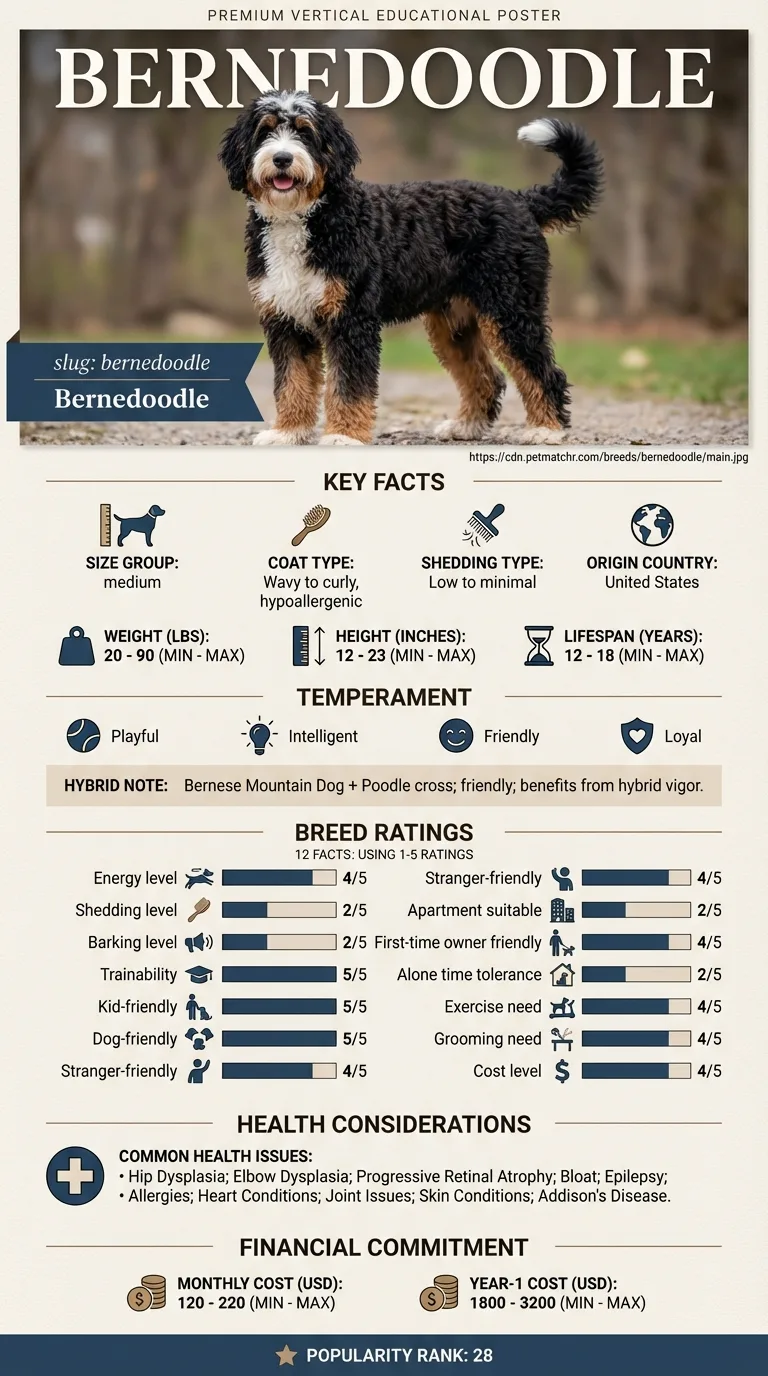
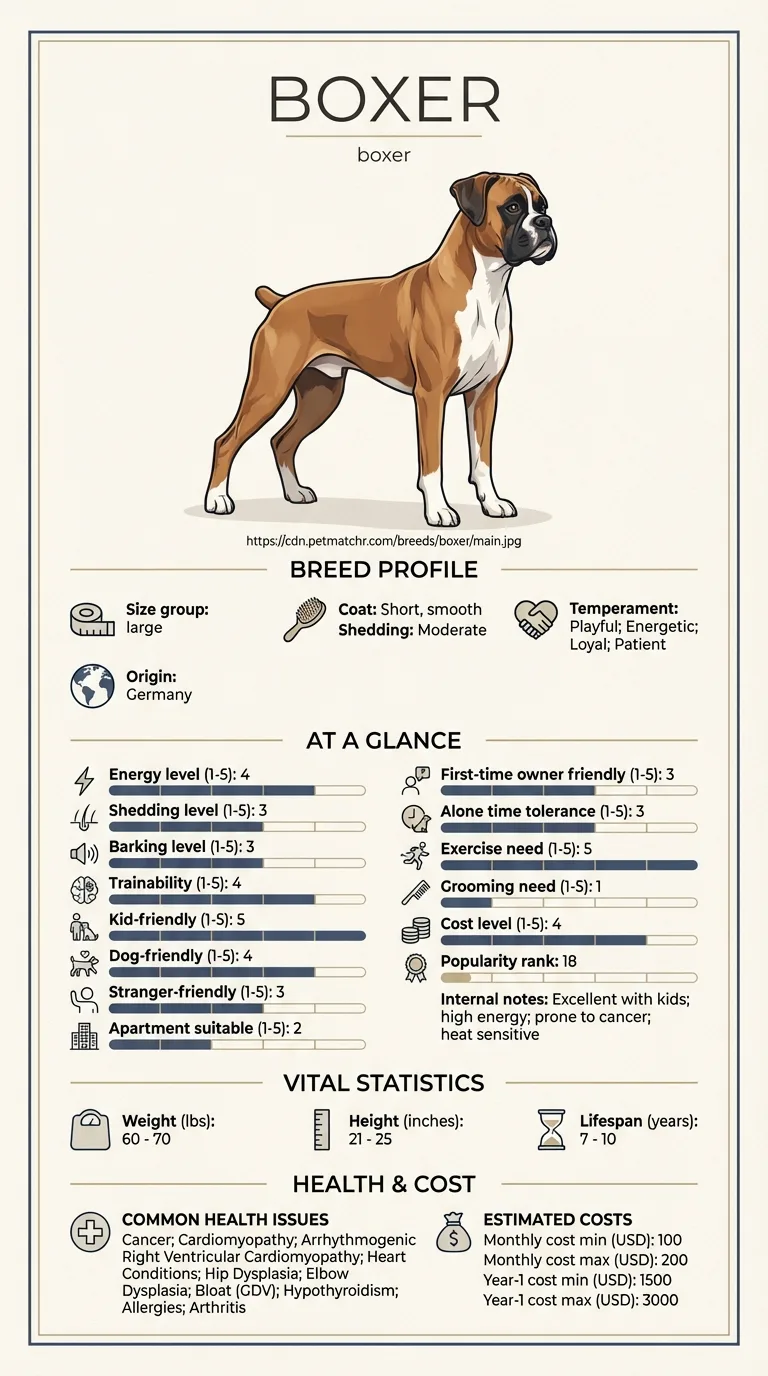
Bernedoodle's weight range runs wide, 20-90 lbs, since it spans mini to standard versions, while a Boxer holds steady at 60-70 lbs. Height overlaps some (12-23 in vs 21-25 in) but a Boxer is a single consistent large-breed frame, whereas a Bernedoodle could turn out closer to a spaniel or closer to a Golden Retriever depending on which parent genes dominate. If you want a predictable adult size, the Boxer is the safer bet.
Energy and exercise
Both dogs need real daily exercise, but the Boxer edges out at a 5/5 versus the Bernedoodle's 4/5. Boxers were bred to run and can keep going well past what a casual walk provides -- plan on 60+ minutes of vigorous activity daily. The Bernedoodle also wants a solid workout but tends to settle faster once it's had one. Neither breed suits someone who wants a low-key couch companion.
Grooming and shedding
This is where the two breeds split hardest. The Bernedoodle's wavy-to-curly coat rates 4/5 on grooming need and requires regular brushing plus periodic professional trims to avoid matting. The Boxer's short, smooth coat needs almost none of that, rating just 1/5. Shedding runs the other direction though -- the Bernedoodle's low-shed coat (2/5) beats the Boxer's moderate shedding (3/5), so you're trading a wash-and-go coat for one that leaves less hair on your couch.
Apartment living, noise and time alone
Neither breed is an obvious apartment pick, and the data agrees -- both land at 2/5 for apartment suitability. Where they differ is time alone: the Boxer tolerates solo hours a bit better (3/5) than the Bernedoodle (2/5), which tends to bond hard and struggle when left. Barking leans in the Bernedoodle's favor at 2/5 versus the Boxer's 3/5, so a Boxer is more likely to vocalize when the doorbell rings or a neighbor walks by.
Training and owner experience
Both breeds are rated good choices for first-time owners, but the Bernedoodle scores higher at 4/5 against the Boxer's 3/5, and its trainability edges out too (5/5 vs 4/5). Boxers are smart but can be stubborn and mouthy as adolescents, which trips up owners expecting an easy learner. If this is your first dog and you want fewer training surprises, the Bernedoodle's numbers make the case.
Kids, other dogs and visitors
Both breeds score a full 5/5 with kids, so neither is a compromise on that front. The Bernedoodle pulls ahead with other dogs (5/5 vs 4/5) and with strangers (4/5 vs 3/5), meaning a mixed household with frequent visitors or a resident second dog probably runs smoother with the Bernedoodle. The Boxer is still solidly social -- just not quite at the same level.
Health and lifespan
The lifespan gap is the headline here: 12-18 years for the Bernedoodle against just 7-10 for the Boxer. Boxers carry real cardiac risk -- cardiomyopathy and arrhythmogenic right ventricular cardiomyopathy both show up on their list alongside cancer, conditions that shorten a lot of Boxer lives. The Bernedoodle's list runs longer (ten items including hip and elbow dysplasia, epilepsy, and Addison's) but skews toward manageable orthopedic and immune issues rather than the cardiac risks driving the Boxer's shorter average.
Cost to keep
Monthly costs sit close together -- $120-220 for the Bernedoodle versus $100-200 for the Boxer -- and first-year costs follow the same pattern ($1,800-3,200 vs $1,500-3,000). Both rate 4/5 on overall cost level. The Bernedoodle's grooming bills push its number up despite a simpler food bill; the Boxer saves on grooming but a first-time owner should budget for cardiac screening given the breed's heart-condition history.
Bernedoodle vs Boxer at a glance
Bernedoodle weighs 20–90 lbs and lives 12–18 years; Boxer weighs 60–70 lbs and lives 7–10 years. The two diverge most on grooming need. They are level on apartment suitability, cost level and energy level, so those cannot decide it. The comparison marks an easier option only where one exists. Facts like weight and country of origin are not scored. Both dogs are rated from the same dataset, which is what makes the numbers comparable with each other even though any individual dog sits somewhere inside its breed's range.
Bernedoodle vs Boxer: Which Suits Your Home? - Bernedoodle vs Boxer at a glance
Frequently asked questions
Which is bigger, the Bernedoodle or the Boxer?
It depends on which Bernedoodle you get. A standard Bernedoodle can outweigh a Boxer at up to 90 lbs, but a mini can come in well under the Boxer's 60-70 lb range. The Boxer is the more size-consistent choice.
Does the Bernedoodle or Boxer shed more?
The Boxer sheds more, rating moderate (3/5) against the Bernedoodle's low (2/5). The trade-off is grooming time -- the Bernedoodle needs regular brushing and trims that the wash-and-go Boxer skips entirely.
Is the Bernedoodle or Boxer better for a first-time owner?
The data favors the Bernedoodle, rated 4/5 for first-time owners against the Boxer's 3/5, and it also trains faster (5/5 vs 4/5 trainability). Boxers aren't hard dogs, but their stubborn streak as adolescents catches new owners off guard.
Can either breed live in an apartment?
Not comfortably -- both score just 2/5 on apartment suitability. High exercise needs and, for the Boxer, more barking mean a house with a yard suits either dog better than a small unit.
How much does each breed cost to keep monthly?
Expect $120-220 a month for a Bernedoodle and $100-200 for a Boxer, both landing at a 4/5 overall cost level. The Bernedoodle's grooming appointments are the main gap-filler in that range.
Do the Bernedoodle and Boxer share health risks?
Yes -- both lists include hip dysplasia, elbow dysplasia, bloat, allergies, and heart conditions. The Boxer's list adds specific cardiac diseases (cardiomyopathy, ARVC) and cancer that push its risk profile higher and its average lifespan lower.
Which breed lives longer?
The Bernedoodle, by a wide margin -- 12-18 years compared to the Boxer's 7-10. That's the single biggest number separating this pair.
Bernedoodle or Boxer -- which is the better overall pick?
For most owners the Bernedoodle wins on the numbers that matter long-term: it lives roughly twice as long and trains more easily. Choose the Boxer only if a low-maintenance coat and higher raw exercise drive top your list.
Costs
What's the monthly cost difference?
Close but not identical -- $120-220 for the Bernedoodle versus $100-200 for the Boxer, both rated a 4/5 cost level overall.
Training
Which needs more exercise?
The Boxer, rated 5/5 versus the Bernedoodle's 4/5. Both need real daily activity, but the Boxer wants more volume of it.
Health
Which breed lives longer?
The Bernedoodle, at 12-18 years against the Boxer's 7-10 -- the largest gap in this comparison.
Related DogBreedCompass guides
Bernedoodle breed guide – Readers comparing the two usually want the full profile of Bernedoodle before deciding.
Boxer breed guide – The same for Boxer, so the comparison can be checked against the detail.
Bernedoodle vs Goldendoodle – Goldendoodle is the closest breed to Bernedoodle on the measured axes, so it is the natural next comparison.
Boxer vs Welsh Springer Spaniel – Welsh Springer Spaniel sits closest to Boxer, which makes it the alternative worth ruling out.
What Bernedoodle costs to keep – Anyone weighing these two is usually also pricing them, and the cost pages carry city-level figures.
Boxer health problems – The health pages set out what each breed is actually screened for.
Health information here is general and is not veterinary advice. If your dog shows pain, sudden behaviour change, or worsening symptoms, consult a licensed veterinarian.
Some links on this site are affiliate links. We may earn a commission at no extra cost to you, and we only suggest products we believe are helpful for dog owners.
We research and check what we publish, but we do not warrant that any figure, date, price, or statement is accurate, complete, or current, and we accept no liability for any loss, cost, injury, or other harm arising from the use of this site. Use it as one reference among several. You remain responsible for your own decisions and for your dog's care - confirm anything that matters with a licensed veterinarian or another qualified professional before you act on it. Full disclaimer.