Basset Hound vs Bloodhound: Which Suits Your Home?
Quick answer
Which breed is the better overall choice?
The Basset wins on nearly every practical measure here - apartment fit, first-time-owner score, lifespan - making it the more forgiving choice unless you specifically want a Bloodhound's tracking ability.
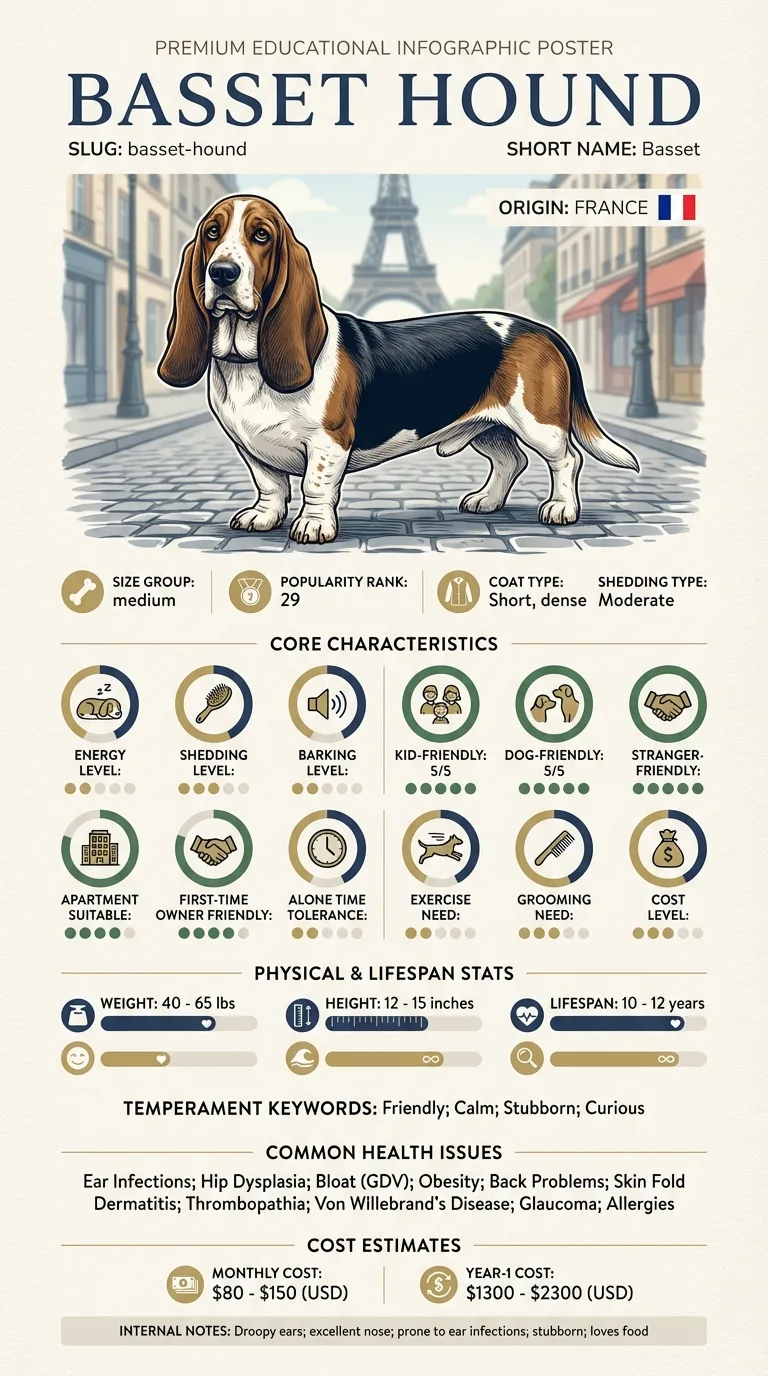
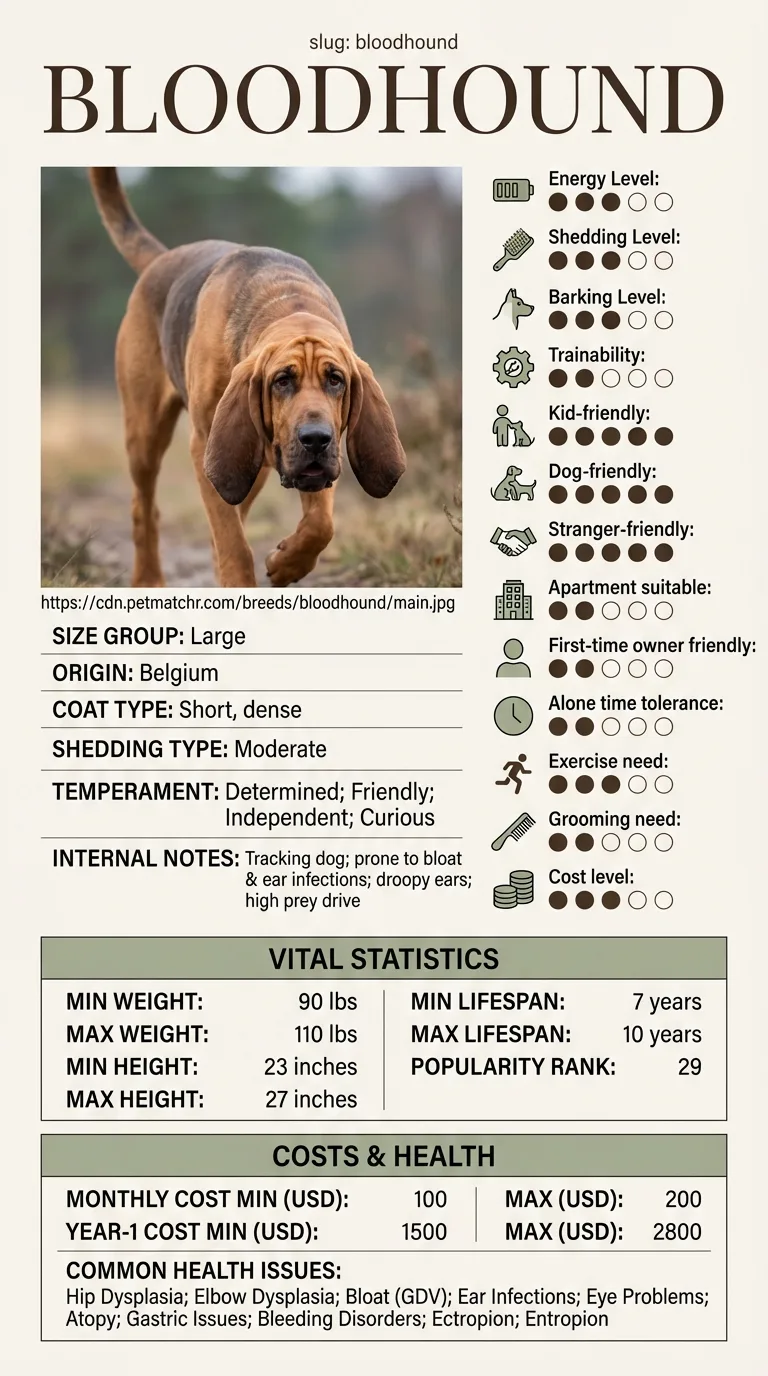
Basset Hound or Bloodhound? On paper they differ most on apartment suitability, and on the scales Bloodhound is the heavier at 90–110 lbs. Here is how the two compare on everything that shapes an ordinary week.
This is for someone already down to Basset Hound and Bloodhound and deciding between them. For this pair the decision usually turns on apartment suitability and good for first-time owners, so those are covered first and in most detail. Anyone choosing from a flat has a clear answer here: Basset Hound rates 4/5 against 2/5. Breed history is left out; what follows is what you will actually live with.
Quick verdict
Between Basset Hound and Bloodhound, apartment suitability is what separates them, and Basset Hound is the lower-effort dog of the two to keep.
Choose basset hound if...
Choose Basset Hound if you are in a flat or a smaller home, this is your first dog and your walking routine is modest.
Choose bloodhound if...
Choose Bloodhound if you do not want a standing grooming appointment, you want a dog that can keep up with an active routine and you want a dog that is more watchful with visitors.
Head-to-head comparison
Feature
basset hound
bloodhound
Winner
Size class
medium
large
Equal
Weight
40–65 lbs
90–110 lbs
Equal
Height
12–15 in
23–27 in
Equal
Lifespan
10–12 years
7–10 years
basset hound
Exercise need
Low (2/5)
Moderate (3/5)
basset hound
Grooming need
Moderate (3/5)
Low (2/5)
bloodhound
Shedding
Moderate (3/5)
Moderate (3/5)
Equal
Energy level
Low (2/5)
Moderate (3/5)
Equal
Barking
Low (2/5)
Moderate (3/5)
basset hound
Apartment suitability
High (4/5)
Low (2/5)
basset hound
Good for first-time owners
High (4/5)
Low (2/5)
basset hound
Tolerates being alone
Low (2/5)
Low (2/5)
Equal
Trainability
Low (2/5)
Low (2/5)
Equal
Good with kids
Very high (5/5)
High (4/5)
basset hound
Good with other dogs
Very high (5/5)
High (4/5)
basset hound
Friendly to strangers
Very high (5/5)
High (4/5)
basset hound
Cost level
Moderate (3/5)
Moderate (3/5)
Equal
Coat
Short, dense
Short, dense
Equal
Origin
France
Belgium
Equal
Typical monthly cost
$80–$150
$100–$200
Equal
Typical first-year cost
$1,300–$2,300
$1,500–$2,800
Equal
Deep dive
Size and build
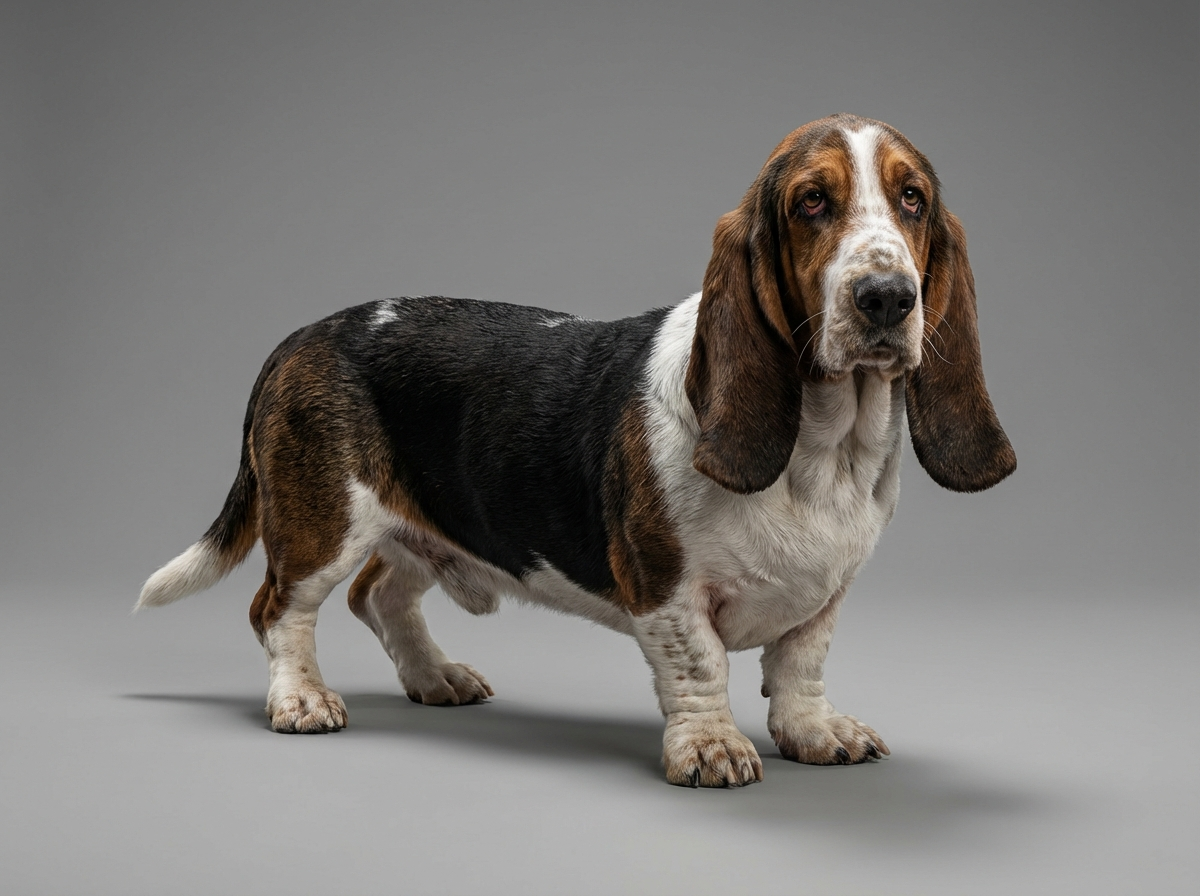
The Bloodhound is a genuinely large dog - 90-110 lbs and up to 27 inches tall - against the Basset's medium 40-65 lbs on a 12-15 inch frame. Both share the same droopy-eared, scent-hound heritage and origin lineage, but the Bloodhound is nearly double the Basset's weight. If you've handled a Basset on leash, know that a Bloodhound pulls with considerably more force behind it.
Energy and exercise
The Bloodhound needs a bit more exercise than the Basset, moderate (3/5) versus low (2/5), driven by its instinct to follow scent trails for long stretches. Energy level is listed as a tie, but that scent drive means Bloodhound walks can turn into extended tracking sessions if you're not careful with the leash. A securely fenced yard matters more for the Bloodhound than the exercise-need number alone suggests, since a good scent trail can override recall entirely.
Grooming and shedding
Shedding ties at moderate (3/5) for both breeds. Grooming need actually favors the Bloodhound slightly (2/5 vs 3/5) - its coat is simpler to maintain, though its deep facial wrinkles need the same kind of regular cleaning the Basset's skin folds require to avoid irritation. Neither breed's coat itself is high-maintenance, but skipping wrinkle and ear cleaning on either dog is how the ear infections on both health lists tend to start.
Apartment living, noise and time alone
The Basset is the stronger apartment fit (4/5 vs 2/5) and barks less (2/5 vs 3/5). Both tolerate being alone equally poorly (2/5), so neither should be left solo for long stretches regardless of home size. If you're in a smaller space, the Basset's numbers line up better with that reality, and its lower bark rating also makes it the friendlier option for thin apartment walls or close-by neighbors.
Training and owner experience
Trainability ties at low (2/5) for both - these are independent scent hounds, not obedience-circuit breeds, and both will follow their nose over your commands given the chance. First-time-owner suitability is where they diverge sharply: the Basset rates high (4/5) while the Bloodhound rates low (2/5), largely due to its size and strength being harder for a beginner to manage physically.
Kids, other dogs and visitors
The Basset scores at the top across this category - 5/5 with kids, other dogs and strangers - while the Bloodhound trails slightly at 4/5 on each. Both are genuinely friendly, low-aggression breeds; the gap here is small but consistent across all three measures in the Basset's favor. Neither is a breed you'd need to worry about around a busy household with frequent visitors, though the Basset's perfect scores give it a slight edge for chaotic family gatherings.
Health and lifespan
The Basset lives longer, 10-12 years against the Bloodhound's 7-10, one of the shorter lifespans among large breeds. Both share bloat and hip dysplasia risk. The Bloodhound's list adds bleeding disorders and entropion/ectropion, eyelid conditions common to its loose facial skin, while the Basset's list includes back problems and thrombopathia specific to its build. Both lists point toward regular vet checkups as non-negotiable rather than optional, given the number of shared and breed-specific risks involved.
Cost to keep
Costs run close: $80-$150 monthly for the Basset versus $100-$200 for the Bloodhound, and $1,300-$2,300 versus $1,500-$2,800 for the first year. Both sit at moderate cost level (3/5), with the Bloodhound's larger size accounting for the modest gap in food and care costs. Given the bloat risk both breeds share, it's worth budgeting for pet insurance regardless of which one you end up choosing.
Basset Hound vs Bloodhound at a glance
Basset Hound weighs 40–65 lbs and lives 10–12 years; Bloodhound weighs 90–110 lbs and lives 7–10 years. The two diverge most on apartment suitability and good for first-time owners. They are level on tolerates being alone, cost level and shedding, so those cannot decide it. The comparison marks an easier option only where one exists. Facts like weight and country of origin are not scored. Both dogs are rated from the same dataset, which is what makes the numbers comparable with each other even though any individual dog sits somewhere inside its breed's range.
Basset Hound vs Bloodhound: Which Suits Your Home? - Basset Hound vs Bloodhound at a glance
Frequently asked questions
How much bigger is the Bloodhound?
Substantially - 90-110 lbs and up to 27 inches, compared to the Basset's 40-65 lbs and 12-15 inches. The Bloodhound is nearly double the Basset's weight.
Which breed lives longer?
The Basset Hound, at 10-12 years, against the Bloodhound's shorter 7-10 year range - a meaningful gap for a decision based partly on longevity.
Is the Bloodhound good for a first-time owner?
Not really - it rates just 2/5 for first-time owners, largely due to its size and strength. The Basset rates much higher at 4/5.
Which needs more exercise?
The Bloodhound, rated moderate (3/5) against the Basset's low (2/5). Its tracking instinct means walks can turn into longer scent-following sessions.
Which is friendlier with kids?
Both do well, but the Basset edges ahead at 5/5 versus the Bloodhound's 4/5. Neither breed is prone to aggression around children.
What's the monthly cost?
$80-$150 for the Basset versus $100-$200 for the Bloodhound - a modest gap tied to the Bloodhound's larger size.
Do they share health risks?
Both carry bloat and hip dysplasia risk. The Bloodhound adds bleeding disorders and eyelid conditions, while the Basset's risks lean toward back problems from its long spine.
The Basset wins on nearly every practical measure here - apartment fit, first-time-owner score, lifespan - making it the more forgiving choice unless you specifically want a Bloodhound's tracking ability.
Costs
What's the monthly cost?
$80-$150 for the Basset, $100-$200 for the Bloodhound - a modest size-driven gap.
Training
How much exercise do they need?
Low for the Basset (2/5), moderate for the Bloodhound (3/5) - neither is a high-energy breed.
Health
Which breed lives longer?
The Basset Hound, at 10-12 years, versus the Bloodhound's 7-10 year range.
Related DogBreedCompass guides
Basset Hound breed guide – Readers comparing the two usually want the full profile of Basset Hound before deciding.
Bloodhound breed guide – The same for Bloodhound, so the comparison can be checked against the detail.
Basset Hound vs Bulldog (English) – Bulldog (English) is the closest breed to Basset Hound on the measured axes, so it is the natural next comparison.
Bloodhound vs Old English Sheepdog – Old English Sheepdog sits closest to Bloodhound, which makes it the alternative worth ruling out.
What Basset Hound costs to keep – Anyone weighing these two is usually also pricing them, and the cost pages carry city-level figures.
Bloodhound health problems – The health pages set out what each breed is actually screened for.
Health information here is general and is not veterinary advice. If your dog shows pain, sudden behaviour change, or worsening symptoms, consult a licensed veterinarian.
Some links on this site are affiliate links. We may earn a commission at no extra cost to you, and we only suggest products we believe are helpful for dog owners.
We research and check what we publish, but we do not warrant that any figure, date, price, or statement is accurate, complete, or current, and we accept no liability for any loss, cost, injury, or other harm arising from the use of this site. Use it as one reference among several. You remain responsible for your own decisions and for your dog's care - confirm anything that matters with a licensed veterinarian or another qualified professional before you act on it. Full disclaimer.