Living
Which breed suits most households better?
The Basset Hound, for anyone without serious working-dog experience - its low exercise need and high scores with kids and strangers make it the more forgiving everyday pet.

Quick answer
Which breed suits most households better?
The Basset Hound, for anyone without serious working-dog experience - its low exercise need and high scores with kids and strangers make it the more forgiving everyday pet.
Basset Hound or Belgian Malinois? On paper they differ most on exercise need, and on the scales Belgian Malinois is the heavier at 55–65 lbs. Here is how the two compare on everything that shapes an ordinary week.
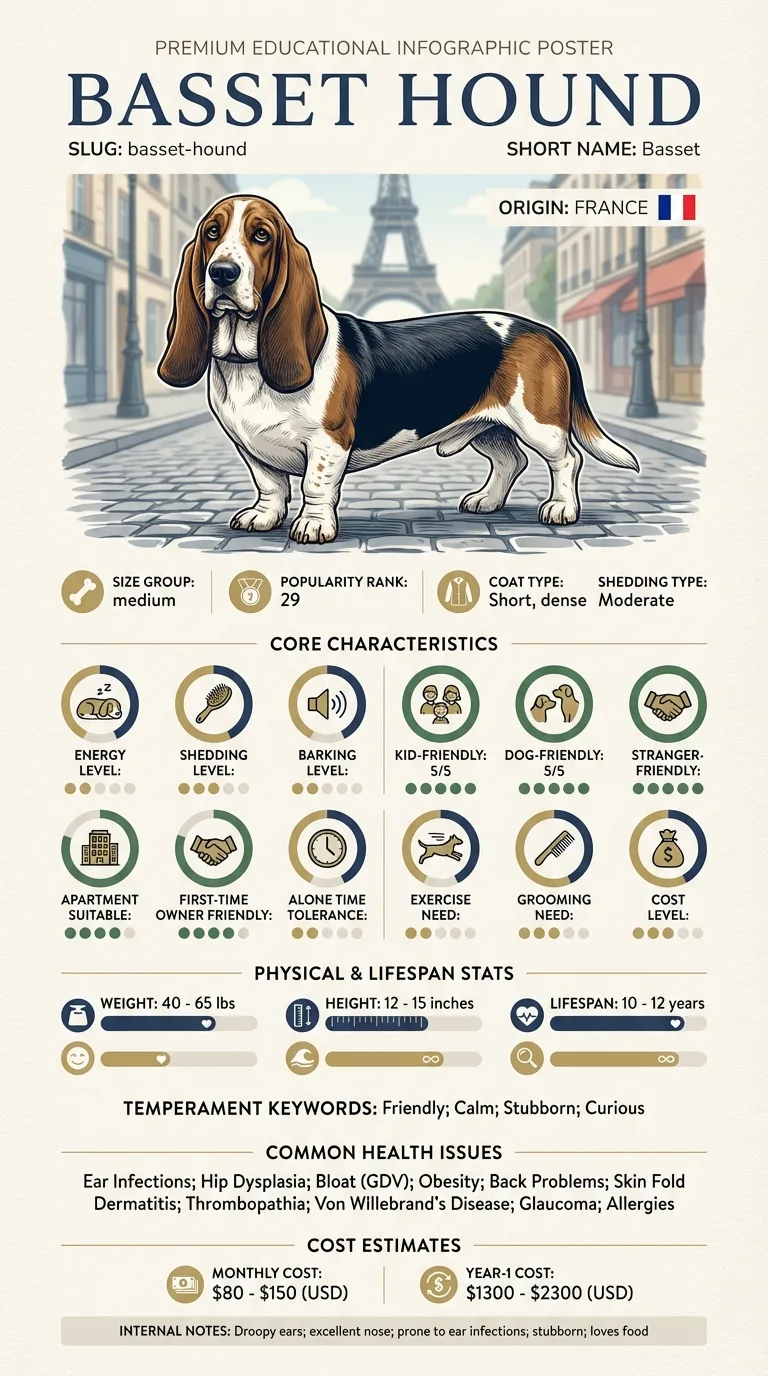
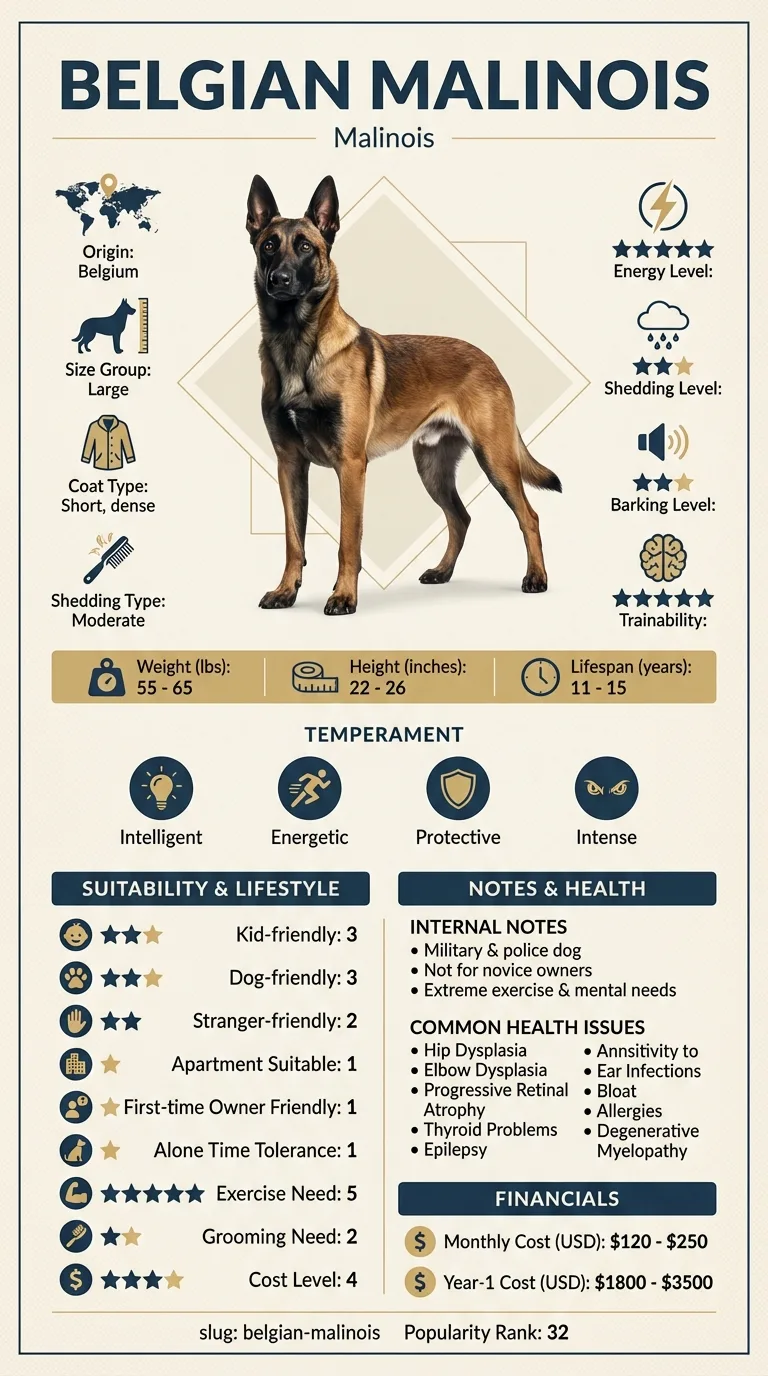
This is for someone already down to Basset Hound and Belgian Malinois and deciding between them. For this pair the decision usually turns on exercise need and energy level, so those are covered first and in most detail. Anyone choosing from a flat has a clear answer here: Basset Hound rates 4/5 against 1/5. The focus throughout is on daily consequences rather than breed background.
Between Basset Hound and Belgian Malinois, exercise need is what separates them, and Basset Hound is the lower-effort dog of the two to keep.
Choose Basset Hound if you are in a flat or a smaller home, this is your first dog and your walking routine is modest.
Choose Belgian Malinois if you do not want a standing grooming appointment, you want a dog that picks up training quickly and you want a dog that can keep up with an active routine.
| Feature | basset hound | belgian malinois | Winner |
|---|---|---|---|
| Size class | medium | large | Equal |
| Weight | 40–65 lbs | 55–65 lbs | Equal |
| Height | 12–15 in | 22–26 in | Equal |
| Lifespan | 10–12 years | 11–15 years | belgian malinois |
| Exercise need | Low (2/5) | Very high (5/5) | basset hound |
| Grooming need | Moderate (3/5) | Low (2/5) | belgian malinois |
| Shedding | Moderate (3/5) | Moderate (3/5) | Equal |
| Energy level | Low (2/5) | Very high (5/5) | Equal |
| Barking | Low (2/5) | Moderate (3/5) | basset hound |
| Apartment suitability | High (4/5) | Very low (1/5) | basset hound |
| Good for first-time owners | High (4/5) | Very low (1/5) | basset hound |
| Tolerates being alone | Low (2/5) | Very low (1/5) | basset hound |
| Trainability | Low (2/5) | Very high (5/5) | belgian malinois |
| Good with kids | Very high (5/5) | Moderate (3/5) | basset hound |
| Good with other dogs | Very high (5/5) | Moderate (3/5) | basset hound |
| Friendly to strangers | Very high (5/5) | Low (2/5) | basset hound |
| Cost level | Moderate (3/5) | High (4/5) | basset hound |
| Coat | Short, dense | Short, dense | Equal |
| Origin | France | Belgium | Equal |
| Typical monthly cost | $80–$150 | $120–$250 | Equal |
| Typical first-year cost | $1,300–$2,300 | $1,800–$3,500 | Equal |
Both land in a similar weight range - 40-65 lbs for the Basset Hound versus 55-65 lbs for the Belgian Malinois - but the resemblance ends there. The Basset stands just 12-15 inches, low-slung and long-bodied, while the Malinois stands tall at 22-26 inches, built lean for speed and work. Comparable weight, completely different silhouette and physical capability.
This is the sharpest contrast in the whole comparison: the Basset needs low exercise (2/5), the Malinois needs very high (5/5) - the maximum on the scale. Malinois are working police and military dogs for a reason; without serious daily output they become genuinely difficult to live with. The Basset is on the opposite end entirely, content with modest walks.
Both wear short, dense coats and shed at the same moderate (3/5) rate. Grooming tips slightly toward the Basset needing more attention (3/5 vs 2/5), largely due to its droopy ears and skin folds, which need regular checks to avoid infection - a condition already flagged on its health list. Coat care itself is minimal for either breed.
The Basset is a strong apartment fit (4/5); the Malinois is nearly the worst case (1/5) given its exercise and working-dog drive. Both tolerate being alone poorly (2/5 and 1/5), and the Malinois barks somewhat more (3/5 vs 2/5). If you live in a small space without a yard, the data points firmly toward the Basset and away from the Malinois.
The Malinois is a trainability standout at 5/5 - it's the breed of choice for elite working programs - but that same drive makes it a poor match for first-time owners (1/5), the lowest possible score. The Basset trains at just 2/5, stubborn and food-motivated rather than eager to please, but is far friendlier to a first-timer (4/5) precisely because its low energy forgives training gaps.
The Basset wins across this whole category: 5/5 with kids, 5/5 with other dogs, 5/5 with strangers - about as sociable a profile as the data offers. The Malinois scores meaningfully lower on all three (3/5, 3/5, 2/5), consistent with a breed bred for protection work and watchfulness rather than open friendliness. Families prioritizing an easygoing household dog will find the Basset the clear fit here.
The Malinois lives a bit longer on average, 11-15 years against the Basset's 10-12. Both breeds carry bloat and hip dysplasia risk, along with allergies and ear infections. The Basset's list adds back problems and skin fold dermatitis tied to its long body and loose skin, while the Malinois carries elbow dysplasia and a notable sensitivity to anesthesia worth flagging before any surgery.
The Basset is the cheaper dog to keep: $80-$150 monthly and $1,300-$2,300 in year one, versus the Malinois at $120-$250 monthly and $1,800-$3,500 for the first year. That cost gap tracks with the Malinois's higher cost-level rating (4/5 vs 3/5) - larger dogs and working-line breeding both add up. Factor in that a Malinois with unmet exercise needs may also mean higher spending on training classes or a professional trainer to keep behavior on track.
Basset Hound weighs 40–65 lbs and lives 10–12 years; Belgian Malinois weighs 55–65 lbs and lives 11–15 years. The two diverge most on exercise need, energy level and apartment suitability and 5 other rated axes. Almost every rated axis separates them at least slightly. The table below marks a winner only where one breed is genuinely easier for a typical owner; size and origin are facts rather than merits and stay level. Ratings come from one source applied to both breeds, so they are meaningful against each other rather than as absolute scores.

The Belgian Malinois, dramatically - it's rated 5/5, the maximum, against the Basset Hound's 2/5. The Malinois is a working breed that needs a serious daily job, not a walk around the block.
No - it's rated 1/5 for first-time owners, the lowest score possible, because of its intensity and training needs. The Basset, by contrast, rates 4/5 and is a much gentler introduction to dog ownership.
The Basset Hound, by a wide margin - it scores 5/5 on both measures. The Malinois scores 3/5 on each, reflecting its more protective, watchful temperament.
The Basset Hound, rated 4/5 for apartment suitability against the Malinois's 1/5. The Malinois's exercise needs make small-space living genuinely unfair to the dog.
The Basset runs $80-$150 a month versus $120-$250 for the Malinois, with first-year costs of $1,300-$2,300 and $1,800-$3,500 respectively. The Malinois costs noticeably more to keep.
Yes - both carry bloat and hip dysplasia risk, plus allergies and ear infections. The Basset adds back problems from its long spine, while the Malinois carries a notable sensitivity to anesthesia.
The Malinois, rated 5/5 versus the Basset's 2/5 - it's one of the most trainable breeds around. The catch is that trainability requires an experienced handler to direct it properly.
The Basset Hound, for anyone without serious working-dog experience - its low exercise need and high scores with kids and strangers make it the more forgiving everyday pet.
$80-$150 for the Basset, $120-$250 for the Malinois - the Malinois costs noticeably more.
The Basset needs just 2/5; the Malinois needs the maximum 5/5 - among the largest exercise gaps in any comparison.
The Malinois, at 11-15 years, edges out the Basset's 10-12 year range.
Secure checkout on Stripe. We never see your card.
7-day money-back guarantee. Instant access.
Health information here is general and is not veterinary advice. If your dog shows pain, sudden behaviour change, or worsening symptoms, consult a licensed veterinarian.
Some links on this site are affiliate links. We may earn a commission at no extra cost to you, and we only suggest products we believe are helpful for dog owners.
We research and check what we publish, but we do not warrant that any figure, date, price, or statement is accurate, complete, or current, and we accept no liability for any loss, cost, injury, or other harm arising from the use of this site. Use it as one reference among several. You remain responsible for your own decisions and for your dog's care - confirm anything that matters with a licensed veterinarian or another qualified professional before you act on it. Full disclaimer.
Match your lifestyle to the right dog.
Take quizNot sure which breed is right for you? Take our 2-minute quiz to find out.
Take the quiz