Behavior
Which breed is more energetic?
The Australian Shepherd, rating a very high 5/5 for exercise need against the Sheepdog's moderate 3/5.

Quick answer
Which breed is more energetic?
The Australian Shepherd, rating a very high 5/5 for exercise need against the Sheepdog's moderate 3/5.
Australian Shepherd or Old English Sheepdog? On paper they differ most on exercise need, and on the scales Old English Sheepdog is the heavier at 60–100 lbs. Here is how the two compare on everything that shapes an ordinary week.
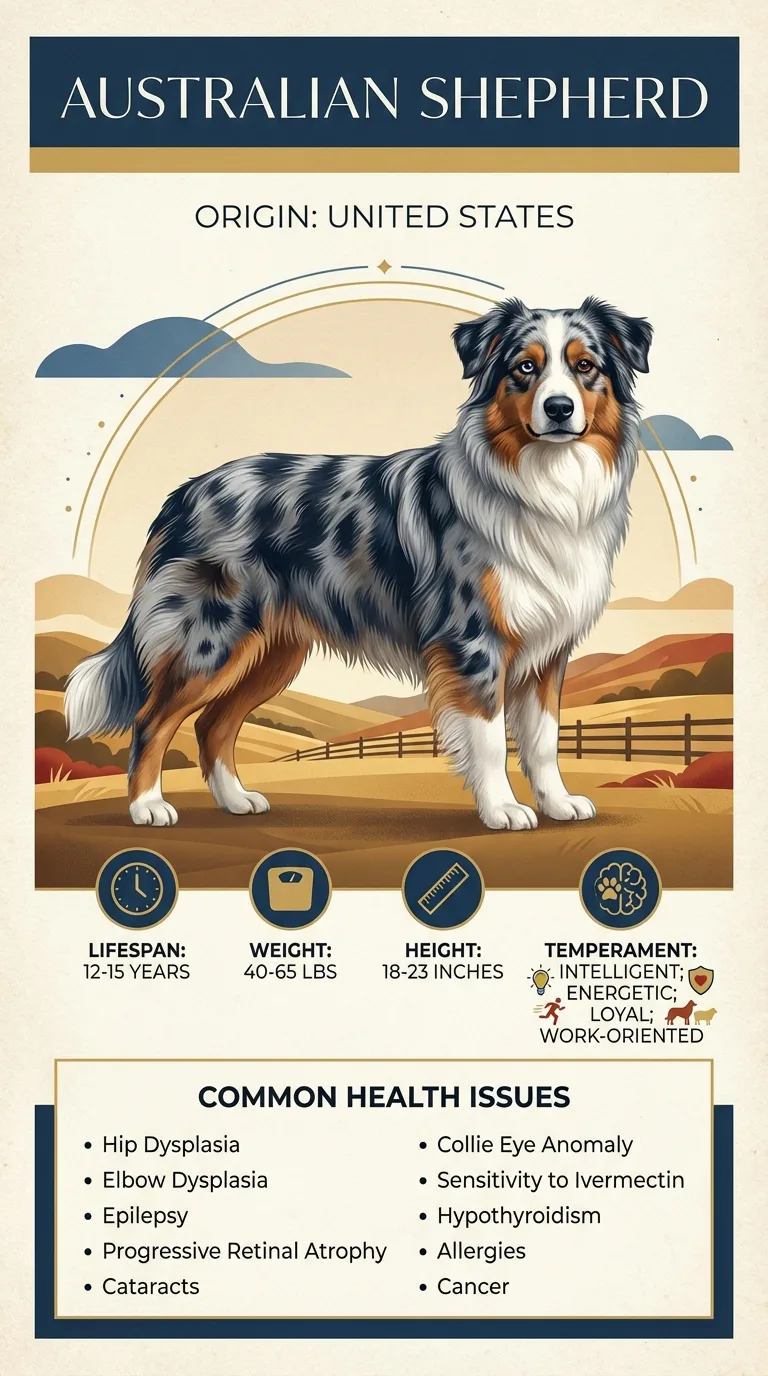
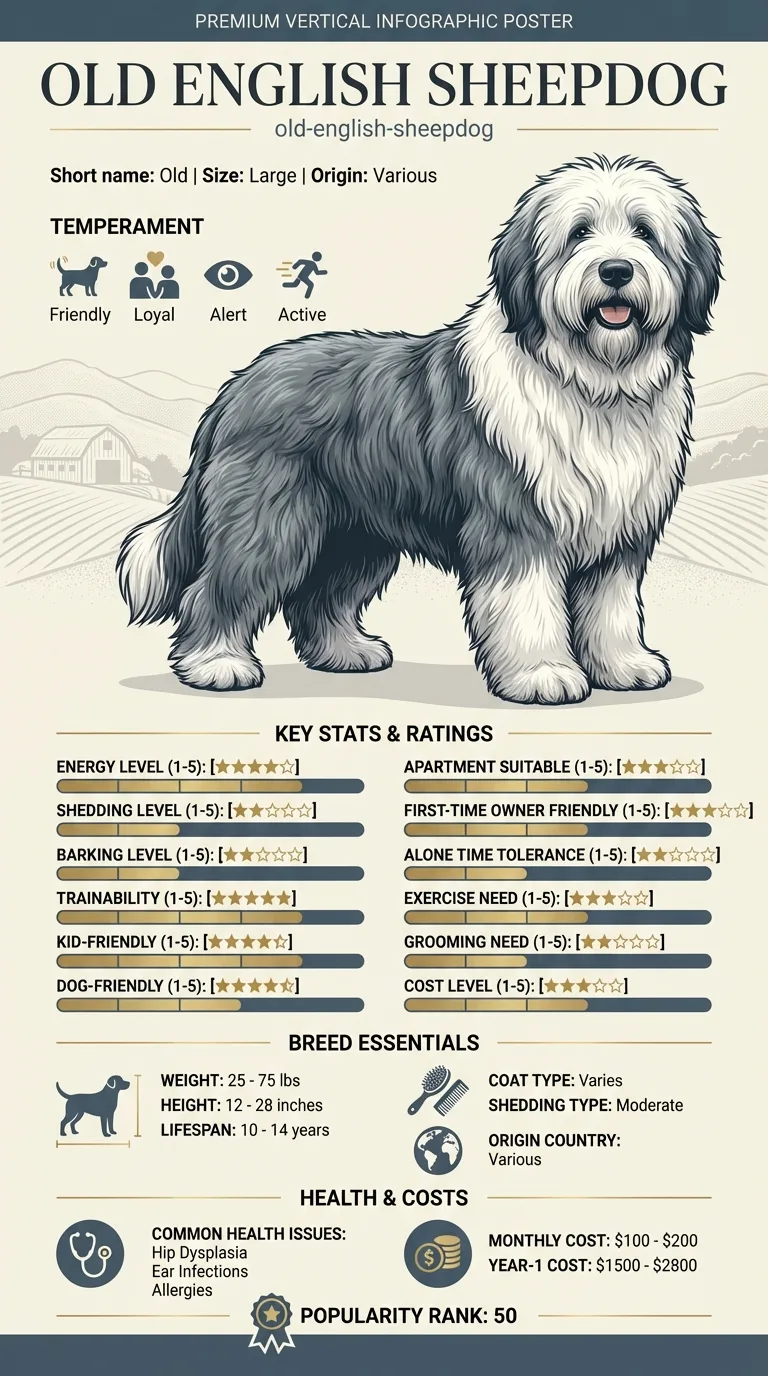
This is for someone already down to Australian Shepherd and Old English Sheepdog and deciding between them. For this pair the decision usually turns on exercise need and grooming need, so those are covered first and in most detail. Anyone choosing from a flat has a clear answer here: Old English Sheepdog rates 2/5 against 1/5. There is no origin story here — only what changes about your week.
Between Australian Shepherd and Old English Sheepdog, exercise need is what separates them, and Old English Sheepdog is the lower-effort dog of the two to keep.
Choose Australian Shepherd if you do not want a standing grooming appointment, you want a dog that picks up training quickly and a smaller dog suits your car, your home or your back.
Choose Old English Sheepdog if your walking routine is modest and there are young children at home.
| Feature | australian shepherd | old english sheepdog | Winner |
|---|---|---|---|
| Size class | medium | large | Equal |
| Weight | 40–65 lbs | 60–100 lbs | Equal |
| Height | 18–23 in | 20–24 in | Equal |
| Lifespan | 12–15 years | 10–12 years | australian shepherd |
| Exercise need | Very high (5/5) | Moderate (3/5) | old english sheepdog |
| Grooming need | Moderate (3/5) | Very high (5/5) | australian shepherd |
| Shedding | High (4/5) | High (4/5) | Equal |
| Energy level | Very high (5/5) | Moderate (3/5) | Equal |
| Barking | Moderate (3/5) | Moderate (3/5) | Equal |
| Apartment suitability | Very low (1/5) | Low (2/5) | old english sheepdog |
| Good for first-time owners | Low (2/5) | Low (2/5) | Equal |
| Tolerates being alone | Low (2/5) | Low (2/5) | Equal |
| Trainability | Very high (5/5) | Moderate (3/5) | australian shepherd |
| Good with kids | High (4/5) | Very high (5/5) | old english sheepdog |
| Good with other dogs | High (4/5) | High (4/5) | Equal |
| Friendly to strangers | Low (2/5) | High (4/5) | old english sheepdog |
| Cost level | Moderate (3/5) | High (4/5) | australian shepherd |
| Coat | Medium-length double coat | Long, shaggy double coat | Equal |
| Origin | United States | Various | Equal |
| Typical monthly cost | $100–$200 | $110–$240 | Equal |
| Typical first-year cost | $1,500–$2,800 | $1,700–$3,200 | Equal |
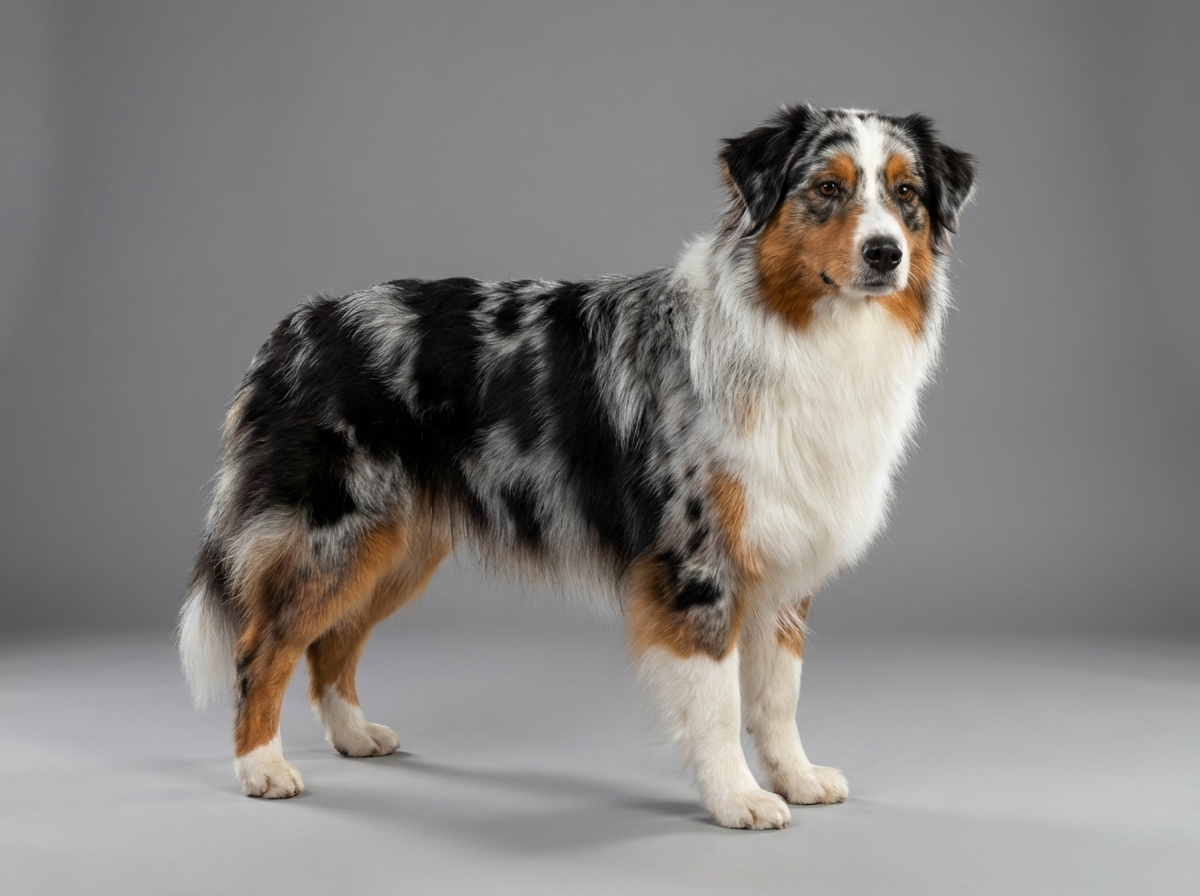
Forty to sixty-five pounds against sixty to a hundred: the Old English Sheepdog simply outweighs the Australian Shepherd by a wide margin, and its extra one to two inches of height only starts to describe the difference. Under that famous shaggy double coat the Sheepdog carries a bear-like, heavy-boned frame built for driving cattle at a walk, while the Aussie's medium 18-23 inch build is lighter, leaner and made for quick direction changes at speed. Owners who have handled both often say the Aussie feels like a sports car next to the Sheepdog's tour bus. Neither breed is small, but the size gap changes everything from crate sizing to how much space either dog takes up on a couch.
Five out of five versus three out of five is not a small gap. The Australian Shepherd was bred to gather scattered sheep across open range for eight-hour stretches, and that history shows up as a dog that wants a job, not a walk. The Old English Sheepdog, despite its bulk, settles for moderate daily activity - a couple of brisk walks and some yard time generally keep it content. An Aussie left under-exercised tends to invent its own entertainment, often at the expense of furniture or herding the family cat. Households with a fenced yard, hiking habit, or dog-sport interest suit the Aussie; a Sheepdog fits a less athletic routine reasonably well.
The coats tell opposite stories from the same shedding score. Both breeds land at a high 4/5 for shedding, but the Old English Sheepdog's grooming demand climbs to a very high 5/5 against the Aussie's moderate 3/5 - the long, shaggy double coat mats within days without regular brushing, and many owners resort to professional grooming every six to eight weeks. The Aussie's medium-length coat sheds plenty, especially during seasonal blowouts, but a weekly brushing session usually covers it. Anyone drawn to the Sheepdog's storybook look should budget real time or real money for coat upkeep; the Aussie asks for far less of either.
Neither dog scores well for apartment life - the Aussie sits at a rock-bottom 1/5, the Sheepdog only slightly better at 2/5 - and both tolerate being left alone poorly, tied at 2/5. Barking lands at a shared moderate 3/5, so noise complaints are not the dividing line here; space and stimulation are. An Aussie confined to a small unit without outlets for its very-high energy tends toward destructive or anxious behavior faster than the Sheepdog does. Both breeds do better with a yard, a predictable schedule, and company for large chunks of the day. City renters considering either dog should have a real exercise and enrichment plan before move-in day, not after.
Trainability splits sharply: the Aussie rates a very high 5/5, the Sheepdog a more middling moderate 3/5, and both still land at only 2/5 for first-time-owner suitability. That combination is telling - the Aussie is easy to teach but hard to satisfy, a dog that picks up cues in a handful of repetitions yet needs a confident handler to channel its work-oriented drive somewhere useful. The Sheepdog is more food-motivated and biddable but can be stubborn about consistency. Loyal describes the Aussie's temperament list, and that loyalty comes bundled with a herding instinct that inexperienced owners sometimes mistake for disobedience rather than boredom.
Good-with-kids scores favor the Sheepdog, a very high 5/5 against the Aussie's still-solid 4/5, and the temperament lists explain why: the Sheepdog is described as adaptable, gentle and playful, while the Aussie's list leans intelligent and work-oriented rather than easygoing. With strangers the contrast sharpens further - the Aussie scores a low 2/5, the Sheepdog a high 4/5, watchful but not standoffish. Both dogs get along well with other dogs at a matched 4/5. Families who host frequently or have young children underfoot may find the Sheepdog's gentler, more watchful nature an easier fit than the Aussie's higher-alert, herding-minded personality around unfamiliar faces.
The Aussie's ten-condition list includes epilepsy, collie eye anomaly and a documented sensitivity to ivermectin - a detail worth flagging to any vet before parasite prevention is prescribed. The Sheepdog's shorter five-item list still carries real weight: primary ciliary dyskinesia and bloat (GDV) alongside hip dysplasia, cataracts and hypothyroidism. Lifespan favors the Aussie clearly, twelve to fifteen years against ten to twelve, a two-to-three-year gap that matters over a dog's lifetime. Both breeds share hip dysplasia, cataracts and hypothyroidism as overlapping risks, so joint and thyroid screening are worth discussing with a breeder or vet regardless of which one joins the household.
Moderate versus high on the cost scale translates to real numbers: the Aussie runs $100-200 monthly and $1,500-2,800 in year one, while the Sheepdog climbs to $110-240 monthly and $1,700-3,200 for a first year - and that gap widens once professional grooming for the Sheepdog's coat enters the picture. Food costs alone favor the Aussie's lighter frame, though the Sheepdog's calmer exercise needs can offset that somewhat in equipment and activity spending. Prospective owners budgeting tightly should factor grooming as a recurring line item for the Sheepdog specifically, since skipping it is not really an option once the coat starts matting.
Australian Shepherd weighs 40–65 lbs and lives 12–15 years; Old English Sheepdog weighs 60–100 lbs and lives 10–12 years. The two diverge most on exercise need, grooming need and energy level and 2 other rated axes. They are level on tolerates being alone, barking and good with other dogs, so those cannot decide it. Where the table declares a winner it means less work for the owner, nothing more; descriptive rows are left as ties on purpose. The value here is in the differences between the two columns; treat any single score as approximate.

Yes - it scores a very high 5/5 for grooming need versus the Aussie's moderate 3/5, and that long shaggy double coat mats quickly without frequent brushing or periodic professional trims.
Neither scores well - the Aussie sits at 1/5 and the Sheepdog at 2/5 for apartment suitability - but the Sheepdog's lower, more moderate exercise need makes confined living slightly more manageable for it than for the very-high-energy Aussie.
On paper, yes - the Aussie rates a very high 5/5 for trainability against the Sheepdog's moderate 3/5 - though the Aussie's intelligence also means it needs consistent mental engagement or that trainability can turn into inventive mischief.
The Australian Shepherd, typically twelve to fifteen years compared with the Old English Sheepdog's ten to twelve.
Both score a low 2/5 for first-time-owner suitability; the Aussie's herding drive and the Sheepdog's grooming and size demands each require more commitment than a typical starter dog.
It can - Aussies and related herding breeds carry a documented sensitivity to ivermectin, so it's worth telling any vet before starting heartworm or parasite prevention.
Both are tied at a high 4/5 for shedding, so neither is a low-shed option, though the Sheepdog's longer coat can make loose hair more visible around the house.
The Australian Shepherd, rating a very high 5/5 for exercise need against the Sheepdog's moderate 3/5.
The Old English Sheepdog, at $1,700-3,200 in year one versus the Aussie's $1,500-2,800, largely due to grooming.
The Old English Sheepdog, scoring a high 4/5 compared to the Aussie's low 2/5.
The Old English Sheepdog, with five documented conditions against the Aussie's ten.
Secure checkout on Stripe. We never see your card.
7-day money-back guarantee. Instant access.
Health information here is general and is not veterinary advice. If your dog shows pain, sudden behaviour change, or worsening symptoms, consult a licensed veterinarian.
Some links on this site are affiliate links. We may earn a commission at no extra cost to you, and we only suggest products we believe are helpful for dog owners.
We research and check what we publish, but we do not warrant that any figure, date, price, or statement is accurate, complete, or current, and we accept no liability for any loss, cost, injury, or other harm arising from the use of this site. Use it as one reference among several. You remain responsible for your own decisions and for your dog's care - confirm anything that matters with a licensed veterinarian or another qualified professional before you act on it. Full disclaimer.
Match your lifestyle to the right dog.
Take quizNot sure which breed is right for you? Take our 2-minute quiz to find out.
Take the quiz