Living
Which breed fits more households?
The Brittany, mainly because of its very high other-dogs and kids scores (5/5 each) and easier trainability. The AmStaff is still a fine family dog, just one that needs more careful dog-to-dog introductions.

Quick answer
Which breed fits more households?
The Brittany, mainly because of its very high other-dogs and kids scores (5/5 each) and easier trainability. The AmStaff is still a fine family dog, just one that needs more careful dog-to-dog introductions.
American Staffordshire Terrier or Brittany Spaniel? On paper they differ most on good with other dogs, and on the scales American Staffordshire Terrier is the heavier at 40–70 lbs. Here is how the two compare on everything that shapes an ordinary week.
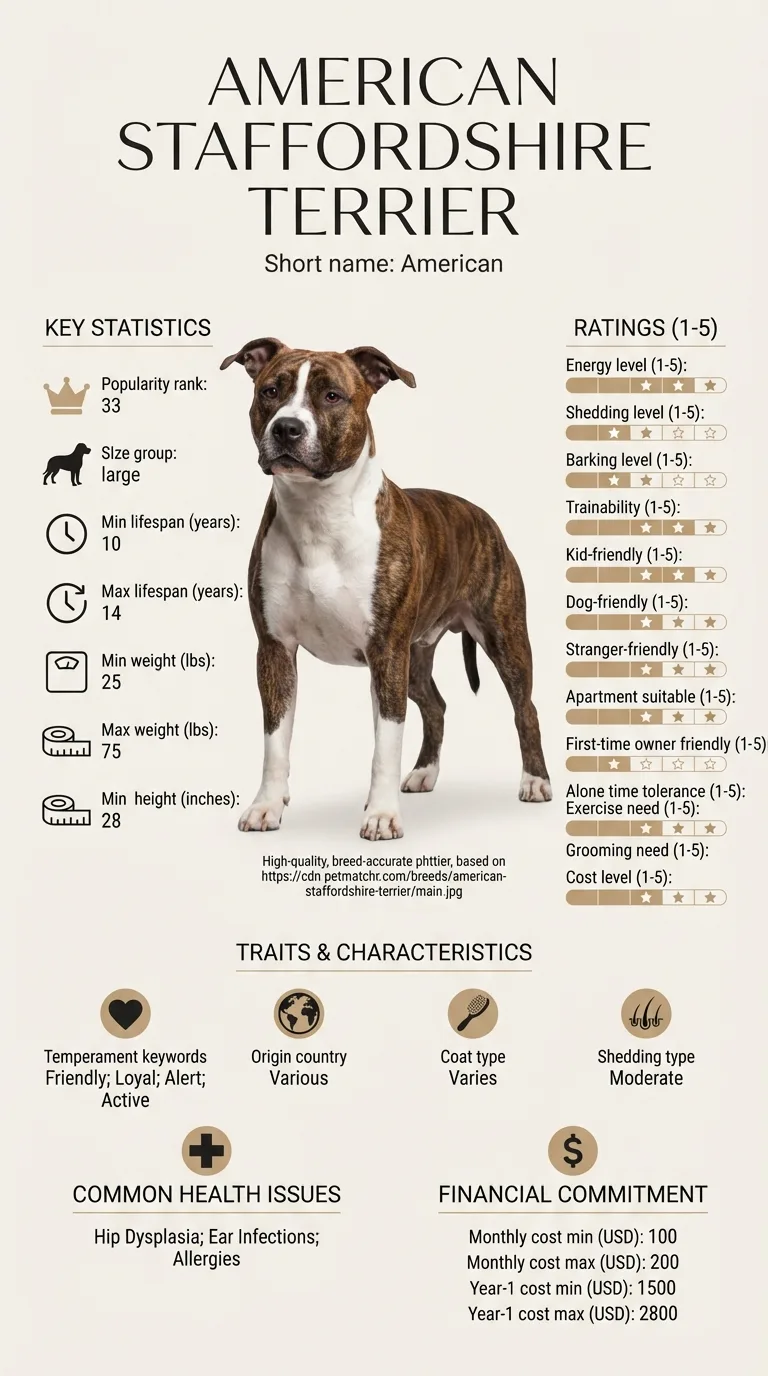
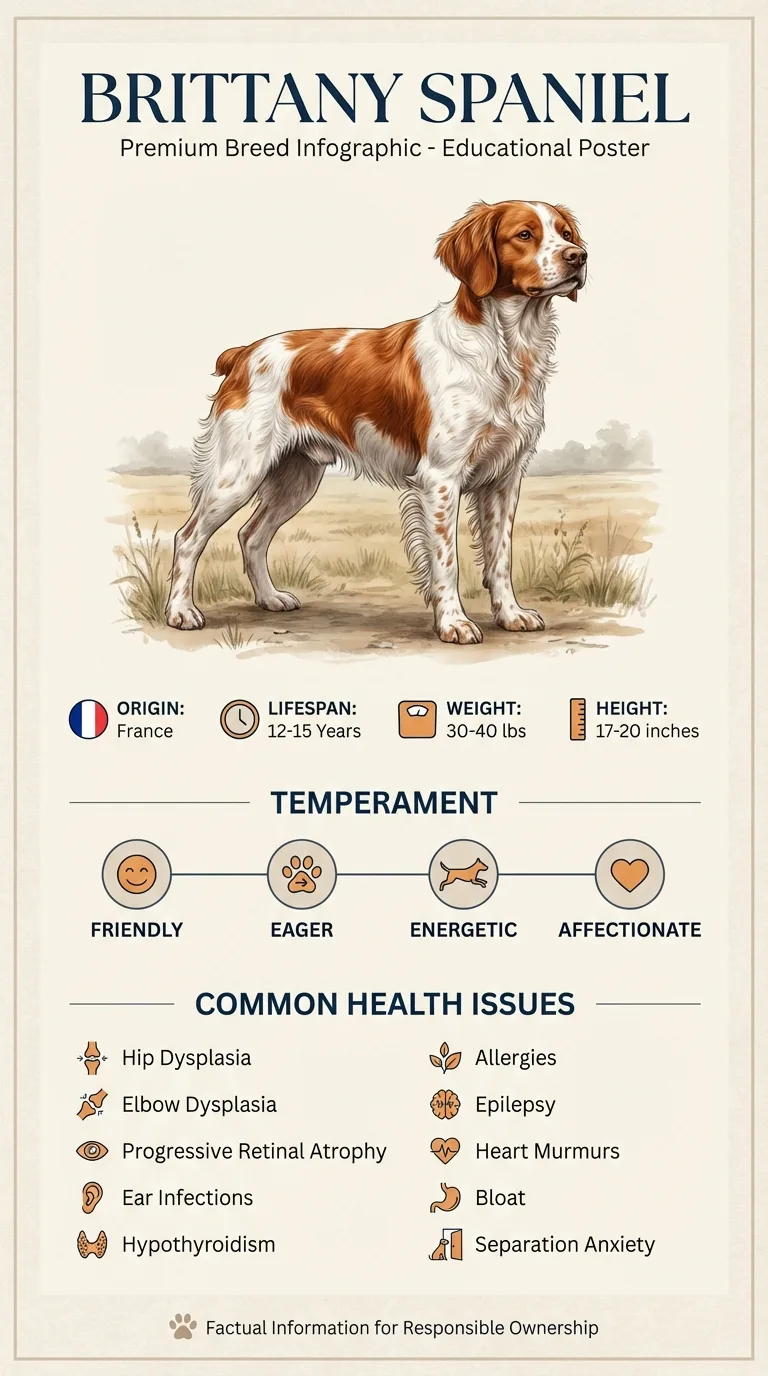
This is for someone already down to American Staffordshire Terrier and Brittany Spaniel and deciding between them. For this pair the decision usually turns on good with other dogs, so those are covered first and in most detail. Both rate 3/5 for flats, so housing does not settle this one. The focus throughout is on daily consequences rather than breed background.
Between American Staffordshire Terrier and Brittany Spaniel, good with other dogs is what separates them, and American Staffordshire Terrier is the lower-effort dog of the two to keep.
Choose American Staffordshire Terrier if you do not want a standing grooming appointment and the dog will be alone during the working day.
Choose Brittany Spaniel if this is your first dog, there are young children at home and you already have another dog.
| Feature | american staffordshire terrier | brittany | Winner |
|---|---|---|---|
| Size class | medium | medium | Equal |
| Weight | 40–70 lbs | 30–40 lbs | Equal |
| Height | 17–19 in | 17–20 in | Equal |
| Lifespan | 12–16 years | 12–15 years | american staffordshire terrier |
| Exercise need | High (4/5) | High (4/5) | Equal |
| Grooming need | Very low (1/5) | Low (2/5) | american staffordshire terrier |
| Shedding | Moderate (3/5) | Moderate (3/5) | Equal |
| Energy level | High (4/5) | High (4/5) | Equal |
| Barking | Low (2/5) | Low (2/5) | Equal |
| Apartment suitability | Moderate (3/5) | Moderate (3/5) | Equal |
| Good for first-time owners | Moderate (3/5) | High (4/5) | brittany |
| Tolerates being alone | Moderate (3/5) | Low (2/5) | american staffordshire terrier |
| Trainability | High (4/5) | Very high (5/5) | brittany |
| Good with kids | High (4/5) | Very high (5/5) | brittany |
| Good with other dogs | Low (2/5) | Very high (5/5) | brittany |
| Friendly to strangers | High (4/5) | High (4/5) | Equal |
| Cost level | Moderate (3/5) | Moderate (3/5) | Equal |
| Coat | Short, stiff and glossy | Medium, wavy coat | Equal |
| Origin | Various | France | Equal |
| Typical monthly cost | $100–$200 | $90–$180 | Equal |
| Typical first-year cost | $1,400–$2,900 | $1,300–$2,500 | Equal |
Put these two side by side and the difference is modest: the Brittany runs 30 to 40 pounds and 17 to 20 inches, the AmStaff 40 to 70 pounds and 17 to 19 inches. Height is nearly identical; the real gap is mass -- a fully grown AmStaff can outweigh a Brittany by 30 pounds or more, even though both stand at roughly the same height.
Don't let the Brittany's smaller frame fool you -- it matches the AmStaff stride for stride here, both rating high (4/5) on exercise need and energy level. Brittanys were bred as bird dogs and carry that same need for sustained daily movement, not just a stroll. If you're hoping the smaller breed means less exercise, this isn't the pairing for that.
The AmStaff has the lower-maintenance coat, rating very low (1/5) on grooming against the Brittany's low (2/5) -- the Brittany's wavy medium coat needs occasional brushing to stay tidy. Shedding ties at moderate (3/5) for both, so neither is a great fit if hair on furniture bothers you, but the AmStaff asks less of your time at home.
Apartment suitability and barking both tie at moderate (3/5) and low (2/5) respectively, so neither breed has a clear edge in a small space. The one difference worth noting: the AmStaff tolerates being left alone slightly better, at moderate (3/5) versus the Brittany's low (2/5) -- and the Brittany's health list even flags separation anxiety as a known issue in the breed.
The Brittany rates very high (5/5) on trainability against the AmStaff's high (4/5), and it also scores better for first-time owners (4/5 versus 3/5). Both are intelligent, responsive breeds, but the Brittany's bird-dog heritage makes it especially eager to work with a handler, which tends to smooth out the learning curve for someone new to dog ownership.
This is where the Brittany pulls ahead clearly: very high (5/5) with kids and, more strikingly, very high (5/5) with other dogs -- against the AmStaff's 4/5 and 2/5 in those same categories. If you're building a multi-dog household or expect frequent playdates, the Brittany's numbers make the decision easier. Both breeds rate high (4/5) with strangers.
Lifespans are close -- 12 to 16 years for the AmStaff, 12 to 15 for the Brittany -- so this isn't a dramatic split. The health lists diverge more: the Brittany's ten-item list includes progressive retinal atrophy, epilepsy, heart murmurs, bloat, and separation anxiety, while the AmStaff's shorter list centers on hip dysplasia, cerebellar ataxia, skin allergies, heart disease, and cruciate ligament tears.
Costs land close together: $100 to $200 monthly for the AmStaff versus $90 to $180 for the Brittany, and $1,400-$2,900 versus $1,300-$2,500 in year one. Neither breed's dollar figures should be a deciding factor here -- the gap is a few hundred dollars a year at most, smaller than the gap in most other categories.
American Staffordshire Terrier weighs 40–70 lbs and lives 12–16 years; Brittany Spaniel weighs 30–40 lbs and lives 12–15 years. The two diverge most on good with other dogs. They are level on apartment suitability, barking and cost level, so those cannot decide it. The table below marks a winner only where one breed is genuinely easier for a typical owner; size and origin are facts rather than merits and stay level. Ratings come from one source applied to both breeds, so they are meaningful against each other rather than as absolute scores.

The AmStaff, by weight -- 40 to 70 pounds against the Brittany's 30 to 40. Heights are close, 17-19 inches versus 17-20, so the AmStaff's extra size is mostly in bulk and build rather than height.
The Brittany, by a wide margin -- it rates very high (5/5) for compatibility with other dogs, while the AmStaff rates low (2/5). If you already have dogs at home or visit dog parks often, that gap matters more than almost anything else in the comparison.
The Brittany edges out the AmStaff, rating very high (5/5) on trainability versus high (4/5). Both are responsive to consistent handling, but the Brittany's working-dog background gives it a slight edge in eagerness to please.
Both shed a moderate amount (3/5), so plan on regular brushing and some hair on furniture either way. Neither is a heavy shedder like a double-coated breed, but neither is low-shed either.
Roughly $100 to $200 a month for an AmStaff and $90 to $180 for a Brittany, with first-year totals of about $1,400-$2,900 and $1,300-$2,500 respectively. The gap is small enough that it shouldn't drive the decision on its own.
Only partially -- hip dysplasia shows up on both lists. Beyond that they diverge: the Brittany's list leans toward epilepsy, progressive retinal atrophy, heart murmurs, and separation anxiety, while the AmStaff's leans toward skin allergies, cerebellar ataxia, and cruciate ligament tears.
The AmStaff, rating moderate (3/5) for alone tolerance against the Brittany's low (2/5). This tracks with the Brittany's health data, which specifically lists separation anxiety as a known concern in the breed.
The Brittany, mainly because of its very high other-dogs and kids scores (5/5 each) and easier trainability. The AmStaff is still a fine family dog, just one that needs more careful dog-to-dog introductions.
Not really -- first-year costs run $1,300-$2,500 for the Brittany and $1,400-$2,900 for the AmStaff, a gap of a few hundred dollars, not thousands.
The same amount -- both rate high (4/5) on exercise need and energy level. Expect to commit to daily vigorous activity for either breed.
The AmStaff, slightly -- 12 to 16 years versus the Brittany's 12 to 15. It's a narrow gap, not a deciding factor on its own.
Secure checkout on Stripe. We never see your card.
7-day money-back guarantee. Instant access.
Health information here is general and is not veterinary advice. If your dog shows pain, sudden behaviour change, or worsening symptoms, consult a licensed veterinarian.
Some links on this site are affiliate links. We may earn a commission at no extra cost to you, and we only suggest products we believe are helpful for dog owners.
We research and check what we publish, but we do not warrant that any figure, date, price, or statement is accurate, complete, or current, and we accept no liability for any loss, cost, injury, or other harm arising from the use of this site. Use it as one reference among several. You remain responsible for your own decisions and for your dog's care - confirm anything that matters with a licensed veterinarian or another qualified professional before you act on it. Full disclaimer.
Match your lifestyle to the right dog.
Take quizNot sure which breed is right for you? Take our 2-minute quiz to find out.
Take the quiz