American Staffordshire Terrier vs Boxer: Which Suits Your Home?
Quick answer
Which breed makes more sense for most owners?
If long-term health risk and lifespan matter most to you, the AmStaff's numbers are hard to ignore -- it's projected to live 5 or more years longer. If you want a dog that's easier with other dogs and kids and don't mind the added heart and cancer risk, the Boxer fits.
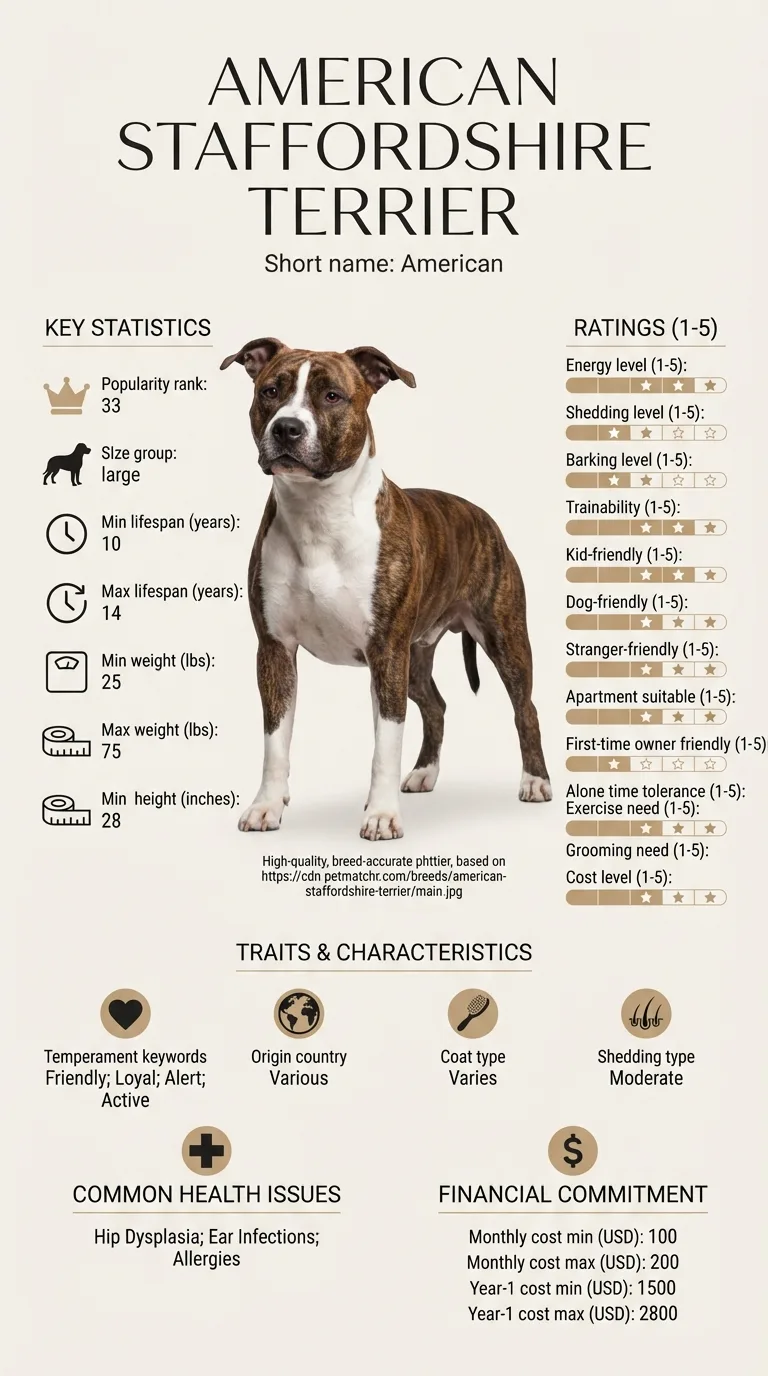
American Staffordshire Terrier or Boxer? On paper they differ most on good with other dogs, and on the scales Boxer is the heavier at 60–70 lbs. Here is how the two compare on everything that shapes an ordinary week.
This is for someone already down to American Staffordshire Terrier and Boxer and deciding between them. For this pair the decision usually turns on good with other dogs, so those are covered first and in most detail. Anyone choosing from a flat has a clear answer here: American Staffordshire Terrier rates 3/5 against 2/5. Breed history is left out; what follows is what you will actually live with.
Quick verdict
Between American Staffordshire Terrier and Boxer, good with other dogs is what separates them, and American Staffordshire Terrier is the lower-effort dog of the two to keep.
Choose american staffordshire terrier if...
Choose American Staffordshire Terrier if you are in a flat or a smaller home, your walking routine is modest and a smaller dog suits your car, your home or your back.
Choose boxer if...
Choose Boxer if there are young children at home, you already have another dog and you want a dog that can keep up with an active routine.
Head-to-head comparison
Feature
american staffordshire terrier
boxer
Winner
Size class
medium
large
Equal
Weight
40–70 lbs
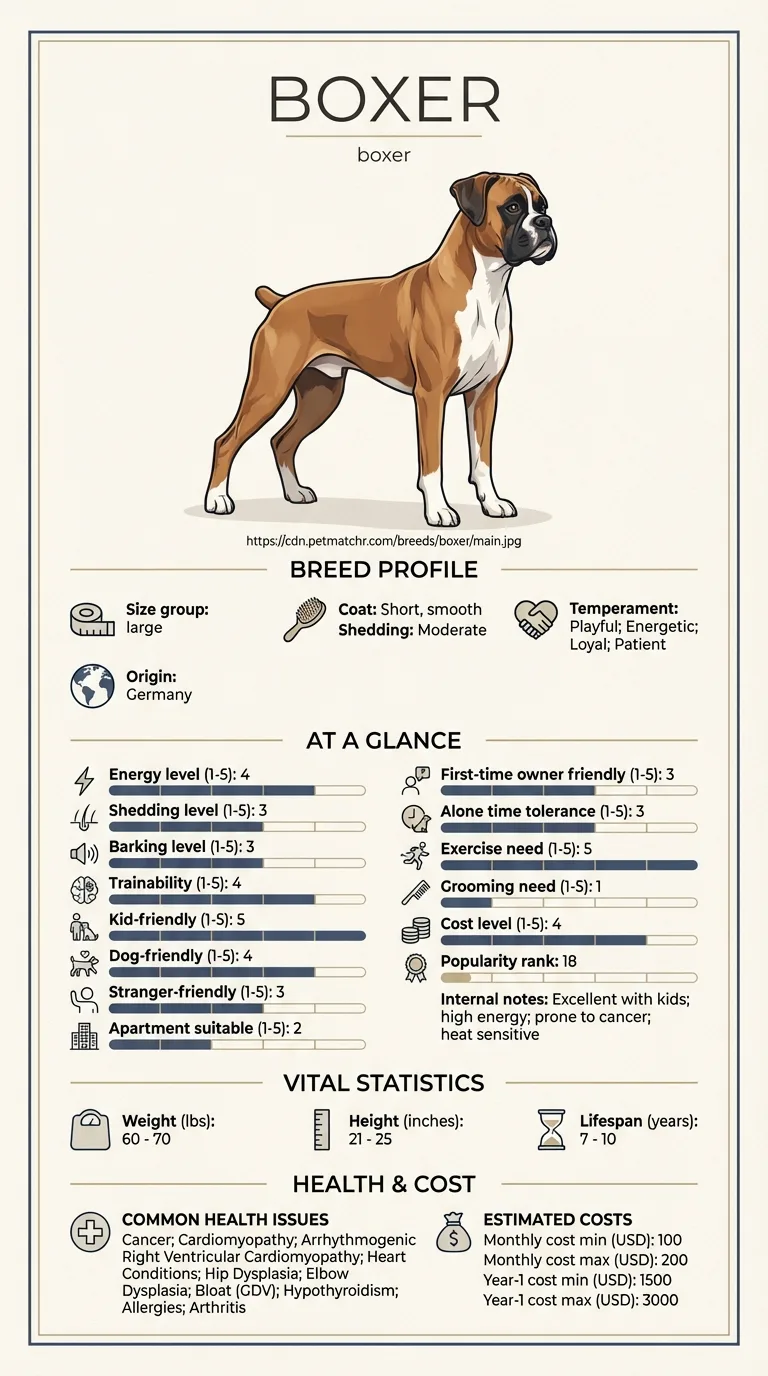
60–70 lbs
Equal
Height
17–19 in
21–25 in
Equal
Lifespan
12–16 years
7–10 years
american staffordshire terrier
Exercise need
High (4/5)
Very high (5/5)
american staffordshire terrier
Grooming need
Very low (1/5)
Very low (1/5)
Equal
Shedding
Moderate (3/5)
Moderate (3/5)
Equal
Energy level
High (4/5)
High (4/5)
Equal
Barking
Low (2/5)
Moderate (3/5)
american staffordshire terrier
Apartment suitability
Moderate (3/5)
Low (2/5)
american staffordshire terrier
Good for first-time owners
Moderate (3/5)
Moderate (3/5)
Equal
Tolerates being alone
Moderate (3/5)
Moderate (3/5)
Equal
Trainability
High (4/5)
High (4/5)
Equal
Good with kids
High (4/5)
Very high (5/5)
boxer
Good with other dogs
Low (2/5)
High (4/5)
boxer
Friendly to strangers
High (4/5)
Moderate (3/5)
american staffordshire terrier
Cost level
Moderate (3/5)
High (4/5)
american staffordshire terrier
Coat
Short, stiff and glossy
Short, smooth
Equal
Origin
Various
Germany
Equal
Typical monthly cost
$100–$200
$100–$200
Equal
Typical first-year cost
$1,400–$2,900
$1,500–$3,000
Equal
Deep dive
Size and build
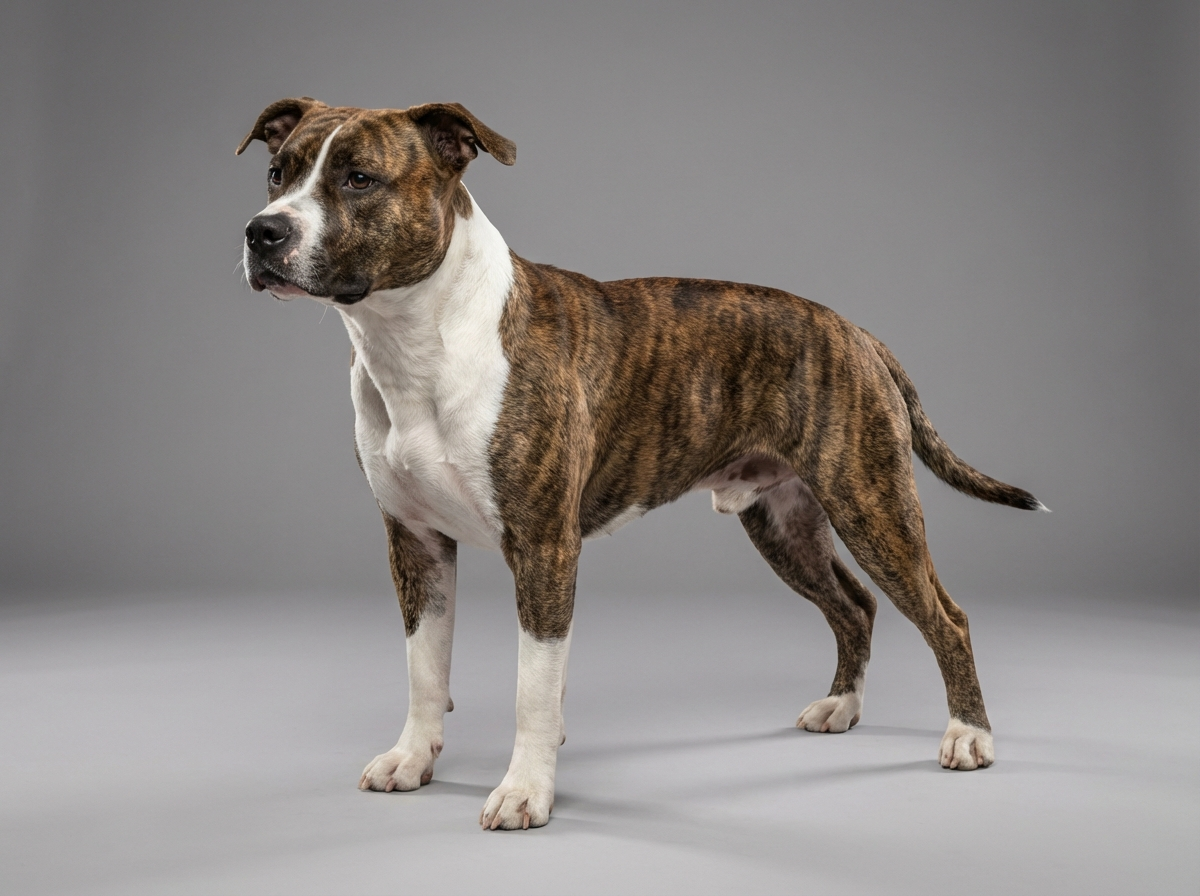
Both breeds sit in similar territory on paper, but the Boxer runs bigger in practice -- 60 to 70 pounds and 21 to 25 inches tall, against the AmStaff's 40 to 70 pounds and 17 to 19 inches. A Boxer's extra height changes how it moves through a house: expect more counter-surfing range and a taller silhouette next to visitors.
Energy and exercise
Both breeds run hot, but the Boxer edges out the AmStaff, rating 5/5 on exercise need against the AmStaff's 4/5. Energy level ties at high (4/5) for both. In practice this means the Boxer wants more than a walk -- it wants a job, a run, or a serious play session, and will find its own entertainment if it doesn't get one.
Grooming and shedding
Grooming needs are identical and minimal for both -- a 1 out of 5, short coats, occasional brushing. Shedding also ties at moderate (3/5). Whichever breed you choose, expect some hair on dark clothing but no professional grooming bills.
Apartment living, noise and time alone
The AmStaff scores slightly better for apartment living (3/5 versus the Boxer's 2/5), and it's also the quieter of the two on paper -- barking rates low (2/5) for the AmStaff against moderate (3/5) for the Boxer. Alone-time tolerance ties at moderate (3/5) for both, so neither is suited to being left for a full workday without a plan.
Training and owner experience
Trainability ties at high (4/5), and both breeds respond well to consistent, positive handling. First-time-owner suitability also ties at moderate (3/5) -- neither is a beginner's breed exactly, since both carry strength and drive that reward an owner who's done this before.
Kids, other dogs and visitors
The Boxer edges ahead with kids (5/5 versus the AmStaff's 4/5) and does notably better with other dogs (4/5 versus 2/5), making it the easier choice for a multi-dog household. The AmStaff comes out ahead with strangers, rating 4/5 against the Boxer's 3/5 -- it tends to warm up to new people a bit more readily.
Health and lifespan
This is the category that matters most for this pairing: the AmStaff's 12 to 16 year lifespan nearly doubles the Boxer's 7 to 10. The Boxer's health list explains why -- cancer, cardiomyopathy, arrhythmogenic right ventricular cardiomyopathy, and general heart conditions all appear, alongside hip and elbow dysplasia, bloat, and arthritis. The AmStaff's list is shorter and less cancer-heavy.
Cost to keep
Cost level rates moderate (3/5) for the AmStaff and high (4/5) for the Boxer, and the dollar figures back that up: $1,500 to $3,000 in year one for the Boxer versus $1,400 to $2,900 for the AmStaff. Given the Boxer's shorter lifespan and heavier cancer and heart risk, budget for higher veterinary costs later in life, even if monthly ranges look similar now ($100-$200 for both).
American Staffordshire Terrier vs Boxer at a glance
American Staffordshire Terrier weighs 40–70 lbs and lives 12–16 years; Boxer weighs 60–70 lbs and lives 7–10 years. The two diverge most on good with other dogs. They are level on tolerates being alone, energy level and good for first-time owners, so those cannot decide it. The comparison marks an easier option only where one exists. Facts like weight and country of origin are not scored. Both dogs are rated from the same dataset, which is what makes the numbers comparable with each other even though any individual dog sits somewhere inside its breed's range.
American Staffordshire Terrier vs Boxer: Which Suits Your Home? - American Staffordshire Terrier vs Boxer at a glance
Frequently asked questions
Which breed lives longer, the AmStaff or the Boxer?
The AmStaff, by a wide margin -- 12 to 16 years against the Boxer's 7 to 10. The Boxer's shorter lifespan tracks with its heavier load of cancer and heart-related conditions.
Is the Boxer's health list really that much longer?
Yes. The Boxer's data lists ten conditions, several of them cardiac (cardiomyopathy, arrhythmogenic right ventricular cardiomyopathy, heart conditions generally) plus cancer, bloat, and arthritis. The AmStaff's list has five: hip dysplasia, cerebellar ataxia, skin allergies, heart disease, and cruciate ligament tears.
Which needs more exercise?
The Boxer, just slightly -- it rates 5/5 on exercise need against the AmStaff's 4/5. Both are high-energy breeds (4/5 on energy level) that need daily vigorous activity, not just a walk around the block.
Which is quieter and better suited to close-quarters living?
The AmStaff, on both counts. It rates low (2/5) for barking versus the Boxer's moderate (3/5), and 3/5 for apartment suitability versus the Boxer's 2/5.
How much should I expect to spend in the first year?
Around $1,400 to $2,900 for an AmStaff and $1,500 to $3,000 for a Boxer. Monthly costs are essentially the same for both, at $100 to $200.
Are either of these breeds good with kids?
Both are, but the Boxer rates higher -- very high (5/5) -- against the AmStaff's high (4/5). The Boxer also does markedly better with other dogs, rating 4/5 versus the AmStaff's 2/5.
Is one better for a first-time owner?
Not really -- both rate moderate (3/5) for first-time owners. Neither is a beginner's breed in the way a Cavalier or Boston Terrier is; both need an owner ready to handle a strong, energetic dog.
If long-term health risk and lifespan matter most to you, the AmStaff's numbers are hard to ignore -- it's projected to live 5 or more years longer. If you want a dog that's easier with other dogs and kids and don't mind the added heart and cancer risk, the Boxer fits.
Costs
How do monthly costs compare?
They're the same on paper -- $100 to $200 for both -- though the Boxer's higher lifetime cancer and heart risk can push actual spending higher later in life.
Behavior
Which dog needs more physical activity?
The Boxer, marginally -- a 5/5 exercise need against the AmStaff's 4/5. Both need daily vigorous exercise, not a casual stroll.
Health
How much longer does the AmStaff typically live?
Roughly 5 years longer on average -- 12 to 16 years versus the Boxer's 7 to 10.
Health information here is general and is not veterinary advice. If your dog shows pain, sudden behaviour change, or worsening symptoms, consult a licensed veterinarian.
Some links on this site are affiliate links. We may earn a commission at no extra cost to you, and we only suggest products we believe are helpful for dog owners.
We research and check what we publish, but we do not warrant that any figure, date, price, or statement is accurate, complete, or current, and we accept no liability for any loss, cost, injury, or other harm arising from the use of this site. Use it as one reference among several. You remain responsible for your own decisions and for your dog's care - confirm anything that matters with a licensed veterinarian or another qualified professional before you act on it. Full disclaimer.