Living
Which is the better fit overall?
The Beagle is the easier default for first-time owners and multi-dog homes; the AmStaff trains more readily if you want a dog that listens closely.

Quick answer
Which is the better fit overall?
The Beagle is the easier default for first-time owners and multi-dog homes; the AmStaff trains more readily if you want a dog that listens closely.
American Staffordshire Terrier or Beagle? On paper they differ most on good with other dogs, and on the scales American Staffordshire Terrier is the heavier at 40–70 lbs. Here is how the two compare on everything that shapes an ordinary week.
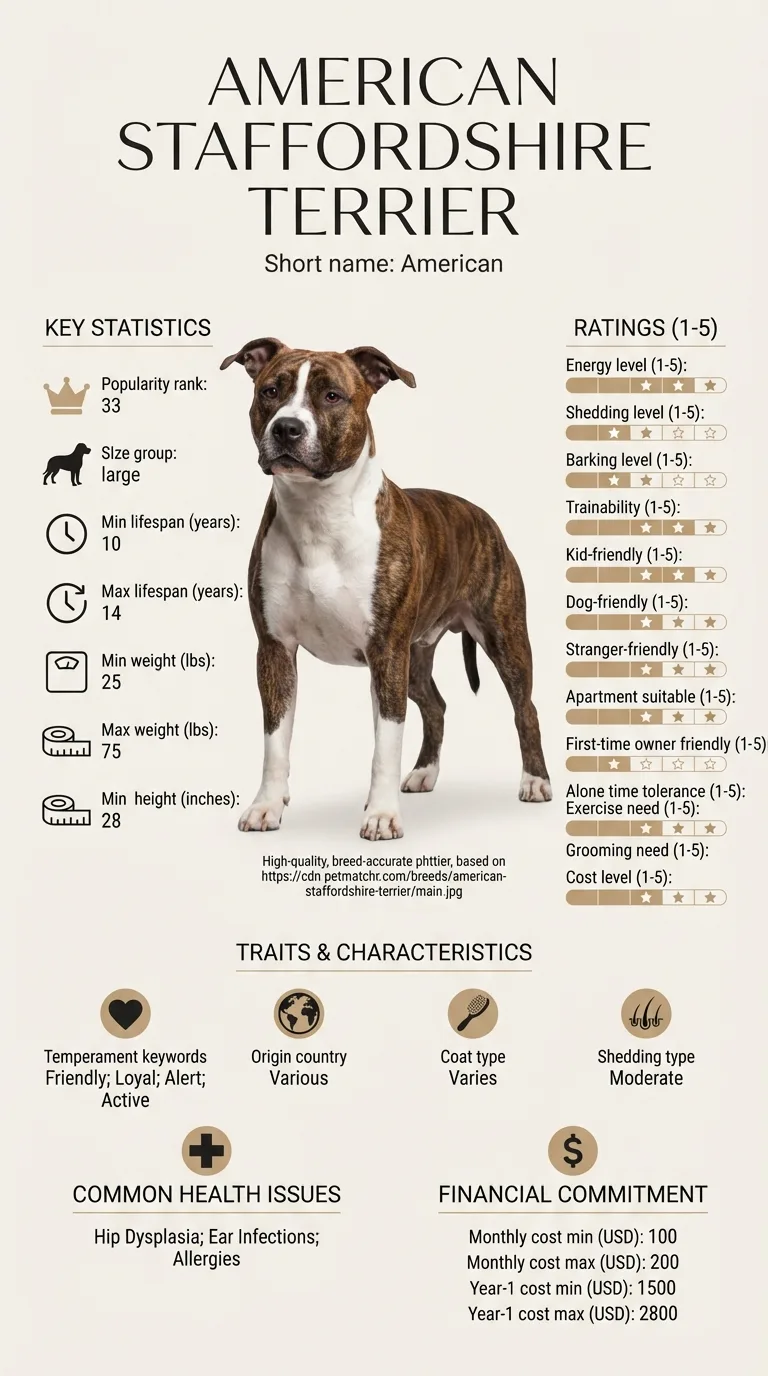
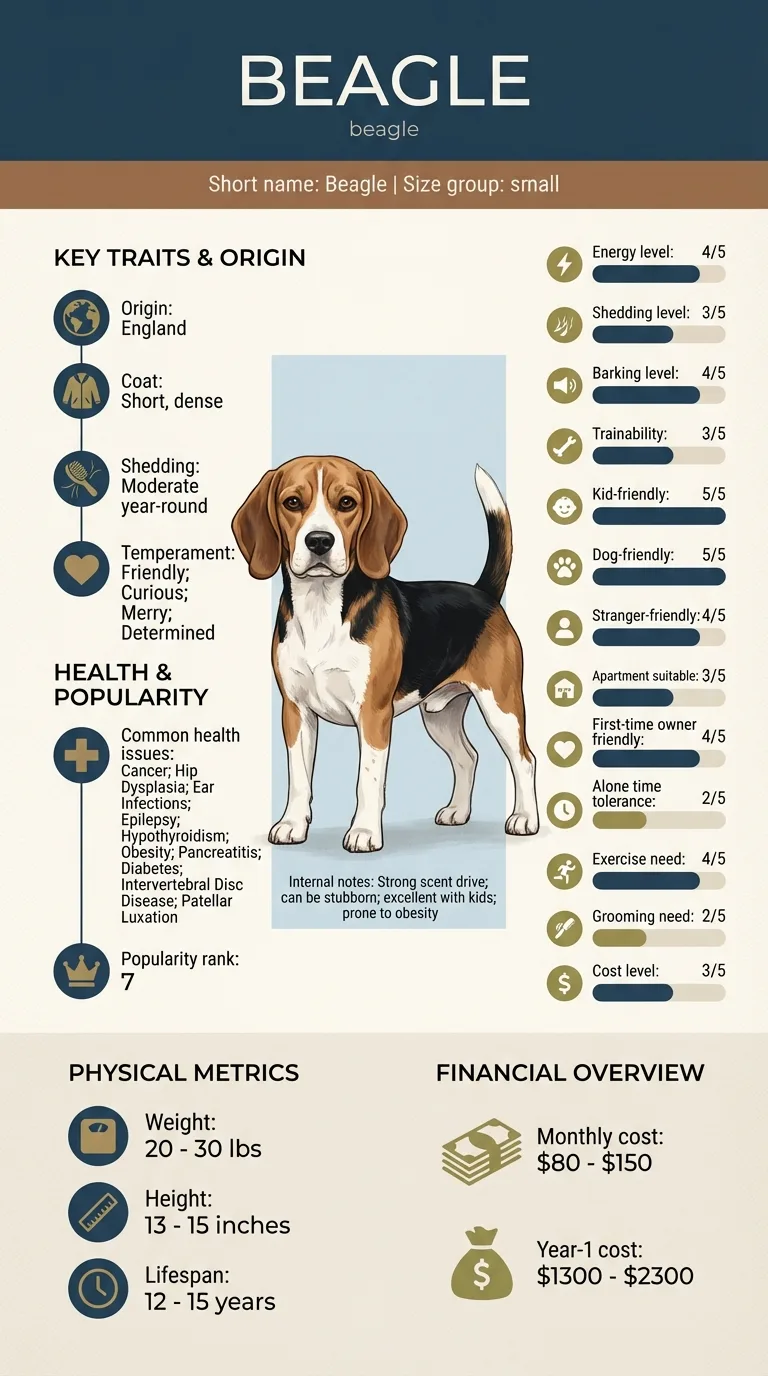
This is for someone already down to American Staffordshire Terrier and Beagle and deciding between them. For this pair the decision usually turns on good with other dogs and barking, so those are covered first and in most detail. Both rate 3/5 for flats, so housing does not settle this one. It is written for the decision rather than the breed history.
Between American Staffordshire Terrier and Beagle, good with other dogs is what separates them, and American Staffordshire Terrier is the lower-effort dog of the two to keep.
Choose American Staffordshire Terrier if you do not want a standing grooming appointment, the dog will be alone during the working day and you want a dog that picks up training quickly.
Choose Beagle if this is your first dog, there are young children at home and you already have another dog.
| Feature | american staffordshire terrier | beagle | Winner |
|---|---|---|---|
| Size class | medium | small | Equal |
| Weight | 40–70 lbs | 20–30 lbs | Equal |
| Height | 17–19 in | 13–15 in | Equal |
| Lifespan | 12–16 years | 12–15 years | american staffordshire terrier |
| Exercise need | High (4/5) | High (4/5) | Equal |
| Grooming need | Very low (1/5) | Low (2/5) | american staffordshire terrier |
| Shedding | Moderate (3/5) | Moderate (3/5) | Equal |
| Energy level | High (4/5) | High (4/5) | Equal |
| Barking | Low (2/5) | High (4/5) | american staffordshire terrier |
| Apartment suitability | Moderate (3/5) | Moderate (3/5) | Equal |
| Good for first-time owners | Moderate (3/5) | High (4/5) | beagle |
| Tolerates being alone | Moderate (3/5) | Low (2/5) | american staffordshire terrier |
| Trainability | High (4/5) | Moderate (3/5) | american staffordshire terrier |
| Good with kids | High (4/5) | Very high (5/5) | beagle |
| Good with other dogs | Low (2/5) | Very high (5/5) | beagle |
| Friendly to strangers | High (4/5) | High (4/5) | Equal |
| Cost level | Moderate (3/5) | Moderate (3/5) | Equal |
| Coat | Short, stiff and glossy | Short, dense | Equal |
| Origin | Various | England | Equal |
| Typical monthly cost | $100–$200 | $80–$150 | Equal |
| Typical first-year cost | $1,400–$2,900 | $1,300–$2,300 | Equal |
The Beagle is a genuine small breed at 20-30 lbs and 13-15 inches, well under half the AmStaff's 40-70 lbs and 17-19 inches. Don't mistake the size gap for an energy gap, though -- these two are closer in drive than their frames suggest, and a Beagle's low weight doesn't mean a low-key dog.
Exercise need and energy level both come in high (4/5) for each breed -- a genuine tie. The Beagle was bred to run a scent trail for hours, and it shows; a bored Beagle finds its own entertainment, usually by following its nose somewhere you didn't intend. Both dogs need a real daily outlet, not just a size-appropriate stroll.
The AmStaff keeps grooming at very low (1/5), the Beagle a touch higher at low (2/5) -- both easy, short-coated breeds that don't ask much beyond a weekly brush. Shedding ties at moderate (3/5) for both, so neither will keep your floors spotless. This is close to a wash between them; you're not choosing based on coat maintenance with this pair.
Apartment suitability ties at moderate (3/5) for both, but barking doesn't: the Beagle rates high (4/5) against the AmStaff's low (2/5). That famous Beagle bay carries, and it's one of the more common complaints from Beagle owners in shared buildings. The AmStaff also tolerates alone time a bit better, moderate (3/5) versus the Beagle's low (2/5).
Trainability favors the AmStaff, high (4/5) against the Beagle's moderate (3/5) -- a nose-driven hound is famously easy to distract mid-lesson. First-time-owner suitability goes to the Beagle, high (4/5) versus moderate (3/5) for the AmStaff, since Beagles are a common, well-understood family breed most novice owners can manage despite the training quirks.
The Beagle rates very high (5/5) with both kids and other dogs, ahead of the AmStaff's high (4/5) with kids and low (2/5) with other dogs -- a meaningful gap if you already have a dog at home or expect frequent playdates. Both greet strangers well, rating high (4/5) each, so neither breed is the reserved, standoffish type around new faces at the door.
Lifespans sit close, 12-16 years for the AmStaff and 12-15 for the Beagle. The Beagle's health list runs to ten items, including epilepsy, pancreatitis, diabetes, and intervertebral disc disease, plus a hip dysplasia risk it shares with the AmStaff. The AmStaff's shorter five-item list adds cerebellar ataxia and heart disease, so the two breeds carry different, not overlapping, sets of concerns beyond hip dysplasia.
Both rate moderate (3/5) on cost level, and the Beagle runs slightly cheaper in practice -- $80-150 monthly and $1,300-2,300 for year one, against $100-200 and $1,400-2,900 for the AmStaff. Neither breed is a budget outlier in either direction, so this comparison probably shouldn't be decided on price alone -- look instead at exercise needs and how each fits your household.
American Staffordshire Terrier weighs 40–70 lbs and lives 12–16 years; Beagle weighs 20–30 lbs and lives 12–15 years. The two diverge most on good with other dogs and barking. They are level on apartment suitability, cost level and energy level, so those cannot decide it. In the table, a "winner" means easier for an ordinary household — not better. Size, coat and origin are recorded without a verdict. Because both breeds are scored the same way, the gaps are reliable even where the absolute numbers are rough.

The AmStaff by a wide margin -- 40-70 lbs against the Beagle's 20-30.
Neither, really -- both rate high (4/5) for exercise need and energy level.
The Beagle, rated high (4/5) against the AmStaff's low (2/5). That bay is a real consideration in close-quarters living.
The Beagle, high (4/5) versus moderate (3/5) for the AmStaff, despite being the harder of the two to train.
Close, with the Beagle a bit cheaper -- $80-150 a month versus $100-200 for the AmStaff.
Hip dysplasia appears on both lists. Otherwise the Beagle's risks skew toward metabolic issues like diabetes and pancreatitis, while the AmStaff's skew toward joints and heart.
The Beagle, rated very high (5/5) against the AmStaff's low (2/5) -- a real factor for multi-dog homes.
The Beagle is the easier default for first-time owners and multi-dog homes; the AmStaff trains more readily if you want a dog that listens closely.
The Beagle, $80-150 versus $100-200 for the AmStaff.
Neither -- both rate high (4/5) for exercise need.
About the same, with the AmStaff's range running slightly higher -- 12-16 years versus 12-15 for the Beagle.
Secure checkout on Stripe. We never see your card.
7-day money-back guarantee. Instant access.
Health information here is general and is not veterinary advice. If your dog shows pain, sudden behaviour change, or worsening symptoms, consult a licensed veterinarian.
Some links on this site are affiliate links. We may earn a commission at no extra cost to you, and we only suggest products we believe are helpful for dog owners.
We research and check what we publish, but we do not warrant that any figure, date, price, or statement is accurate, complete, or current, and we accept no liability for any loss, cost, injury, or other harm arising from the use of this site. Use it as one reference among several. You remain responsible for your own decisions and for your dog's care - confirm anything that matters with a licensed veterinarian or another qualified professional before you act on it. Full disclaimer.
Match your lifestyle to the right dog.
Take quizNot sure which breed is right for you? Take our 2-minute quiz to find out.
Take the quiz