Behavior
Which is the better overall pick?
For most households, the APBT — cheaper to keep, longer-lived, and better rated with kids and strangers. The Rottweiler mix appeals if you want more size and don't mind the added cost.

Quick answer
Which is the better overall pick?
For most households, the APBT — cheaper to keep, longer-lived, and better rated with kids and strangers. The Rottweiler mix appeals if you want more size and don't mind the added cost.
American Pit Bull Terrier or Rottweiler Mix? On paper they differ most on cost level, and on the scales Rottweiler Mix is the heavier at 80–135 lbs. Here is how the two compare on everything that shapes an ordinary week.
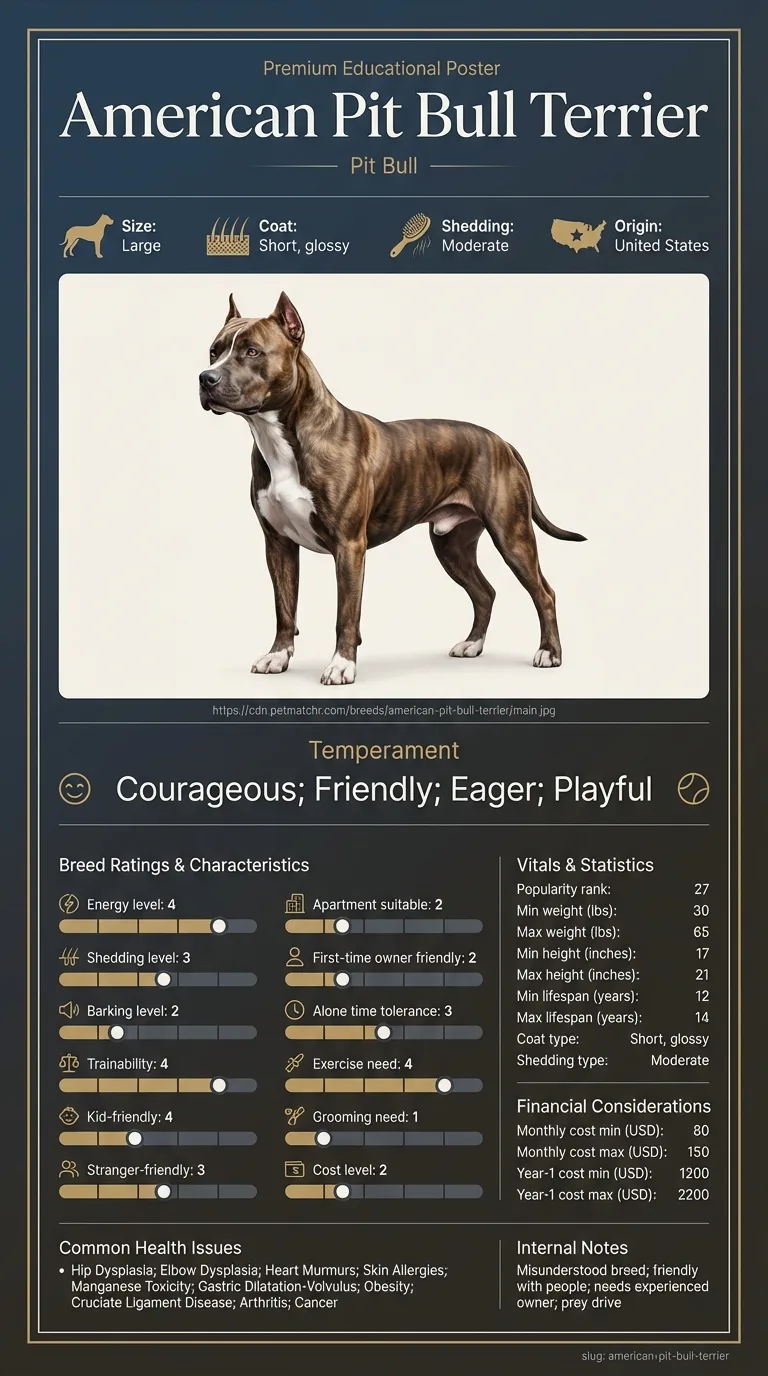
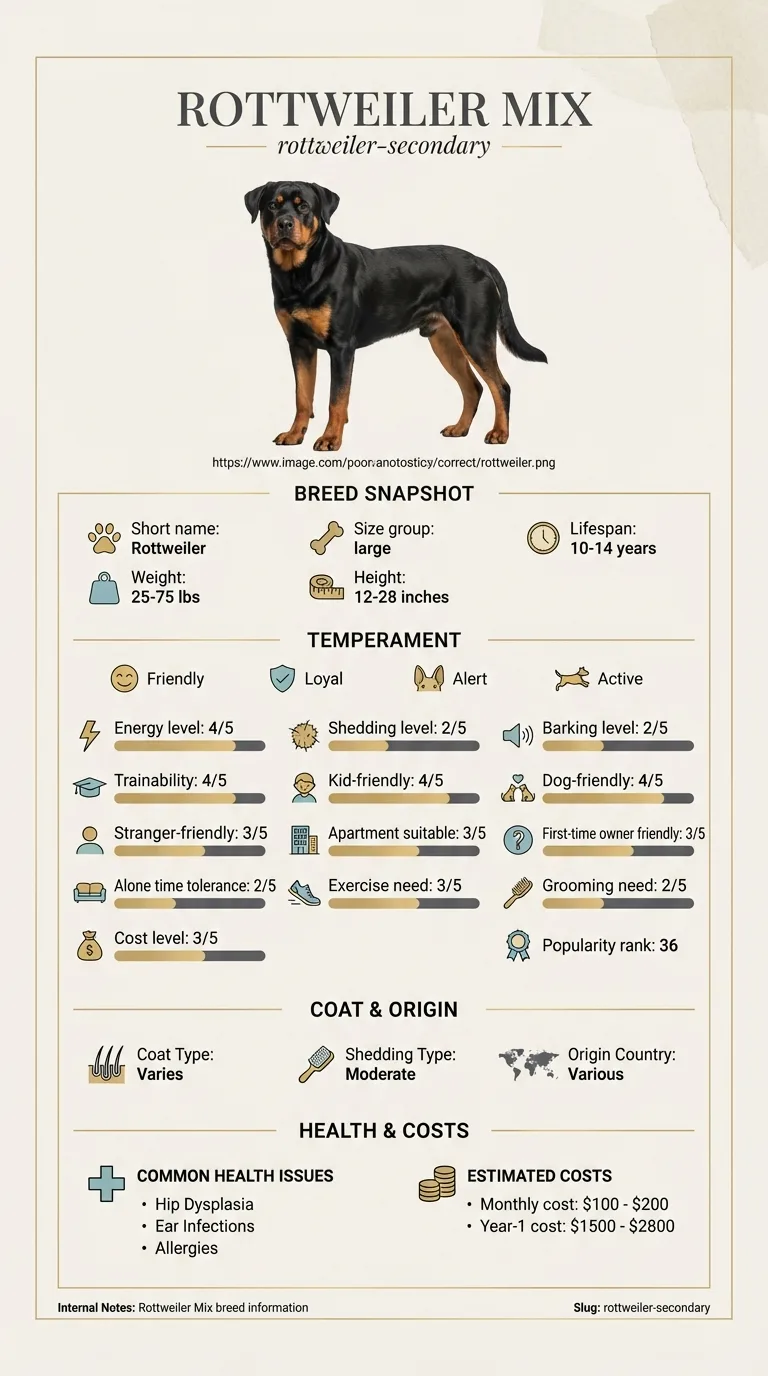
This is for someone already down to American Pit Bull Terrier and Rottweiler Mix and deciding between them. For this pair the decision usually turns on cost level, so those are covered first and in most detail. Both rate 2/5 for flats, so housing does not settle this one. The focus throughout is on daily consequences rather than breed background.
Between American Pit Bull Terrier and Rottweiler Mix, cost level is what separates them, and American Pit Bull Terrier is the lower-effort dog of the two to keep.
Choose American Pit Bull Terrier if you do not want a standing grooming appointment, there are young children at home and a smaller dog suits your car, your home or your back.
Choose Rottweiler Mix if you want a dog that is more watchful with visitors.
| Feature | american pit bull terrier | rottweiler secondary | Winner |
|---|---|---|---|
| Size class | large | large | Equal |
| Weight | 30–65 lbs | 80–135 lbs | Equal |
| Height | 17–21 in | 22–27 in | Equal |
| Lifespan | 12–14 years | 9–10 years | american pit bull terrier |
| Exercise need | High (4/5) | High (4/5) | Equal |
| Grooming need | Very low (1/5) | Low (2/5) | american pit bull terrier |
| Shedding | Moderate (3/5) | Moderate (3/5) | Equal |
| Energy level | High (4/5) | Moderate (3/5) | Equal |
| Barking | Low (2/5) | Low (2/5) | Equal |
| Apartment suitability | Low (2/5) | Low (2/5) | Equal |
| Good for first-time owners | Low (2/5) | Low (2/5) | Equal |
| Tolerates being alone | Moderate (3/5) | Moderate (3/5) | Equal |
| Trainability | High (4/5) | High (4/5) | Equal |
| Good with kids | High (4/5) | Moderate (3/5) | american pit bull terrier |
| Good with other dogs | Low (2/5) | Low (2/5) | Equal |
| Friendly to strangers | Moderate (3/5) | Low (2/5) | american pit bull terrier |
| Cost level | Low (2/5) | High (4/5) | american pit bull terrier |
| Coat | Short, glossy | Short, dense double coat | Equal |
| Origin | United States | Various | Equal |
| Typical monthly cost | $80–$150 | $110–$240 | Equal |
| Typical first-year cost | $1,200–$2,200 | $1,700–$3,200 | Equal |
Weight is where these two split hardest: an American Pit Bull Terrier tops out around 65 lbs, while a Rottweiler mix can run 80 to 135 lbs and stand up to 27 inches at the shoulder. Both get filed under "large," but you're looking at two different dogs to lift into a car or hold on a leash. The Rottweiler mix's extra 50-plus pounds changes what kind of harness, crate and vehicle space you need.
Both breeds rate a 4 out of 5 on exercise need, so neither is a couch companion. The APBT tends to channel that energy into sprinting and tug-style play, while a Rottweiler mix's build favors steadier work like hauling weight or long walks. Plan on 60-plus minutes of real exertion daily for either one, not just a stroll around the block.
The APBT's short coat needs almost nothing — occasional brushing, done. The Rottweiler mix scores a 2 out of 5 for grooming, thanks to a denser double coat, and sheds at the same moderate rate (3/5) as the APBT. Expect a bit more brushing and more hair on the couch with the mix, though neither breed needs professional grooming.
Neither dog is an apartment natural — both land at 2 out of 5 for apartment suitability and moderate for tolerating being left alone. Barking is low for both, so noise complaints aren't the issue; space and exercise access are. A house with a yard suits either breed better than a fifth-floor walk-up.
Both breeds score 4 out of 5 on trainability, and both also score low (2/5) for first-time-owner suitability. That combination — smart and trainable, but not forgiving of a passive handler — means you need to actually do the training, not just own a naturally easy dog. Prior experience with a strong, motivated breed helps with either one.
The APBT edges ahead with kids (4/5 vs. 3/5) and with strangers (3/5 vs. 2/5), while both breeds share the same low rating with other dogs (2/5). If you're picturing a dog that greets houseguests warmly, the APBT's temperament list — friendly, playful — backs that up more than the Rottweiler mix's watchful, steady profile. Neither is a natural fit for a multi-dog household without careful introductions.
The APBT is the longer-lived pick here — 12 to 14 years against 9 to 10 for the Rottweiler mix, a real gap. Both breeds carry hip and elbow dysplasia risk and cruciate ligament issues. The Rottweiler mix's list adds osteosarcoma and subaortic stenosis, two serious cancer and cardiac risks worth asking a breeder or vet about specifically.
Money is the clearest split on this page: APBT ownership runs $80-150 a month and $1,200-2,200 in year one, while a Rottweiler mix runs $110-240 a month and $1,700-3,200 in year one. Larger dogs eat more, need bigger everything, and often cost more at the vet — budget accordingly if you're leaning toward the mix.
American Pit Bull Terrier weighs 30–65 lbs and lives 12–14 years; Rottweiler Mix weighs 80–135 lbs and lives 9–10 years. The two diverge most on cost level. They are level on tolerates being alone, apartment suitability and barking, so those cannot decide it. The table below marks a winner only where one breed is genuinely easier for a typical owner; size and origin are facts rather than merits and stay level. Ratings come from one source applied to both breeds, so they are meaningful against each other rather than as absolute scores.

Considerably — a Rottweiler mix can weigh 80 to 135 lbs and stand up to 27 inches, versus 30 to 65 lbs and 17 to 21 inches for the APBT. Even the low end of the mix's range beats the APBT's high end.
They're close — both rate moderate (3/5) — but neither is a low-shedding breed. Expect regular vacuuming with either dog, especially during seasonal coat blows.
Not really — both score just 2 out of 5 for first-time-owner suitability. Both need an owner ready to handle a strong, high-energy dog with consistent training from day one.
The APBT, by a wide margin — 12 to 14 years versus 9 to 10 for the Rottweiler mix. That's two to five extra years of companionship on average.
The APBT, at $80-150 a month against $110-240 for the Rottweiler mix. The gap traces mostly to size — food, medication and preventive care scale with body weight.
Yes — both are prone to hip dysplasia, elbow dysplasia, and cruciate ligament problems. Where they diverge is the Rottweiler mix's added cardiac and cancer risk (subaortic stenosis, osteosarcoma).
The APBT rates higher on both — 4/5 with kids versus 3/5, and 3/5 with strangers versus 2/5. Neither substitutes for supervision and socialization, but the data favors the APBT here.
For most households, the APBT — cheaper to keep, longer-lived, and better rated with kids and strangers. The Rottweiler mix appeals if you want more size and don't mind the added cost.
About $30-90 more per month for the Rottweiler mix ($110-240 vs. $80-150 for the APBT), driven mainly by its larger body size.
Both need real daily exercise — both rate 4 out of 5. Figure on 60 minutes-plus of active exercise, not just leash walks.
The APBT, averaging 12-14 years versus 9-10 for the Rottweiler mix.
Secure checkout on Stripe. We never see your card.
7-day money-back guarantee. Instant access.
Health information here is general and is not veterinary advice. If your dog shows pain, sudden behaviour change, or worsening symptoms, consult a licensed veterinarian.
Some links on this site are affiliate links. We may earn a commission at no extra cost to you, and we only suggest products we believe are helpful for dog owners.
We research and check what we publish, but we do not warrant that any figure, date, price, or statement is accurate, complete, or current, and we accept no liability for any loss, cost, injury, or other harm arising from the use of this site. Use it as one reference among several. You remain responsible for your own decisions and for your dog's care - confirm anything that matters with a licensed veterinarian or another qualified professional before you act on it. Full disclaimer.
Match your lifestyle to the right dog.
Take quizNot sure which breed is right for you? Take our 2-minute quiz to find out.
Take the quiz