Health
Is liver disease common in Shelties?
No. It is not among the five conditions documented for the breed, and the recognised hepatitis predispositions belong to other breeds entirely.

Quick answer
Is liver disease common in Shelties?
No. It is not among the five conditions documented for the breed, and the recognised hepatitis predispositions belong to other breeds entirely.
Liver disease is the great imitator. It produces vague signs, it is found on bloodwork more often than by symptoms, and by the time a dog looks ill a great deal of liver tissue has already been lost.
Owners handed a blood report with raised liver enzymes and no symptoms to match. People whose older Sheltie has become picky about food and lost weight. Anyone trying to understand why a liver problem in this particular breed complicates medication choices.
This guide is not medical advice. If your dog shows pain, sudden behavior change, or worsening symptoms, consult a licensed veterinarian.
Some links may be affiliate links. We may earn a commission at no extra cost to you. We only suggest products we believe are helpful for dog owners.
We research and check what we publish, but we do not warrant that any figure, date, price, or statement is accurate, complete, or current, and we accept no liability for any loss, cost, injury, or other harm arising from the use of this site. Use it as one reference among several. You remain responsible for your own decisions and for your dog's care - confirm anything that matters with a licensed veterinarian or another qualified professional before you act on it. Full disclaimer.
Chronic hepatitis is ongoing inflammation of liver tissue that progressively replaces functioning cells with fibrous scar. In some breeds the driver is copper accumulating in the liver because of an inherited defect in how it is excreted; in others the cause is never identified. The liver's spare capacity means signs appear late, so this is a disease found by bloodwork far more often than by an owner noticing something. It is managed rather than cured, and how well it is managed depends heavily on catching it before extensive scarring.
Uncommon generally and not documented in the Shetland Sheepdog. Raised liver enzymes, by contrast, are found regularly on routine senior bloodwork in dogs of every breed and usually resolve into something other than chronic hepatitis. Given a 12 to 14 year lifespan, most Sheltie owners will encounter an abnormal liver value at some point and very few will encounter genuine chronic liver disease.
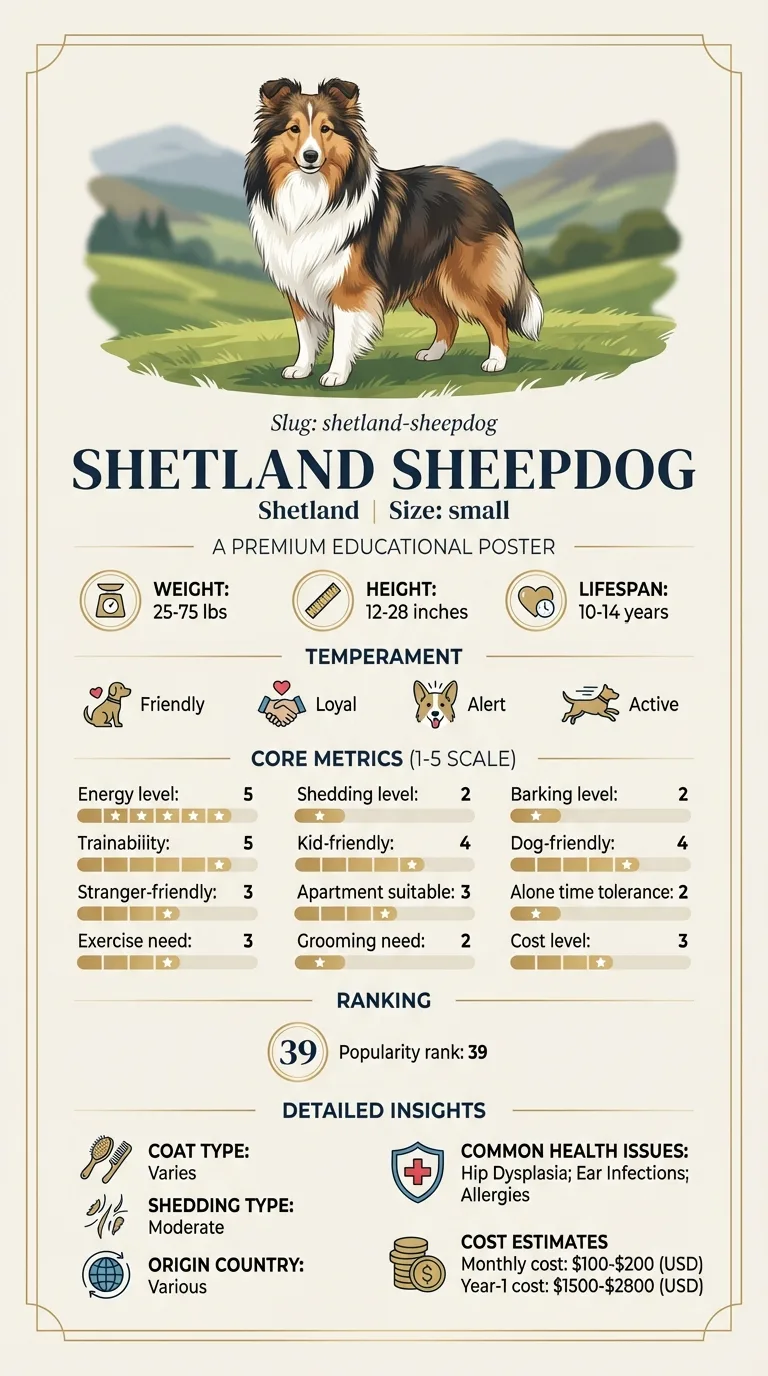
The Shetland Sheepdog carries no documented liver predisposition and no known copper storage defect. Where the breed genuinely intersects with liver medicine is in drug handling. MDR1 drug sensitivity is documented here, and the protein it encodes contributes to biliary drug excretion as well as to the blood-brain barrier. A Sheltie with liver disease therefore has two potential reasons for altered drug handling rather than one. Hypothyroidism, also documented in the breed, is a further indirect link, since thyroid disease commonly raises liver enzyme values without any liver disease being present.
Toxin exposure is the environmental route that matters most, and it is largely preventable. Xylitol in sugar-free products, certain mushrooms, blue-green algae in stagnant summer water and various human medications all damage canine liver tissue, sometimes catastrophically and sometimes within hours. Mouldy food from bins and compost is another route. A curious herding dog with a strong interest in scavenging is exactly the patient who finds these, and a reliable leave it cue is a genuine liver protection measure.
Go to an emergency hospital immediately for jaundice with collapse, for seizures or disorientation and head pressing, for a rapidly swelling abdomen, for uncontrolled bleeding or dark tarry stools, or for any suspected poisoning, which is time critical and far more treatable in the first hour. Seek a prompt appointment for yellowing of the gums or eye whites in an otherwise stable dog, for persistent vomiting, for unexplained weight loss, or for a marked increase in thirst. If routine bloodwork shows raised liver enzymes without symptoms, ask what the recheck plan is and whether a bile acid test to assess function is appropriate rather than accepting an unexplained number.
See all Shetland Sheepdog health problems, which breeds are prone to chronic active hepatitis, or the full Shetland Sheepdog breed guide for temperament, exercise needs and ownership costs.
Investigating an abnormal liver value usually takes four to eight weeks across a recheck, function testing and imaging. Where chronic hepatitis is confirmed, treatment is lifelong with bloodwork every few months. Existing scar tissue does not resolve, though inflammation can often be controlled and progression slowed considerably.
In most Shelties, success is an abnormal number that turns out to have a mundane explanation and normalises on recheck. Where real disease exists, success is stable bloodwork, a dog eating well and maintaining weight, and progression slowed enough that the liver lasts as long as the rest of the dog does.
The presentation is frustratingly nonspecific early on and becomes distinctive only late. Knowing both ends of that range helps you judge urgency.
The protein encoded by the MDR1 gene does two relevant things. It sits in the blood-brain barrier, pumping certain drug molecules out of the central nervous system, and it also appears in liver cells contributing to biliary excretion, one of the routes by which the body clears drugs. A dog with a faulty version has reduced capacity in both places.
Now layer a diseased liver on top. Long-term treatment of chronic hepatitis involves medication given for months or years, and a liver that is scarred processes drugs less efficiently than a healthy one. In a Shetland Sheepdog, which carries a documented MDR1 drug sensitivity, you can end up with two independent reasons for a standard dose to behave abnormally. That is not a reason to withhold treatment, and it is a very strong reason for your vet to know the genotype before writing the prescription.
The practical instruction is simple: if your Sheltie has abnormal liver values, get MDR1 tested if it has not been done already, and make sure the result is in the file at every practice that treats her. A cheek swab and a two week wait is a small price for removing a variable from a long treatment course.
The other thing worth understanding is that raised liver enzymes are a finding, not a diagnosis. They rise in response to many things, including medications the dog is already taking, hormonal disease such as the hypothyroidism documented in this breed, dental infection, and simple age-related nodular change that means nothing at all. A vet will usually recheck, run a bile acid test to assess actual liver function rather than damage, and image the liver before anything invasive is considered.

Errol was eleven when a pre-anesthetic blood panel before a dental showed liver enzymes at roughly three times the upper limit. He had no symptoms at all. His owner Lorna had spent the previous week reading about liver failure and arrived at the recheck expecting bad news. The vet worked through his medication list and found he had been on a long course of an anti-inflammatory for a stiff hip, prescribed months earlier and never formally reviewed. The drug was stopped, the values were rechecked after four weeks and had fallen to within normal range, and a bile acid test confirmed normal liver function. His MDR1 test, done at the same time, showed one faulty copy, which was recorded before the dental was rescheduled. Errol had his teeth done six weeks later without incident.
Key takeaway: An abnormal liver value is a question, not a verdict. The first place to look is the medication list nobody has reviewed.
It is not documented for the breed. The recognised predispositions sit with Dobermanns, Bedlington Terriers, West Highland Whites, Cocker Spaniels and Labradors, several linked to inherited copper storage. A Sheltie with hepatitis is an individual case, not a breed pattern.
That is a common and usually undramatic situation. Enzymes indicate cell disturbance rather than failing function. Expect your vet to recheck after a few weeks, assess actual function with a bile acid test, and consider imaging before anything more.
Enzymes measure damage. Function is measured by bile acids, albumin, glucose, clotting and bilirubin. A dog can have markedly raised enzymes with entirely normal function, which is why one abnormal number is not a diagnosis.
Treat it as urgent. Yellowing of the gums, eye whites or inner ears means bilirubin is accumulating, and the causes range from liver disease to bile duct obstruction to destruction of red blood cells. It needs same-day assessment.
Not on your own initiative. Some supplements are used in veterinary liver protocols and some interfere with medication or with test results. Ask your vet rather than adding something before the diagnosis is complete.
Not always, but it is the only way to distinguish the types of chronic hepatitis and to measure copper in the tissue, which determines treatment. It requires anesthesia, which is why MDR1 status should be known first in this breed.
No. It is not among the five conditions documented for the breed, and the recognised hepatitis predispositions belong to other breeds entirely.
Check the whites of the eyes, the gums and the inside of the ear flap. Coat colour tells you nothing, so look at bare tissue.
No. They indicate cell disturbance. Function is assessed separately with bile acids and other tests before any conclusion is drawn.
The gene affects drug handling, and a scarred liver clears drugs less well. Two overlapping factors make the genotype important information.
Repeat bloodwork, imaging and possibly biopsy under anesthesia run well beyond the breed's usual eighty to a hundred and fifty dollar monthly spend.
A one-page prep sheet for this condition: the signs, the questions to ask, what to get priced. Unlocks here.
You get: Vet visit prep sheet
No spam. One-click unsubscribe. See our privacy policy.
Preview page 1 before you decide.