Health
What is von Willebrand's disease in dogs?
An inherited deficiency of a blood clotting protein that can cause excessive bleeding from injury or surgery.

Quick answer
What is von Willebrand's disease in dogs?
An inherited deficiency of a blood clotting protein that can cause excessive bleeding from injury or surgery.
A dog with this condition can look and act completely healthy for its entire life until a specific moment, surgery, a deep cut, or trauma, exposes the underlying clotting problem all at once.
This is most relevant to owners scheduling any surgical procedure, including a routine spay or neuter, since knowing a dog's von Willebrand status ahead of time changes how a vet approaches even a straightforward procedure.
This guide is not medical advice. If your dog shows pain, sudden behavior change, or worsening symptoms, consult a licensed veterinarian.
Some links may be affiliate links. We may earn a commission at no extra cost to you. We only suggest products we believe are helpful for dog owners.
Check this first
Excessive, hard-to-stop bleeding from any wound, prolonged bleeding after a nail trim, blood in the urine or stool, or unusual bruising should prompt an urgent vet visit, since these can indicate a significant clotting problem, whether previously diagnosed or not, that needs specific management.
A known von Willebrand's diagnosis without any active bleeding is not itself an emergency; it's a standing piece of medical information that should be shared proactively with any vet performing surgery or an invasive procedure, so appropriate precautions, like having compatible blood products available, can be arranged in advance.
The most useful practical framing for owners is that this condition is largely about preparation rather than day-to-day monitoring: a dog with known von Willebrand's disease that never needs surgery or sustains a major injury may never have a clinical bleeding event at all, but the same dog undergoing an unplanned emergency procedure without that information on record faces meaningfully higher risk.
If any of these apply, call your vet or an emergency clinic now. The rest of this page is for the cases that are not an emergency.
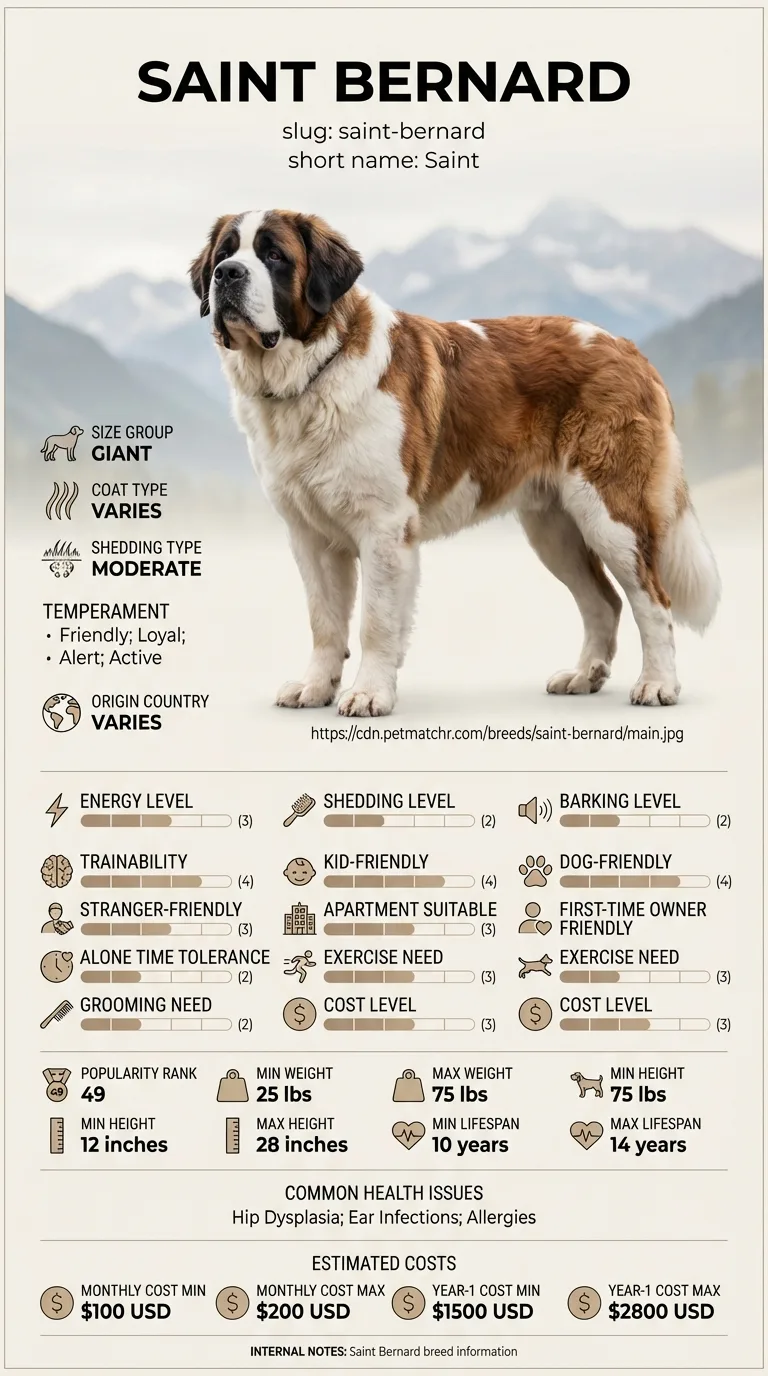
Von Willebrand's disease is an inherited deficiency or dysfunction of a protein essential to normal blood clotting, and it's notable for how invisible it typically is in daily life. A Saint Bernard can carry this condition and show no signs at all until a surgery, deep wound, or significant trauma reveals a clotting problem that had been present, unnoticed, all along, which is exactly why proactive testing matters more than watching for symptoms.
Von Willebrand's disease is a well-documented inherited condition across a range of breeds, and while it's not universally present in all Saint Bernard lines, its potential presence is significant enough that pre-surgical screening is a reasonable precaution.
Von Willebrand's disease results from an inherited gene mutation affecting production or function of von Willebrand factor, and the condition's prevalence varies by specific bloodline rather than applying uniformly across an entire breed, meaning individual testing is far more informative than assuming risk based on breed alone.
This is a purely genetic condition with no environmental cause, but environmental and situational factors, specifically surgery, trauma, or certain medications, are what actually trigger a clinically significant bleeding episode in a dog that carries the underlying genetic deficiency.
Talk to your vet about screening before any surgical procedure, and about any unusual or prolonged bleeding from an injury or nail trim. Excessive, hard-to-stop bleeding, blood in urine or stool, or unusual bruising need an urgent vet visit.
Because this condition is often invisible until a bleeding event happens, a few gaps in awareness and planning create real risk.
See all Saint Bernard health problems, which breeds are prone to von willebrands disease, or the full Saint Bernard breed guide for temperament, exercise needs and ownership costs.
Testing can be done at any age and provides a result within days to a couple of weeks, and because this condition is lifelong, its practical relevance is ongoing, most notably resurfacing before any future surgery or significant medical procedure.
Success means having a known status on record well before it's urgently needed, allowing any future surgery or injury to be managed with appropriate precautions in advance rather than being discovered as a crisis during an unplanned bleeding event.
Before Yukon's neuter surgery, Peter's vet recommended a von Willebrand's factor screening as a standard precaution for the breed. The test came back showing a moderate deficiency, information that would have gone unnoticed without the screening, since Yukon had never had any bleeding issues from minor cuts before. With that information in hand, Yukon's surgical team took specific precautions, including having compatible blood products on standby, and the neuter proceeded without any excessive bleeding. Peter now keeps Yukon's test results on file to share with any future vet.
Key takeaway: Yukon had shown zero signs of a clotting problem his entire life, and it was the proactive screening before a routine surgery, not any prior symptom, that caught a real risk before it became a crisis on the operating table.
It's an inherited deficiency or dysfunction of von Willebrand factor, a protein essential for normal blood clotting, which can cause excessive bleeding from injuries or during surgery in affected dogs.
A specific blood test measuring von Willebrand factor levels can confirm the diagnosis, and genetic testing is available for certain breeds to identify carriers and affected dogs before any bleeding episode occurs.
No, severity varies significantly. Some affected dogs have only mildly reduced clotting factor and may never experience a notable bleeding episode, while others have more severe deficiency and higher bleeding risk during surgery or injury.
No, it's a lifelong genetic condition, but it can be managed by informing vets ahead of any procedure and, in some cases, using specific treatments or blood products around surgery to reduce bleeding risk.
Yes, typically, but the procedure should be planned with the diagnosis in mind, often including precautions like having compatible blood products on hand and possibly a more conservative surgical approach.
It's a documented genetic condition across several breeds, and testing is the only reliable way to know an individual dog's status rather than assuming based on breed alone.
The screening or genetic test itself is relatively affordable, though any additional surgical precautions needed for a confirmed affected dog can add a modest cost to procedures that would otherwise be routine.
An inherited deficiency of a blood clotting protein that can cause excessive bleeding from injury or surgery.
A specific blood test measuring clotting factor levels, or genetic testing, confirms the diagnosis.
Yes, with proper precautions and advance planning informed by the diagnosis.
Yes, genetic testing helps avoid pairings that could produce affected puppies.
No, it's a relatively affordable one-time test compared to most veterinary diagnostics.
A one-page prep sheet for this condition: the signs, the questions to ask, what to get priced. Unlocks here.
You get: Vet visit prep sheet
No spam. One-click unsubscribe. See our privacy policy.
Preview page 1 before you decide.