Living
Which is bigger?
The Vizsla, at 45–65 lbs versus the Shiba Inu's 17–23 lbs.

Quick answer
Which is bigger?
The Vizsla, at 45–65 lbs versus the Shiba Inu's 17–23 lbs.
Shiba Inu or Vizsla? On paper they differ most on apartment suitability, and on the scales Vizsla is the heavier at 45–65 lbs. Here is how the two compare on everything that shapes an ordinary week.
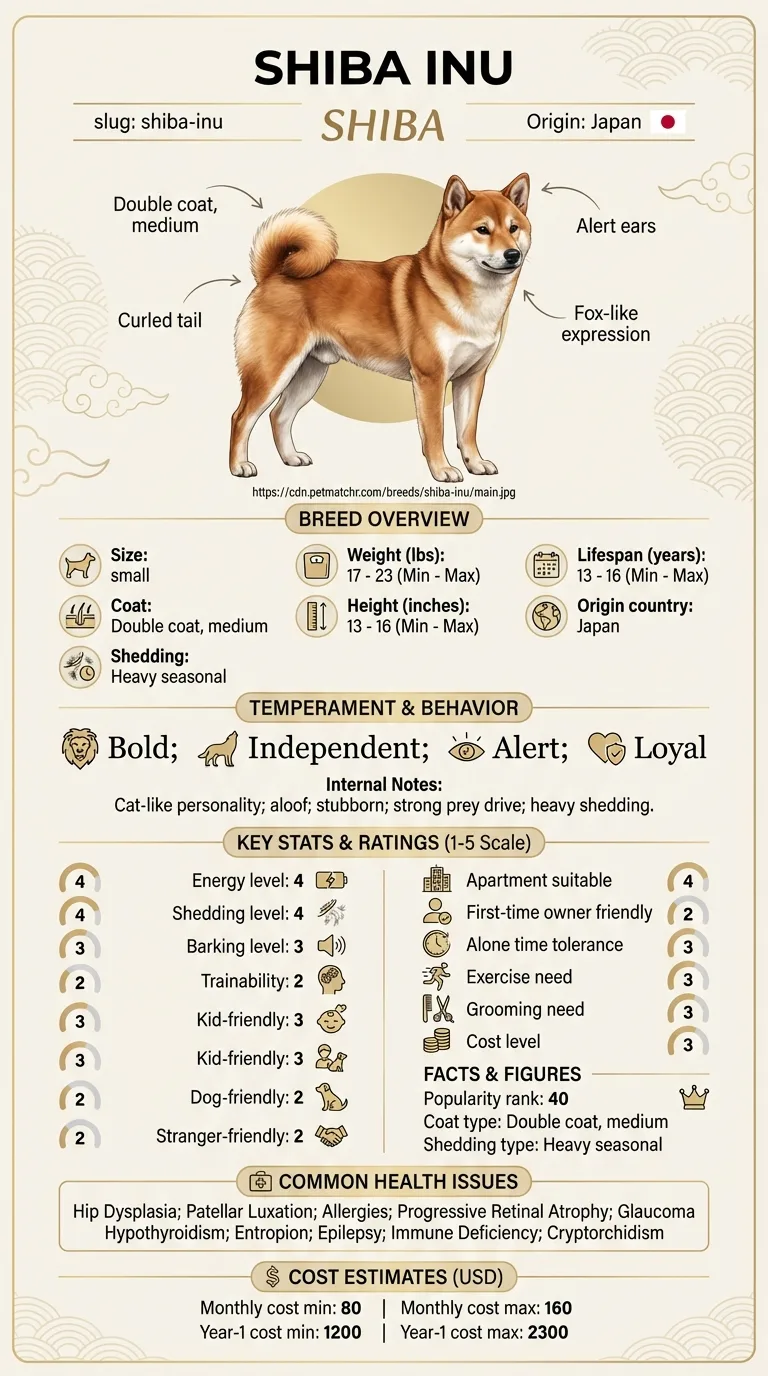
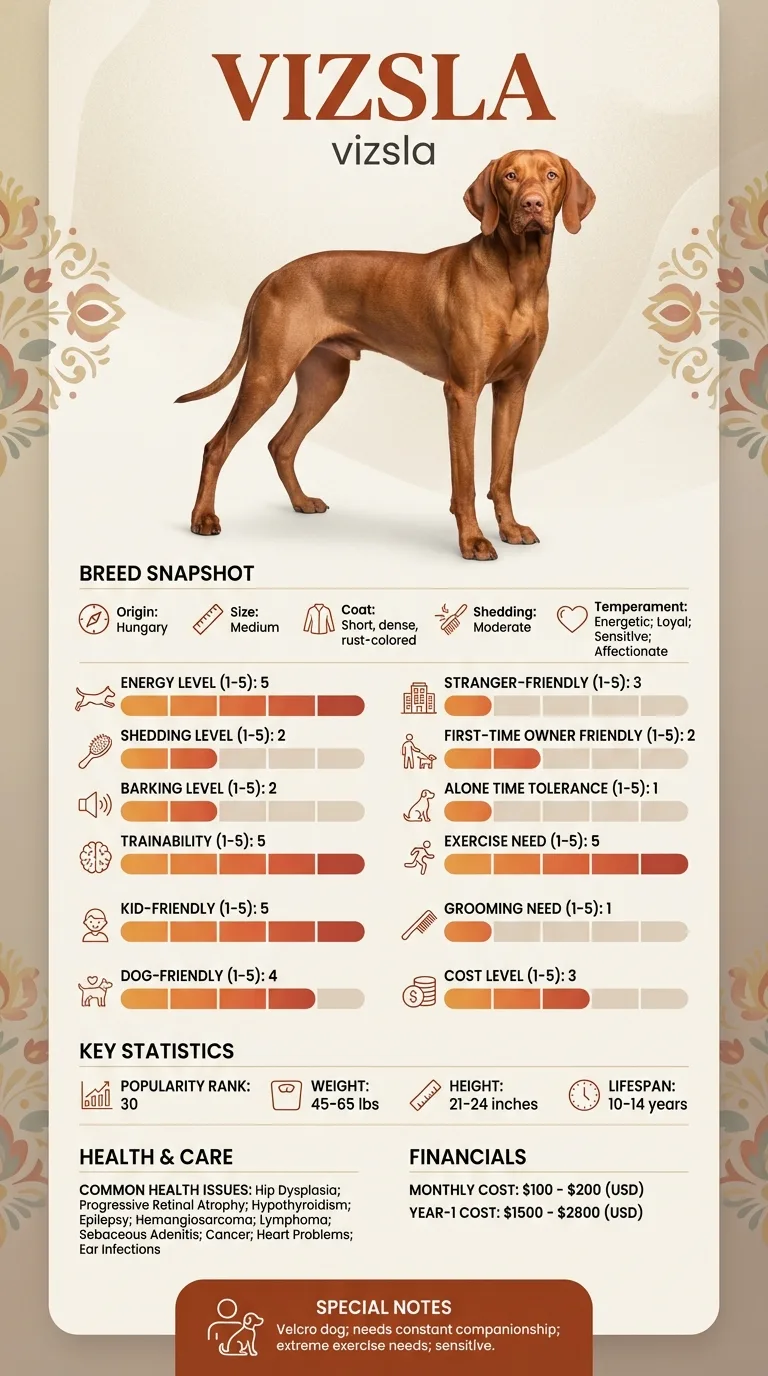
This is for someone already down to Shiba Inu and Vizsla and deciding between them. For this pair the decision usually turns on apartment suitability and trainability, so those are covered first and in most detail. Anyone choosing from a flat has a clear answer here: Shiba Inu rates 4/5 against 1/5. Breed history is left out; what follows is what you will actually live with.
Between Shiba Inu and Vizsla, apartment suitability is what separates them, and Shiba Inu is the lower-effort dog of the two to keep.
Choose Shiba Inu if you are in a flat or a smaller home, your walking routine is modest and the dog will be alone during the working day.
Choose Vizsla if you do not want a standing grooming appointment, shedding is a problem in your house and there are young children at home.
| Feature | shiba inu | vizsla | Winner |
|---|---|---|---|
| Size class | small | medium | Equal |
| Weight | 17–23 lbs | 45–65 lbs | Equal |
| Height | 13–16 in | 21–24 in | Equal |
| Lifespan | 13–16 years | 10–14 years | shiba inu |
| Exercise need | Moderate (3/5) | Very high (5/5) | shiba inu |
| Grooming need | Moderate (3/5) | Very low (1/5) | vizsla |
| Shedding | High (4/5) | Low (2/5) | vizsla |
| Energy level | High (4/5) | Very high (5/5) | Equal |
| Barking | Moderate (3/5) | Low (2/5) | vizsla |
| Apartment suitability | High (4/5) | Very low (1/5) | shiba inu |
| Good for first-time owners | Low (2/5) | Low (2/5) | Equal |
| Tolerates being alone | Moderate (3/5) | Very low (1/5) | shiba inu |
| Trainability | Low (2/5) | Very high (5/5) | vizsla |
| Good with kids | Moderate (3/5) | Very high (5/5) | vizsla |
| Good with other dogs | Low (2/5) | High (4/5) | vizsla |
| Friendly to strangers | Low (2/5) | Moderate (3/5) | vizsla |
| Cost level | Moderate (3/5) | Moderate (3/5) | Equal |
| Coat | Double coat, medium | Short, dense, rust-colored | Equal |
| Origin | Japan | Hungary | Equal |
| Typical monthly cost | $80–$160 | $100–$200 | Equal |
| Typical first-year cost | $1,200–$2,300 | $1,500–$2,800 | Equal |
The Vizsla is a substantially bigger dog than the Shiba Inu — 45–65 lbs and 21–24 inches tall, compared to the Shiba's compact 17–23 lbs and 13–16 inches. Where the Shiba carries a dense medium double coat that adds visual bulk, the Vizsla's short, sleek, rust-colored coat shows off a lean, athletic build honed for pointing and retrieving game across open fields. The size difference matters practically: a Vizsla needs a bigger vehicle for transport, a larger bed, and proportionally more food, while the Shiba's smaller frame makes it easier to manage physically even for owners with limited strength or space.
The Vizsla is one of the highest-energy breeds a Shiba Inu could be compared against, rated Very High (5/5) for exercise need versus the Shiba's Moderate (3/5). Vizslas were bred as all-day hunting companions and genuinely need vigorous daily exercise — running, swimming, or extended off-leash work — to avoid anxiety and destructive behavior; the breed's nickname among owners, 'Velcro dog,' captures both its exercise needs and its need for closeness. The Shiba's Moderate exercise requirement is a fraction of that commitment. Anyone weighing these two breeds because of appearance alone should know the daily time investment is nowhere close to equal.
The Vizsla is the easy-care coat here: Very Low (1/5) grooming and Low (2/5) shedding thanks to its short, dense coat that needs little more than an occasional wipe-down. The Shiba Inu asks more, rated Moderate (3/5) grooming and High (4/5) shedding from its plush double coat, which blows out seasonally and leaves noticeably more hair around the house. For owners prioritizing minimal coat maintenance, the Vizsla wins clearly on this axis — though its very high exercise needs mean the time saved grooming will likely be spent instead on long daily runs or field work.
The Shiba Inu is far better suited to compact living, rated High (4/5) for apartment suitability against the Vizsla's Very Low (1/5) — a direct result of the Vizsla's intense exercise requirements and its low tolerance for being alone, rated Very Low (1/5) versus the Shiba's Moderate (3/5). On barking, the Vizsla is actually the quieter breed at Low (2/5) compared to the Shiba's Moderate (3/5), so noise complaints are less likely to come from vocalization and more from a Vizsla's anxious pacing or destructive behavior if its exercise and companionship needs go unmet in a small space.
The Vizsla rates Very High (5/5) for trainability, a sharp contrast to the Shiba Inu's Low (2/5) — Vizslas were bred to work in close partnership with hunters and are eager, food- and praise-motivated learners. Both breeds rate Low (2/5) for first-time owners, though, because each brings its own challenge: the Shiba's Bold, Independent temperament resists repetitive commands, while the Vizsla's Sensitive, Energetic nature means it needs gentle handling and enough exercise before training even begins, or its energy overwhelms the lesson. A first-time owner drawn to the Vizsla's trainability should still be prepared for the exercise commitment that comes attached to it.
The Vizsla is markedly more social across the board: Very High (5/5) with kids, High (4/5) with other dogs, and Moderate (3/5) with strangers, against the Shiba Inu's Moderate (3/5), Low (2/5), and Low (2/5). The Vizsla's Loyal, Affectionate temperament and its reputation as a velcro dog make it eager to be part of every family activity, while the Shiba's more Independent, Alert nature keeps it more reserved with new people and other animals. Families wanting a dog that actively seeks out kids and welcomes the neighbor's dog at the park will find the Vizsla the more natural fit.
The Shiba Inu has the lifespan edge, 13–16 years versus the Vizsla's 10–14. Shiba owners should watch for Hip Dysplasia, Patellar Luxation, Allergies, Progressive Retinal Atrophy, and Glaucoma. The Vizsla's list shares Hip Dysplasia, Progressive Retinal Atrophy, Hypothyroidism, and Epilepsy but adds more serious cancer risks — Hemangiosarcoma and Lymphoma specifically — plus Sebaceous Adenitis (a skin condition) and Heart Problems. That cancer-heavy profile is a known concern in the Vizsla breed generally and worth discussing with a breeder or vet about family health history, since it can affect both quality of life and long-term veterinary costs more than the Shiba's more varied but generally less severe list.
Both breeds fall in the Moderate (3/5) cost bracket, with the Vizsla running a bit higher: $100–$200 monthly and $1,500–$2,800 in the first year, against the Shiba's $80–$160 and $1,200–$2,300. Size accounts for some of that gap, but the Vizsla's cancer-related health risks — Hemangiosarcoma and Lymphoma among them — can mean higher lifetime veterinary costs if either condition develops, since cancer treatment and diagnostics are typically among the more expensive categories of dog healthcare. Shiba owners face a comparatively lower risk profile on that front, even though grooming and shedding cleanup add their own smaller recurring costs.
Shiba Inu weighs 17–23 lbs and lives 13–16 years; Vizsla weighs 45–65 lbs and lives 10–14 years. The two diverge most on apartment suitability, trainability and exercise need and 5 other rated axes. They are level on cost level and good for first-time owners, so those cannot decide it. The comparison marks an easier option only where one exists. Facts like weight and country of origin are not scored. Both dogs are rated from the same dataset, which is what makes the numbers comparable with each other even though any individual dog sits somewhere inside its breed's range.

The Vizsla, rated Very High (5/5) versus the Shiba Inu's Moderate (3/5) — Vizslas need vigorous daily activity or they become anxious and destructive.
Yes, considerably — the Vizsla rates Very High (5/5) trainability against the Shiba Inu's Low (2/5).
The Vizsla, rated Low (2/5) versus the Shiba Inu's High (4/5), thanks to its short, sleek coat.
No — it rates Very Low (1/5) for apartment suitability due to its intense exercise needs and low tolerance for being alone, versus the Shiba Inu's High (4/5).
The Vizsla, rated Very High (5/5) with kids versus the Shiba Inu's Moderate (3/5).
Cancer risk, including Hemangiosarcoma and Lymphoma, both specifically listed among its known health conditions.
The Shiba Inu, with a 13–16 year range versus the Vizsla's 10–14 years.
The Vizsla, at 45–65 lbs versus the Shiba Inu's 17–23 lbs.
The Vizsla, rated Very Low (1/5) versus the Shiba Inu's Moderate (3/5).
The Vizsla, rated Low (2/5) barking versus the Shiba Inu's Moderate (3/5).
The Vizsla, rated Very High (5/5) versus the Shiba Inu's Low (2/5).
Secure checkout on Stripe. We never see your card.
7-day money-back guarantee. Instant access.
Health information here is general and is not veterinary advice. If your dog shows pain, sudden behaviour change, or worsening symptoms, consult a licensed veterinarian.
Some links on this site are affiliate links. We may earn a commission at no extra cost to you, and we only suggest products we believe are helpful for dog owners.
We research and check what we publish, but we do not warrant that any figure, date, price, or statement is accurate, complete, or current, and we accept no liability for any loss, cost, injury, or other harm arising from the use of this site. Use it as one reference among several. You remain responsible for your own decisions and for your dog's care - confirm anything that matters with a licensed veterinarian or another qualified professional before you act on it. Full disclaimer.
Match your lifestyle to the right dog.
Take quizNot sure which breed is right for you? Take our 2-minute quiz to find out.
Take the quiz