Living
Which is bigger?
The Rottweiler, at up to 135 lbs versus the Shiba Inu's 23 lbs.

Quick answer
Which is bigger?
The Rottweiler, at up to 135 lbs versus the Shiba Inu's 23 lbs.
Rottweiler or Shiba Inu? On paper they differ most on apartment suitability, and on the scales Rottweiler is the heavier at 80–135 lbs. Here is how the two compare on everything that shapes an ordinary week.
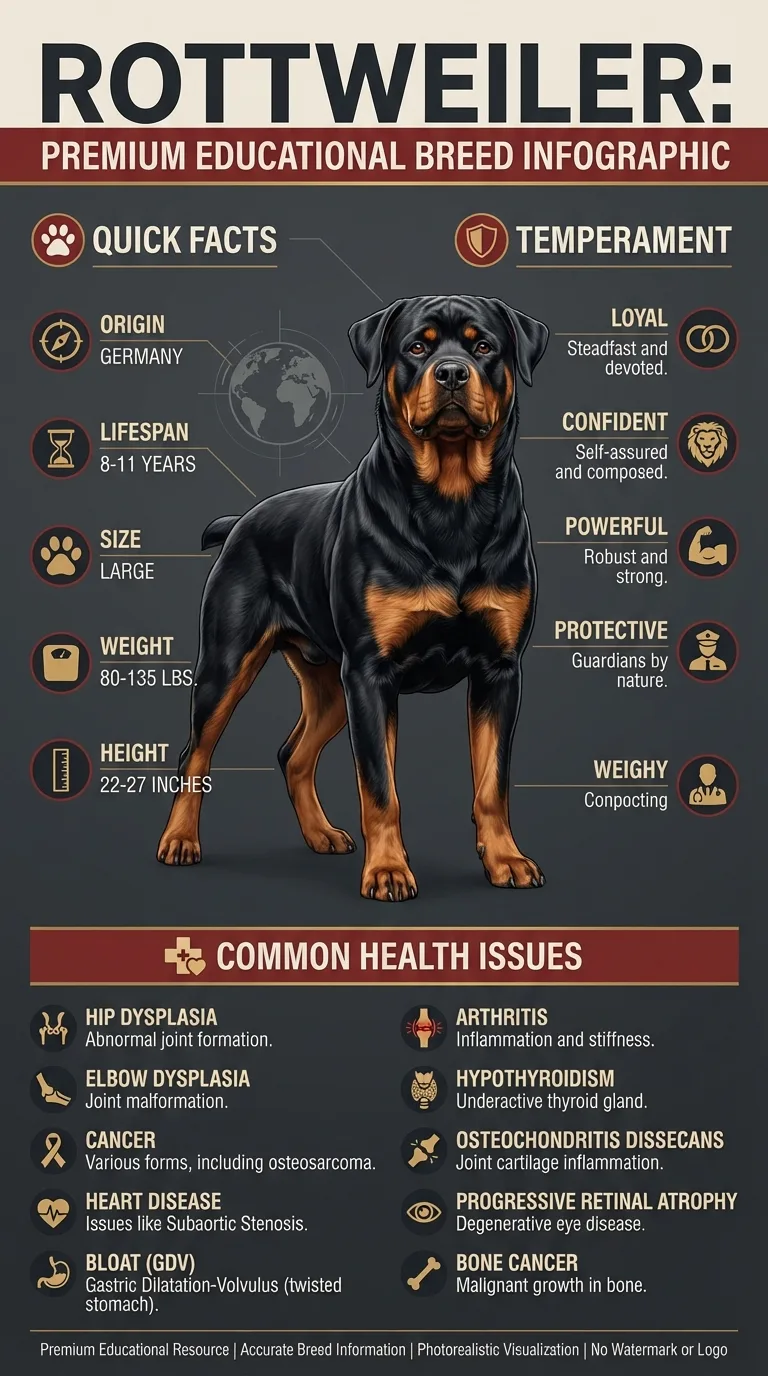
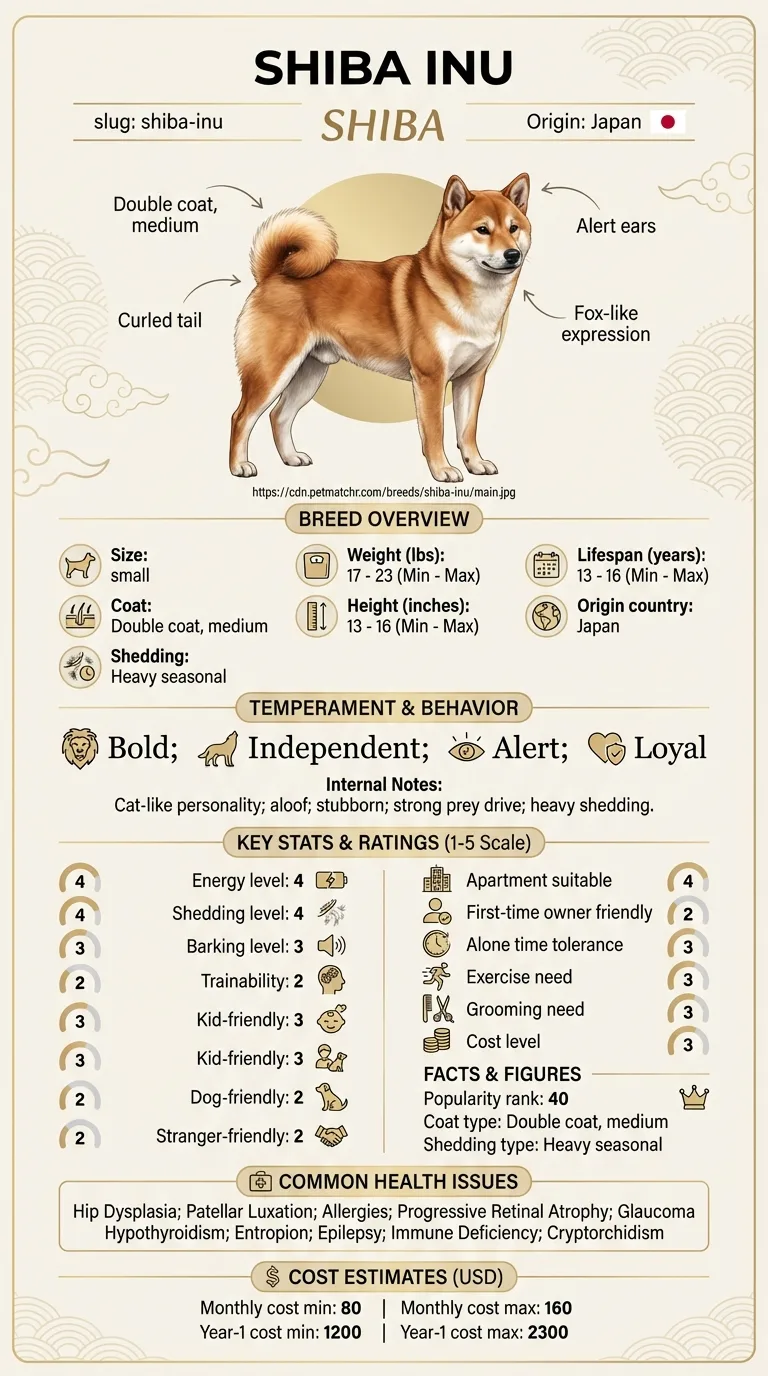
This is for someone already down to Rottweiler and Shiba Inu and deciding between them. For this pair the decision usually turns on apartment suitability and trainability, so those are covered first and in most detail. Anyone choosing from a flat has a clear answer here: Shiba Inu rates 4/5 against 2/5. Breed history is left out; what follows is what you will actually live with.
Between Rottweiler and Shiba Inu, apartment suitability is what separates them, and Shiba Inu is the lower-effort dog of the two to keep.
Choose Rottweiler if you do not want a standing grooming appointment, there are young children at home and you already have another dog.
Choose Shiba Inu if you are in a flat or a smaller home, your walking routine is modest and the dog will be alone during the working day.
| Feature | rottweiler | shiba inu | Winner |
|---|---|---|---|
| Size class | large | small | Equal |
| Weight | 80–135 lbs | 17–23 lbs | Equal |
| Height | 22–27 in | 13–16 in | Equal |
| Lifespan | 8–11 years | 13–16 years | shiba inu |
| Exercise need | High (4/5) | Moderate (3/5) | shiba inu |
| Grooming need | Low (2/5) | Moderate (3/5) | rottweiler |
| Shedding | High (4/5) | High (4/5) | Equal |
| Energy level | High (4/5) | High (4/5) | Equal |
| Barking | Moderate (3/5) | Moderate (3/5) | Equal |
| Apartment suitability | Low (2/5) | High (4/5) | shiba inu |
| Good for first-time owners | Low (2/5) | Low (2/5) | Equal |
| Tolerates being alone | Low (2/5) | Moderate (3/5) | shiba inu |
| Trainability | High (4/5) | Low (2/5) | rottweiler |
| Good with kids | High (4/5) | Moderate (3/5) | rottweiler |
| Good with other dogs | Moderate (3/5) | Low (2/5) | rottweiler |
| Friendly to strangers | Low (2/5) | Low (2/5) | Equal |
| Cost level | High (4/5) | Moderate (3/5) | shiba inu |
| Coat | Double coat, short | Double coat, medium | Equal |
| Origin | Germany | Japan | Equal |
| Typical monthly cost | $125–$250 | $80–$160 | Equal |
| Typical first-year cost | $2,000–$3,500 | $1,200–$2,300 | Equal |
The Rottweiler's 80–135 lb, 22–27 in frame dwarfs the Shiba Inu's compact 17–23 lbs and 13–16 in — a large guardian breed against a small-to-medium Japanese hunting breed. Both share a double coat and a confident bearing disproportionate to size in the Shiba's case, but anyone picturing similar handling needs should recalibrate: the Shiba is closer in scale to a fox than to the Rottweiler it's being compared against here. Handling logistics differ sharply too — a Shiba Inu can be carried short distances if needed, while the Rottweiler's bulk makes that impossible past puppyhood.
The Rottweiler needs more daily activity on paper, High (4/5) exercise need against Moderate (3/5) for the Shiba Inu, though both share a High (4/5) energy level rating — the Shiba's energy tends to arrive in short, intense bursts rather than the sustained work drive the Rottweiler was bred for. Neither is a low-activity breed, but the Shiba's needs are more manageable in shorter sessions. A Shiba's energy often shows up as sudden zoomies rather than sustained exertion, so shorter, varied activity sessions tend to suit it better than one long walk.
Grooming need favors the Rottweiler, Low (2/5) versus Moderate (3/5) for the Shiba Inu, whose medium double coat needs more brushing to manage its notorious seasonal blowouts. Shedding is tied at High (4/5) for both, and Shiba owners often describe their breed's coat-blow weeks as producing startling amounts of fur despite the dog's small size. Two dramatic coat-blow periods a year are typical, each requiring daily brushing for a week or two to keep loose fur under control.
The Shiba Inu is the far better apartment prospect, High (4/5) versus Low (2/5) for the Rottweiler, and it also tolerates time alone better, Moderate (3/5) against Low (2/5). Barking ties at Moderate (3/5) for both, though the Shiba is famous for its distinctive high-pitched Shiba scream rather than continuous barking, a different noise profile worth researching before committing to small-space living. The Shiba's small size and high apartment suitability score make it a popular choice in dense urban housing where a Rottweiler simply wouldn't be practical.
The Rottweiler is the more trainable of the two, High (4/5) against a notably low Low (2/5) for the Shiba Inu, whose Independent temperament word is doing a lot of work here — Shibas are famous among trainers for a cat-like refusal to prioritize human approval. Both breeds score Low (2/5) for first-time-owner suitability, so despite the size difference neither is an easy beginner pick; the Rottweiler needs firm guidance for its size and power, the Shiba for its stubbornness. Positive, reward-based methods tend to work better with the Shiba's Independent streak than the firmer corrections that can suit the more biddable Rottweiler.
The Rottweiler edges ahead with kids, High (4/5) versus Moderate (3/5), and with other dogs, Moderate (3/5) versus Low (2/5) — Shiba Inus are known for dog-selectiveness, which the data reflects. Both tie at Low (2/5) for friendliness to strangers; the Rottweiler's Protective temperament and the Shiba's Bold, Independent streak both translate to reserve around unfamiliar people. Because Shibas can be selective around unfamiliar dogs, careful introductions at a young age matter more for this breed than raw temperament scores alone suggest.
The Shiba Inu lives considerably longer, 13–16 years against 8–11 for the Rottweiler. Its ten-condition health list — including Patellar Luxation, Allergies, Progressive Retinal Atrophy, Glaucoma, Epilepsy, Immune Deficiency, and Cryptorchidism — is just as long as the Rottweiler's own ten-item list, which centers more on orthopedic and cancer risk (Hip Dysplasia, Bloat, Bone Cancer). A longer life doesn't mean a shorter list of things to watch for with the Shiba. Eye conditions dominate much of the Shiba's list — Progressive Retinal Atrophy, Glaucoma, and Entropion all appear — making regular ophthalmologic checkups a sensible habit.
The Shiba Inu costs noticeably less to keep, Moderate (3/5) against High (4/5) for the Rottweiler, with monthly costs of $80–$160 versus $125–$250 and first-year costs of $1,200–$2,300 against $2,000–$3,500 — smaller food portions accounting for much of the difference despite the Shiba's own list of eye and immune conditions to monitor. Smaller portion sizes mean the Shiba's food costs stay consistently lower than the Rottweiler's across the dog's entire lifetime, not just in the first year.
Rottweiler weighs 80–135 lbs and lives 8–11 years; Shiba Inu weighs 17–23 lbs and lives 13–16 years. The two diverge most on apartment suitability and trainability. They are level on barking, energy level and good for first-time owners, so those cannot decide it. The comparison marks an easier option only where one exists. Facts like weight and country of origin are not scored. Both dogs are rated from the same dataset, which is what makes the numbers comparable with each other even though any individual dog sits somewhere inside its breed's range.

No — the Rottweiler scores High (4/5) for trainability against Low (2/5) for the Shiba, whose Independent streak makes it notoriously resistant to typical obedience methods.
The Shiba Inu, rated High (4/5) for apartment suitability versus Low (2/5) for the Rottweiler.
Yes, both are rated High (4/5) for shedding despite the large size difference, and the Shiba's seasonal coat blow can be surprisingly heavy for its size.
The Shiba Inu, with a 13–16 year lifespan versus 8–11 years for the Rottweiler.
Not especially — it scores Low (2/5) for compatibility with other dogs, below the Rottweiler's Moderate (3/5), reflecting the breed's known dog-selectiveness.
Neither — both score Low (2/5), the Rottweiler out of protectiveness and the Shiba out of its Bold, Independent nature.
The Shiba Inu, at $80–$160 a month against $125–$250 for the Rottweiler.
The Rottweiler, at up to 135 lbs versus the Shiba Inu's 23 lbs.
The Shiba Inu, rated Low (2/5) on trainability versus High (4/5) for the Rottweiler.
The Shiba Inu, Moderate (3/5) versus Low (2/5) for the Rottweiler.
The Shiba Inu, rated High (4/5) for apartment suitability against Low (2/5) for the Rottweiler.
Secure checkout on Stripe. We never see your card.
7-day money-back guarantee. Instant access.
Health information here is general and is not veterinary advice. If your dog shows pain, sudden behaviour change, or worsening symptoms, consult a licensed veterinarian.
Some links on this site are affiliate links. We may earn a commission at no extra cost to you, and we only suggest products we believe are helpful for dog owners.
We research and check what we publish, but we do not warrant that any figure, date, price, or statement is accurate, complete, or current, and we accept no liability for any loss, cost, injury, or other harm arising from the use of this site. Use it as one reference among several. You remain responsible for your own decisions and for your dog's care - confirm anything that matters with a licensed veterinarian or another qualified professional before you act on it. Full disclaimer.
Match your lifestyle to the right dog.
Take quizNot sure which breed is right for you? Take our 2-minute quiz to find out.
Take the quiz