Living
Which is bigger?
Neither — both fall in the same 80–135 lb, 22–27 in range in this comparison.

Quick answer
Which is bigger?
Neither — both fall in the same 80–135 lb, 22–27 in range in this comparison.
Rottweiler or Rottweiler Mix? On paper they differ most on energy level, and on the scales Rottweiler is the heavier at 80–135 lbs. Here is how the two compare on everything that shapes an ordinary week.
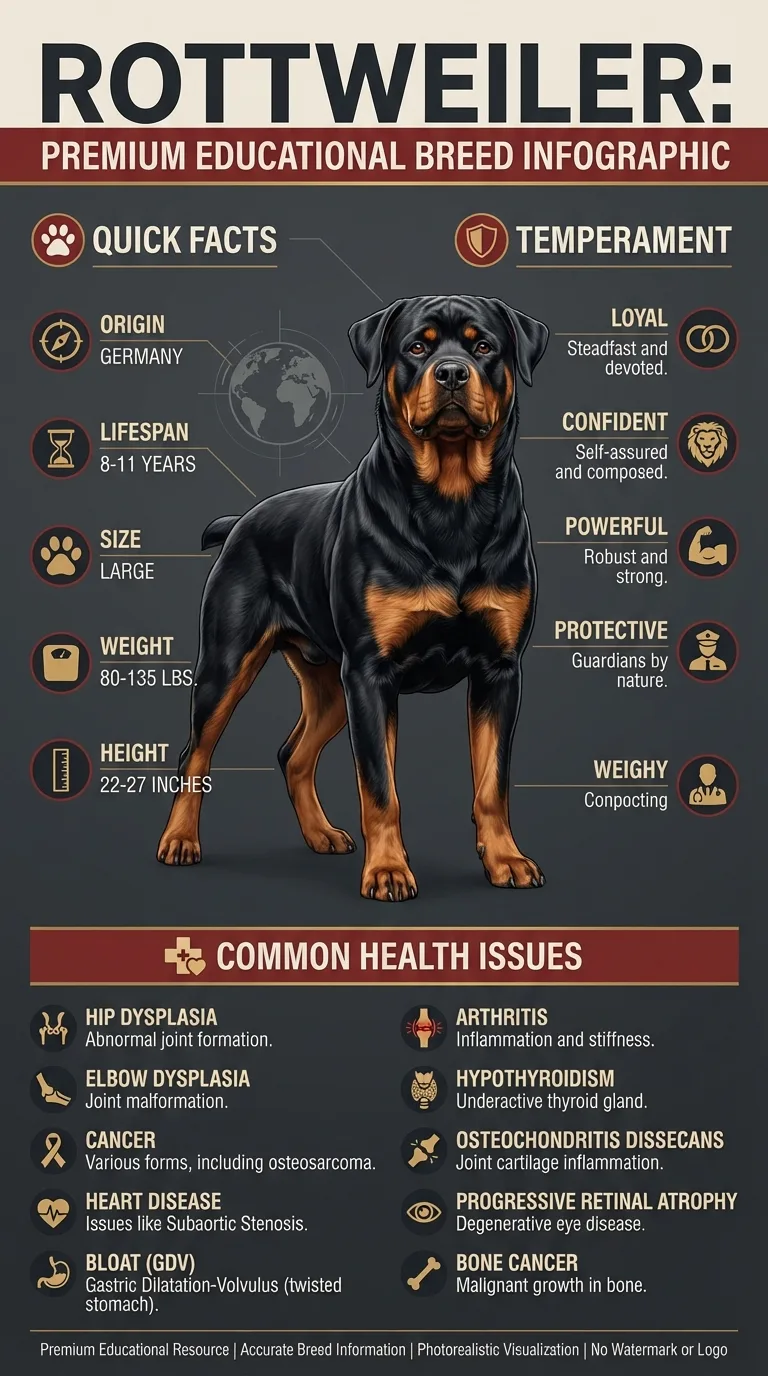
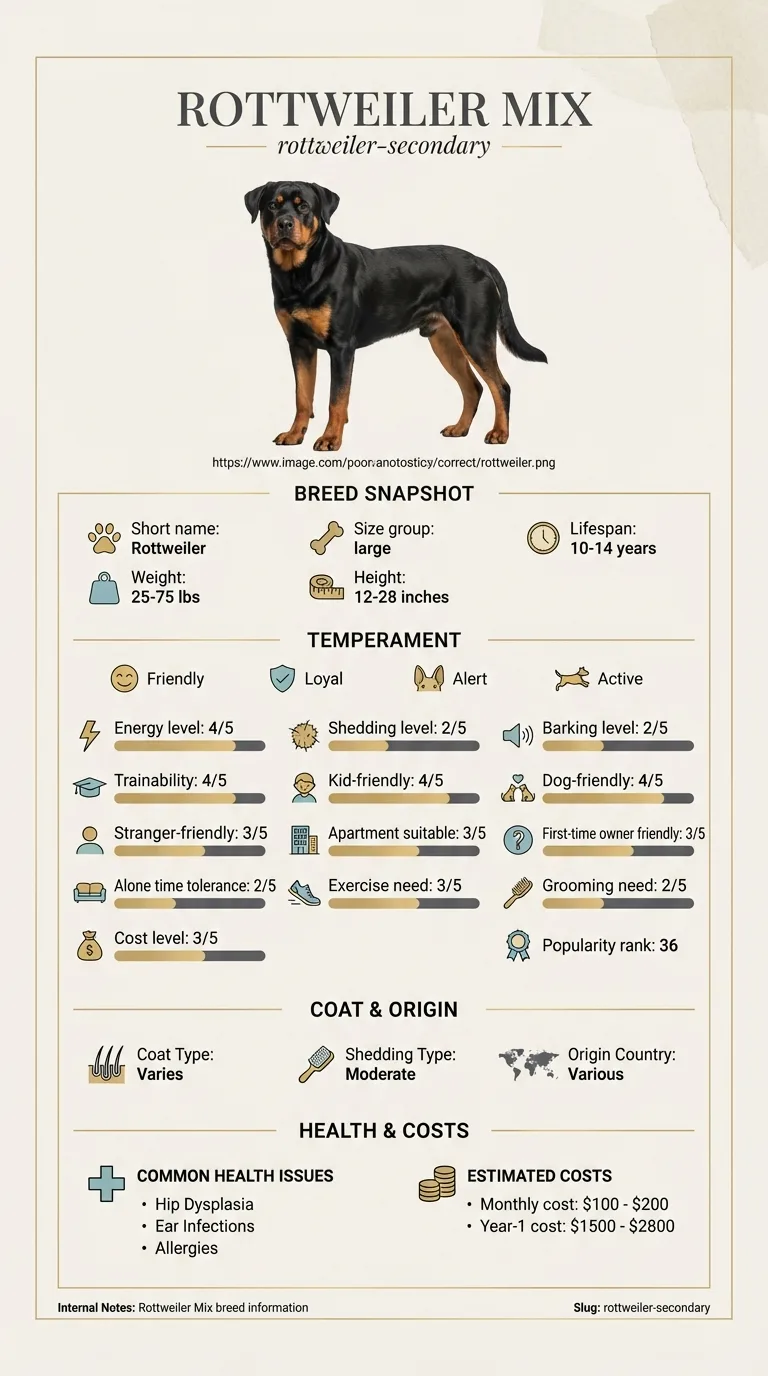
This is for someone already down to Rottweiler and Rottweiler Mix and deciding between them. Because the two are so evenly matched, the page works through every axis rather than leading with one. Both rate 2/5 for flats, so housing does not settle this one. Breed history is left out; what follows is what you will actually live with.
Between Rottweiler and Rottweiler Mix, they are closer than most pairings, and the choice comes down to temperament, and Rottweiler Mix is the lower-effort dog of the two to keep.
Choose Rottweiler if there are young children at home and you already have another dog.
Choose Rottweiler Mix if shedding is a problem in your house and the dog will be alone during the working day.
| Feature | rottweiler | rottweiler secondary | Winner |
|---|---|---|---|
| Size class | large | large | Equal |
| Weight | 80–135 lbs | 80–135 lbs | Equal |
| Height | 22–27 in | 22–27 in | Equal |
| Lifespan | 8–11 years | 9–10 years | Equal |
| Exercise need | High (4/5) | High (4/5) | Equal |
| Grooming need | Low (2/5) | Low (2/5) | Equal |
| Shedding | High (4/5) | Moderate (3/5) | rottweiler secondary |
| Energy level | High (4/5) | Moderate (3/5) | Equal |
| Barking | Moderate (3/5) | Low (2/5) | rottweiler secondary |
| Apartment suitability | Low (2/5) | Low (2/5) | Equal |
| Good for first-time owners | Low (2/5) | Low (2/5) | Equal |
| Tolerates being alone | Low (2/5) | Moderate (3/5) | rottweiler secondary |
| Trainability | High (4/5) | High (4/5) | Equal |
| Good with kids | High (4/5) | Moderate (3/5) | rottweiler |
| Good with other dogs | Moderate (3/5) | Low (2/5) | rottweiler |
| Friendly to strangers | Low (2/5) | Low (2/5) | Equal |
| Cost level | High (4/5) | High (4/5) | Equal |
| Coat | Double coat, short | Short, dense double coat | Equal |
| Origin | Germany | Various | Equal |
| Typical monthly cost | $125–$250 | $110–$240 | Equal |
| Typical first-year cost | $2,000–$3,500 | $1,700–$3,200 | Equal |
Both land in the same large-breed bracket on paper — 80 to 135 pounds and 22 to 27 inches at the shoulder for both the purebred Rottweiler and the Rottweiler Mix in this comparison, since the mix here still carries dominant Rottweiler size genes. In practice a mix drawn from a smaller second breed can land anywhere within or even below that range, so buyers should treat the mix's upper weight as a working estimate rather than a guarantee. Both are broad-chested, heavily muscled dogs built for a working past, and neither is a breed you casually pick up — expect a dog that fills a doorway and a car seat alike.
Exercise need scores identical at High (4/5) for the purebred, with energy level and exercise listed as High/Moderate for the mix — a small but real difference. A purebred Rottweiler tends to hold peak drive later into adulthood, while a mix often settles into a steadier, moderate-energy adult temperament once past the first two years. Either dog needs structured daily work — leash walks, tug, weight-pulling games — rather than unsupervised yard time, since both were bred from cart-pulling and herding stock that expects a job.
Grooming need sits at Low (2/5) for both, since neither carries a coat that needs trimming or professional styling — a weekly brush covers the basics. Shedding is where they diverge: the purebred Rottweiler sheds at a High (4/5) rate off its dense double coat, while the mix sheds at a more moderate (3/5) clip, likely reflecting a lighter undercoat contributed by the second breed. Owners sensitive to loose black-and-tan hair on furniture will notice the difference within the first shedding season.
Both score Low (2/5) for apartment suitability and Low (2/5) for first-time-owner fit, so neither is an easy small-space pick. Barking differs — Moderate (3/5) for the purebred against Low (2/5) for the mix — and the mix also tolerates being alone a notch better, Moderate (3/5) versus Low (2/5) for the purebred. That combination suggests the mix may cope marginally better with a working owner's schedule, though both still do best with a yard and company.
Trainability is identical at High (4/5) for both, and both carry the breed's core temperament words — Confident and Loyal appear on each list. The purebred adds Powerful and Protective, while the mix is described as Watchful and Steady, hinting at a slightly more even-keeled default disposition. Both still need an owner who starts obedience and socialization early and keeps a firm, consistent hand.
The purebred edges ahead with kids, High (4/5) versus Moderate (3/5) for the mix, and also scores better with other dogs, Moderate (3/5) versus Low (2/5). Friendliness to strangers is Low (2/5) for both, unsurprising given the shared guarding lineage. Families wanting a dog that actively enjoys a busy household with children may lean purebred; those prioritizing calm behavior around unfamiliar dogs at the park should temper expectations for either.
Lifespan runs 8 to 11 years for the purebred and a tighter 9 to 10 for the mix. The purebred's list is longer and heavier — Hip Dysplasia, Elbow Dysplasia, Cancer, Heart Disease, Bloat (GDV), Arthritis, Hypothyroidism, Osteochondritis Dissecans, Progressive Retinal Atrophy, and Bone Cancer, ten conditions in total. The mix's list is shorter at five — Hip Dysplasia, Elbow Dysplasia, Osteosarcoma, Subaortic Stenosis, and Cruciate Ligament Tears — a pattern consistent with the hybrid vigor mixed-breed dogs often show, though joint and cardiac risk clearly still carries through. Both lists share Hip Dysplasia and Elbow Dysplasia as top orthopedic concerns, underscoring that joint screening matters regardless of which dog a family chooses.
Cost level is High (4/5) for both, with monthly costs nearly matched at $125–$250 for the purebred and $110–$240 for the mix. First-year costs follow the same pattern, $2,000–$3,500 versus $1,700–$3,200. The mix trims a modest amount off both figures, likely reflecting lower average vet bills tied to its shorter, lighter health list, but neither dog is a budget breed — food volume alone for an 80-plus-pound dog keeps monthly spend elevated regardless of pedigree.
Rottweiler weighs 80–135 lbs and lives 8–11 years; Rottweiler Mix weighs 80–135 lbs and lives 9–10 years. No rated axis separates them by more than a single point, which makes this one of the closer pairings on the site. They are level on apartment suitability, cost level and exercise need, so those cannot decide it. The comparison marks an easier option only where one exists. Facts like weight and country of origin are not scored. Both dogs are rated from the same dataset, which is what makes the numbers comparable with each other even though any individual dog sits somewhere inside its breed's range.

Based on the data here, yes to a degree — the mix's health list includes five conditions (Hip Dysplasia, Elbow Dysplasia, Osteosarcoma, Subaortic Stenosis, Cruciate Ligament Tears) versus ten for the purebred, and its lifespan window's lower end is a year higher (9 vs 8 years). Mixed heritage often reduces concentration of breed-specific risk, though joint disease clearly persists in both.
Not necessarily in this comparison — both are listed in the same 80–135 lb, 22–27 in range, since the mix here still carries strong Rottweiler size genes. A mix from a different pairing could easily land smaller; always ask a breeder or shelter about the specific parentage.
The mix, modestly — Moderate (3/5) shedding versus High (4/5) for the purebred Rottweiler, likely due to a lighter undercoat from its second breed.
The purebred scores higher, High (4/5) versus Moderate (3/5) for the mix, though both can do well with structured introductions and supervision given their Loyal, Confident temperaments.
Neither — both score Low (2/5) for first-time-owner suitability. These are strong, protective dogs that need an owner ready for serious training and socialization regardless of pedigree.
Yes, Low (2/5) versus Moderate (3/5) for the purebred, and the mix also tolerates being alone slightly better (Moderate vs Low), which may suit working households.
Only slightly — both sit at High (4/5) cost level, with the mix running about $10–15 less per month ($110–$240 vs $125–$250) and a few hundred dollars less in year-one costs.
Neither — both fall in the same 80–135 lb, 22–27 in range in this comparison.
The mix tends to settle into a steadier, more moderate energy level than the purebred.
The purebred Rottweiler, at Moderate (3/5) versus Low (2/5) for the mix.
The Rottweiler Mix, with five documented common issues against the purebred's ten.
Secure checkout on Stripe. We never see your card.
7-day money-back guarantee. Instant access.
Health information here is general and is not veterinary advice. If your dog shows pain, sudden behaviour change, or worsening symptoms, consult a licensed veterinarian.
Some links on this site are affiliate links. We may earn a commission at no extra cost to you, and we only suggest products we believe are helpful for dog owners.
We research and check what we publish, but we do not warrant that any figure, date, price, or statement is accurate, complete, or current, and we accept no liability for any loss, cost, injury, or other harm arising from the use of this site. Use it as one reference among several. You remain responsible for your own decisions and for your dog's care - confirm anything that matters with a licensed veterinarian or another qualified professional before you act on it. Full disclaimer.
Match your lifestyle to the right dog.
Take quizNot sure which breed is right for you? Take our 2-minute quiz to find out.
Take the quiz