If your space and experience level are limited, the numbers point to the Pomeranian — smaller, more apartment-friendly, easier for a first-timer. The Rottweiler needs more room, more experience, and more exercise to thrive.
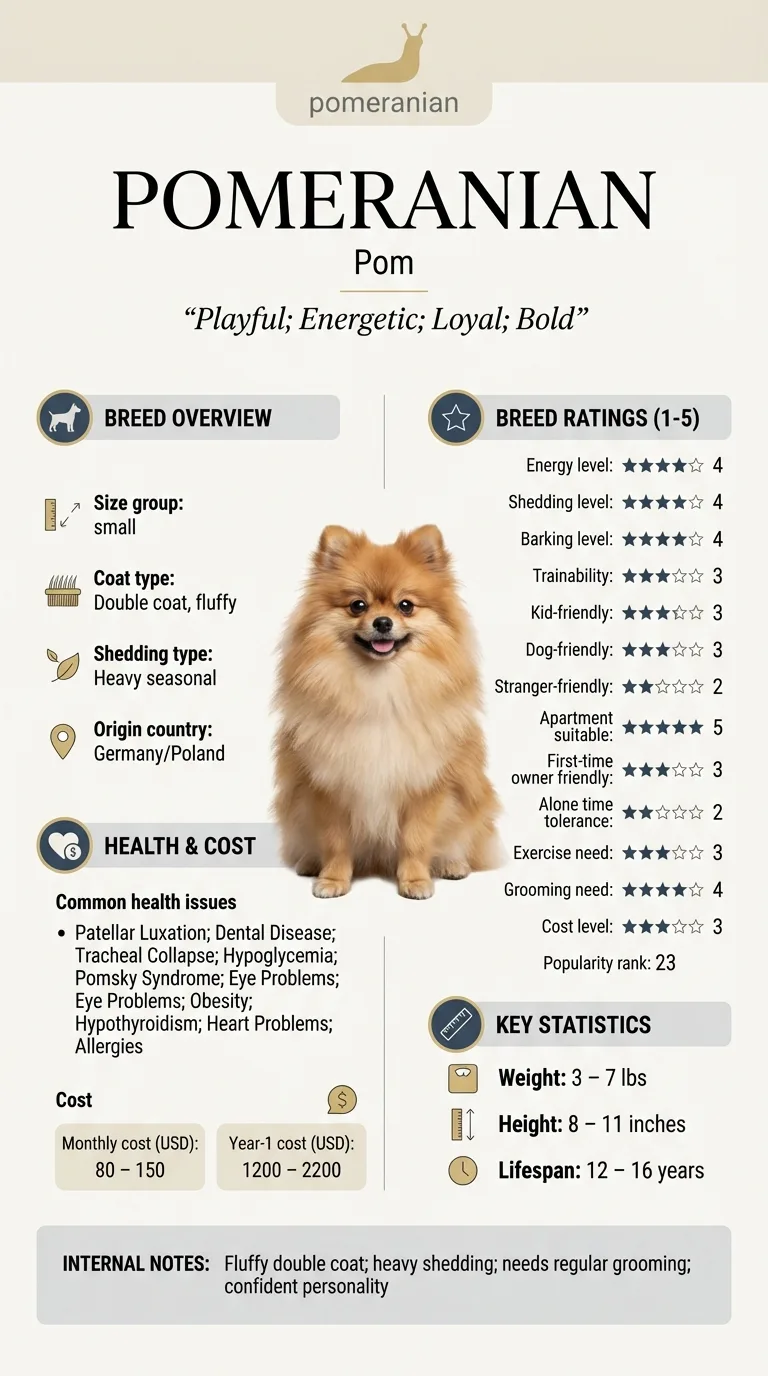
Pomeranian or Rottweiler? On paper they differ most on apartment suitability, and on the scales Rottweiler is the heavier at 80–135 lbs. Here is how the two compare on everything that shapes an ordinary week.
This is for someone already down to Pomeranian and Rottweiler and deciding between them. For this pair the decision usually turns on apartment suitability and grooming need, so those are covered first and in most detail. Anyone choosing from a flat has a clear answer here: Pomeranian rates 5/5 against 2/5. It is written for the decision rather than the breed history.
Quick verdict
Between Pomeranian and Rottweiler, apartment suitability is what separates them, and Pomeranian is the lower-effort dog of the two to keep.
Choose pomeranian if...
Choose Pomeranian if you are in a flat or a smaller home, this is your first dog and your walking routine is modest.
Choose rottweiler if...
Choose Rottweiler if you do not want a standing grooming appointment, there are young children at home and you want a dog that picks up training quickly.
Head-to-head comparison
Feature
pomeranian
rottweiler
Winner
Size class
small
large
Equal
Weight
3–7 lbs
80–135 lbs
Equal
Height
8–11 in
22–27 in
Equal
Lifespan
12–16 years
8–11 years
pomeranian
Exercise need
Moderate (3/5)
High (4/5)
pomeranian
Grooming need
High (4/5)
Low (2/5)
rottweiler
Shedding
High (4/5)
High (4/5)
Equal
Energy level
High (4/5)
High (4/5)
Equal
Barking
High (4/5)
Moderate (3/5)
rottweiler
Apartment suitability
Very high (5/5)
Low (2/5)
pomeranian
Good for first-time owners
Moderate (3/5)
Low (2/5)
pomeranian
Tolerates being alone
Low (2/5)
Low (2/5)
Equal
Trainability
Moderate (3/5)
High (4/5)
rottweiler
Good with kids
Moderate (3/5)
High (4/5)
rottweiler
Good with other dogs
Moderate (3/5)
Moderate (3/5)
Equal
Friendly to strangers
Low (2/5)
Low (2/5)
Equal
Cost level
Moderate (3/5)
High (4/5)
pomeranian
Coat
Double coat, fluffy
Double coat, short
Equal
Origin
Germany/Poland
Germany
Equal
Typical monthly cost
$80–$150
$125–$250
Equal
Typical first-year cost
$1,200–$2,200
$2,000–$3,500
Equal
Deep dive
Size and build
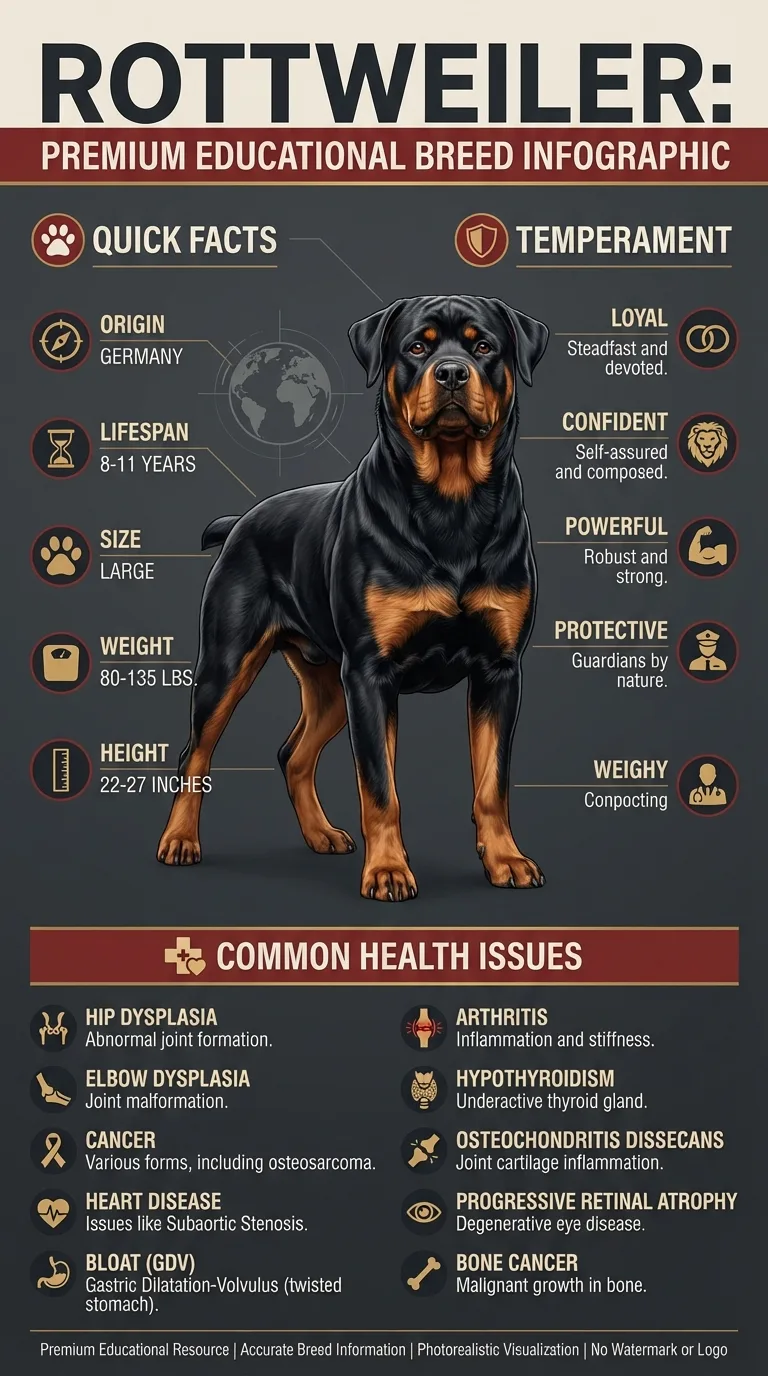
A Rottweiler outweighs a Pomeranian by more than a hundred pounds at the high end — 80-135 lbs against 3-7 lbs, with height running 22-27 inches versus 8-11. This isn't a comparison of similar dogs at different price points; it's toy versus working breed, and every other line in this guide follows from that gap.
Energy and exercise
The Rottweiler carries a high (4/5) exercise need and high (4/5) energy level — it wants a job, or at minimum a long daily walk and something to think about. The Pomeranian's moderate (3/5) exercise need is real but far more forgiving; a couple of short walks and some indoor play cover it.
Grooming and shedding
Here the small dog is the higher-maintenance one. The Pomeranian's double coat rates a high 4/5 for grooming and high (4/5) for shedding, needing brushing several times a week to avoid mats. The Rottweiler's short coat is a low 2/5 for grooming effort, though it still sheds at a high (4/5) rate — expect hair either way, just less brushing with the Rottweiler.
Apartment living, noise and time alone
The scores split sharply. The Pomeranian rates a very high 5/5 for apartment suitability; the Rottweiler drops to low (2/5), reflecting its size and exercise needs more than any behavioral issue. Barking runs the other way — Pomeranian high (4/5), Rottweiler moderate (3/5) — and neither breed tolerates being left alone well, both scoring low (2/5).
Training and owner experience
The Rottweiler trains more readily, rated high (4/5) versus the Pomeranian's moderate (3/5), but it's rated low (2/5) for first-time owners against the Pomeranian's moderate (3/5). Translation: a Rottweiler is easier to teach but less forgiving of an inexperienced handler, since size and strength turn small training gaps into real problems.
Kids, other dogs and visitors
The Rottweiler rates high (4/5) with kids against the Pomeranian's moderate (3/5), and both dogs land at moderate (3/5) with other dogs and low (2/5) with strangers. A well-raised Rottweiler's reputation with families runs counter to its watchdog image, but that low-with-strangers score means neither breed is the dog you want greeting delivery drivers unsupervised.
Health and lifespan
The lifespan gap is the sharpest number in this comparison — 12-16 years for the Pomeranian against just 8-11 for the Rottweiler. Large-breed biology drives the Rottweiler's health list too: cancer, bone cancer, bloat, and hip and elbow dysplasia all appear, risks tied to size and rapid growth that a 3-7 lb dog simply doesn't share.
Cost to keep
Expect to pay more for the Rottweiler at every stage — $125-$250 a month against the Pomeranian's $80-$150, and $2,000-$3,500 in year one versus $1,200-$2,200. Food volume, larger-dose medications, and bigger vet bills for a bigger body all add up.
Pomeranian vs Rottweiler at a glance
Pomeranian weighs 3–7 lbs and lives 12–16 years; Rottweiler weighs 80–135 lbs and lives 8–11 years. The two diverge most on apartment suitability and grooming need. They are level on tolerates being alone, good with other dogs and energy level, so those cannot decide it. In the table, a "winner" means easier for an ordinary household — not better. Size, coat and origin are recorded without a verdict. Because both breeds are scored the same way, the gaps are reliable even where the absolute numbers are rough.
Pomeranian vs Rottweiler: Which Suits Your Home? - Pomeranian vs Rottweiler at a glance
Frequently asked questions
How much bigger is a Rottweiler than a Pomeranian?
Roughly 15 to 20 times heavier at the high end — 80-135 lbs versus 3-7 lbs. It's one of the largest size gaps you'll find in a single breed comparison.
Which breed lives longer?
The Pomeranian, by a wide margin — 12-16 years against the Rottweiler's 8-11. That gap is typical of small-versus-large breed biology rather than anything specific to these two dogs.
Is a Rottweiler a good apartment dog?
Not by the numbers — it rates low (2/5) for apartment suitability, against the Pomeranian's very high (5/5). Size and exercise needs are the main reasons, not noise; the Rottweiler is actually the quieter barker of the two (moderate 3/5 vs. the Pomeranian's high 4/5).
Which is easier for a first-time owner?
The Pomeranian, rated moderate (3/5) versus the Rottweiler's low (2/5). The Rottweiler trains faster once you're working with it (high 4/5 trainability) but its size raises the stakes for handling mistakes.
What will each cost you monthly?
The Pomeranian runs $80-$150 a month; the Rottweiler runs $125-$250. First-year costs follow the same pattern, roughly $1,000 more for the Rottweiler.
Do these two breeds share any health risks?
Hypothyroidism appears on both lists. Otherwise the risk profiles diverge by size — the Rottweiler's list is dominated by joint and cancer risks tied to its mass, while the Pomeranian's includes small-breed issues like tracheal collapse and hypoglycemia.
Which is better with kids?
The Rottweiler rates high (4/5) with kids against the Pomeranian's moderate (3/5), assuming proper training and socialization — size alone means supervision matters more with the larger dog regardless of temperament scores.
If your space and experience level are limited, the numbers point to the Pomeranian — smaller, more apartment-friendly, easier for a first-timer. The Rottweiler needs more room, more experience, and more exercise to thrive.
Costs
What's the monthly cost difference?
The Rottweiler runs about $45-$100 more per month than the Pomeranian — $125-$250 versus $80-$150 — mostly food and vet costs scaled to size.
Living
How much exercise does each need?
The Rottweiler needs high (4/5) daily exercise; the Pomeranian's moderate (3/5) need is easier to fit around a normal workday.
Health
How long does each breed typically live?
The Pomeranian averages 12-16 years; the Rottweiler averages 8-11 — a gap of roughly four to five years driven by large-breed biology.
Related DogBreedCompass guides
Pomeranian breed guide – Readers comparing the two usually want the full profile of Pomeranian before deciding.
Rottweiler breed guide – The same for Rottweiler, so the comparison can be checked against the detail.
Pomeranian vs Yorkshire Terrier – Yorkshire Terrier is the closest breed to Pomeranian on the measured axes, so it is the natural next comparison.
Rottweiler vs Rottweiler Mix – Rottweiler Mix sits closest to Rottweiler, which makes it the alternative worth ruling out.
What Pomeranian costs to keep – Anyone weighing these two is usually also pricing them, and the cost pages carry city-level figures.
Rottweiler health problems – The health pages set out what each breed is actually screened for.
Health information here is general and is not veterinary advice. If your dog shows pain, sudden behaviour change, or worsening symptoms, consult a licensed veterinarian.
Some links on this site are affiliate links. We may earn a commission at no extra cost to you, and we only suggest products we believe are helpful for dog owners.
We research and check what we publish, but we do not warrant that any figure, date, price, or statement is accurate, complete, or current, and we accept no liability for any loss, cost, injury, or other harm arising from the use of this site. Use it as one reference among several. You remain responsible for your own decisions and for your dog's care - confirm anything that matters with a licensed veterinarian or another qualified professional before you act on it. Full disclaimer.