Behavior
Which breed is easier to groom?
The Vizsla, rated very low (1/5) for grooming need against the Corgi's moderate (3/5).

Quick answer
Which breed is easier to groom?
The Vizsla, rated very low (1/5) for grooming need against the Corgi's moderate (3/5).
Pembroke Welsh Corgi or Vizsla? On paper they differ most on apartment suitability, and on the scales Vizsla is the heavier at 45–65 lbs. Here is how the two compare on everything that shapes an ordinary week.
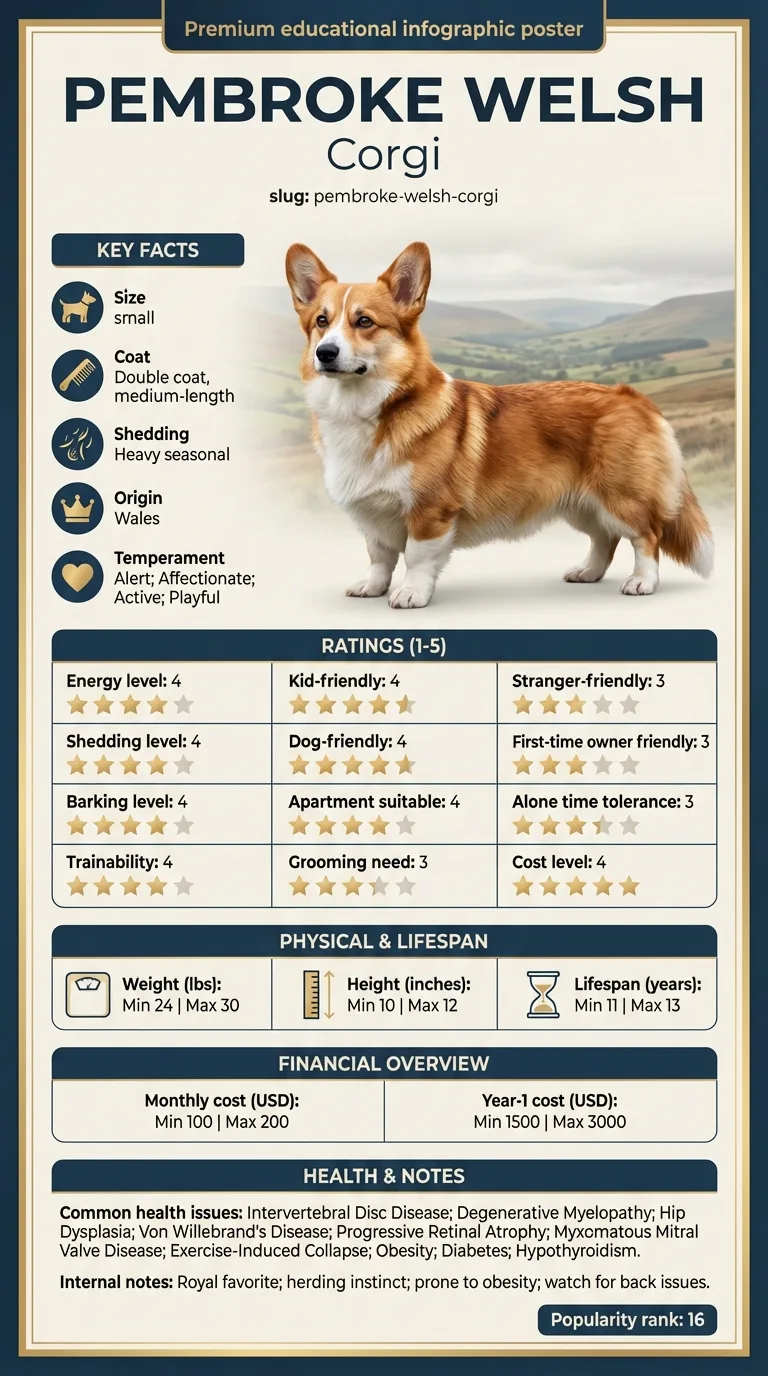
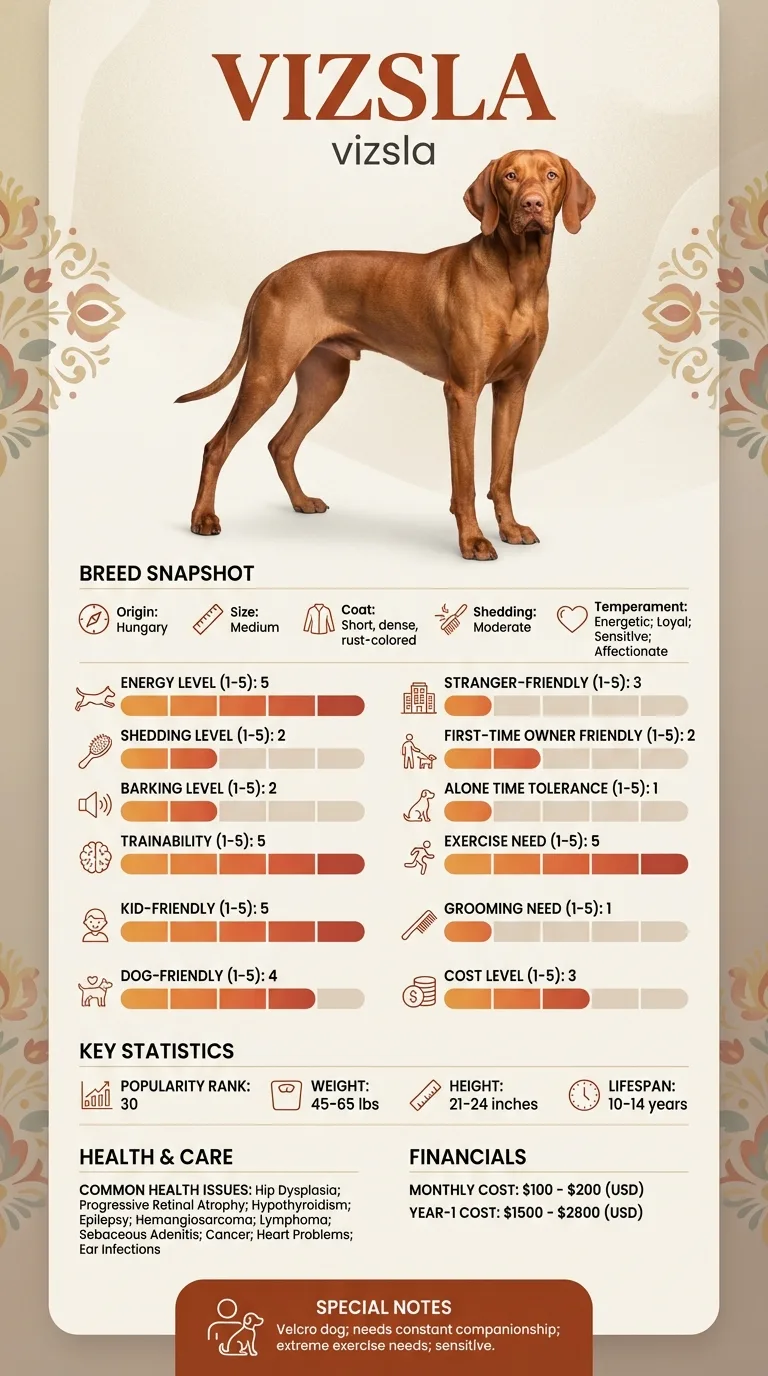
This is for someone already down to Pembroke Welsh Corgi and Vizsla and deciding between them. For this pair the decision usually turns on apartment suitability and grooming need, so those are covered first and in most detail. Anyone choosing from a flat has a clear answer here: Pembroke Welsh Corgi rates 4/5 against 1/5. It is written for the decision rather than the breed history.
Between Pembroke Welsh Corgi and Vizsla, apartment suitability is what separates them, and Pembroke Welsh Corgi is the lower-effort dog of the two to keep.
Choose Pembroke Welsh Corgi if you are in a flat or a smaller home, this is your first dog and your walking routine is modest.
Choose Vizsla if you do not want a standing grooming appointment, shedding is a problem in your house and there are young children at home.
| Feature | pembroke welsh corgi | vizsla | Winner |
|---|---|---|---|
| Size class | small | medium | Equal |
| Weight | 24–30 lbs | 45–65 lbs | Equal |
| Height | 10–12 in | 21–24 in | Equal |
| Lifespan | 11–13 years | 10–14 years | Equal |
| Exercise need | High (4/5) | Very high (5/5) | pembroke welsh corgi |
| Grooming need | Moderate (3/5) | Very low (1/5) | vizsla |
| Shedding | High (4/5) | Low (2/5) | vizsla |
| Energy level | High (4/5) | Very high (5/5) | Equal |
| Barking | High (4/5) | Low (2/5) | vizsla |
| Apartment suitability | High (4/5) | Very low (1/5) | pembroke welsh corgi |
| Good for first-time owners | Moderate (3/5) | Low (2/5) | pembroke welsh corgi |
| Tolerates being alone | Moderate (3/5) | Very low (1/5) | pembroke welsh corgi |
| Trainability | High (4/5) | Very high (5/5) | vizsla |
| Good with kids | High (4/5) | Very high (5/5) | vizsla |
| Good with other dogs | High (4/5) | High (4/5) | Equal |
| Friendly to strangers | Moderate (3/5) | Moderate (3/5) | Equal |
| Cost level | High (4/5) | Moderate (3/5) | vizsla |
| Coat | Double coat, medium-length | Short, dense, rust-colored | Equal |
| Origin | Wales | Hungary | Equal |
| Typical monthly cost | $100–$200 | $100–$200 | Equal |
| Typical first-year cost | $1,500–$3,000 | $1,500–$2,800 | Equal |
Ten to twelve inches at the shoulder and 24 to 30 pounds describes the Pembroke Welsh Corgi's low, long frame, a build shaped by centuries of cattle-herding work that required nipping at heels while staying under kick range. The Vizsla stands nearly double that height, 21 to 24 inches, and weighs up to 65 pounds on a lean, aristocratic Hungarian pointer's frame built for speed across open terrain. Despite the Corgi's stubby legs, its double coat carries real bulk and sheds accordingly, while the Vizsla's short, dense, rust-colored coat lies close to the body with almost no bulk at all. The two breeds could hardly look more different standing side by side, yet both stem from working backgrounds that still shape their daily needs.
Exercise need rates high (4/5) for the Corgi and very high (5/5) for the Vizsla, and anyone who's owned a Vizsla will tell you that number undersells it — the breed is famous for needing hours, not minutes, of real activity, having earned the nickname 'velcro dog' for how intensely it bonds to its person and wants to be moving alongside them. The Corgi's energy is still substantial for its size, active and playful, but a herding dog's stamina doesn't demand the same distance running a pointer bred for all-day fieldwork does. Energy level itself ties at high versus very high, but an owner underestimating the Vizsla's exercise requirement based on its elegant, compact build is a common and costly mistake.
Grooming need actually favors the larger dog by a wide margin: moderate (3/5) for the Corgi against very low (1/5) for the Vizsla, whose short, dense coat needs almost no maintenance beyond an occasional wipe-down. Shedding tells the same story in reverse proportion to expectation — high (4/5) for the Corgi, low (2/5) for the Vizsla — because that low, fluffy double coat blows its undercoat seasonally in noticeable amounts despite the dog's small stature. A household choosing based purely on coat upkeep and hair around the house would find the taller, leaner Vizsla the far easier of the two to live with, a genuine surprise to anyone assuming small dogs mean less fur.
Apartment suitability favors the Corgi decisively, high (4/5) against the Vizsla's very low (1/5), and the Corgi's compact frame is really only half the reason — its far greater tolerance for being alone, moderate (3/5) versus the Vizsla's very low (1/5), matters just as much for anyone working outside the home. A Vizsla's sensitive, velcro-like attachment to its owner means genuine distress during long solo stretches, a trait that shows up as destructive behavior in small spaces fast. Barking cuts the other way, though: the Corgi rates high (4/5), vocal by herding-dog nature, against the Vizsla's low (2/5), so the smaller dog's apartment suitability comes with a noise trade-off neighbors will notice.
Trainability favors the Vizsla, very high (5/5) against the Corgi's still-solid high (4/5), and the temperament word 'sensitive' is worth paying attention to — Vizslas respond poorly to harsh correction and do best with gentle, consistent positive reinforcement. First-time-owner suitability, though, tips toward the Corgi, moderate (3/5) versus the Vizsla's low (2/5); a Corgi's alert, affectionate nature is easier for a beginner to manage day to day even if it's marginally less naturally obedient, while the Vizsla's intensity, exercise demands, and emotional sensitivity ask more of a new owner than its trainability score alone suggests. A highly trainable dog isn't automatically an easy dog.
Good with kids favors the Vizsla, very high (5/5) against the Corgi's still-good high (4/5), while good with other dogs and friendliness to strangers both tie — high (4/5) and moderate (3/5) respectively. A Corgi's herding instinct can surface as heel-nipping around running children, a behavior worth managing early even though the breed's affectionate, playful temperament makes it a devoted family dog overall. The Vizsla's loyal, affectionate nature and its documented tendency to bond intensely to one household make it an excellent fit for a family that's home often, though that same sensitivity means it doesn't do well being passed around between multiple caretakers or left with unfamiliar people regularly.
Lifespan ties closely, 11 to 13 years for the Corgi against 10 to 14 for the Vizsla, but the health profiles diverge sharply in kind. The Corgi's long back and short legs, the same chondrodystrophy-linked build seen in other low-slung breeds, drives intervertebral disc disease and degenerative myelopathy near the top of its list, alongside exercise-induced collapse, obesity, and diabetes — the last two compounded by a breed prone to overeating on a body that doesn't burn calories quickly. The Vizsla's risks skew toward cancer: hemangiosarcoma, lymphoma, and cancer broadly listed alongside hip dysplasia, epilepsy, and heart problems. Ten conditions apiece, but a Corgi owner watches the spine and the waistline while a Vizsla owner watches for cancer screening as the dog ages.
Monthly costs actually tie at $100-$200 for both breeds, and first-year totals sit close as well — $1,500-$3,000 for the Corgi against $1,500-$2,800 for the Vizsla — despite the Vizsla weighing more than double the Corgi's weight. Cost level rates high for the Corgi and moderate for the Vizsla, which seems backward until you factor in the Corgi's longer health list: back-related imaging and potential IVDD surgery, diabetes management, and cardiac screening for myxomatous mitral valve disease all add recurring expense that a leaner, more athletically built Vizsla doesn't generate as often. Size alone doesn't predict cost here nearly as well as breed-specific health risk does.
Pembroke Welsh Corgi weighs 24–30 lbs and lives 11–13 years; Vizsla weighs 45–65 lbs and lives 10–14 years. The two diverge most on apartment suitability, grooming need and shedding and 2 other rated axes. They are level on good with other dogs and friendly to strangers, so those cannot decide it. In the table, a "winner" means easier for an ordinary household — not better. Size, coat and origin are recorded without a verdict. Because both breeds are scored the same way, the gaps are reliable even where the absolute numbers are rough.

It was bred as an all-day hunting and pointing dog and rates very high (5/5) for exercise need — its lean build hides genuine endurance demands.
The Pembroke Welsh Corgi, rated high (4/5), against the Vizsla's low (2/5), despite the Corgi being the much smaller dog.
Yes — its long spine and short legs put it at risk for intervertebral disc disease and degenerative myelopathy, both listed on its health profile.
The Corgi, rated moderate (3/5), compared to the Vizsla's very low (1/5) — Vizslas are known for intense attachment to their owners.
It rates low (2/5) for first-time-owner suitability, mainly due to its exercise demands and emotional sensitivity, versus the Corgi's moderate (3/5).
The Vizsla's health list includes hemangiosarcoma, lymphoma, and cancer broadly, a heavier cancer burden than what appears on the Corgi's profile.
The Vizsla, rated very low (1/5) for grooming need against the Corgi's moderate (3/5).
The Corgi, rated high (4/5), compared to the Vizsla's low (2/5).
The Vizsla, rated very high (5/5), versus the Corgi's high (4/5).
The Corgi, rated high (4/5) for apartment suitability, against the Vizsla's very low (1/5).
Secure checkout on Stripe. We never see your card.
7-day money-back guarantee. Instant access.
Health information here is general and is not veterinary advice. If your dog shows pain, sudden behaviour change, or worsening symptoms, consult a licensed veterinarian.
Some links on this site are affiliate links. We may earn a commission at no extra cost to you, and we only suggest products we believe are helpful for dog owners.
We research and check what we publish, but we do not warrant that any figure, date, price, or statement is accurate, complete, or current, and we accept no liability for any loss, cost, injury, or other harm arising from the use of this site. Use it as one reference among several. You remain responsible for your own decisions and for your dog's care - confirm anything that matters with a licensed veterinarian or another qualified professional before you act on it. Full disclaimer.
Match your lifestyle to the right dog.
Take quizNot sure which breed is right for you? Take our 2-minute quiz to find out.
Take the quiz