Living
Which breed should you pick overall?
It comes down to shedding and noise tolerance — the Griffon sheds and barks less, the Pomeranian lives slightly longer and carries a bit more energy.

Quick answer
Which breed should you pick overall?
It comes down to shedding and noise tolerance — the Griffon sheds and barks less, the Pomeranian lives slightly longer and carries a bit more energy.
Brussels Griffon or Pomeranian? On paper they differ most on shedding, and on the scales Brussels Griffon is the heavier at 8–12 lbs. Here is how the two compare on everything that shapes an ordinary week.
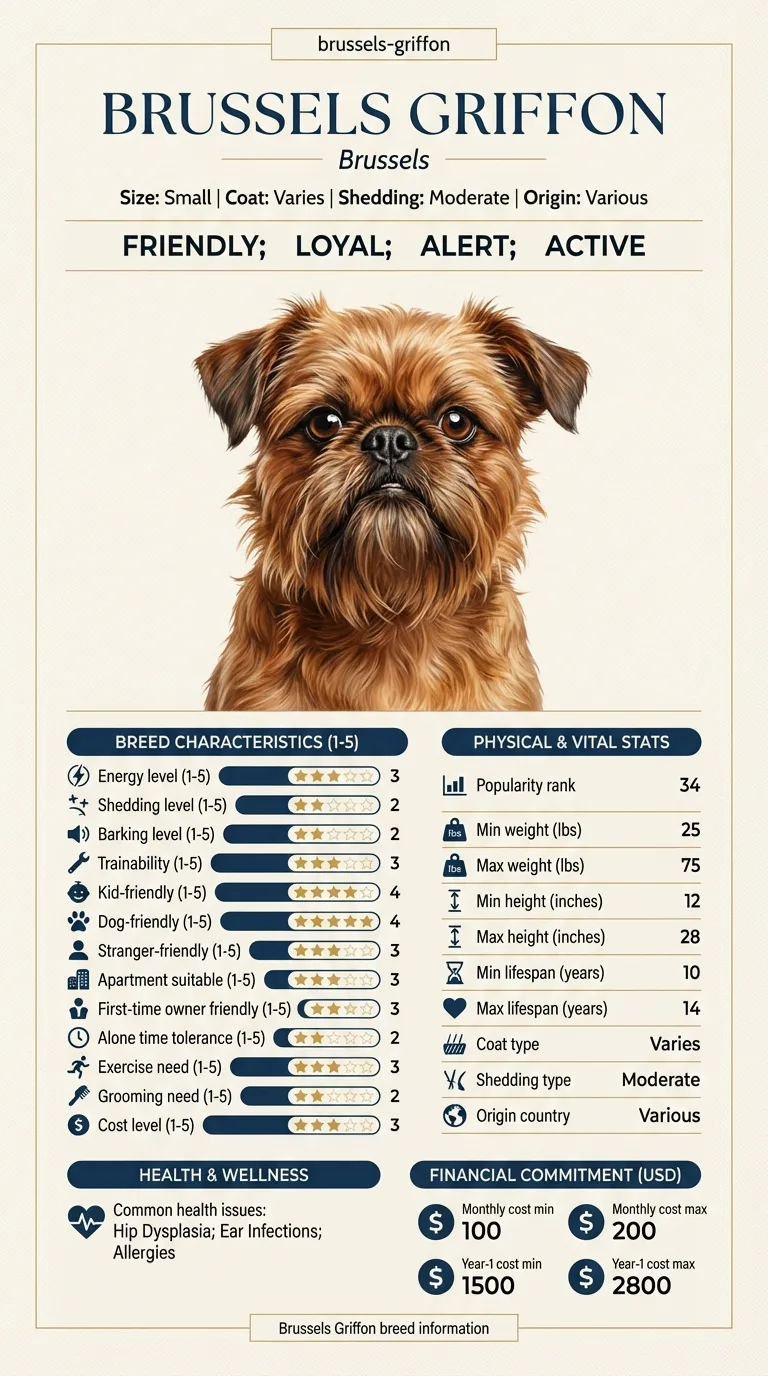
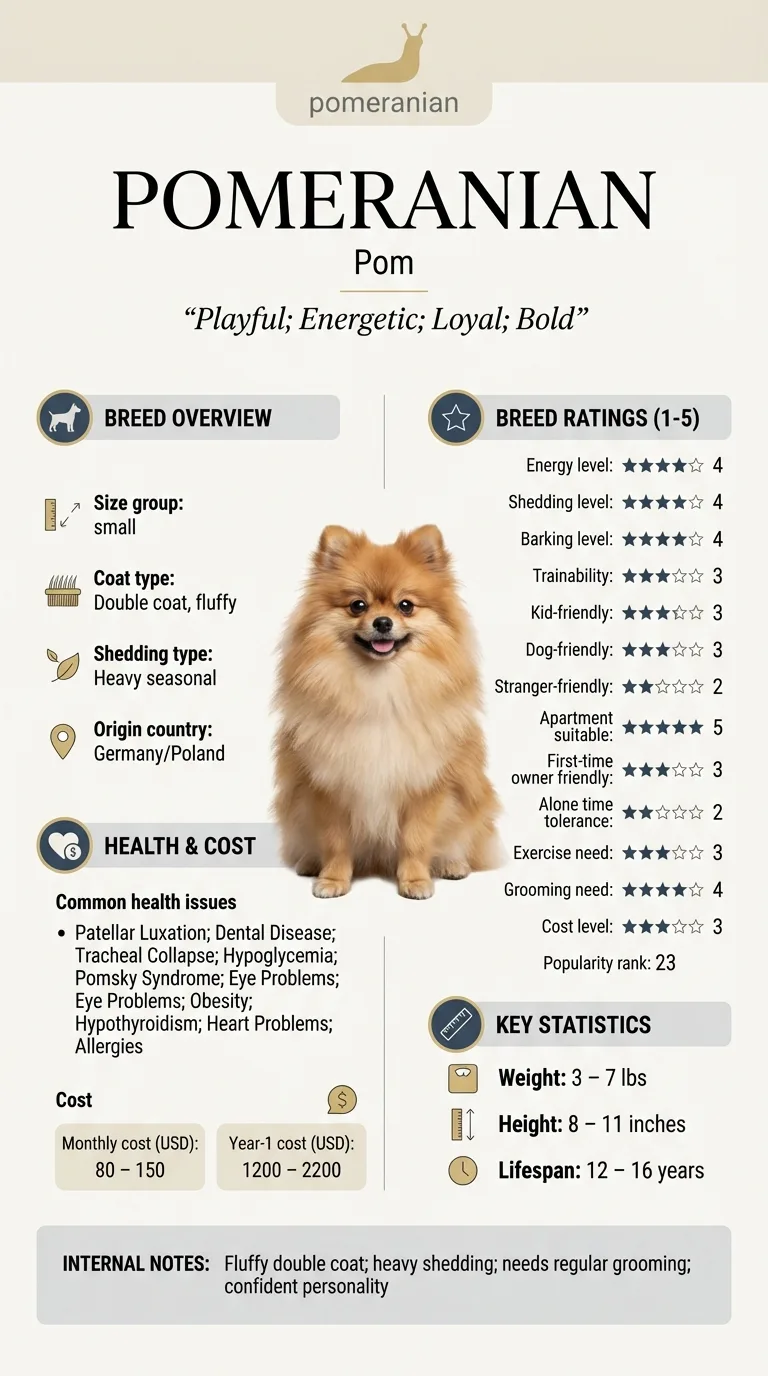
This is for someone already down to Brussels Griffon and Pomeranian and deciding between them. For this pair the decision usually turns on shedding, so those are covered first and in most detail. Both rate 5/5 for flats, so housing does not settle this one. It is written for the decision rather than the breed history.
Between Brussels Griffon and Pomeranian, shedding is what separates them, and Brussels Griffon is the lower-effort dog of the two to keep.
Choose Brussels Griffon if you do not want a standing grooming appointment, shedding is a problem in your house and your walking routine is modest.
Choose Pomeranian if a smaller dog suits your car, your home or your back, you want a dog that can keep up with an active routine and you want a dog that is more watchful with visitors.
| Feature | brussels griffon | pomeranian | Winner |
|---|---|---|---|
| Size class | small | small | Equal |
| Weight | 8–12 lbs | 3–7 lbs | Equal |
| Height | 7–10 in | 8–11 in | Equal |
| Lifespan | 12–15 years | 12–16 years | pomeranian |
| Exercise need | Low (2/5) | Moderate (3/5) | brussels griffon |
| Grooming need | Moderate (3/5) | High (4/5) | brussels griffon |
| Shedding | Low (2/5) | High (4/5) | brussels griffon |
| Energy level | Moderate (3/5) | High (4/5) | Equal |
| Barking | Moderate (3/5) | High (4/5) | brussels griffon |
| Apartment suitability | Very high (5/5) | Very high (5/5) | Equal |
| Good for first-time owners | Moderate (3/5) | Moderate (3/5) | Equal |
| Tolerates being alone | Low (2/5) | Low (2/5) | Equal |
| Trainability | Moderate (3/5) | Moderate (3/5) | Equal |
| Good with kids | Moderate (3/5) | Moderate (3/5) | Equal |
| Good with other dogs | Moderate (3/5) | Moderate (3/5) | Equal |
| Friendly to strangers | Moderate (3/5) | Low (2/5) | brussels griffon |
| Cost level | Moderate (3/5) | Moderate (3/5) | Equal |
| Coat | Rough or smooth | Double coat, fluffy | Equal |
| Origin | Various | Germany/Poland | Equal |
| Typical monthly cost | $80–$150 | $80–$150 | Equal |
| Typical first-year cost | $1,100–$2,300 | $1,200–$2,200 | Equal |
At 8 to 12 pounds, the Brussels Griffon actually outweighs the Pomeranian, which typically runs 3 to 7 pounds. Height tells a different story: the Griffon stands 7 to 10 inches, the Pomeranian 8 to 11, so the Pom is often the taller, leggier dog despite carrying less weight. Neither will strain a leash or knock over a coffee table. If you're choosing by scale alone, expect the Griffon to feel more solid in your arms and the Pomeranian to feel lighter but not necessarily smaller-boned.
The Griffon's exercise need sits at a low 2 out of 5, while the Pomeranian rates a moderate 3 out of 5. In practice that's the difference between two short walks and a bit of indoor play versus a dog that wants more structured activity to burn off its energy. Both land at similar overall energy levels, so don't expect a couch potato either way — the gap shows up more in how much dedicated exercise time each dog asks of you.
Coat maintenance splits clearly here. The Griffon's rough-or-smooth coat needs moderate grooming (3/5) and sheds lightly (2/5). The Pomeranian's fluffy double coat pushes both numbers up to 4/5 — expect more brushing sessions and more fur on your clothes and furniture, especially during seasonal blowouts. If shedding is a dealbreaker, the Griffon is the easier of the two to live with.
Both breeds score a full 5 out of 5 for apartment suitability, so square footage isn't the deciding factor. Noise might be: the Pomeranian rates a high 4/5 on barking, the Griffon a more moderate 3/5. Neither dog tolerates being left alone well — both land at a low 2/5 — so if you're gone long hours, this comparison doesn't hand you an easy winner on that front.
Trainability comes out even at a moderate 3/5 for both dogs, and both are rated a moderate 3/5 fit for first-time owners. Neither is the plug-and-play beginner breed some toy dogs are, but neither demands an experienced trainer either. Expect consistent, patient sessions to matter more than raw dog intelligence with this pair. Housetraining in particular tends to take longer with toy breeds generally, so budget extra weeks of consistency with either dog before you can trust them loose in the house.
Both dogs are moderate, not exceptional, with kids and with other dogs — a 3/5 across the board. The Griffon edges ahead with strangers at 3/5 versus the Pomeranian's 2/5, matching the Griffon's alert-but-devoted temperament against the Pomeranian's bolder, more energetic streak. Neither breed is an instinctive greeter, so plan on supervised introductions with visitors regardless of which one you pick.
The Pomeranian's 12-to-16-year lifespan edges out the Griffon's 12-to-15. Both share a risk for patellar luxation and eye problems, but their longer lists diverge: the Griffon carries brachycephalic airway concerns and the neurological condition syringomyelia, while the Pomeranian's list runs longer overall, covering dental disease, tracheal collapse, hypoglycemia, and heart problems among others. Budget for regular vet checkups either way.
Cost lands at a tie — both breeds rate a moderate 3/5, with monthly costs running $80 to $150 for either dog. First-year costs are close too: $1,100 to $2,300 for the Griffon versus $1,200 to $2,200 for the Pomeranian. Neither breed will surprise your budget compared to the other; the real cost swing here comes from grooming frequency more than sticker price.
Brussels Griffon weighs 8–12 lbs and lives 12–15 years; Pomeranian weighs 3–7 lbs and lives 12–16 years. The two diverge most on shedding. They are level on tolerates being alone, apartment suitability and cost level, so those cannot decide it. In the table, a "winner" means easier for an ordinary household — not better. Size, coat and origin are recorded without a verdict. Because both breeds are scored the same way, the gaps are reliable even where the absolute numbers are rough.

By weight, yes — 8 to 12 pounds against 3 to 7. By height they're close, 7 to 10 inches versus 8 to 11, so the Pomeranian can look just as tall despite weighing less.
The Griffon, clearly. It rates a low 2/5 on shedding against the Pomeranian's high 4/5, a direct result of the Pom's fluffy double coat.
Both rate a moderate 3/5 for first-time owners — workable but not effortless. Expect a learning curve with training and grooming regardless of which you choose.
Yes, both score a perfect 5/5 for apartment suitability. The bigger apartment consideration is barking, where the Pomeranian (4/5) is noisier than the Griffon (3/5).
Nothing, on paper — both run $80 to $150 a month. First-year costs are within $100 of each other too.
Yes, both are prone to patellar luxation and eye issues. Beyond that they diverge: the Griffon's list leans toward airway and spinal concerns, the Pomeranian's toward dental, thyroid, and heart conditions.
The Pomeranian, rated 4/5 versus the Griffon's 3/5. If a quiet building is a priority, factor that in alongside the shedding difference.
It comes down to shedding and noise tolerance — the Griffon sheds and barks less, the Pomeranian lives slightly longer and carries a bit more energy.
Both run $80 to $150 a month, so cost doesn't break the tie between them.
The Griffon needs less structured exercise (2/5) than the Pomeranian (3/5), though both are fine with modest daily activity.
The Pomeranian, typically 12 to 16 years versus the Griffon's 12 to 15 — a narrow edge, not a dramatic one.
Secure checkout on Stripe. We never see your card.
7-day money-back guarantee. Instant access.

Health information here is general and is not veterinary advice. If your dog shows pain, sudden behaviour change, or worsening symptoms, consult a licensed veterinarian.
Some links on this site are affiliate links. We may earn a commission at no extra cost to you, and we only suggest products we believe are helpful for dog owners.
We research and check what we publish, but we do not warrant that any figure, date, price, or statement is accurate, complete, or current, and we accept no liability for any loss, cost, injury, or other harm arising from the use of this site. Use it as one reference among several. You remain responsible for your own decisions and for your dog's care - confirm anything that matters with a licensed veterinarian or another qualified professional before you act on it. Full disclaimer.
Match your lifestyle to the right dog.
Take quizNot sure which breed is right for you? Take our 2-minute quiz to find out.
Take the quiz