Living
Which is the better overall choice?
The Bernedoodle suits households that can't provide constant companionship; the Vizsla rewards an active owner who's home most of the day and wants an intense, low-grooming athletic dog.

Quick answer
Which is the better overall choice?
The Bernedoodle suits households that can't provide constant companionship; the Vizsla rewards an active owner who's home most of the day and wants an intense, low-grooming athletic dog.
Bernedoodle or Vizsla? On paper they differ most on grooming need, and on the scales Bernedoodle is the heavier at 20–90 lbs. Here is how the two compare on everything that shapes an ordinary week.
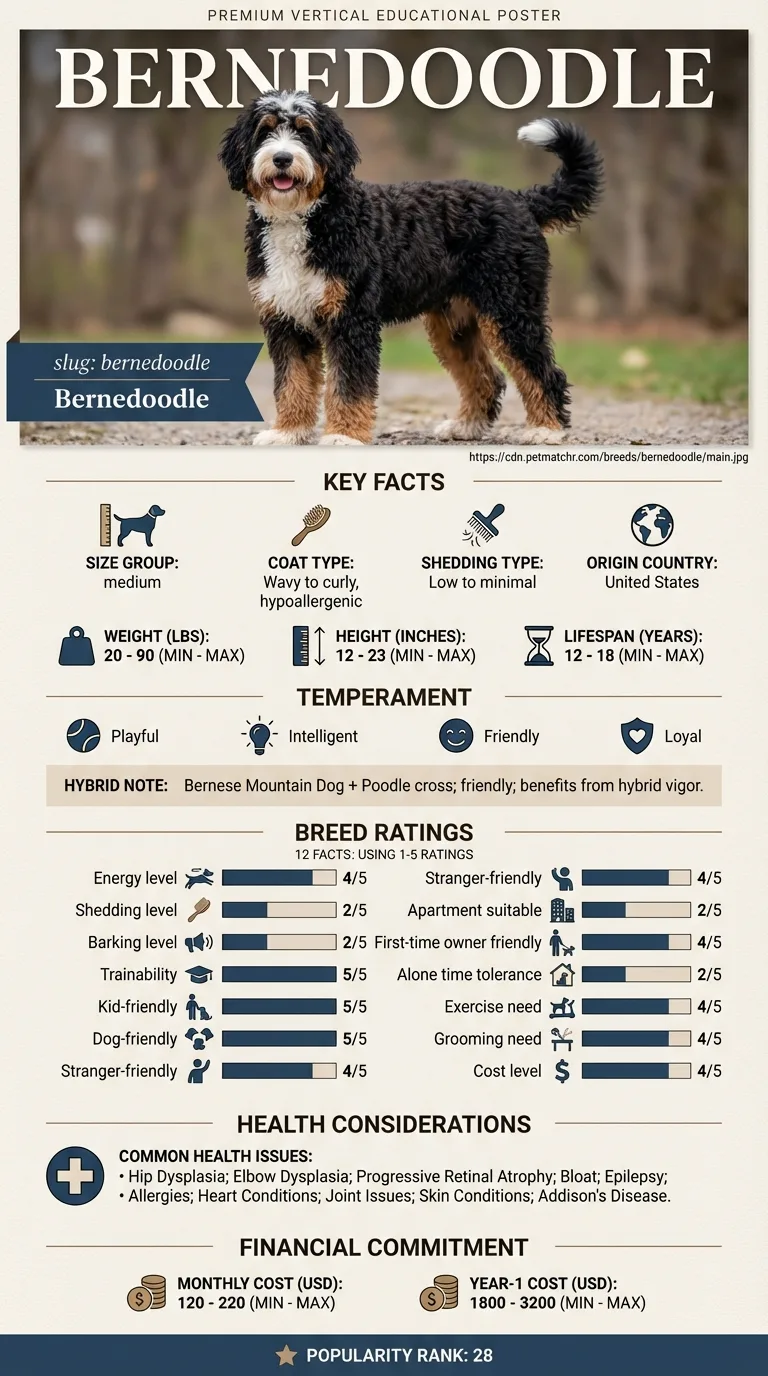
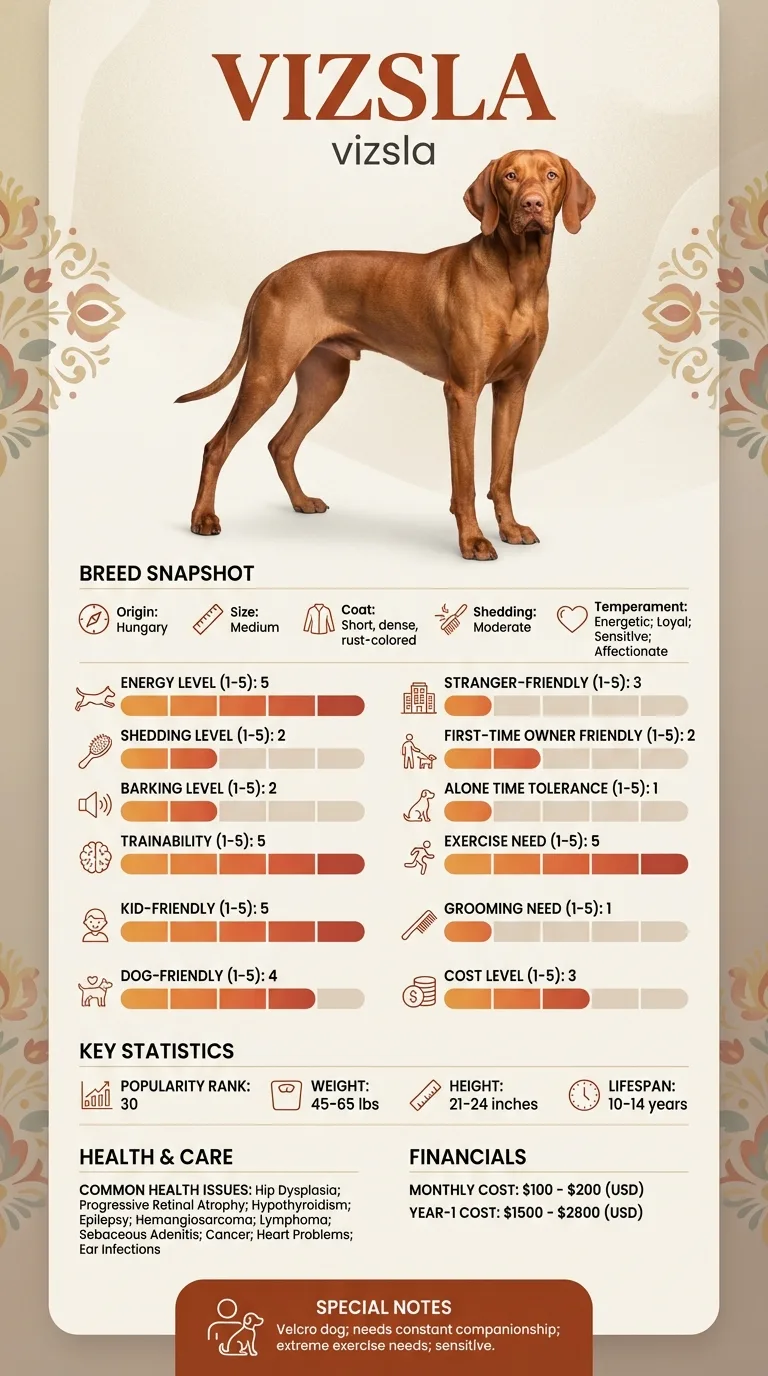
This is for someone already down to Bernedoodle and Vizsla and deciding between them. For this pair the decision usually turns on grooming need and good for first-time owners, so those are covered first and in most detail. Anyone choosing from a flat has a clear answer here: Bernedoodle rates 2/5 against 1/5. There is no origin story here — only what changes about your week.
Between Bernedoodle and Vizsla, grooming need is what separates them, and Bernedoodle is the lower-effort dog of the two to keep.
Choose Bernedoodle if this is your first dog, your walking routine is modest and you already have another dog.
Choose Vizsla if you do not want a standing grooming appointment, you want a dog that can keep up with an active routine and you want a dog that is more watchful with visitors.
| Feature | bernedoodle | vizsla | Winner |
|---|---|---|---|
| Size class | medium | medium | Equal |
| Weight | 20–90 lbs | 45–65 lbs | Equal |
| Height | 12–23 in | 21–24 in | Equal |
| Lifespan | 12–18 years | 10–14 years | bernedoodle |
| Exercise need | High (4/5) | Very high (5/5) | bernedoodle |
| Grooming need | High (4/5) | Very low (1/5) | vizsla |
| Shedding | Low (2/5) | Low (2/5) | Equal |
| Energy level | High (4/5) | Very high (5/5) | Equal |
| Barking | Low (2/5) | Low (2/5) | Equal |
| Apartment suitability | Low (2/5) | Very low (1/5) | bernedoodle |
| Good for first-time owners | High (4/5) | Low (2/5) | bernedoodle |
| Tolerates being alone | Low (2/5) | Very low (1/5) | bernedoodle |
| Trainability | Very high (5/5) | Very high (5/5) | Equal |
| Good with kids | Very high (5/5) | Very high (5/5) | Equal |
| Good with other dogs | Very high (5/5) | High (4/5) | bernedoodle |
| Friendly to strangers | High (4/5) | Moderate (3/5) | bernedoodle |
| Cost level | High (4/5) | Moderate (3/5) | vizsla |
| Coat | Wavy to curly, hypoallergenic | Short, dense, rust-colored | Equal |
| Origin | United States | Hungary | Equal |
| Typical monthly cost | $120–$220 | $100–$200 | Equal |
| Typical first-year cost | $1,800–$3,200 | $1,500–$2,800 | Equal |
Both breeds sit in the medium size class, but a Vizsla's 45-65 lbs and 21-24 inch frame reads leaner and taller than a Bernedoodle's stockier, more variable 20-90 lbs and up to 23 inches. A Vizsla is built for distance running; a Bernedoodle is built more like a companion dog that happens to be athletic.
The Vizsla needs more from you — a very high 5/5 for exercise against the Bernedoodle's 4/5 — and it's not a rating to underestimate. Vizslas were bred as all-day hunting companions, and an under-exercised one tends to channel that energy into anxious or destructive behavior rather than settling down.
Coat care flips dramatically in the Vizsla's favor: a 1/5 grooming need against the Bernedoodle's 4/5, since its short, sleek coat needs almost no brushing or trimming. Shedding actually ties at a low 2/5 for both, so the Vizsla's real advantage is time spent, not fur on the couch. That gap adds up over a year — expect regular professional grooming appointments for the Bernedoodle that a Vizsla simply never needs.
Neither dog suits small-space living, but the Vizsla is worse off at 1/5 for apartment suitability and, notably, only 1/5 for tolerating time alone — well below the Bernedoodle's already-low 2/5. Vizslas are known as "velcro dogs" that struggle with isolation, so this pairing really comes down to how much company you can offer during the day.
Trainability ties at the top for both breeds, 5/5 each, so obedience work won't be the sticking point. First-time-owner suitability is where they split — 4/5 for the Bernedoodle against a low 2/5 for the Vizsla, whose intensity and sensitivity require a handler who can read and manage a genuinely high-drive dog.
Kids score a full 5/5 for both breeds, so that's settled either way. The Bernedoodle is slightly more outgoing elsewhere — 5/5 with other dogs against the Vizsla's 4/5, and 4/5 with strangers against a moderate 3/5, consistent with the Vizsla's tendency to bond tightly with its own household rather than everyone it meets.
The Bernedoodle's 12-18 year lifespan outpaces the Vizsla's 10-14, and the health lists explain part of the gap — the Vizsla's risks lean heavily toward cancer, with hemangiosarcoma, lymphoma, and cancer generally all named alongside hip dysplasia, progressive retinal atrophy, and epilepsy shared with the Bernedoodle. Sebaceous adenitis, a skin condition fairly specific to the breed, rounds out the Vizsla's list.
Keeping a Vizsla runs a bit cheaper — 3/5 on the cost scale against the Bernedoodle's 4/5, with monthly costs of $100-200 versus $120-220 and first-year totals of $1,500-2,800 against $1,800-3,200. Minimal grooming spend is the main reason the Vizsla comes in lower despite its high exercise demands. Its intensity does mean more spent on toys, training classes, or a dog walker if your days run long — the sticker price isn't the whole story.
Bernedoodle weighs 20–90 lbs and lives 12–18 years; Vizsla weighs 45–65 lbs and lives 10–14 years. The two diverge most on grooming need and good for first-time owners. They are level on barking, good with kids and shedding, so those cannot decide it. Where the table declares a winner it means less work for the owner, nothing more; descriptive rows are left as ties on purpose. The value here is in the differences between the two columns; treat any single score as approximate.

Both are medium breeds, but the Vizsla is leaner and more consistent — 45-65 lbs and 21-24 inches, against the Bernedoodle's wider 20-90 lb range.
Yes — a very high 5/5 against the Bernedoodle's 4/5, and Vizslas were bred as all-day hunting companions.
The data backs that reputation up — it rates just 1/5 for tolerating time alone, the lowest score in this batch, against the Bernedoodle's 2/5.
Very little — 1/5, well below the Bernedoodle's 4/5, thanks to its short, sleek coat.
Not generally — 2/5, against the Bernedoodle's 4/5, due to its intensity and sensitivity.
A cancer-heavy list — hemangiosarcoma, lymphoma, and cancer generally, alongside hip dysplasia, progressive retinal atrophy, epilepsy, and sebaceous adenitis, a skin condition fairly specific to the breed.
The Vizsla is a bit cheaper — $100-200 monthly and $1,500-2,800 in year one, against the Bernedoodle's $120-220 and $1,800-3,200.
The Bernedoodle suits households that can't provide constant companionship; the Vizsla rewards an active owner who's home most of the day and wants an intense, low-grooming athletic dog.
$100-200 for the Vizsla, $120-220 for the Bernedoodle.
The Vizsla, at a very high 5/5 against the Bernedoodle's 4/5.
The Bernedoodle, 12-18 years versus 10-14 for the Vizsla.
Secure checkout on Stripe. We never see your card.
7-day money-back guarantee. Instant access.
Health information here is general and is not veterinary advice. If your dog shows pain, sudden behaviour change, or worsening symptoms, consult a licensed veterinarian.
Some links on this site are affiliate links. We may earn a commission at no extra cost to you, and we only suggest products we believe are helpful for dog owners.
We research and check what we publish, but we do not warrant that any figure, date, price, or statement is accurate, complete, or current, and we accept no liability for any loss, cost, injury, or other harm arising from the use of this site. Use it as one reference among several. You remain responsible for your own decisions and for your dog's care - confirm anything that matters with a licensed veterinarian or another qualified professional before you act on it. Full disclaimer.
Match your lifestyle to the right dog.
Take quizNot sure which breed is right for you? Take our 2-minute quiz to find out.
Take the quiz