Behavior
Beagle or Vizsla — which should I get?
Beagle if you want a lower-key, apartment-tolerant dog for a first-time owner; Vizsla if you're an active household that can give it near-constant company and daily hard exercise.

Quick answer
Beagle or Vizsla — which should I get?
Beagle if you want a lower-key, apartment-tolerant dog for a first-time owner; Vizsla if you're an active household that can give it near-constant company and daily hard exercise.
Beagle or Vizsla? On paper they differ most on apartment suitability, and on the scales Vizsla is the heavier at 45–65 lbs. Here is how the two compare on everything that shapes an ordinary week.
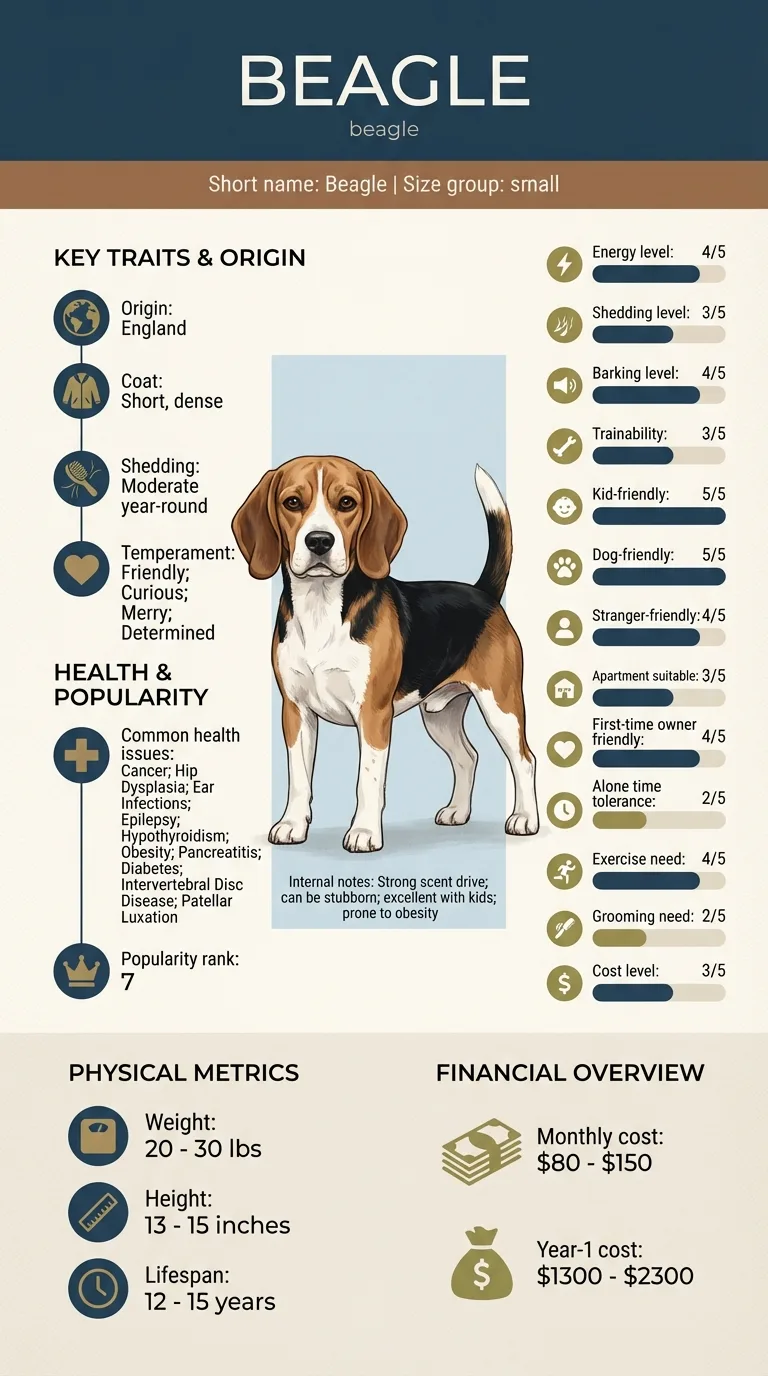
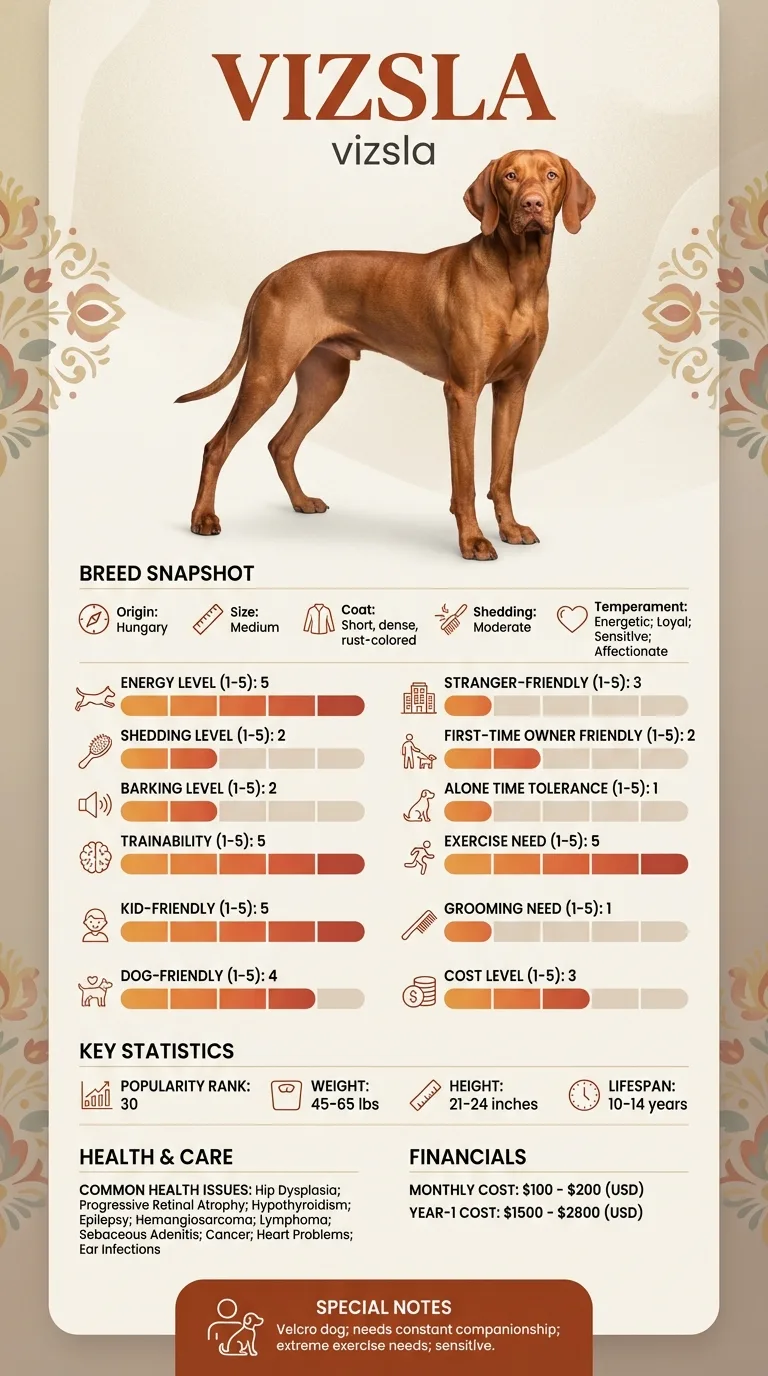
This is for someone already down to Beagle and Vizsla and deciding between them. For this pair the decision usually turns on apartment suitability and good for first-time owners, so those are covered first and in most detail. Anyone choosing from a flat has a clear answer here: Beagle rates 3/5 against 1/5. Breed history is left out; what follows is what you will actually live with.
Between Beagle and Vizsla, apartment suitability is what separates them, and Beagle is the lower-effort dog of the two to keep.
Choose Beagle if you are in a flat or a smaller home, this is your first dog and your walking routine is modest.
Choose Vizsla if you do not want a standing grooming appointment, shedding is a problem in your house and you want a dog that picks up training quickly.
| Feature | beagle | vizsla | Winner |
|---|---|---|---|
| Size class | small | medium | Equal |
| Weight | 20–30 lbs | 45–65 lbs | Equal |
| Height | 13–15 in | 21–24 in | Equal |
| Lifespan | 12–15 years | 10–14 years | beagle |
| Exercise need | High (4/5) | Very high (5/5) | beagle |
| Grooming need | Low (2/5) | Very low (1/5) | vizsla |
| Shedding | Moderate (3/5) | Low (2/5) | vizsla |
| Energy level | High (4/5) | Very high (5/5) | Equal |
| Barking | High (4/5) | Low (2/5) | vizsla |
| Apartment suitability | Moderate (3/5) | Very low (1/5) | beagle |
| Good for first-time owners | High (4/5) | Low (2/5) | beagle |
| Tolerates being alone | Low (2/5) | Very low (1/5) | beagle |
| Trainability | Moderate (3/5) | Very high (5/5) | vizsla |
| Good with kids | Very high (5/5) | Very high (5/5) | Equal |
| Good with other dogs | Very high (5/5) | High (4/5) | beagle |
| Friendly to strangers | High (4/5) | Moderate (3/5) | beagle |
| Cost level | Moderate (3/5) | Moderate (3/5) | Equal |
| Coat | Short, dense | Short, dense, rust-colored | Equal |
| Origin | England | Hungary | Equal |
| Typical monthly cost | $80–$150 | $100–$200 | Equal |
| Typical first-year cost | $1,300–$2,300 | $1,500–$2,800 | Equal |
A Beagle tops out around 30 pounds and 15 inches at the shoulder — genuinely small. A Vizsla is built on a different scale entirely: 45 to 65 pounds and up to two feet tall, all lean muscle with almost no fat cover. Pick the Beagle if you want a dog you can lift into the car; pick the Vizsla if you want one that can keep pace on a bike.
Both breeds want real daily exercise, but the Vizsla sits a notch above at 5 out of 5 versus the Beagle's 4. Vizslas were bred to run all day beside a horse and hunter, and an under-exercised one gets destructive fast. A Beagle's energy is nose-driven rather than athletic — long walks and scent games satisfy it in a way that a Vizsla, wired for sustained aerobic output, simply won't accept.
Neither breed needs a groomer. The Vizsla's short rust coat is about as low-maintenance as coats get, rating a 1 out of 5 for grooming, and it sheds less than the Beagle's moderate 3-out-of-5 coat. The Beagle isn't high-maintenance either — a weekly brush handles it — but if you're allergic to dog hair on the couch, the Vizsla leaves less of it behind.
The Beagle is the more apartment-friendly of the two on paper, rating moderate versus the Vizsla's very low score, but it comes with a catch: Beagles bark and bay a lot, rated 4 out of 5, and thin walls will not thank you. The Vizsla barks far less but its very high exercise needs and near-total intolerance of being alone (1 out of 5) make a small unit a poor match regardless of the quiet.
Trainability and first-timer suitability pull in opposite directions here. The Vizsla is highly trainable (5 out of 5) but rated low for first-time owners, because that intelligence comes wrapped in sensitivity and separation anxiety that punishes inconsistent handling. The Beagle trains at a middling 3 out of 5 — that nose will win arguments with you — but scores high, 4 out of 5, for owners new to dogs precisely because its stubbornness is low-stakes.
Both breeds are rated a full 5 out of 5 with kids, so that's not a deciding factor. The Beagle edges ahead with other dogs (5 versus 4) and with strangers (4 versus 3) — pack-hunting history made it the more socially easygoing of the two. The Vizsla's affection runs narrower and more intense, typically toward its own family, which shows up as a slightly more reserved 3 out of 5 with people it doesn't know.
The Beagle's 12-to-15-year lifespan runs a year or two longer than the Vizsla's 10 to 14. The two breeds share five conditions to watch for — hip dysplasia, hypothyroidism, epilepsy, cancer, and ear infections — but the Vizsla's list adds serious cancers like hemangiosarcoma and lymphoma, while the Beagle's leans toward manageable issues like obesity and pancreatitis tied to its famous appetite.
Budget a bit more for the Vizsla. Monthly costs run $100 to $200 against the Beagle's $80 to $150, and first-year totals land at $1,500 to $2,800 versus $1,300 to $2,300 once you count the larger dog's bigger food bill, higher-dose flea and heartworm prevention, and vet visits sized for a 55-pound athlete rather than a 25-pound scent hound. Neither breed carries a high price tag by dog standards — both land in the moderate cost bracket overall.
Beagle weighs 20–30 lbs and lives 12–15 years; Vizsla weighs 45–65 lbs and lives 10–14 years. The two diverge most on apartment suitability, good for first-time owners and barking and 1 other rated axes. They are level on cost level and good with kids, so those cannot decide it. The comparison marks an easier option only where one exists. Facts like weight and country of origin are not scored. Both dogs are rated from the same dataset, which is what makes the numbers comparable with each other even though any individual dog sits somewhere inside its breed's range.

A lot bigger. A Vizsla runs 45 to 65 pounds and 21 to 24 inches tall, while a Beagle tops out at 30 pounds and 15 inches. You're comparing a compact hound to a genuinely large-framed sporting dog.
The Vizsla, rated low (2/5) shedding against the Beagle's moderate (3/5). Its short rust coat drops less hair overall, though neither breed needs professional grooming.
The Beagle is — it rates high (4/5) for first-timers. The Vizsla rates low (2/5); its intensity, separation anxiety, and exercise demands are a lot to manage without prior dog experience.
Not comfortably. It rates very low (1/5) for apartment suitability and also scores very low for tolerating time alone, a combination that's rough in a small unit. The Beagle, at moderate (3/5), does better, though its high barking rating (4/5) is worth weighing against thin walls.
The Beagle. Typical monthly costs run $80 to $150 versus $100 to $200 for the Vizsla, and first-year costs land around $1,300 to $2,300 against $1,500 to $2,800 — the gap mostly comes down to size.
Yes — both are prone to hip dysplasia, hypothyroidism, epilepsy, cancer, and ear infections. Beyond that they diverge: the Vizsla carries added cancer risk (hemangiosarcoma, lymphoma) while the Beagle's extra risks (obesity, pancreatitis, diabetes) tie more to appetite and weight.
Neither handles it well, but the Beagle is the lesser evil — low (2/5) tolerance for being alone versus the Vizsla's very low (1/5). Vizslas are famous velcro dogs and genuinely struggle with solo time.
Beagle if you want a lower-key, apartment-tolerant dog for a first-time owner; Vizsla if you're an active household that can give it near-constant company and daily hard exercise.
Beagle runs $80 to $150 a month, Vizsla runs $100 to $200 — both moderate, but the Vizsla's larger size adds up.
The Vizsla, rated very high (5/5) versus the Beagle's high (4/5). It was bred for all-day fieldwork and needs it.
The Beagle, typically 12 to 15 years versus the Vizsla's 10 to 14.
Secure checkout on Stripe. We never see your card.
7-day money-back guarantee. Instant access.
Health information here is general and is not veterinary advice. If your dog shows pain, sudden behaviour change, or worsening symptoms, consult a licensed veterinarian.
Some links on this site are affiliate links. We may earn a commission at no extra cost to you, and we only suggest products we believe are helpful for dog owners.
We research and check what we publish, but we do not warrant that any figure, date, price, or statement is accurate, complete, or current, and we accept no liability for any loss, cost, injury, or other harm arising from the use of this site. Use it as one reference among several. You remain responsible for your own decisions and for your dog's care - confirm anything that matters with a licensed veterinarian or another qualified professional before you act on it. Full disclaimer.
Match your lifestyle to the right dog.
Take quizNot sure which breed is right for you? Take our 2-minute quiz to find out.
Take the quiz