Living
Beagle or Standard Schnauzer?
Take the Schnauzer if you want a highly trainable dog and don't mind grooming bills. Take the Beagle if you want an easier-going first dog that's friendlier with other dogs and strangers.

Quick answer
Beagle or Standard Schnauzer?
Take the Schnauzer if you want a highly trainable dog and don't mind grooming bills. Take the Beagle if you want an easier-going first dog that's friendlier with other dogs and strangers.
Beagle or Schnauzer (Standard)? On paper they differ most on grooming need, and on the scales Schnauzer (Standard) is the heavier at 26–50 lbs. Here is how the two compare on everything that shapes an ordinary week.
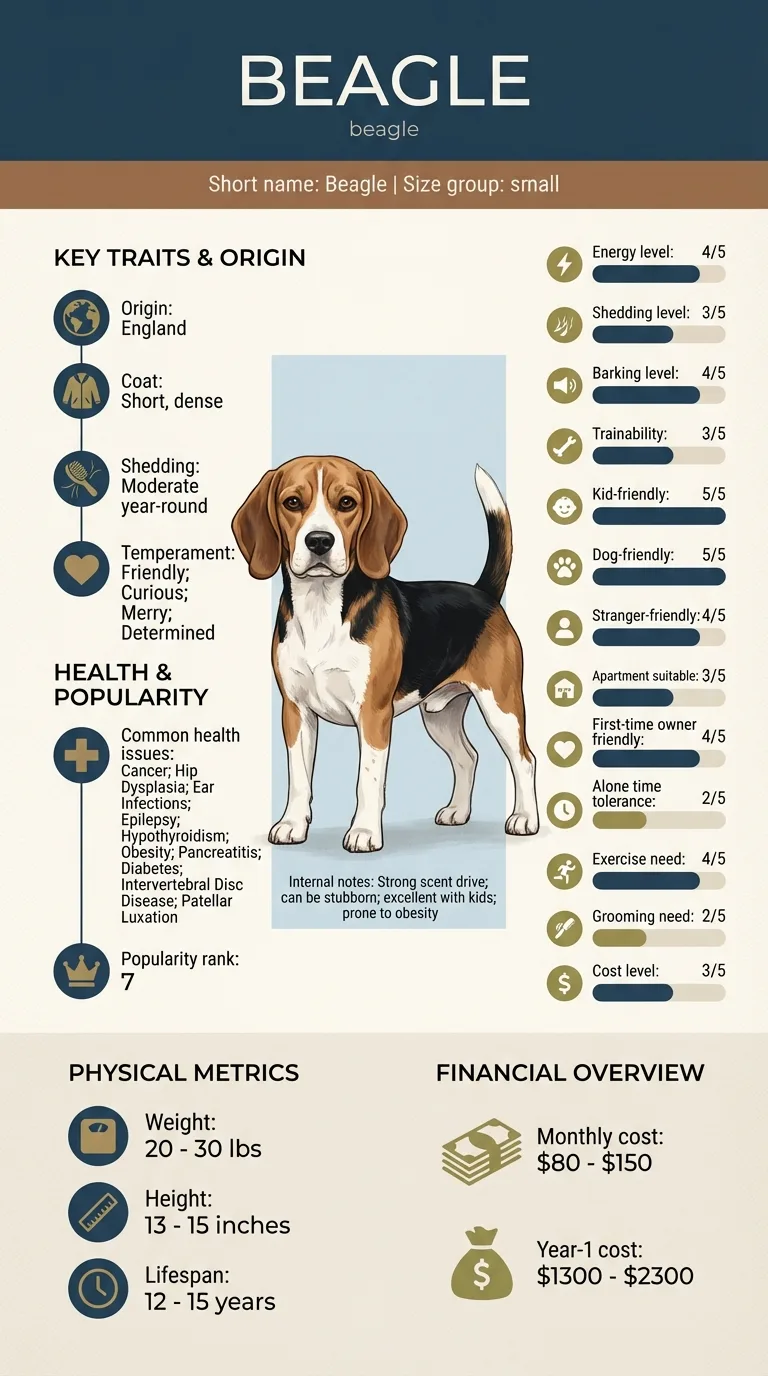
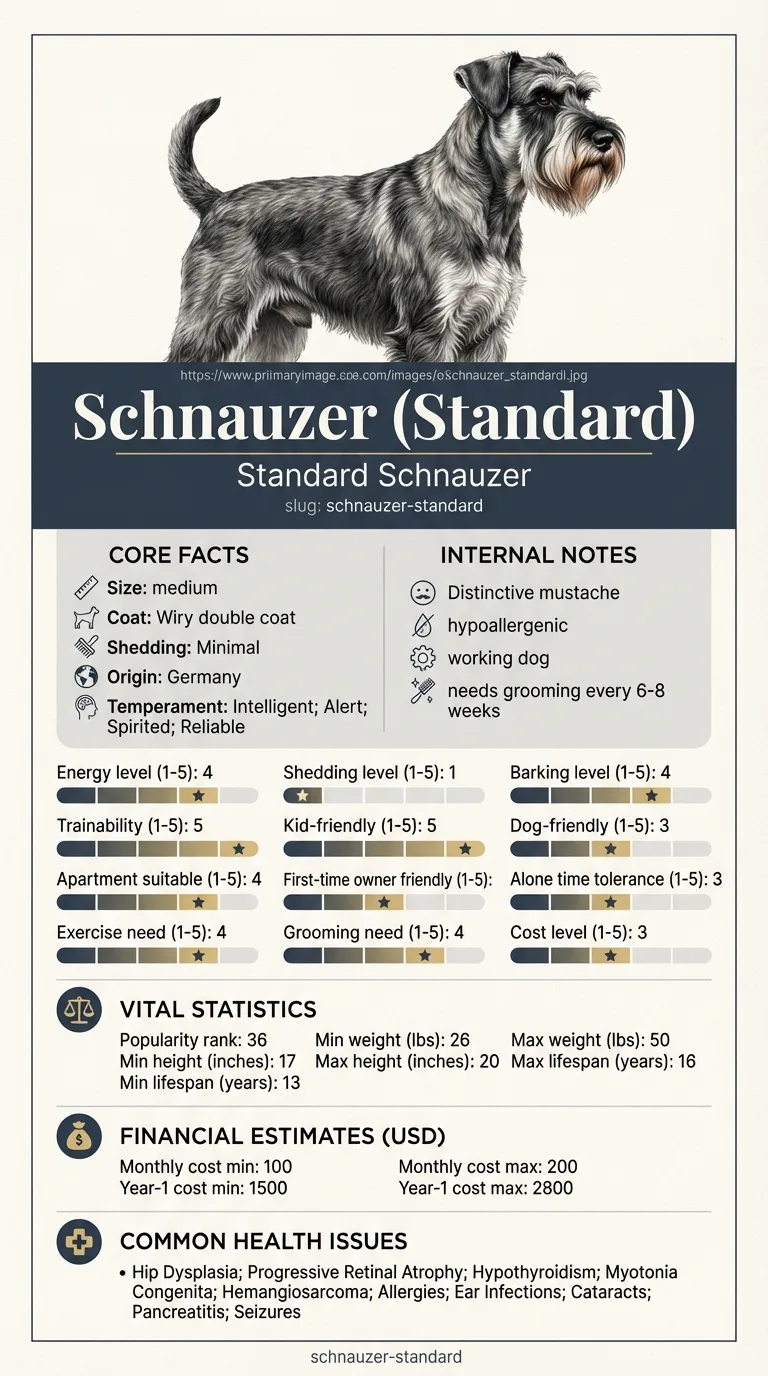
This is for someone already down to Beagle and Schnauzer (Standard) and deciding between them. For this pair the decision usually turns on grooming need and shedding, so those are covered first and in most detail. Anyone choosing from a flat has a clear answer here: Schnauzer (Standard) rates 4/5 against 3/5. It is written for the decision rather than the breed history.
Between Beagle and Schnauzer (Standard), grooming need is what separates them, and Beagle is the lower-effort dog of the two to keep.
Choose Beagle if this is your first dog, you do not want a standing grooming appointment and you already have another dog.
Choose Schnauzer (Standard) if you are in a flat or a smaller home, shedding is a problem in your house and the dog will be alone during the working day.
| Feature | beagle | schnauzer standard | Winner |
|---|---|---|---|
| Size class | small | medium | Equal |
| Weight | 20–30 lbs | 26–50 lbs | Equal |
| Height | 13–15 in | 17–20 in | Equal |
| Lifespan | 12–15 years | 13–16 years | schnauzer standard |
| Exercise need | High (4/5) | High (4/5) | Equal |
| Grooming need | Low (2/5) | High (4/5) | beagle |
| Shedding | Moderate (3/5) | Very low (1/5) | schnauzer standard |
| Energy level | High (4/5) | High (4/5) | Equal |
| Barking | High (4/5) | High (4/5) | Equal |
| Apartment suitability | Moderate (3/5) | High (4/5) | schnauzer standard |
| Good for first-time owners | High (4/5) | Moderate (3/5) | beagle |
| Tolerates being alone | Low (2/5) | Moderate (3/5) | schnauzer standard |
| Trainability | Moderate (3/5) | Very high (5/5) | schnauzer standard |
| Good with kids | Very high (5/5) | Very high (5/5) | Equal |
| Good with other dogs | Very high (5/5) | Moderate (3/5) | beagle |
| Friendly to strangers | High (4/5) | Moderate (3/5) | beagle |
| Cost level | Moderate (3/5) | Moderate (3/5) | Equal |
| Coat | Short, dense | Wiry double coat | Equal |
| Origin | England | Germany | Equal |
| Typical monthly cost | $80–$150 | $100–$200 | Equal |
| Typical first-year cost | $1,300–$2,300 | $1,500–$2,800 | Equal |
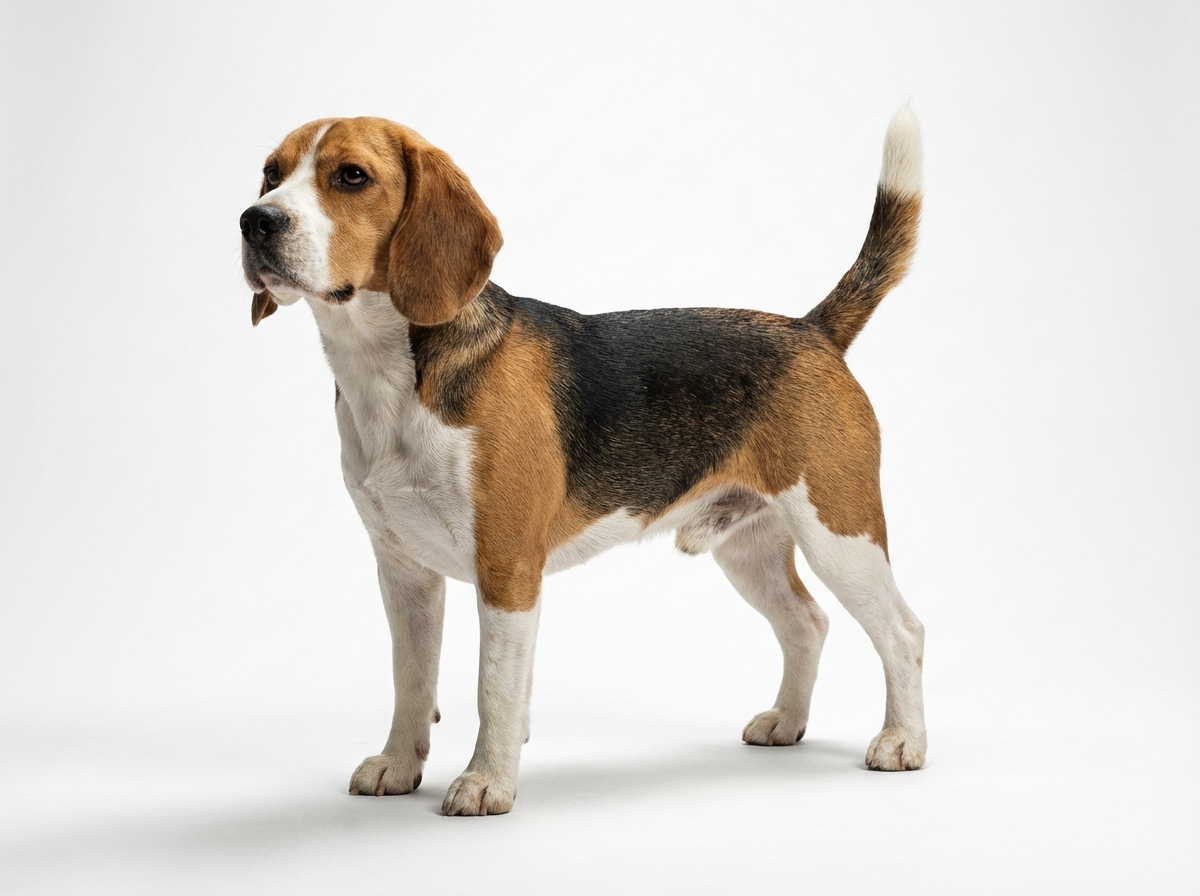
The Standard Schnauzer runs larger across the board - 26-50 lbs and 17-20 inches against the Beagle's 20-30 lbs and 13-15 inches. Both fall into the small-to-medium range, but the Schnauzer's wiry-coated, square-built frame reads as a noticeably bigger dog next to the Beagle. Make sure any crate, bed, or car harness you buy accounts for that larger frame rather than assuming small-breed sizing will fit.
Both breeds tie at high (4/5) for exercise need and energy level - this is one of the more evenly matched pairs on this page. Expect either dog to want a real daily walk plus something to occupy its brain; neither is content to nap through the afternoon. A tired Schnauzer or Beagle is a well-behaved one - skimping on exercise with either breed tends to show up as restlessness or destructive habits indoors.
The Schnauzer demands more upkeep - high (4/5) grooming against the Beagle's low (2/5) - but sheds far less in return, very low (1/5) against the Beagle's moderate (3/5). That wiry double coat needs regular stripping or clipping, a cost the Beagle simply doesn't carry. Many owners of Standard Schnauzers learn hand-stripping themselves to cut down on professional grooming costs over time.
Both breeds bark a lot - tied at high (4/5) - so neither is a quiet-apartment pick on noise alone. The Schnauzer does rate better for apartment suitability overall (high 4/5 versus the Beagle's moderate 3/5), likely reflecting its lower tendency to roam and sniff. Training a reliable quiet cue is worth prioritizing with either breed if you share walls with neighbors.
The Schnauzer rates very high (5/5) on trainability against the Beagle's moderate (3/5), one of the bigger training gaps on this page. Even so, the Beagle edges ahead for first-time owners (high 4/5 versus moderate 3/5) - a sharp, willful Schnauzer still needs a handler who'll follow through. A Schnauzer that's mentally under-stimulated can become vocal or pushy, so consistent structure pays off more with this breed than with a Beagle.
Both breeds tie at very high (5/5) with kids. The Beagle pulls ahead with other dogs (very high 5/5 versus moderate 3/5) and strangers (high 4/5 versus moderate 3/5) - the Schnauzer tends to be more reserved with dogs and people it doesn't know, a trait bred into it as a working guard dog. Early socialization can soften that reserve, though it rarely disappears completely.
These two share several risks: hip dysplasia, hypothyroidism, pancreatitis, and ear infections all appear on both lists, along with seizure-related conditions (epilepsy for the Beagle, seizures for the Schnauzer). The Schnauzer also lives a bit longer, 13-16 years against the Beagle's 12-15. Regular bloodwork as it ages can help catch hypothyroidism and other conditions early, before symptoms become obvious enough to affect its quality of life.
Costs are close: both rate moderate (3/5) overall, with monthly costs of $80-150 for the Beagle against $100-200 for the Schnauzer, and first-year totals of $1,300-2,300 versus $1,500-2,800. The Schnauzer's grooming needs account for most of that gap. Over a dog's lifetime, that difference alone can add up to well over a thousand dollars more than a comparably long-lived Beagle.
Beagle weighs 20–30 lbs and lives 12–15 years; Schnauzer (Standard) weighs 26–50 lbs and lives 13–16 years. The two diverge most on grooming need, shedding and trainability and 1 other rated axes. They are level on barking, cost level and energy level, so those cannot decide it. In the table, a "winner" means easier for an ordinary household — not better. Size, coat and origin are recorded without a verdict. Because both breeds are scored the same way, the gaps are reliable even where the absolute numbers are rough.

Noticeably - 26-50 lbs and 17-20 inches against the Beagle's 20-30 lbs and 13-15 inches. Both count as small-to-medium, but the Schnauzer is the bigger dog.
The Schnauzer, rated very low (1/5) against the Beagle's moderate (3/5). It comes with a tradeoff - high (4/5) grooming needs versus the Beagle's low (2/5).
It's workable at moderate (3/5), but the Beagle rates higher (high, 4/5). The Schnauzer's very high trainability (5/5) is an asset, but its more reserved nature with strangers and other dogs takes some handling.
The Schnauzer, rated high (4/5) apartment suitability against the Beagle's moderate (3/5) - though both bark a lot, tied at high (4/5), so thin walls are a risk with either.
About $20-50 - the Schnauzer runs $100-200 monthly against the Beagle's $80-150, mostly from grooming.
Yes, several - hip dysplasia, hypothyroidism, pancreatitis, and ear infections all show up on both lists, along with seizure-related conditions for each.
The Beagle, clearly. It rates very high (5/5) with other dogs and high (4/5) with strangers, against the Schnauzer's moderate (3/5) for both.
Take the Schnauzer if you want a highly trainable dog and don't mind grooming bills. Take the Beagle if you want an easier-going first dog that's friendlier with other dogs and strangers.
Close but not equal - the Schnauzer runs $100-200 monthly against the Beagle's $80-150.
Tied - both rate high (4/5) for exercise need, one of the most evenly matched pairs on this site.
The Schnauzer lives a bit longer, 13-16 years against the Beagle's 12-15.
Secure checkout on Stripe. We never see your card.
7-day money-back guarantee. Instant access.
Health information here is general and is not veterinary advice. If your dog shows pain, sudden behaviour change, or worsening symptoms, consult a licensed veterinarian.
Some links on this site are affiliate links. We may earn a commission at no extra cost to you, and we only suggest products we believe are helpful for dog owners.
We research and check what we publish, but we do not warrant that any figure, date, price, or statement is accurate, complete, or current, and we accept no liability for any loss, cost, injury, or other harm arising from the use of this site. Use it as one reference among several. You remain responsible for your own decisions and for your dog's care - confirm anything that matters with a licensed veterinarian or another qualified professional before you act on it. Full disclaimer.
Match your lifestyle to the right dog.
Take quizNot sure which breed is right for you? Take our 2-minute quiz to find out.
Take the quiz