Behavior
Beagle or Brussels Griffon — which fits your life?
Pick the Griffon for a true small-space, low-exercise dog that bonds closely with you. Pick the Beagle if you have kids, another dog, or want a more classically easygoing family pet.

Quick answer
Beagle or Brussels Griffon — which fits your life?
Pick the Griffon for a true small-space, low-exercise dog that bonds closely with you. Pick the Beagle if you have kids, another dog, or want a more classically easygoing family pet.
Beagle or Brussels Griffon? On paper they differ most on exercise need, and on the scales Beagle is the heavier at 20–30 lbs. Here is how the two compare on everything that shapes an ordinary week.
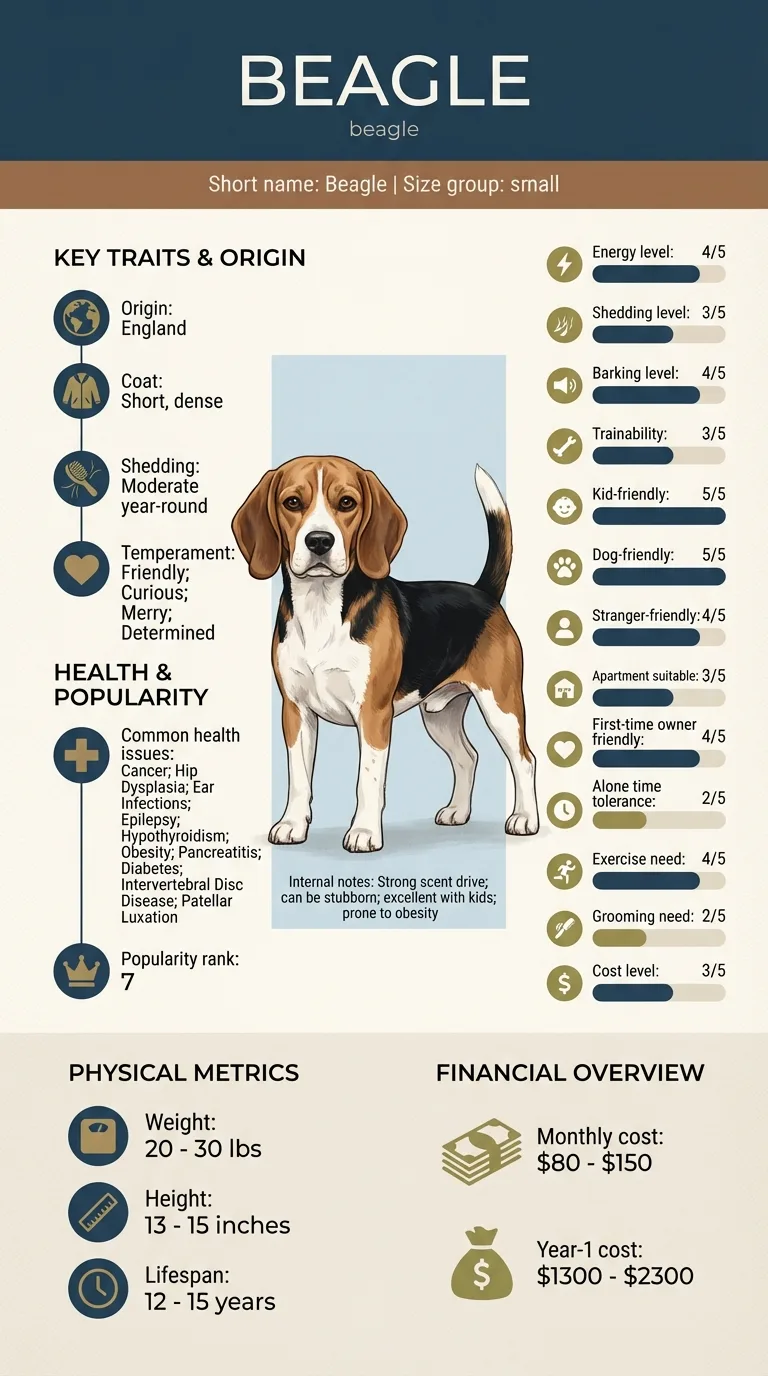
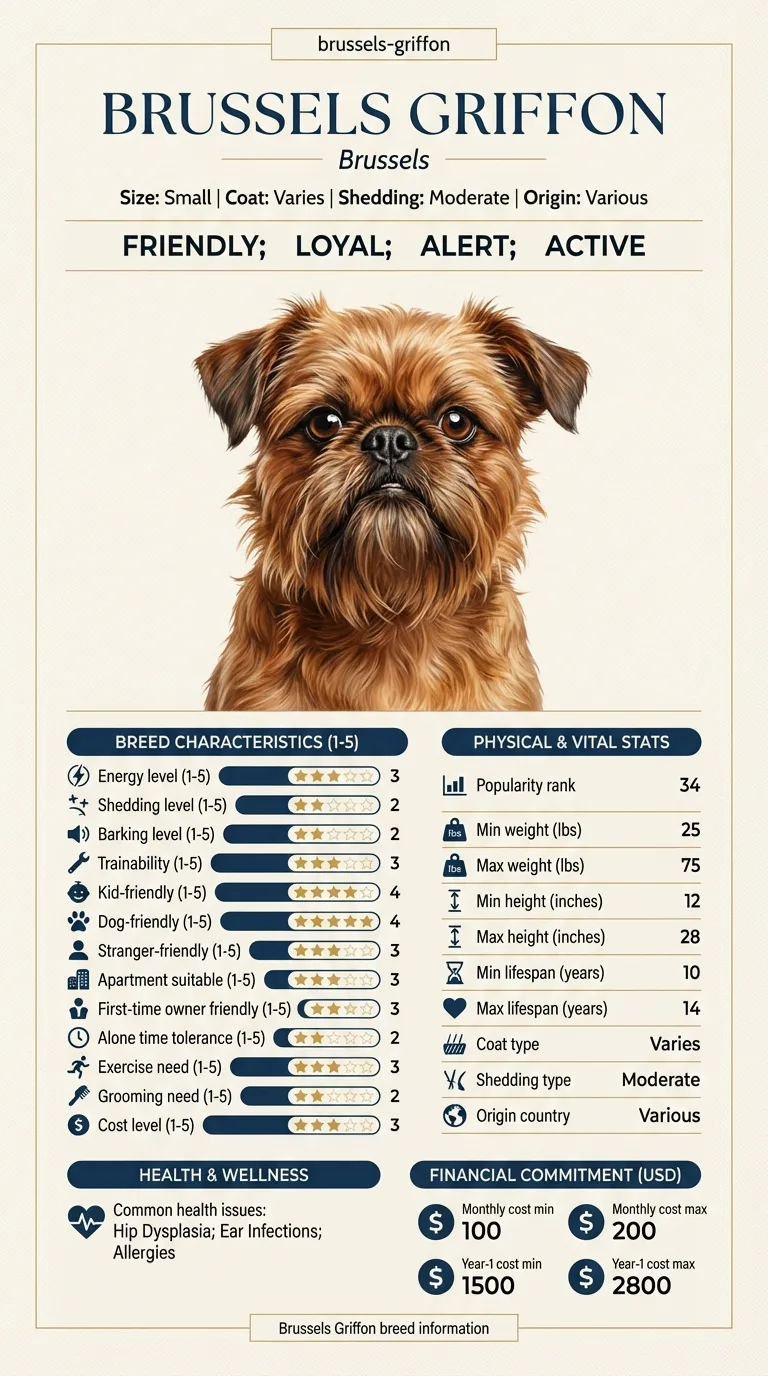
This is for someone already down to Beagle and Brussels Griffon and deciding between them. For this pair the decision usually turns on exercise need and apartment suitability, so those are covered first and in most detail. Anyone choosing from a flat has a clear answer here: Brussels Griffon rates 5/5 against 3/5. Breed history is left out; what follows is what you will actually live with.
Between Beagle and Brussels Griffon, exercise need is what separates them, and Brussels Griffon is the lower-effort dog of the two to keep.
Choose Beagle if this is your first dog, you do not want a standing grooming appointment and there are young children at home.
Choose Brussels Griffon if you are in a flat or a smaller home, shedding is a problem in your house and your walking routine is modest.
| Feature | beagle | brussels griffon | Winner |
|---|---|---|---|
| Size class | small | small | Equal |
| Weight | 20–30 lbs | 8–12 lbs | Equal |
| Height | 13–15 in | 7–10 in | Equal |
| Lifespan | 12–15 years | 12–15 years | Equal |
| Exercise need | High (4/5) | Low (2/5) | brussels griffon |
| Grooming need | Low (2/5) | Moderate (3/5) | beagle |
| Shedding | Moderate (3/5) | Low (2/5) | brussels griffon |
| Energy level | High (4/5) | Moderate (3/5) | Equal |
| Barking | High (4/5) | Moderate (3/5) | brussels griffon |
| Apartment suitability | Moderate (3/5) | Very high (5/5) | brussels griffon |
| Good for first-time owners | High (4/5) | Moderate (3/5) | beagle |
| Tolerates being alone | Low (2/5) | Low (2/5) | Equal |
| Trainability | Moderate (3/5) | Moderate (3/5) | Equal |
| Good with kids | Very high (5/5) | Moderate (3/5) | beagle |
| Good with other dogs | Very high (5/5) | Moderate (3/5) | beagle |
| Friendly to strangers | High (4/5) | Moderate (3/5) | beagle |
| Cost level | Moderate (3/5) | Moderate (3/5) | Equal |
| Coat | Short, dense | Rough or smooth | Equal |
| Origin | England | Various | Equal |
| Typical monthly cost | $80–$150 | $80–$150 | Equal |
| Typical first-year cost | $1,300–$2,300 | $1,100–$2,300 | Equal |
Don't let 'small' fool you into thinking these two are close in size. The Beagle weighs 20-30 lbs and stands 13-15 inches; the Brussels Griffon weighs just 8-12 lbs and tops out around 10 inches. That's roughly a third of the Beagle's weight in some cases. If you're picturing a lap dog, the Griffon delivers that in a way the Beagle, built more like a compact hound, never will.
The gap here is real: the Beagle rates a high 4/5 on exercise need, the Griffon a low 2/5. A Beagle without a real walk or a scent game most days gets destructive. A Griffon is content with shorter, lower-intensity sessions and more couch time. If your schedule doesn't allow for daily 45-60 minute walks, the Griffon is the more forgiving choice by a wide margin.
This is one of the rare categories where the Beagle wins outright — 2/5 grooming need against the Griffon's 3/5, since the Griffon's rough or smooth coat needs more regular attention than the Beagle's short, dense one. Shedding runs the other way: the Griffon sheds less (2/5 versus 3/5). Net-net, expect slightly more brushing time with the Griffon but less fur on the couch.
The Griffon was practically made for small spaces — a very high 5/5 on apartment suitability, plus lower exercise needs and a 3/5 barking score against the Beagle's 4/5. The Beagle rates only 3/5 for apartment living and has a genuine baying instinct that carries through walls. For a studio or a building with a strict noise policy, the Griffon is the clearer fit.
Both breeds score an identical 3/5 on trainability, so neither has an edge in the obedience department. Where they differ is first-time-owner suitability: the Beagle rates a high 4/5, the Griffon a more moderate 3/5. The Griffon is known for a sensitive, alert temperament that can require a more patient, experienced hand than the Beagle's easier-going nature.
The Beagle wins across the board on social scores — 5/5 with kids and other dogs versus the Griffon's 3/5 on both, and 4/5 with strangers against the Griffon's 3/5. That's a meaningful gap if you have young children, an existing dog, or a house full of frequent visitors. The Griffon tends to bond tightly with one or two people rather than the whole household.
Both breeds share the same 12-15 year lifespan. Health profiles diverge sharply, though: the Beagle's list runs to ten conditions including cancer, pancreatitis, and diabetes, while the Griffon's shorter list is dominated by brachycephalic airway syndrome (BOAS), a direct consequence of its flat face, plus syringomyelia. Hip dysplasia and patellar luxation are the two conditions both breeds share.
Monthly costs match almost exactly — $80-150 for both breeds, each rated a moderate 3/5. First-year costs are close too: $1,300-2,300 for the Beagle versus $1,100-2,300 for the Griffon. Don't expect the smaller dog to be meaningfully cheaper; smaller breeds often carry higher per-pound vet and food costs that offset the size difference.
Beagle weighs 20–30 lbs and lives 12–15 years; Brussels Griffon weighs 8–12 lbs and lives 12–15 years. The two diverge most on exercise need, apartment suitability and good with kids and 1 other rated axes. They are level on tolerates being alone, cost level and trainability, so those cannot decide it. The comparison marks an easier option only where one exists. Facts like weight and country of origin are not scored. Both dogs are rated from the same dataset, which is what makes the numbers comparable with each other even though any individual dog sits somewhere inside its breed's range.

Significantly — the Griffon weighs 8-12 lbs versus the Beagle's 20-30 lbs, and stands about 7-10 inches tall against the Beagle's 13-15. It's a genuinely tiny dog next to a Beagle.
The Griffon, at a low 2/5 versus the Beagle's moderate 3/5. It does need slightly more grooming attention (3/5 versus 2/5) to keep its coat in shape, though.
It's workable but rated a step below the Beagle — 3/5 versus 4/5 for first-time owners. Its sensitive, alert temperament can take more experience to manage than the Beagle's straightforward friendliness.
The Griffon by a wide margin — 5/5 apartment suitability against the Beagle's 3/5, plus lower exercise needs and a quieter bark rating. If you're in a small unit, the Griffon is built for it.
Both run $80-150 a month and both rate a moderate 3/5 on overall cost. The smaller Griffon isn't the budget option you might expect.
Only a couple — hip dysplasia and patellar luxation appear on both lists. Otherwise their health profiles look very different: the Griffon's issues center on its flat face (BOAS) and spine (syringomyelia), while the Beagle's list is longer and more varied.
The Beagle, clearly — 5/5 on both measures versus the Griffon's 3/5 on both. If your household includes young kids or another dog, the Beagle's data profile fits better.
Pick the Griffon for a true small-space, low-exercise dog that bonds closely with you. Pick the Beagle if you have kids, another dog, or want a more classically easygoing family pet.
No — both run $80-150 a month at the same moderate cost rating. Size doesn't translate into savings here.
The Beagle needs a high 4/5 worth of daily activity; the Griffon gets by on a low 2/5. That's the widest exercise gap in this comparison.
Neither — both average 12-15 years.
Secure checkout on Stripe. We never see your card.
7-day money-back guarantee. Instant access.

Health information here is general and is not veterinary advice. If your dog shows pain, sudden behaviour change, or worsening symptoms, consult a licensed veterinarian.
Some links on this site are affiliate links. We may earn a commission at no extra cost to you, and we only suggest products we believe are helpful for dog owners.
We research and check what we publish, but we do not warrant that any figure, date, price, or statement is accurate, complete, or current, and we accept no liability for any loss, cost, injury, or other harm arising from the use of this site. Use it as one reference among several. You remain responsible for your own decisions and for your dog's care - confirm anything that matters with a licensed veterinarian or another qualified professional before you act on it. Full disclaimer.
Match your lifestyle to the right dog.
Take quizNot sure which breed is right for you? Take our 2-minute quiz to find out.
Take the quiz