Living
Which is the better overall pick?
It's close, the Am Staff for a friendlier stranger-greeter with a longer lifespan, the Corgi for slightly better apartment suitability and dog-park sociability.

Quick answer
Which is the better overall pick?
It's close, the Am Staff for a friendlier stranger-greeter with a longer lifespan, the Corgi for slightly better apartment suitability and dog-park sociability.
American Staffordshire Terrier or Pembroke Welsh Corgi? On paper they differ most on grooming need, and on the scales American Staffordshire Terrier is the heavier at 40–70 lbs. Here is how the two compare on everything that shapes an ordinary week.
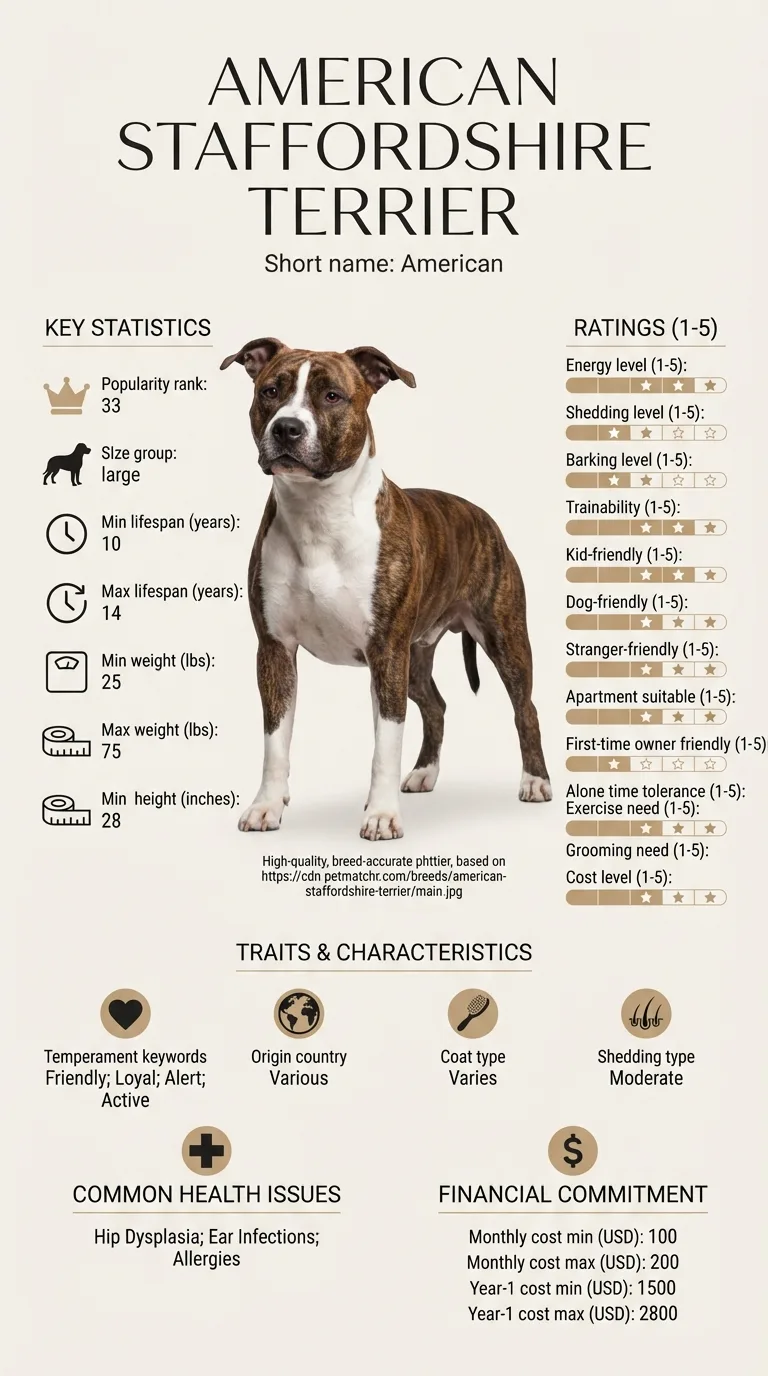
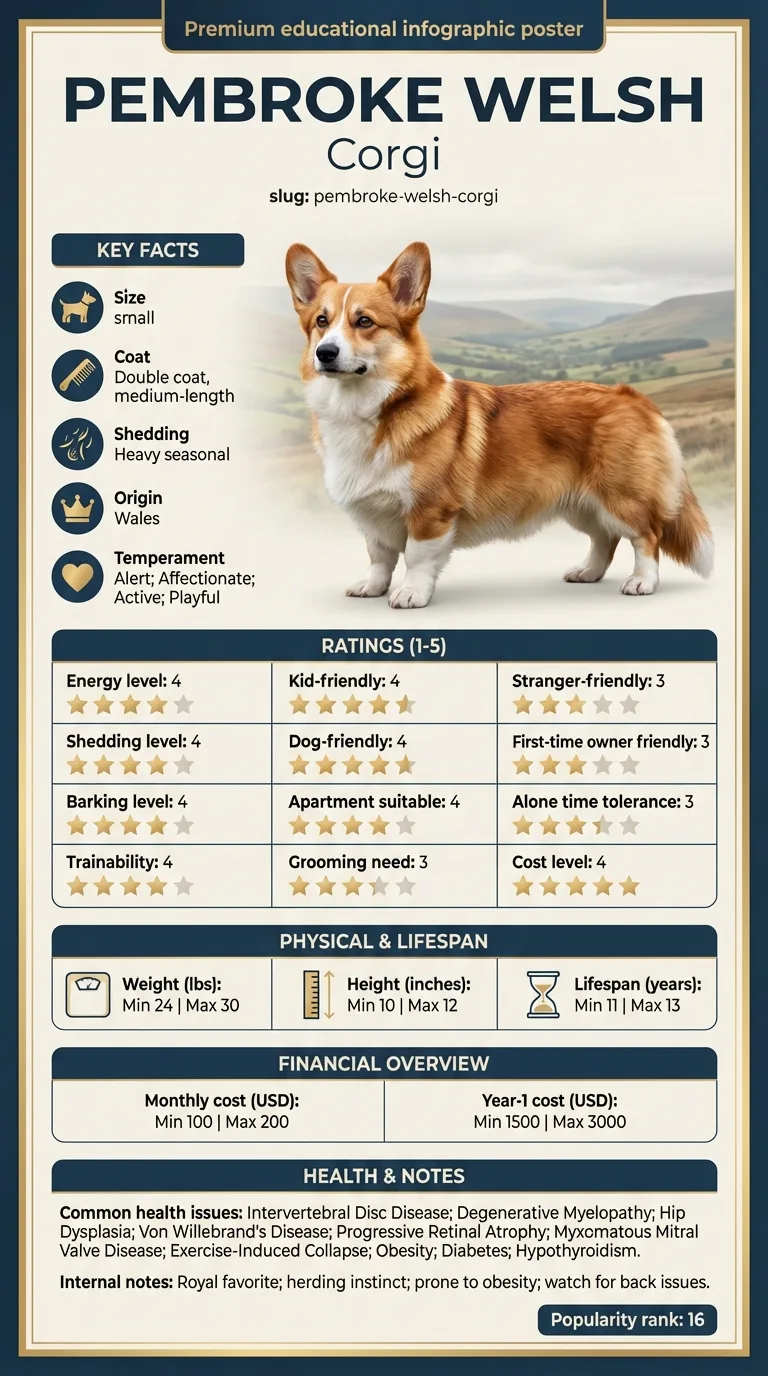
This is for someone already down to American Staffordshire Terrier and Pembroke Welsh Corgi and deciding between them. For this pair the decision usually turns on grooming need and barking, so those are covered first and in most detail. Anyone choosing from a flat has a clear answer here: Pembroke Welsh Corgi rates 4/5 against 3/5. Breed history is left out; what follows is what you will actually live with.
Between American Staffordshire Terrier and Pembroke Welsh Corgi, grooming need is what separates them, and American Staffordshire Terrier is the lower-effort dog of the two to keep.
Choose American Staffordshire Terrier if you do not want a standing grooming appointment and shedding is a problem in your house.
Choose Pembroke Welsh Corgi if you are in a flat or a smaller home, you already have another dog and a smaller dog suits your car, your home or your back.
| Feature | american staffordshire terrier | pembroke welsh corgi | Winner |
|---|---|---|---|
| Size class | medium | small | Equal |
| Weight | 40–70 lbs | 24–30 lbs | Equal |
| Height | 17–19 in | 10–12 in | Equal |
| Lifespan | 12–16 years | 11–13 years | american staffordshire terrier |
| Exercise need | High (4/5) | High (4/5) | Equal |
| Grooming need | Very low (1/5) | Moderate (3/5) | american staffordshire terrier |
| Shedding | Moderate (3/5) | High (4/5) | american staffordshire terrier |
| Energy level | High (4/5) | High (4/5) | Equal |
| Barking | Low (2/5) | High (4/5) | american staffordshire terrier |
| Apartment suitability | Moderate (3/5) | High (4/5) | pembroke welsh corgi |
| Good for first-time owners | Moderate (3/5) | Moderate (3/5) | Equal |
| Tolerates being alone | Moderate (3/5) | Moderate (3/5) | Equal |
| Trainability | High (4/5) | High (4/5) | Equal |
| Good with kids | High (4/5) | High (4/5) | Equal |
| Good with other dogs | Low (2/5) | High (4/5) | pembroke welsh corgi |
| Friendly to strangers | High (4/5) | Moderate (3/5) | american staffordshire terrier |
| Cost level | Moderate (3/5) | High (4/5) | american staffordshire terrier |
| Coat | Short, stiff and glossy | Double coat, medium-length | Equal |
| Origin | Various | Wales | Equal |
| Typical monthly cost | $100–$200 | $100–$200 | Equal |
| Typical first-year cost | $1,400–$2,900 | $1,500–$3,000 | Equal |
Short legs, long body versus a compact athletic frame, the Corgi's 24-30 lbs and 10-12 inches sit well below the Am Staff's 40-70 lbs and 17-19 inches, even though both land in the same general weight neighborhood at the low end. It's less a size difference than a shape difference: the Corgi carries real bulk on a much shorter frame.
Both breeds rate high energy (4/5) and a high exercise need (4/5), this is a genuine tie, and it matters, because Corgis have a reputation for being deceptively demanding for their size. Anyone expecting a low-key small dog because of the Corgi's stature should recalibrate; it wants real daily activity, same as the Am Staff.
The Am Staff's short coat needs almost no work (1/5 grooming) and sheds moderately (3/5); the Corgi needs more brushing (3/5) and sheds more (4/5) thanks to its medium-length double coat. Corgis are known for shedding heavily twice a year on top of a steady baseline, factor that into your vacuum budget.
The Corgi edges out the Am Staff on apartment suitability (4/5 versus 3/5) but barks considerably more (4/5 versus 2/5), a herding-breed trait tied to its alertness. Both tolerate being alone at the same moderate level (3/5), so neither is well suited to a long, empty workday.
Trainability, first-time-owner suitability, and alone-tolerance all come back tied between these two breeds, 4/5, 3/5, and 3/5 respectively. There's genuinely little separating them on the raw obedience and beginner-friendliness numbers; the deciding factors here are elsewhere in this comparison.
Both score a high 4/5 with kids. The Corgi does better with other dogs (4/5 versus 2/5), while the Am Staff is friendlier to strangers, high 4/5 versus the Corgi's moderate 3/5. A Corgi's herding instinct can also show up as nipping at heels during play, worth mentioning if you have small kids who run.
The Am Staff's 12-16 year lifespan edges out the Corgi's 11-13. The Corgi's health list runs considerably longer, though, ten conditions including intervertebral disc disease and degenerative myelopathy, both tied to its long spine and short legs, plus von Willebrand's disease and exercise-induced collapse. The Am Staff's five conditions look almost simple by comparison.
Monthly costs are essentially identical, $100-200 for both breeds. First-year costs tilt slightly toward the Corgi being pricier, $1,500-3,000 versus the Am Staff's $1,400-2,900, likely reflecting the Corgi's longer health-monitoring list and its higher cost-level rating overall (4/5 versus 3/5).
American Staffordshire Terrier weighs 40–70 lbs and lives 12–16 years; Pembroke Welsh Corgi weighs 24–30 lbs and lives 11–13 years. The two diverge most on grooming need, barking and good with other dogs. They are level on tolerates being alone, energy level and exercise need, so those cannot decide it. The comparison marks an easier option only where one exists. Facts like weight and country of origin are not scored. Both dogs are rated from the same dataset, which is what makes the numbers comparable with each other even though any individual dog sits somewhere inside its breed's range.

Yes, notably, 24-30 lbs and 10-12 inches versus the Am Staff's 40-70 lbs and 17-19 inches, though the Corgi is stockier than its height suggests.
Yes, this data rates Corgi exercise need at a high 4/5, tied with the Am Staff. It's a common misconception that their short legs mean low energy.
The Corgi, whose long spine and short legs put it at risk for intervertebral disc disease and degenerative myelopathy, neither of which appears on the Am Staff's health list.
The Corgi, rated high (4/5) against the Am Staff's low (2/5). It's a herding-breed trait tied to alertness, not a training failure.
Nearly none monthly, both run $100-200. First-year costs are close too, $1,500-3,000 for the Corgi versus $1,400-2,900 for the Am Staff.
The Am Staff, rated high (4/5) versus the Corgi's moderate (3/5). The Corgi's watchfulness makes it a decent alert barker but a less instant greeter.
The Am Staff, at 12-16 years versus the Corgi's 11-13.
It's close, the Am Staff for a friendlier stranger-greeter with a longer lifespan, the Corgi for slightly better apartment suitability and dog-park sociability.
Nearly, both run $100-200 a month, with the Corgi running marginally higher in year one due to its longer health-watch list.
Neither has an edge, both rate a high 4/5. The Corgi's short legs don't mean low energy.
The Corgi, with ten listed conditions including two spine-related ones, versus five for the Am Staff.
Secure checkout on Stripe. We never see your card.
7-day money-back guarantee. Instant access.

Health information here is general and is not veterinary advice. If your dog shows pain, sudden behaviour change, or worsening symptoms, consult a licensed veterinarian.
Some links on this site are affiliate links. We may earn a commission at no extra cost to you, and we only suggest products we believe are helpful for dog owners.
We research and check what we publish, but we do not warrant that any figure, date, price, or statement is accurate, complete, or current, and we accept no liability for any loss, cost, injury, or other harm arising from the use of this site. Use it as one reference among several. You remain responsible for your own decisions and for your dog's care - confirm anything that matters with a licensed veterinarian or another qualified professional before you act on it. Full disclaimer.
Match your lifestyle to the right dog.
Take quizNot sure which breed is right for you? Take our 2-minute quiz to find out.
Take the quiz