Living
Which one suits a small home better?
The Corgi, rated high (4/5) for apartment suitability against the Pit Bull's low (2/5), despite matching it on exercise need.

Quick answer
Which one suits a small home better?
The Corgi, rated high (4/5) for apartment suitability against the Pit Bull's low (2/5), despite matching it on exercise need.
American Pit Bull Terrier or Pembroke Welsh Corgi? On paper they differ most on grooming need, and on the scales American Pit Bull Terrier is the heavier at 30–65 lbs. Here is how the two compare on everything that shapes an ordinary week.
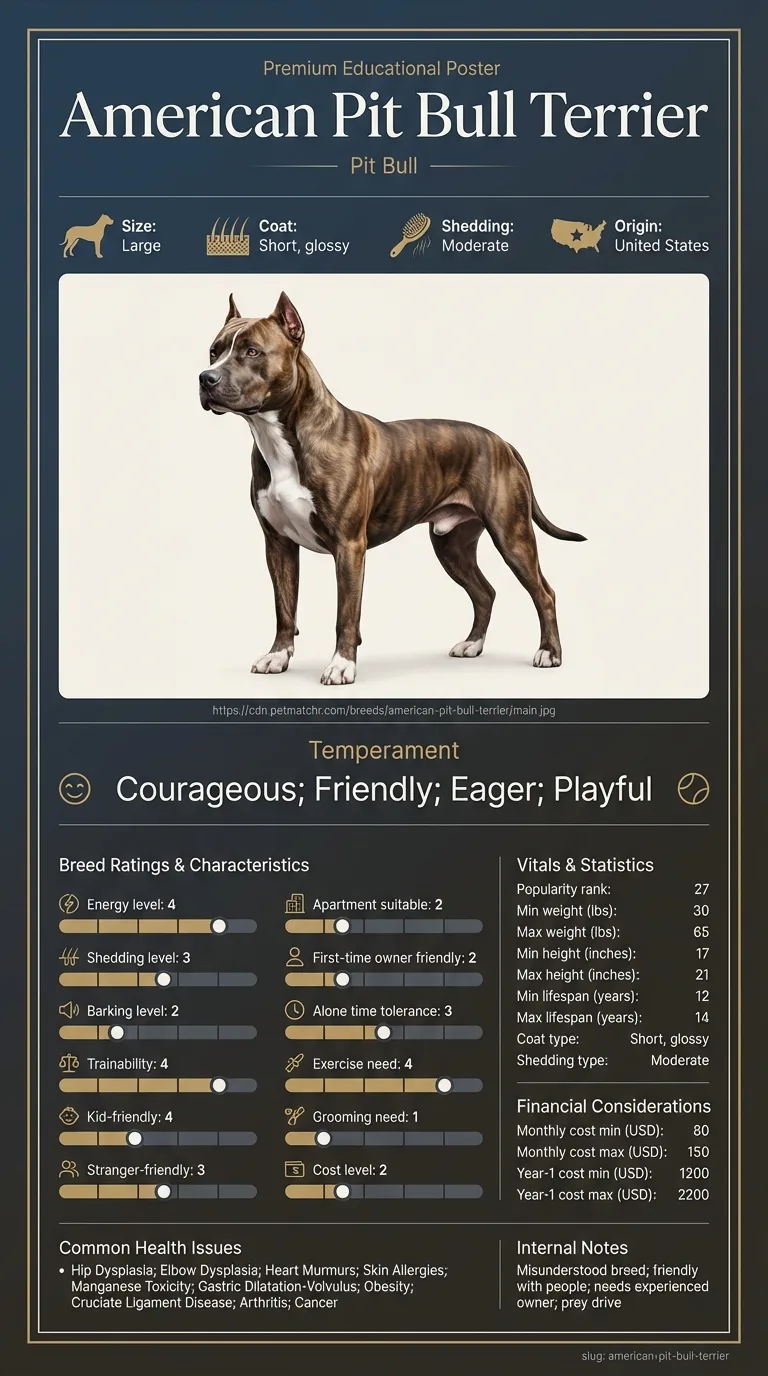
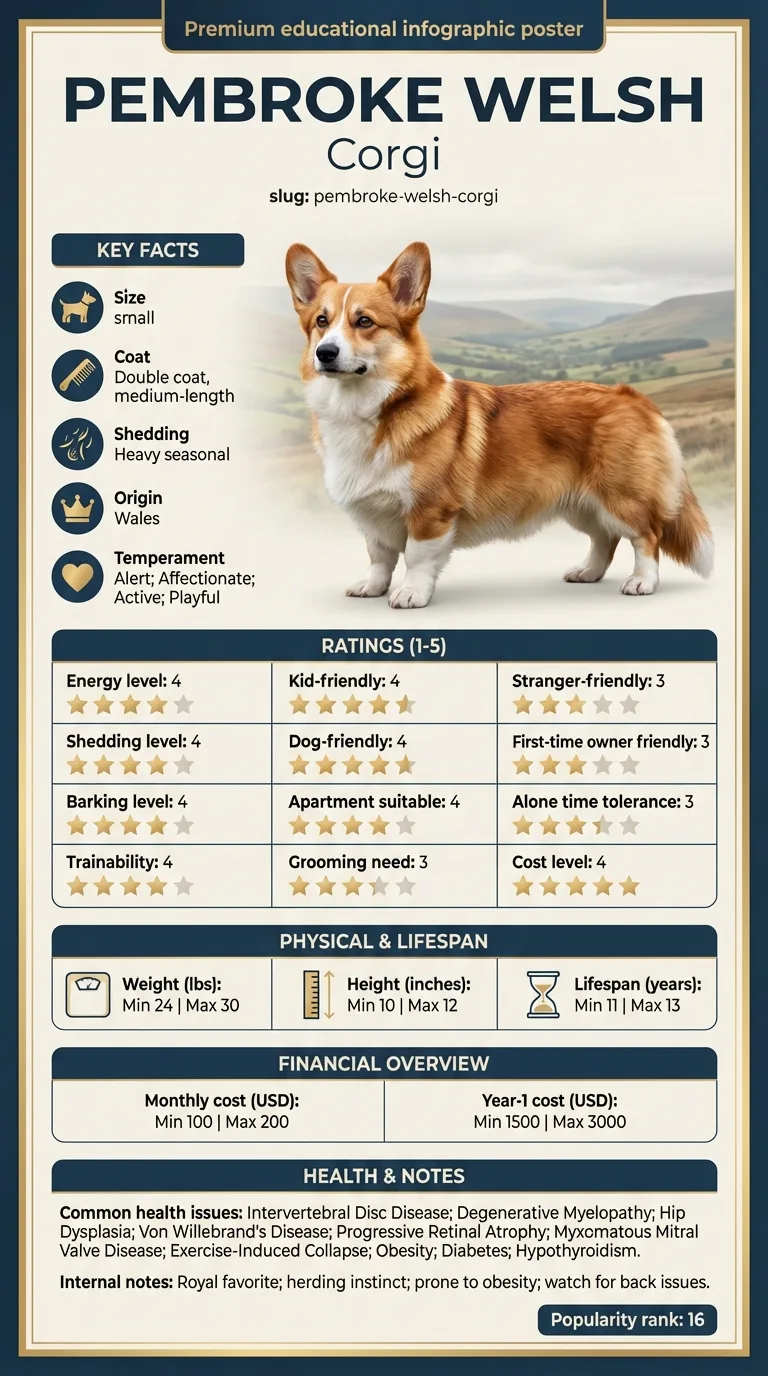
This is for someone already down to American Pit Bull Terrier and Pembroke Welsh Corgi and deciding between them. For this pair the decision usually turns on grooming need and apartment suitability, so those are covered first and in most detail. Anyone choosing from a flat has a clear answer here: Pembroke Welsh Corgi rates 4/5 against 2/5. There is no origin story here — only what changes about your week.
Between American Pit Bull Terrier and Pembroke Welsh Corgi, grooming need is what separates them, and Pembroke Welsh Corgi is the lower-effort dog of the two to keep.
Choose American Pit Bull Terrier if you do not want a standing grooming appointment and shedding is a problem in your house.
Choose Pembroke Welsh Corgi if you are in a flat or a smaller home, this is your first dog and you already have another dog.
| Feature | american pit bull terrier | pembroke welsh corgi | Winner |
|---|---|---|---|
| Size class | large | small | Equal |
| Weight | 30–65 lbs | 24–30 lbs | Equal |
| Height | 17–21 in | 10–12 in | Equal |
| Lifespan | 12–14 years | 11–13 years | american pit bull terrier |
| Exercise need | High (4/5) | High (4/5) | Equal |
| Grooming need | Very low (1/5) | Moderate (3/5) | american pit bull terrier |
| Shedding | Moderate (3/5) | High (4/5) | american pit bull terrier |
| Energy level | High (4/5) | High (4/5) | Equal |
| Barking | Low (2/5) | High (4/5) | american pit bull terrier |
| Apartment suitability | Low (2/5) | High (4/5) | pembroke welsh corgi |
| Good for first-time owners | Low (2/5) | Moderate (3/5) | pembroke welsh corgi |
| Tolerates being alone | Moderate (3/5) | Moderate (3/5) | Equal |
| Trainability | High (4/5) | High (4/5) | Equal |
| Good with kids | High (4/5) | High (4/5) | Equal |
| Good with other dogs | Low (2/5) | High (4/5) | pembroke welsh corgi |
| Friendly to strangers | Moderate (3/5) | Moderate (3/5) | Equal |
| Cost level | Low (2/5) | High (4/5) | american pit bull terrier |
| Coat | Short, glossy | Double coat, medium-length | Equal |
| Origin | United States | Wales | Equal |
| Typical monthly cost | $80–$150 | $100–$200 | Equal |
| Typical first-year cost | $1,200–$2,200 | $1,500–$3,000 | Equal |
The size-class labels say large versus small, but the actual numbers are closer than that suggests. The Corgi weighs 24 to 30 pounds against the Pit Bull's 30 to 65, so the weight gap is less dramatic than the label implies. Height is where they really diverge, 10 to 12 inches for the low-slung, long-backed Corgi versus 17 to 21 for the Pit Bull's taller frame.
Don't let the Corgi's short legs fool you, it matches the Pit Bull's exercise need at 4 out of 5. This is a herding breed bred to work all day, and it needs a job or a serious daily outlet to stay out of trouble. Neither dog is a good match for a household that can only offer a short walk around the block.
The Pit Bull is about as low-maintenance as coats get, a 1 out of 5 for grooming. The Corgi sits at a moderate 3, and its double coat sheds at a high 4 out of 5, expect fur on the furniture and a heavier shed twice a year as the undercoat blows. Neither requires professional grooming, but the Corgi asks for a lot more brushing.
The Corgi rates high (4/5) for apartment suitability despite its exercise needs, largely because of its compact size. The Pit Bull rates low (2/5), it simply takes up more space and needs more room to burn off energy. The Corgi is also the more vocal of the two, rated high (4/5) for barking against the Pit Bull's low (2/5), a trait rooted in its herding background.
Both breeds train well, tied at 4 out of 5 for trainability, but the Corgi is the friendlier pick for someone newer to dog ownership, moderate 3/5 versus the Pit Bull's low 2/5. Corgis are smart enough to get themselves into trouble without consistent structure, so training still matters, it's just a gentler learning curve than the Pit Bull's strength and drive demand.
Both rate high (4/5) with kids, so this category is a wash. The Corgi pulls ahead with other dogs, 4/5 versus 2/5, making it the easier choice for multi-dog households or frequent dog-park trips. Strangers are a tie at moderate (3/5) for both, neither breed is instantly warm to unfamiliar people, though neither is standoffish either.
The Pit Bull lives a bit longer on average, 12 to 14 years against the Corgi's 11 to 13. Hip dysplasia and obesity show up on both lists, worth watching given how easily a low-slung, food-motivated breed like the Corgi can gain weight. The Corgi's list also carries spine-specific risks, intervertebral disc disease and degenerative myelopathy, a direct consequence of its long back and short legs.
The Pit Bull is the cheaper dog to keep, $80 to $150 monthly and $1,200 to $2,200 in year one, against the Corgi's $100 to $200 and $1,500 to $3,000. The Corgi's higher cost level, 4/5 versus 2/5, tracks with its grooming needs and the vet attention its spine and joints may need over time.
American Pit Bull Terrier weighs 30–65 lbs and lives 12–14 years; Pembroke Welsh Corgi weighs 24–30 lbs and lives 11–13 years. The two diverge most on grooming need, apartment suitability and barking and 2 other rated axes. They are level on tolerates being alone, energy level and exercise need, so those cannot decide it. Where the table declares a winner it means less work for the owner, nothing more; descriptive rows are left as ties on purpose. The value here is in the differences between the two columns; treat any single score as approximate.

In weight, yes but not dramatically, 24 to 30 pounds versus 30 to 65. In height it's a much bigger gap, since the Corgi stands barely a foot tall.
No, it matches the Pit Bull's high (4/5) exercise need. Corgis were bred to herd cattle all day and carry that drive regardless of leg length.
The Corgi rates moderate (3/5) for first-time owners against the Pit Bull's low (2/5), making it the more forgiving choice for someone new to dog ownership.
The Corgi, rated high (4/5) against the Pit Bull's moderate (3/5), that double coat blows out seasonally.
$80 to $150 for the Pit Bull, $100 to $200 for the Corgi, a modest but consistent gap driven by grooming and cost level.
Hip dysplasia and obesity appear on both lists. Beyond that, the Corgi carries spine-specific risks tied to its body shape that the Pit Bull doesn't share.
The Corgi, rated high (4/5) against the Pit Bull's low (2/5), a herding trait worth knowing about if you have close neighbors.
The Corgi, rated high (4/5) for apartment suitability against the Pit Bull's low (2/5), despite matching it on exercise need.
The Pit Bull runs $80 to $150, the Corgi $100 to $200, grooming is the main driver of the gap.
Yes, both are rated 4/5 for exercise need. The Corgi's short legs don't reduce its drive to work.
The Pit Bull, typically by about a year, 12 to 14 years versus the Corgi's 11 to 13.
Secure checkout on Stripe. We never see your card.
7-day money-back guarantee. Instant access.
Health information here is general and is not veterinary advice. If your dog shows pain, sudden behaviour change, or worsening symptoms, consult a licensed veterinarian.
Some links on this site are affiliate links. We may earn a commission at no extra cost to you, and we only suggest products we believe are helpful for dog owners.
We research and check what we publish, but we do not warrant that any figure, date, price, or statement is accurate, complete, or current, and we accept no liability for any loss, cost, injury, or other harm arising from the use of this site. Use it as one reference among several. You remain responsible for your own decisions and for your dog's care - confirm anything that matters with a licensed veterinarian or another qualified professional before you act on it. Full disclaimer.
Match your lifestyle to the right dog.
Take quizNot sure which breed is right for you? Take our 2-minute quiz to find out.
Take the quiz