DogBreedCompass

Pit Bull or Border Collie: The Cleverest Breed Is Not the Easiest

The Border Collie is widely called the most intelligent dog breed, and it rates 1/5 for first-time owners — one of only two breeds on this site to score that low. Those two facts are directly connected.

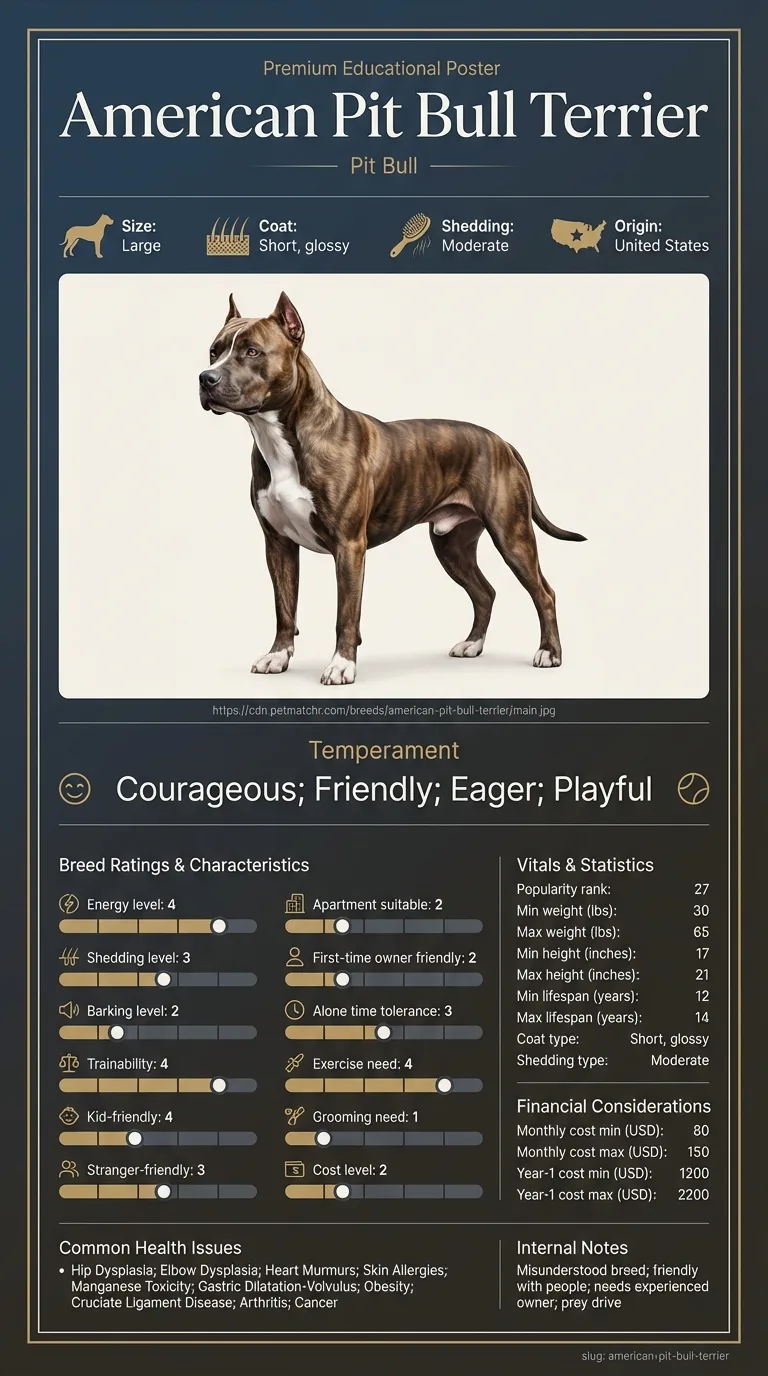
american pit bull terrier infographic
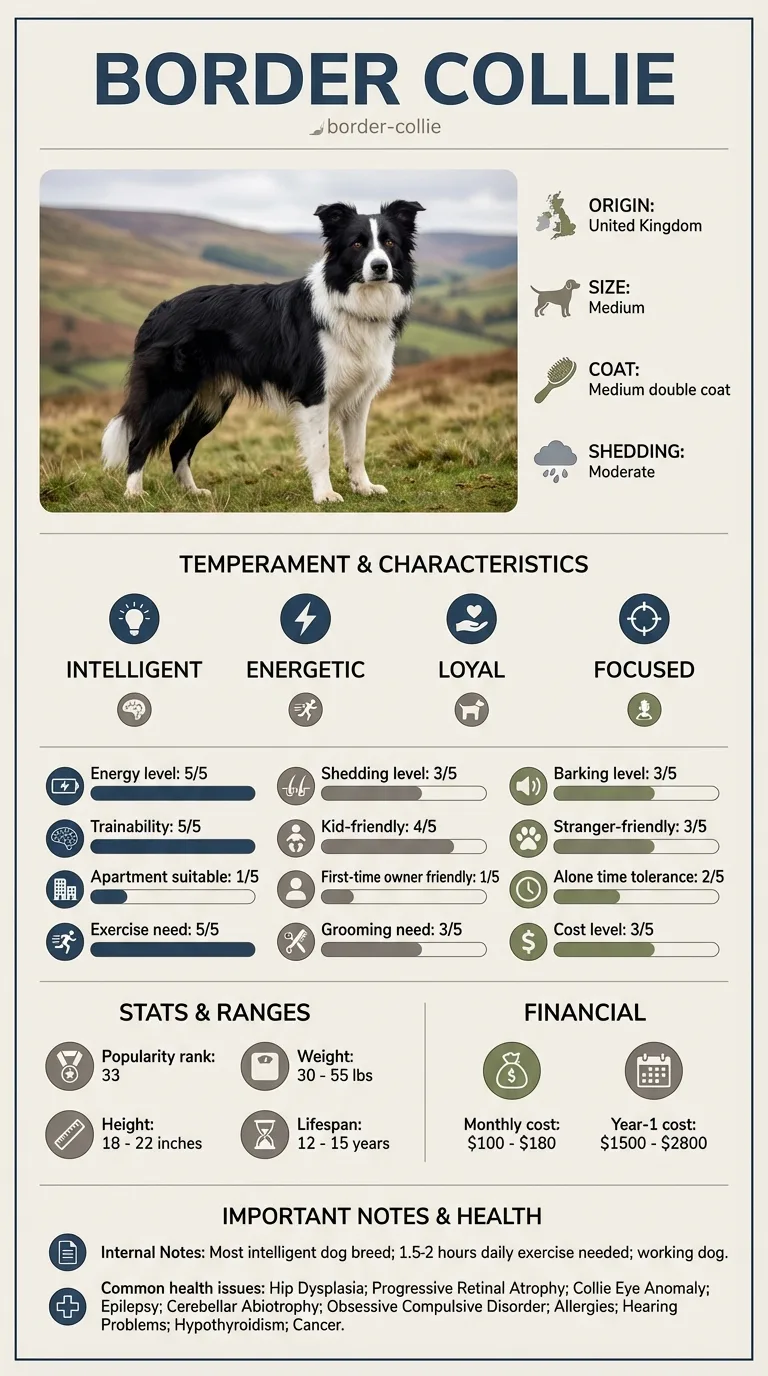
border collie infographic

This page is for someone who wants a highly trainable dog and is trying to work out whether the most trainable breed available is actually the right one for their life.

Quick verdict

The Border Collie is a magnificent dog for someone with a job for it and a poor choice for almost everyone else, while the Pit Bull asks for less time and more judgement.

Choose american pit bull terrier if...

Choose the American Pit Bull Terrier if you want an athletic, trainable dog that will do an hour a day and then genuinely settle, with almost no grooming and the lowest running costs here.

Choose border collie if...

Choose the Border Collie only if you can supply one and a half to two hours daily including real mental work, ideally a dog sport or stock work, and someone is around for much of the day.

Head-to-head comparison

Featureamerican pit bull terrierborder collieWinner
Weight30–65 lbs30–55 lbsEqual
Height17–21 in18–22 inEqual
Lifespan12–14 years12–15 yearsborder collie
CoatShort, glossyMedium double coatamerican pit bull terrier
Grooming need1/53/5american pit bull terrier
Shedding3/5 — moderate3/5 — moderateEqual
Energy level4/55/5american pit bull terrier
Exercise need4/55/5american pit bull terrier
Trainability4/55/5border collie
Barking2/53/5american pit bull terrier
Good with kids4/54/5Equal
Good with other dogs2/54/5border collie
Friendly to strangers3/53/5Equal
Apartment suitability2/51/5american pit bull terrier
Good for first-time owners2/51/5american pit bull terrier
Tolerates being alone3/52/5american pit bull terrier
Typical monthly cost$80–150$100–180american pit bull terrier
Typical first-year cost$1,200–2,200$1,500–2,800american pit bull terrier

Deep dive

Why the cleverest breed rates 1/5 for beginners

Intelligence in a dog is not the same as being easy to live with, and the Border Collie is the clearest demonstration of that on this site.

What the breed actually has is an extraordinary capacity to learn contingencies — to notice that A predicts B, and to act on it. In a training session that is a gift: a Border Collie can learn a new behaviour in a handful of repetitions and hold it for years. Outside a training session it is a liability, because the dog learns the things nobody meant to teach it with the same efficiency. That the doorbell means excitement. That barking at the fence makes the postman leave. That a car reversing on the drive can be herded. That a shadow on the wall can be chased.

A 1/5 for first-time owners describes exactly that. A breed at 2/5 punishes ordinary mistakes; a breed at 1/5 does not tolerate the learning curve at all. Inconsistency does not produce a slightly worse dog — it produces a dog that has trained itself into a set of self-reinforcing habits.

The second half of the problem is that a Border Collie does not switch off on its own. It was bred to work all day and to remain alert between jobs, and an unemployed one generates work. That is the source of nearly every complaint about the breed in pet homes.

The Pit Bull's 4/5 trainability is nearly as high and comes without the compulsion. It learns quickly, enjoys structured work, takes to obedience, weight pull and scent work — and then lies down. Its 3/5 tolerance for time alone against the Collie's 2/5 reflects the same difference: one dog is content to be off duty, the other has no concept of it.

Obsessive behaviour listed as a health problem

Obsessive compulsive disorder appears on the Border Collie's health list alongside epilepsy and cancer, and that placement is not a filing error. Compulsive behaviour is common enough in the breed to be treated as a clinical issue.

The forms it takes are recognisable: chasing shadows and light reflections, spinning, tail chasing, flank sucking, fixating on water from a hose or a puddle, and staring at or stalking objects for long periods. It begins as a self-soothing outlet for unspent drive and becomes self-reinforcing, and at the far end it displaces normal behaviour — a dog that will not eat, rest or engage because it is patrolling a wall for a light that appeared once.

The critical practical point is that these behaviours are far easier to prevent than to treat. Prevention means not starting them: no laser pointers, ever; no encouraging shadow or reflection chasing because it looks funny; managing access to hoses and sprinklers; and above all meeting the exercise and mental requirement so the dog is not looking for an outlet. Once established, treatment usually involves a behaviourist, environmental management and sometimes medication, and progress is measured in months.

Cerebellar abiotrophy is the other neurological entry and is quite different — an inherited degeneration of the cerebellum causing progressive loss of coordination, typically appearing between about six weeks and two years as a wobbly, high-stepping gait, tremors and difficulty judging distance. There is a DNA test in the breed, so a breeder should be able to give both parents' status.

Epilepsy, allergies, hypothyroidism and cancer complete the picture, alongside the eye and hearing entries covered below.

The Pit Bull's list is physical rather than neurological: hip and elbow dysplasia, skin allergies, heart murmurs, bloat, obesity, cruciate ligament disease, arthritis and cancer.

Eye and hearing tests before you buy

The Border Collie's list names collie eye anomaly, progressive retinal atrophy and hearing problems, and all three are addressable at the point of purchase rather than afterwards.

Collie eye anomaly is a congenital malformation of the tissues at the back of the eye. It is present at birth rather than developing later, it ranges from mild changes that never affect sight to retinal detachment and blindness, and it is diagnosed by an ophthalmologist examining puppies at around six to eight weeks. That window matters, because milder changes become harder to see in an older dog. There is also a DNA test.

Progressive retinal atrophy is the later-onset condition, causing gradual loss of vision starting with night blindness, and it also has DNA testing available in the breed.

Hearing problems are the third, and they connect to coat colour. Merle and heavily white-marked dogs carry a higher risk of congenital deafness, and the risk is greatest in dogs inheriting two copies of the merle gene — which is why merle-to-merle breeding is avoided by responsible breeders. Deafness is screenable by a BAER hearing test.

So the breeder conversation is unusually concrete: ask whether the litter was eye-examined at six to eight weeks, what the parents' DNA results are for collie eye anomaly, progressive retinal atrophy and cerebellar abiotrophy, whether merle was involved on both sides, and what the hip scores are.

A breeder who answers all of that specifically is a different proposition from one who says the line is healthy.

The Pit Bull's equivalent list is shorter: hip and elbow scores, a cardiac check for the heart murmurs on its list, and honest information about allergies in the line.

Two hours of work against one hour of exercise

The Border Collie's notes are specific: one and a half to two hours daily. What they do not say, and what matters more, is that a large share of it has to be mental.

Running a Border Collie does not satisfy it. A dog that has covered ten miles is a fitter dog with the same unmet need, and there is a well-known trap in which owners escalate the physical exercise, produce an athlete, and end up with a harder problem than they started with. What genuinely works is structured work with rules and an end: herding if available, agility, obedience, rally, flyball, disc, scent work, or trick training sessions with real criteria.

The Pit Bull's 4/5 asks for an hour to ninety minutes of largely physical activity — a brisk walk plus a flirt pole, spring pole, tug or a twenty-minute training session — and then the dog settles hard. That difference in the shape of the requirement, rather than the size of it, is what makes the Pit Bull workable for people with jobs.

Coats follow the same pattern. The Collie's medium double coat rates 3/5, needing brushing two or three times a week with attention to the ruff, britches and feathering, and it sheds moderately with seasonal peaks. It should not be shaved. The Pit Bull's 1/5 is a curry mitt once a week and nothing else, with 3/5 shedding of short stiff hairs that work into fabric.

Cost runs $100–180 a month against $80–150, at cost level 3/5 against 2/5.

With other dogs the Collie leads 4/5 to 2/5 and is generally easy in group settings, though it may try to herd them. The Pit Bull's 2/5 is its defining management task, alongside the tenancy and insurance restrictions that commonly apply to bully-type dogs and almost never to herding breeds.

Children, households and the honest recommendation

Both breeds rate 4/5 with children and 3/5 with strangers, and both can be excellent family dogs in the right household.

The Collie's caution is herding instinct aimed at movement: circling, staring, bumping and nipping at the heels of running children. It is hardware rather than misbehaviour, it responds to early redirection, and it is one of the most common reasons Border Collies are rehomed from family homes with young children. Its 3/5 with strangers is a working dog's reserve rather than suspicion.

The Pit Bull's caution is physical enthusiasm — it is strong and will knock a small child over in play — and the 2/5 with other dogs, which means family walks in busy places need planning.

On beginners, 1/5 against 2/5 is a meaningful gap and it should be read plainly. Many people who want a Border Collie would be better served by a less driven herding breed, a Labrador, or a Pit Bull. Very few people who want a Pit Bull would be better served by a Border Collie.

Where the Collie is unmatched is as a partner in an activity. If you intend to compete in agility or obedience, do stock work, or spend two hours a day outdoors with a dog that will do anything you ask, nothing else comes close, and a well-exercised Border Collie in the right home is calm, affectionate and genuinely easy.

Lifespans are close at 12 to 15 years against 12 to 14, and both breeds age well when kept lean.

The test for the Collie is simple and worth being honest about: name the activity you will do with the dog three times a week, every week, for the next twelve years. If there is no answer, this is the wrong breed.

American Pit Bull Terrier vs Border Collie at a glance

The Border Collie is widely called the most intelligent dog breed, and it rates just 1/5 for first-time owners — one of only two breeds on this whole site to score that low. Those two facts are directly connected: the intelligence needs somewhere to go.

The Border Collie is a magnificent dog for someone with an actual job for it — stock work, a demanding sport, structured daily training — and a poor choice for almost everyone else. The Pit Bull asks for less time overall and more judgement around other dogs, but it will genuinely settle once its exercise is met.

Choose the American Pit Bull Terrier if you want an athletic, trainable dog that will do an hour a day and then settle, with almost no grooming and the lowest running costs here. Choose the Border Collie only if you can supply one and a half to two hours daily including real mental work, and someone is around for much of the day.

Frequently asked questions

Why does the most intelligent breed rate 1/5 for beginners?

Because it learns unintended lessons as fast as intended ones and never switches off on its own. Inconsistency produces self-reinforcing habits rather than a slightly less trained dog, and an unemployed Border Collie generates its own work.

Why is obsessive compulsive disorder on the health list?

Because compulsive behaviour — shadow and light chasing, spinning, tail chasing, flank sucking — is common enough in the breed to be treated clinically. It starts as an outlet for unspent drive and becomes self-reinforcing.

Should I use a laser pointer with a Border Collie?

No. Chasing a light the dog can never catch is one of the most reliable ways to start a compulsive habit in this breed, and those habits are far easier to prevent than to treat.

What tests should a Border Collie breeder have done?

Eye examination of the puppies at six to eight weeks for collie eye anomaly, DNA results for collie eye anomaly, progressive retinal atrophy and cerebellar abiotrophy, hip scores, and a BAER hearing test where merle or heavy white marking is involved.

Will running a Border Collie tire it out?

Not on its own. Physical exercise without mental work produces a fitter dog with the same unmet need. Herding, agility, obedience, scent work or structured training sessions are what actually satisfy the breed.

Which is better with other dogs?

The Border Collie at 4/5 against 2/5, though it may try to herd them. The Pit Bull needs planned introductions on neutral ground and can become less tolerant at social maturity.

Which is cheaper to keep?

The Pit Bull at $80–150 a month against $100–180, at cost level 2/5 against 3/5, with almost nothing spent on grooming. Insurance is the variable that works against it.

Quick answers

View more answers
Living

Pit Bull or Border Collie: which should I choose?

The Border Collie only if you can name the activity you will do with it three times a week for a decade. Otherwise the Pit Bull — nearly as trainable, half the daily requirement, and it genuinely settles once the work is done.

Costs

Which is cheaper to own?

The American Pit Bull Terrier at $80–150 a month against $100–180, and $1,200–2,200 in the first year against $1,500–2,800.

Health

What is cerebellar abiotrophy?

An inherited degeneration of the cerebellum appearing between about six weeks and two years, causing a wobbly high-stepping gait and tremors. A DNA test exists, so both parents' status should be known.

Behavior

Do Border Collies herd children?

Frequently. Circling, staring, bumping and heel-nipping aimed at running children is instinct rather than misbehaviour, and it is one of the more common reasons the breed is rehomed from family homes.

Related DogBreedCompass guides

  • American Pit Bull Terrier breed guideThe Pit Bull profile covers temperament, exercise and the practical realities of ownership.
  • Border Collie breed guideThe Border Collie profile covers the breed's drive, exercise requirement and herding instinct.
  • hip dysplasia in Border ColliesHip dysplasia sits on both lists and is the shared screening question for either breeder.
  • cancer in Border ColliesCancer is on both lists and is usually what limits the upper end of either breed's lifespan.
  • separation anxiety in Pit Bull TerriersBoth breeds struggle when left too long, and telling anxiety from boredom changes the fix.
  • American Pit Bull Terrier vs Australian ShepherdBuyers weighing herding breeds usually compare the two obvious candidates side by side.

Related guides

Important reminder

Health information here is general and is not veterinary advice. Neurological signs, DNA testing and screening should be discussed with your own veterinarian.

Some links on this site are affiliate links. We may earn a commission if you buy through them, at no additional cost to you.

Find Your Perfect Breed

Match your lifestyle to the right dog.

Take quiz

Find your match

Not sure which breed is right for you? Take our 2-minute quiz to find out.

Take the quiz