Costs
Shetland Sheepdog cost in Phoenix
$82–$155 monthly and $1,133–$2,369 in year one, marginally above average. The desert-specific line is valley fever, a soil fungus whose treatment course runs for months rather than weeks.

See Shetland Sheepdog price across all cities →
Quick answer
Shetland Sheepdog cost in Phoenix
$82–$155 monthly and $1,133–$2,369 in year one, marginally above average. The desert-specific line is valley fever, a soil fungus whose treatment course runs for months rather than weeks.
There is a fungus in the desert soil here. Coccidioides grows in the top few inches of ground across the Sonoran Desert, and when that soil is disturbed the spores go airborne and get inhaled. In people it is called valley fever; in dogs it is the same organism and the same disease, and Arizona veterinarians see it constantly. It is one of the few genuinely region-specific diseases in American veterinary medicine, and it does not exist as a risk in most of the cities on this site.
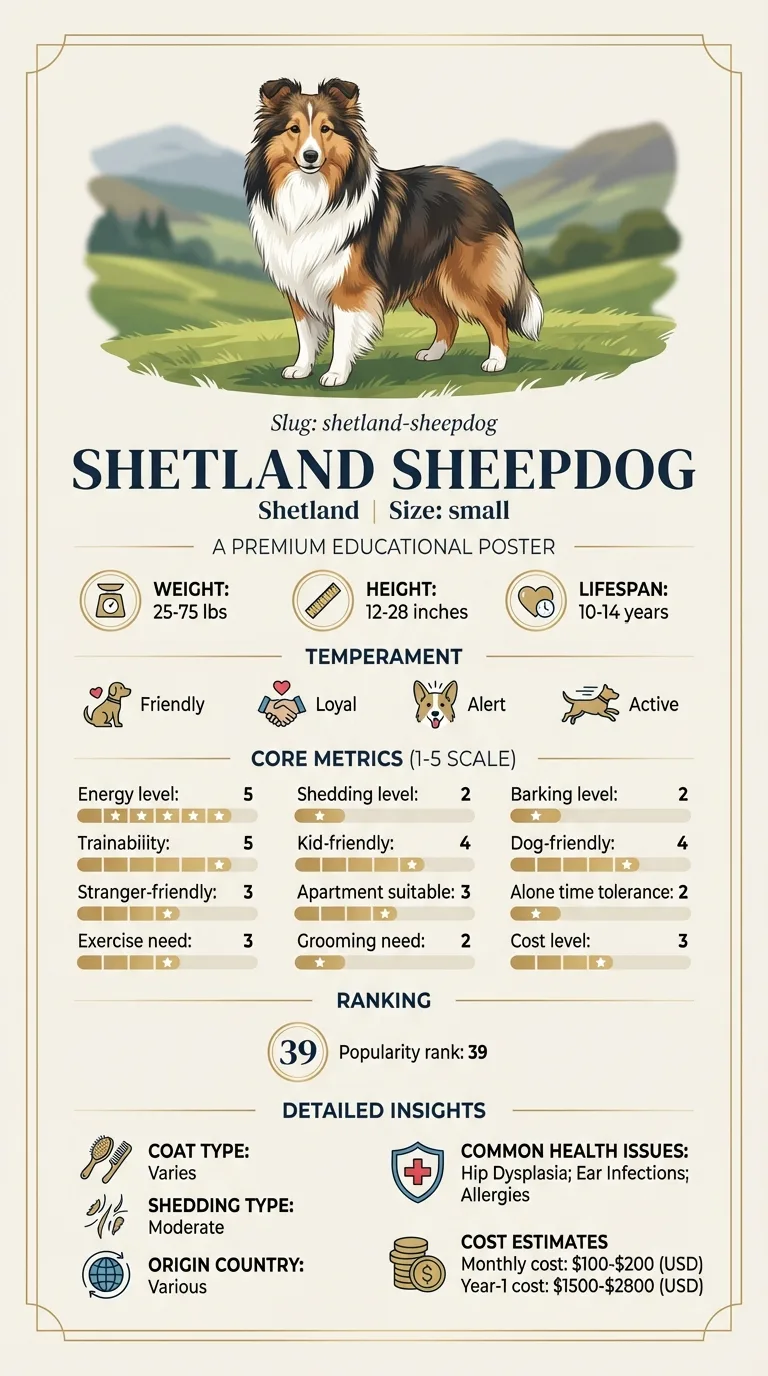
The breed's documented conditions are Collie Eye Anomaly, MDR1 Drug Sensitivity, Dermatomyositis, Hypothyroidism and Patellar Luxation. MDR1 is directly relevant to a long treatment course: it is an inherited sensitivity to certain veterinary drugs, and any dog facing months of medication should have its genotype on the chart from the outset.
Phoenix runs slightly above national norms with year-round prevention, and the genuinely region-specific cost is a fungal infection whose treatment is measured in months.
Estimate · source: estimation · confidence: medium · updated 2026-10-06 · not a quote
| Item | Cost range |
|---|---|
Initial costs (exam, sterilization, genetic testing, gear) Get the MDR1 genotype on the chart early, since a long medication course is a realistic prospect in this region. | $380 - $640 |
| Item | Cost range |
|---|---|
Food Portions for a fifteen-to-twenty-five-pound dog at Phoenix grocery pricing. | $32 - $55 |
Year-round parasite prevention Twelve months, though dry-climate pressure is lower than in a humid city; match to a confirmed MDR1 result. | $17 - $31 |
Antifungal course if diagnosed Commonly six to twelve months of oral medication, which is where the real annual cost of this condition sits. | $40 - $130 |
Coat maintenance and de-shedding Thorough undercoat raking keeps air moving through the coat, which is what replaces the shave people reach for. | $30 - $60 |
Each range starts from a national baseline for this breed's size class and is then adjusted for local cost of living and veterinary pricing. The baselines, and the source each one came from, are listed on our sources page (dataset 2026.09). Two inputs, the purchase price and the emergency reserve, have no published national figure we could verify, so we leave them to you rather than invent them.
These are planning estimates, not quotes. Your own numbers will move with the individual dog, your vet and your insurer. Build a budget with your own figures.
Valley fever is an acquired infectious disease rather than an inherited one, which puts it squarely inside what a policy covers, and its long treatment course is exactly the shape of claim that benefits from cover.
For a dog living in the endemic region and exercising outdoors daily, a twelve-month antifungal course is a plausible rather than remote scenario. Enrol before any respiratory sign is recorded.
A household with a genuine reserve that walks its dog on paved routes rather than open desert has a lower exposure, though the fungus is regional rather than site-specific.
The Phoenix savings come from reducing soil exposure and from never reaching for the clippers.
Most infections in dogs are mild and self-limiting, and the animal clears them without anyone knowing. The cases that matter present with a persistent dry cough, lethargy, a poor appetite, weight loss, sometimes a fever that comes and goes, and in the disseminated form, lameness where the infection has reached bone. The early picture looks like a lot of other things, which is why the local reflex to test for it is the useful thing about being in Arizona.
The cost structure is unusual and worth understanding before it arrives. Diagnosis involves bloodwork, a titre and often chest imaging. Treatment is an oral antifungal, and the course is long: months at minimum, commonly six to twelve, occasionally longer, with periodic titres to track the response and liver monitoring alongside. So the expense is not a single dramatic bill but a modest monthly one that continues for a year, plus recheck appointments. Owners routinely underestimate the total because no individual invoice is alarming.
Prevention is limited and honest advice says so. There is no vaccine in general use, and the fungus is in the ground across the whole region. What genuinely reduces exposure is avoiding freshly disturbed soil: construction sites and their edges, dust storms, and areas being graded or landscaped. Keeping the dog on established paths rather than letting it dig in loose desert dirt is the practical measure. It is a reduction rather than an elimination, and it is worth doing anyway.
The other desert cost is heat, and for a small dog the specific issue is ground temperature rather than air temperature. Asphalt, concrete and decorative rock all absorb and hold heat far past sunset, and a dog walks with its whole body a few inches above that surface. Summer walks belong at genuine dawn and full dark, and the back of your hand on the ground is a better guide than a thermometer reading of the air.
The coat should not be clipped in response to any of this. A long, dense double coat slows heat gain and blocks solar radiation reaching the skin, and shaving it removes both while sometimes damaging how it regrows. Rake the undercoat out thoroughly instead so air can move through it.
Parasite prevention runs the full twelve months here, though the dry climate keeps some of the pressure lower than in a humid city. Buy it as a fixed line and confirm the product against a known MDR1 genotype rather than a default choice.

A north Phoenix owner treated her Sheltie for what she assumed was kennel cough after a boarding stay, and when it had not cleared in three weeks the practice ran a titre. The result came back positive and the dog started an antifungal course that ran eight months, with rechecks every couple of months. No individual bill was large. Added up across the year it came to more than she had spent on the dog in the previous three combined, which is the part nobody had warned her about.
Key takeaway: This is a slow-burning expense rather than a dramatic one, and its total is what surprises people. In the endemic region, a cough that will not clear is worth testing for early.
About $82 to $155, slightly above the national average, with year-round parasite prevention and desert-specific health risks as the local additions.
Roughly $1,133 to $2,369, covering the first exam, sterilization, vaccinations and setup gear.
It is an infection caused by a fungus living in Sonoran Desert soil, inhaled when the ground is disturbed. Dogs get it readily, and Arizona veterinarians see it routinely.
No single bill is dramatic, but the antifungal course commonly runs six to twelve months with periodic titres and liver monitoring, so the annual total is substantial.
Only partially. Avoid freshly disturbed soil, construction sites, dust storms and areas being graded, and keep the dog on established paths rather than digging in loose desert dirt.
About $545 covers a typical significant visit, though a long antifungal course is a sustained cost rather than a single emergency.
$82–$155 monthly and $1,133–$2,369 in year one, marginally above average. The desert-specific line is valley fever, a soil fungus whose treatment course runs for months rather than weeks.
A persistent dry cough, lethargy, poor appetite, weight loss, intermittent fever, and lameness if the infection has spread to bone. The early picture resembles several other things.
This guide is not medical advice. If your dog shows pain, sudden behavior change, or worsening symptoms, consult a licensed veterinarian.
Some links may be affiliate links. We may earn a commission at no extra cost to you. We only suggest products we believe are helpful for dog owners.
We research and check what we publish, but we do not warrant that any figure, date, price, or statement is accurate, complete, or current, and we accept no liability for any loss, cost, injury, or other harm arising from the use of this site. Use it as one reference among several. You remain responsible for your own decisions and for your dog's care - confirm anything that matters with a licensed veterinarian or another qualified professional before you act on it. Full disclaimer.
One sheet with every line item, the emergency fund and when insurance pays off - unlocks on this page.
You get: 12-month budget sheet
No spam. One-click unsubscribe. See our privacy policy.
See a sample page before you decide.