Living
Which is bigger?
The Rottweiler Mix, up to roughly 8 times heavier than the Shih Tzu.

Quick answer
Which is bigger?
The Rottweiler Mix, up to roughly 8 times heavier than the Shih Tzu.
Rottweiler Mix or Shih Tzu? On paper they differ most on grooming need, and on the scales Rottweiler Mix is the heavier at 80–135 lbs. Here is how the two compare on everything that shapes an ordinary week.
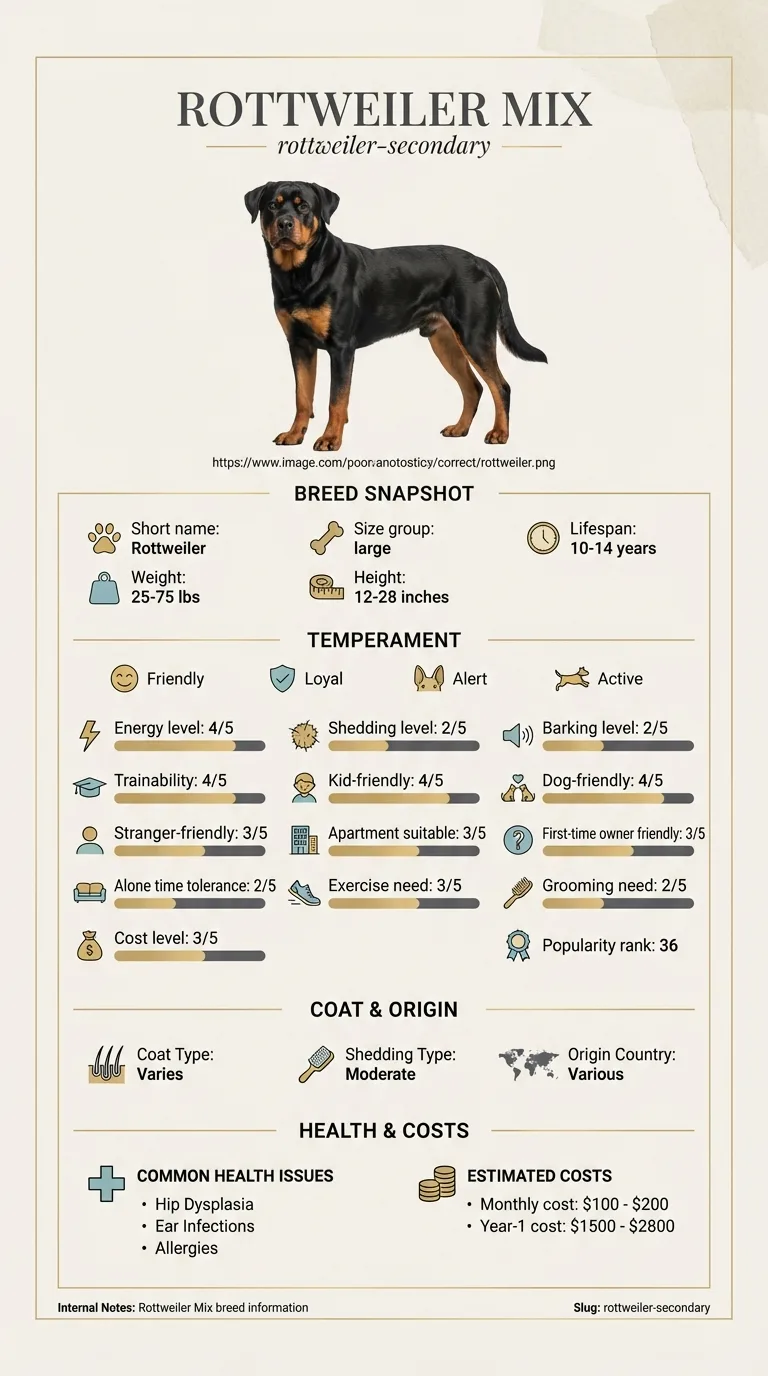
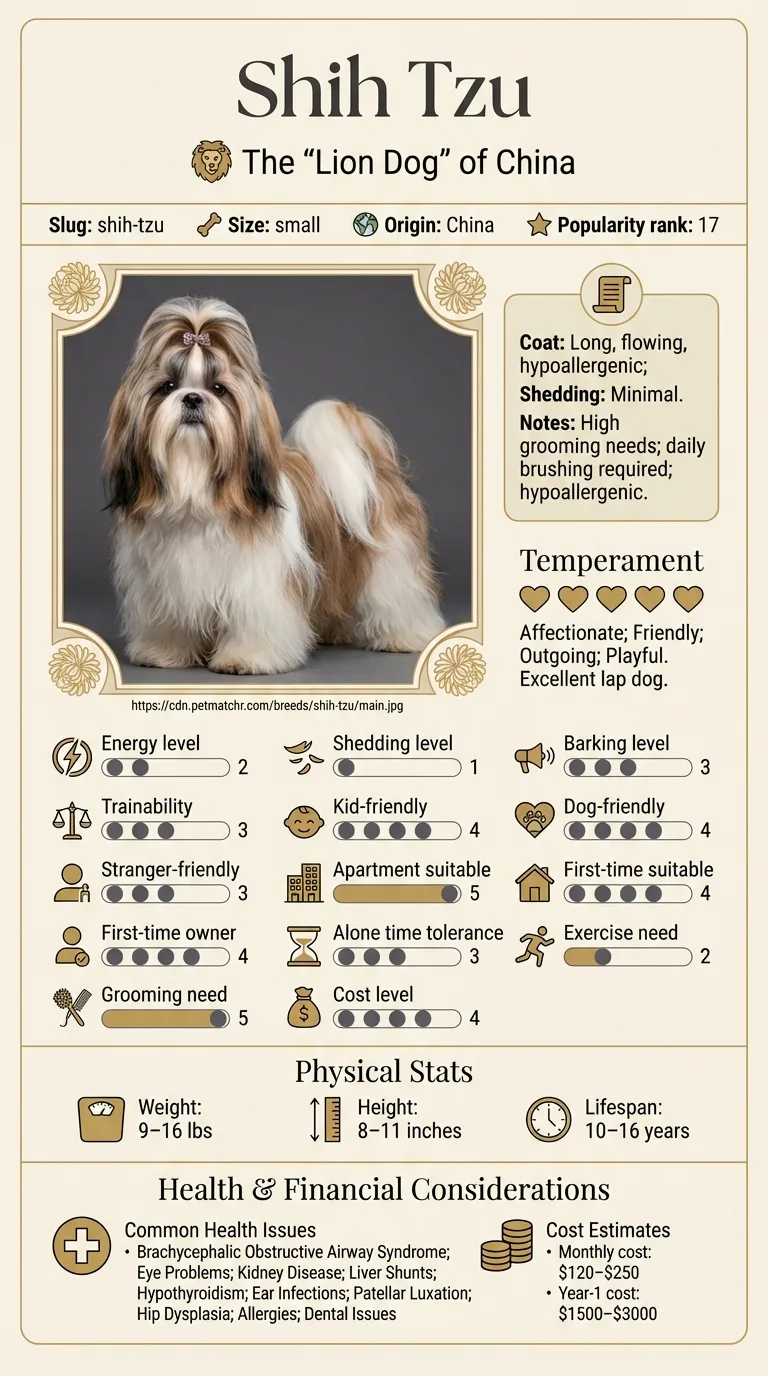
This is for someone already down to Rottweiler Mix and Shih Tzu and deciding between them. For this pair the decision usually turns on grooming need and apartment suitability, so those are covered first and in most detail. Anyone choosing from a flat has a clear answer here: Shih Tzu rates 5/5 against 2/5. The focus throughout is on daily consequences rather than breed background.
Between Rottweiler Mix and Shih Tzu, grooming need is what separates them, and Shih Tzu is the lower-effort dog of the two to keep.
Choose Rottweiler Mix if you do not want a standing grooming appointment, you want a dog that picks up training quickly and you want a dog that can keep up with an active routine.
Choose Shih Tzu if you are in a flat or a smaller home, this is your first dog and shedding is a problem in your house.
| Feature | rottweiler secondary | shih tzu | Winner |
|---|---|---|---|
| Size class | large | small | Equal |
| Weight | 80–135 lbs | 9–16 lbs | Equal |
| Height | 22–27 in | 8–11 in | Equal |
| Lifespan | 9–10 years | 10–16 years | shih tzu |
| Exercise need | High (4/5) | Low (2/5) | shih tzu |
| Grooming need | Low (2/5) | Very high (5/5) | rottweiler secondary |
| Shedding | Moderate (3/5) | Very low (1/5) | shih tzu |
| Energy level | Moderate (3/5) | Low (2/5) | Equal |
| Barking | Low (2/5) | Moderate (3/5) | rottweiler secondary |
| Apartment suitability | Low (2/5) | Very high (5/5) | shih tzu |
| Good for first-time owners | Low (2/5) | High (4/5) | shih tzu |
| Tolerates being alone | Moderate (3/5) | Moderate (3/5) | Equal |
| Trainability | High (4/5) | Moderate (3/5) | rottweiler secondary |
| Good with kids | Moderate (3/5) | High (4/5) | shih tzu |
| Good with other dogs | Low (2/5) | High (4/5) | shih tzu |
| Friendly to strangers | Low (2/5) | Moderate (3/5) | shih tzu |
| Cost level | High (4/5) | High (4/5) | Equal |
| Coat | Short, dense double coat | Long, flowing, hypoallergenic | Equal |
| Origin | Various | China | Equal |
| Typical monthly cost | $110–$240 | $120–$250 | Equal |
| Typical first-year cost | $1,700–$3,200 | $1,500–$3,000 | Equal |
At 9-16 lbs and 8-11 inches, the Shih Tzu could nearly fit inside the Rottweiler Mix's food bowl -- the Rottweiler Mix runs 80-135 lbs and 22-27 inches, making this one of the largest size mismatches in any breed comparison. This isn't a question of degree but of category: a companion lapdog built for laps and carriers versus a large, muscular breed built for physical work. The practical implications are immediate -- travel crates, car space, and even the strength needed to control the dog on leash differ enormously between the two.
Exercise need favors the Rottweiler Mix's higher demand, High (4/5), against the Shih Tzu's Low (2/5) -- a reversal of the usual assumption that bigger dogs are harder to satisfy physically. The Shih Tzu's Playful, Outgoing temperament shows up more in short bursts of indoor energy than sustained cardio, and its brachycephalic (short-nosed) structure means it shouldn't be pushed into vigorous exercise in heat regardless. The Rottweiler Mix genuinely needs daily structured activity to stay balanced. For owners who want minimal walking commitment, the Shih Tzu's Low exercise need is one of the most decisive numbers in this whole comparison.
Grooming need is where the Shih Tzu demands the most: Very High (5/5) against the Rottweiler Mix's Low (2/5), reflecting its long, flowing coat that mats quickly without daily brushing and typically needs professional trimming every four to six weeks. Shedding runs the opposite direction -- Very Low (1/5) for the Shih Tzu versus Moderate (3/5) for the Rottweiler Mix, which is part of why the breed is often marketed to allergy-conscious households. In practice, this trades one chore for another: less vacuuming with the Shih Tzu, but a far more demanding, ongoing coat-care routine than the wash-and-brush Rottweiler Mix requires.
Apartment suitability rates Very High (5/5) for the Shih Tzu against Low (2/5) for the Rottweiler Mix, making the Shih Tzu one of the most apartment-friendly breeds in this dataset. Barking runs slightly higher for the Shih Tzu, Moderate (3/5) versus Low (2/5) for the Rottweiler Mix, though its small size means that barking is far less disruptive in volume than a large breed's. Both tie at Moderate (3/5) for tolerating being alone. For anyone living in a small unit with noise-conscious neighbors, the Shih Tzu's compact size and low exercise demand make it dramatically easier to house than the Rottweiler Mix.
Trainability favors the Rottweiler Mix, High (4/5) against the Shih Tzu's Moderate (3/5), yet the good-for-first-time-owners score flips decisively: Low (2/5) for the Rottweiler Mix versus High (4/5) for the Shih Tzu. That gap is really about manageability rather than intelligence -- an Affectionate, Friendly Shih Tzu that ignores a recall command poses little practical risk, while a Confident, Watchful Rottweiler Mix that pulls hard on leash or misreads a stranger's approach is a genuinely different management challenge. First-time owners drawn to the Rottweiler Mix's capability should be honest about whether they can commit to consistent, early obedience work.
The Shih Tzu outperforms the Rottweiler Mix with kids (High 4/5 vs Moderate 3/5), other dogs (High 4/5 vs Low 2/5), and strangers (Moderate 3/5 vs Low 2/5), consistent with a breed bred for centuries specifically as a companion animal. Its Friendly, Outgoing nature means it typically greets new people and pets with curiosity rather than caution. The Rottweiler Mix's Loyal, Steady disposition still suits calm, structured households well, but it requires more deliberate socialization to reach the same comfort level around unfamiliar faces that comes naturally to the Shih Tzu.
Lifespan favors the Shih Tzu, 10-16 years against the Rottweiler Mix's 9-10, though the Shih Tzu's ten-item health list is notably longer: Brachycephalic Obstructive Airway Syndrome, Eye Problems, Kidney Disease, Liver Shunts, Hypothyroidism, Ear Infections, Patellar Luxation, Hip Dysplasia, Allergies, and Dental Issues. The airway syndrome in particular means heat and strenuous exercise both carry real risk for this breed. The Rottweiler Mix's shorter but more orthopedically weighted list -- Hip Dysplasia, Elbow Dysplasia, Osteosarcoma, Subaortic Stenosis, Cruciate Ligament Tears -- reflects the mechanical toll of a large, muscular frame. Prospective owners of either breed should ask breeders directly about airway or joint screening results.
Cost level actually ties at High (4/5) for both breeds, an unusual result given the size difference, and the monthly figures reflect that closeness: $110-$240 for the Rottweiler Mix versus $120-$250 for the Shih Tzu. First-year costs run $1,700-$3,200 and $1,500-$3,000 respectively -- genuinely comparable ranges. The explanation is the Shih Tzu's Very High (5/5) grooming need, where recurring professional grooming appointments offset the savings from a smaller body and lower food bill. Anyone assuming a 12-lb dog is automatically cheaper than a 100-lb one should look closely at grooming line items before budgeting.
Rottweiler Mix weighs 80–135 lbs and lives 9–10 years; Shih Tzu weighs 9–16 lbs and lives 10–16 years. The two diverge most on grooming need, apartment suitability and exercise need and 3 other rated axes. They are level on tolerates being alone and cost level, so those cannot decide it. The table below marks a winner only where one breed is genuinely easier for a typical owner; size and origin are facts rather than merits and stay level. Ratings come from one source applied to both breeds, so they are meaningful against each other rather than as absolute scores.

Surprisingly close -- both tie at High (4/5) cost level, since the Shih Tzu's Very High (5/5) grooming needs offset its much lower food costs.
The Shih Tzu by far, rated Low (2/5) exercise need versus High (4/5) for the Rottweiler Mix.
Yes, it rates Very High (5/5) for apartment suitability, one of the best scores in this comparison, versus Low (2/5) for the Rottweiler Mix.
The Shih Tzu, rated High (4/5) versus Low (2/5) for the Rottweiler Mix.
Brachycephalic Obstructive Airway Syndrome is on their health watch-list due to their short muzzle, meaning heat and vigorous exercise need extra caution.
The Shih Tzu, rated Very Low (1/5) shedding compared to Moderate (3/5) for the Rottweiler Mix.
The Shih Tzu, typically 10-16 years versus 9-10 years for the Rottweiler Mix.
The Rottweiler Mix, up to roughly 8 times heavier than the Shih Tzu.
The Shih Tzu, rated Very High (5/5) versus Low (2/5) for the Rottweiler Mix.
The Shih Tzu, rated Very High (5/5) apartment suitability.
The Shih Tzu, rated Low (2/5) versus High (4/5) for the Rottweiler Mix.
Secure checkout on Stripe. We never see your card.
7-day money-back guarantee. Instant access.
Health information here is general and is not veterinary advice. If your dog shows pain, sudden behaviour change, or worsening symptoms, consult a licensed veterinarian.
Some links on this site are affiliate links. We may earn a commission at no extra cost to you, and we only suggest products we believe are helpful for dog owners.
We research and check what we publish, but we do not warrant that any figure, date, price, or statement is accurate, complete, or current, and we accept no liability for any loss, cost, injury, or other harm arising from the use of this site. Use it as one reference among several. You remain responsible for your own decisions and for your dog's care - confirm anything that matters with a licensed veterinarian or another qualified professional before you act on it. Full disclaimer.
Match your lifestyle to the right dog.
Take quizNot sure which breed is right for you? Take our 2-minute quiz to find out.
Take the quiz