Living
Which is smaller?
The Miniature Poodle, at 10–15 lbs versus the Standard's 45–70 lbs.

Quick answer
Which is smaller?
The Miniature Poodle, at 10–15 lbs versus the Standard's 45–70 lbs.
Poodle (Miniature) or Poodle (Standard)? On paper they differ most on apartment suitability, and on the scales Poodle (Standard) is the heavier at 45–70 lbs. Here is how the two compare on everything that shapes an ordinary week.
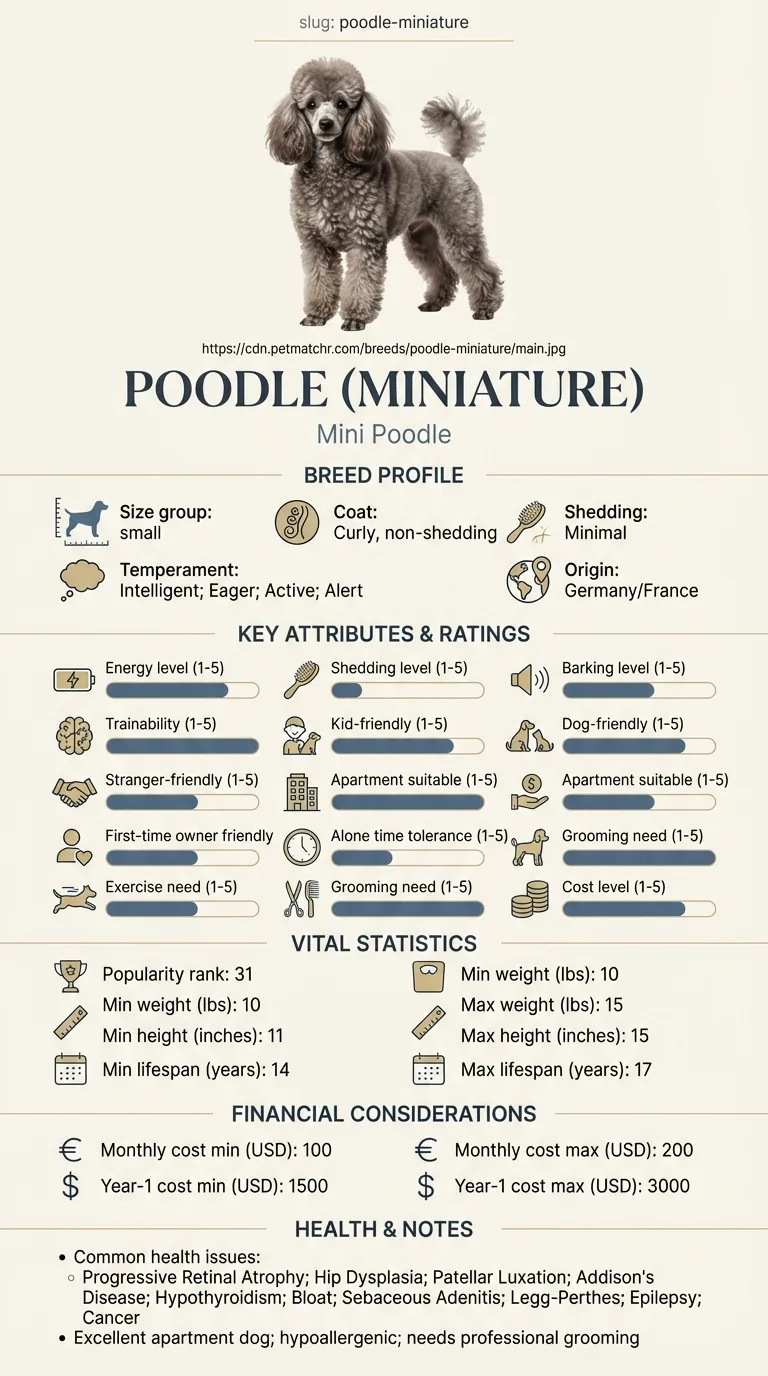
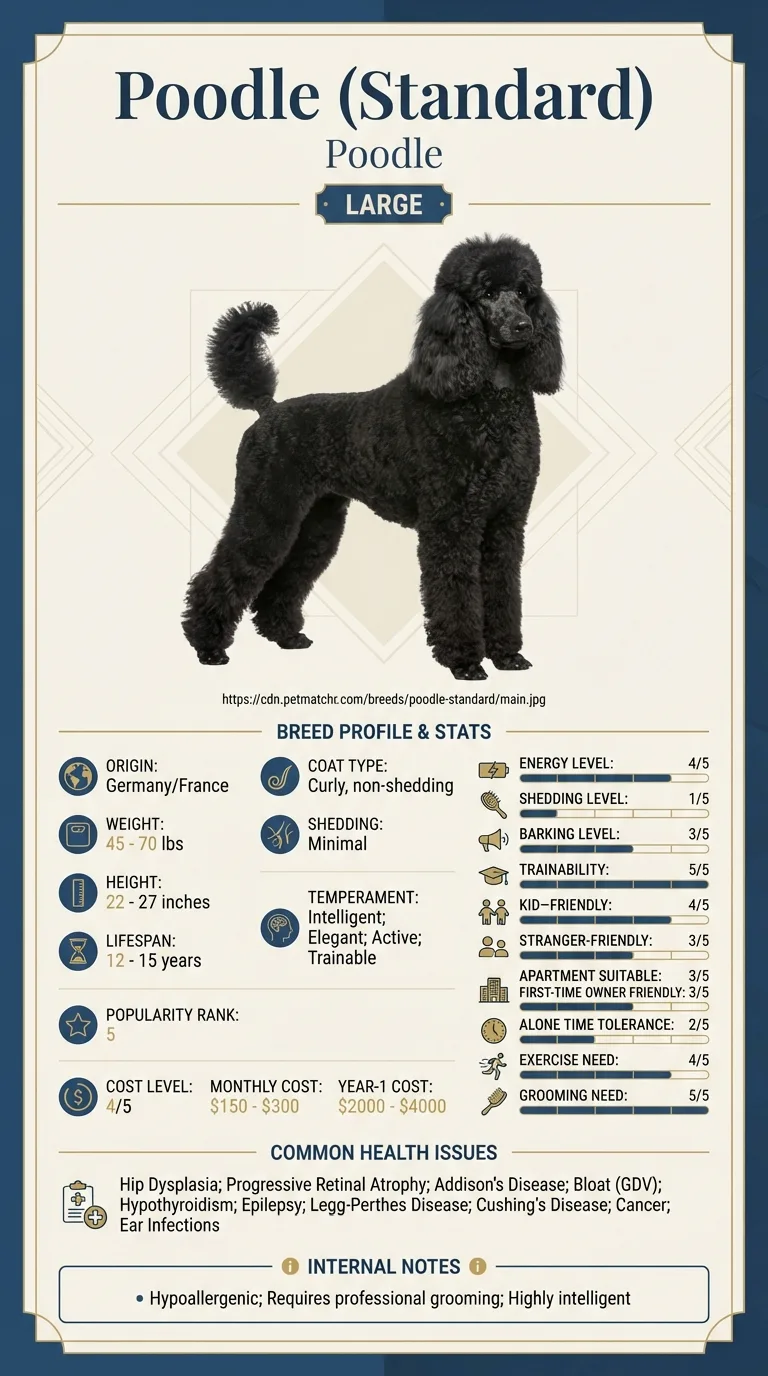
This is for someone already down to Poodle (Miniature) and Poodle (Standard) and deciding between them. For this pair the decision usually turns on apartment suitability, so those are covered first and in most detail. Anyone choosing from a flat has a clear answer here: Poodle (Miniature) rates 5/5 against 3/5. It is written for the decision rather than the breed history.
Between Poodle (Miniature) and Poodle (Standard), apartment suitability is what separates them, and Poodle (Miniature) is the lower-effort dog of the two to keep.
Choose Poodle (Miniature) if you are in a flat or a smaller home, your walking routine is modest and a smaller dog suits your car, your home or your back.
Choose Poodle (Standard) if you want a dog that can keep up with an active routine.
| Feature | poodle miniature | poodle standard | Winner |
|---|---|---|---|
| Size class | small | large | Equal |
| Weight | 10–15 lbs | 45–70 lbs | Equal |
| Height | 11–15 in | 22–27 in | Equal |
| Lifespan | 14–17 years | 12–15 years | poodle miniature |
| Exercise need | Moderate (3/5) | High (4/5) | poodle miniature |
| Grooming need | Very high (5/5) | Very high (5/5) | Equal |
| Shedding | Very low (1/5) | Very low (1/5) | Equal |
| Energy level | High (4/5) | High (4/5) | Equal |
| Barking | Moderate (3/5) | Moderate (3/5) | Equal |
| Apartment suitability | Very high (5/5) | Moderate (3/5) | poodle miniature |
| Good for first-time owners | Moderate (3/5) | Moderate (3/5) | Equal |
| Tolerates being alone | Low (2/5) | Low (2/5) | Equal |
| Trainability | Very high (5/5) | Very high (5/5) | Equal |
| Good with kids | High (4/5) | High (4/5) | Equal |
| Good with other dogs | High (4/5) | High (4/5) | Equal |
| Friendly to strangers | Moderate (3/5) | Moderate (3/5) | Equal |
| Cost level | High (4/5) | High (4/5) | Equal |
| Coat | Curly, non-shedding | Curly, non-shedding | Equal |
| Origin | Germany/France | Germany/France | Equal |
| Typical monthly cost | $100–$200 | $150–$300 | Equal |
| Typical first-year cost | $1,500–$3,000 | $2,000–$4,000 | Equal |
This comparison is really about scale within one breed: the Miniature Poodle runs 10 to 15 pounds and 11 to 15 inches, while the Standard Poodle reaches 45 to 70 pounds and 22 to 27 inches, roughly four to five times the weight in the same curly, non-shedding coat and elegant silhouette. Everything structural about the Poodle — the coat type, the proud carriage, the build — carries over between sizes; what changes is how much space, food, and physical handling each variety requires. Choosing between them is less about temperament differences and more about which scale of the same dog fits your household.
The Standard Poodle rates higher for exercise need, High (4/5) against the Miniature's Moderate (3/5), even though both tie at High (4/5) for energy level — the larger frame simply needs more physical output to burn off the same underlying Active, Intelligent drive. In practice this means a Standard Poodle benefits from real running or swimming sessions, while a Miniature can meet its exercise needs with brisker but shorter walks and play in a smaller space. Both varieties are more athletic than their elegant looks might suggest, a legacy of the breed's original water-retrieving purpose.
Grooming need and shedding tie exactly between the two sizes — Very high (5/5) grooming and Very low (1/5) shedding for both — since the coat itself doesn't change with size, only the surface area being clipped. In practical terms this means a Standard Poodle's grooming sessions simply take longer and cost more per visit than a Miniature's, given more coat to work through, even though the frequency and technique are identical. Anyone choosing based on grooming effort per session should lean Miniature; anyone choosing based on grooming principles alone will find no difference between the two.
Apartment suitability favors the Miniature, Very high (5/5) against the Standard's Moderate (3/5), the clearest practical difference size makes in daily living — a 12-pound dog simply fits a small unit more comfortably than a 55-pound one, even with identical Moderate (3/5) barking ratings for both. Neither variety tolerates being alone especially well, both tying at Low (2/5), so separation planning matters regardless of size. For anyone specifically constrained by square footage, the Miniature is the more practical pick despite both dogs sharing essentially the same personality and training profile.
Trainability ties at Very high (5/5) for both sizes, and first-time-owner suitability ties at Moderate (3/5) too — the training experience with a Poodle doesn't meaningfully change based on which size you choose, since intelligence and eagerness (Miniature) or elegance and trainability (Standard) both describe the same underlying responsiveness to structured teaching. The practical difference shows up in physical handling: a Standard Poodle pulling on leash is a bigger management challenge than a Miniature doing the same, even if both learn commands at a similar pace. Consider your own strength and space, not trainability, when picking a size.
Kids, other dogs, and strangers all tie between the two sizes — High (4/5) with kids, High (4/5) with other dogs, Moderate (3/5) with strangers — reinforcing that temperament carries over consistently across the Poodle's size varieties. The Miniature's listed traits (Eager, Alert) and the Standard's (Elegant, Trainable) suggest subtle differences in day-to-day demeanor, with the Standard perhaps reading as more composed and the Miniature as more energetic in social settings, but the underlying social scores are identical. A household choosing based on how the dog will behave around kids or guests can treat both sizes as equivalent.
The Miniature holds a lifespan edge, 14 to 17 years against the Standard's 12 to 15, a common pattern where smaller varieties of the same breed tend to outlive their larger counterparts. The health lists overlap heavily — both share Progressive Retinal Atrophy, Hip Dysplasia, Addison's Disease, Bloat, Hypothyroidism, Epilepsy, Legg-Perthes, and Cancer — but each carries one distinct entry: the Miniature lists Sebaceous Adenitis, a skin condition, while the Standard lists Cushing's Disease and Ear Infections instead. Given how much overlap exists, most preventive screening applies equally to either size, with the size-specific extras worth flagging to a vet regardless of which you choose.
Cost level ties at High (4/5) for both, but the dollar ranges diverge meaningfully by size — $100–$200 monthly and $1,500–$3,000 in year one for the Miniature versus $150–$300 monthly and $2,000–$4,000 for the Standard. Since grooming need is identical between the two, that gap comes almost entirely from food volume and the larger vet-dosage costs that scale with a Standard's greater body mass. A budget-conscious household that still wants Poodle temperament and trainability can save meaningfully by choosing the Miniature over the Standard.
Poodle (Miniature) weighs 10–15 lbs and lives 14–17 years; Poodle (Standard) weighs 45–70 lbs and lives 12–15 years. The two diverge most on apartment suitability. They are level on tolerates being alone, barking and cost level, so those cannot decide it. In the table, a "winner" means easier for an ordinary household — not better. Size, coat and origin are recorded without a verdict. Because both breeds are scored the same way, the gaps are reliable even where the absolute numbers are rough.

Yes — they're size varieties of the same breed, sharing an identical curly, non-shedding coat, Very high (5/5) trainability, and largely overlapping health profile.
The Miniature, rated Very high (5/5) for apartment suitability versus the Standard's Moderate (3/5).
No — both tie at Very high (5/5) for trainability, so training experience doesn't change based on which size you pick.
The Miniature, at $1,500–$3,000 in year one versus the Standard's $2,000–$4,000, mostly from lower food volume.
The Miniature, typically 14–17 years, versus the Standard's 12–15 years, following the common smaller-lives-longer pattern within a breed.
Mostly the same — both share seven of the ten listed conditions, though the Miniature adds Sebaceous Adenitis while the Standard adds Cushing's Disease and Ear Infections.
The Standard, rated High (4/5) for exercise need versus the Miniature's Moderate (3/5), simply due to its larger frame.
The Miniature Poodle, at 10–15 lbs versus the Standard's 45–70 lbs.
Neither — both tie at Very low (1/5) shedding.
Neither — both tie at Moderate (3/5) for stranger-friendliness.
Neither in principle — both rate Very high (5/5), though the Standard's sessions take longer given more coat.
Secure checkout on Stripe. We never see your card.
7-day money-back guarantee. Instant access.
Health information here is general and is not veterinary advice. If your dog shows pain, sudden behaviour change, or worsening symptoms, consult a licensed veterinarian.
Some links on this site are affiliate links. We may earn a commission at no extra cost to you, and we only suggest products we believe are helpful for dog owners.
We research and check what we publish, but we do not warrant that any figure, date, price, or statement is accurate, complete, or current, and we accept no liability for any loss, cost, injury, or other harm arising from the use of this site. Use it as one reference among several. You remain responsible for your own decisions and for your dog's care - confirm anything that matters with a licensed veterinarian or another qualified professional before you act on it. Full disclaimer.
Match your lifestyle to the right dog.
Take quizNot sure which breed is right for you? Take our 2-minute quiz to find out.
Take the quiz