Living
Which breed should most people pick?
If shedding is a dealbreaker, go Schnauzer -- it rates Very low (1/5) versus the Corgi's High (4/5), and it also trains a notch easier at Very high (5/5).

Quick answer
Which breed should most people pick?
If shedding is a dealbreaker, go Schnauzer -- it rates Very low (1/5) versus the Corgi's High (4/5), and it also trains a notch easier at Very high (5/5).
Pembroke Welsh Corgi or Schnauzer (Standard)? On paper they differ most on shedding, and on the scales Schnauzer (Standard) is the heavier at 26–50 lbs. Here is how the two compare on everything that shapes an ordinary week.
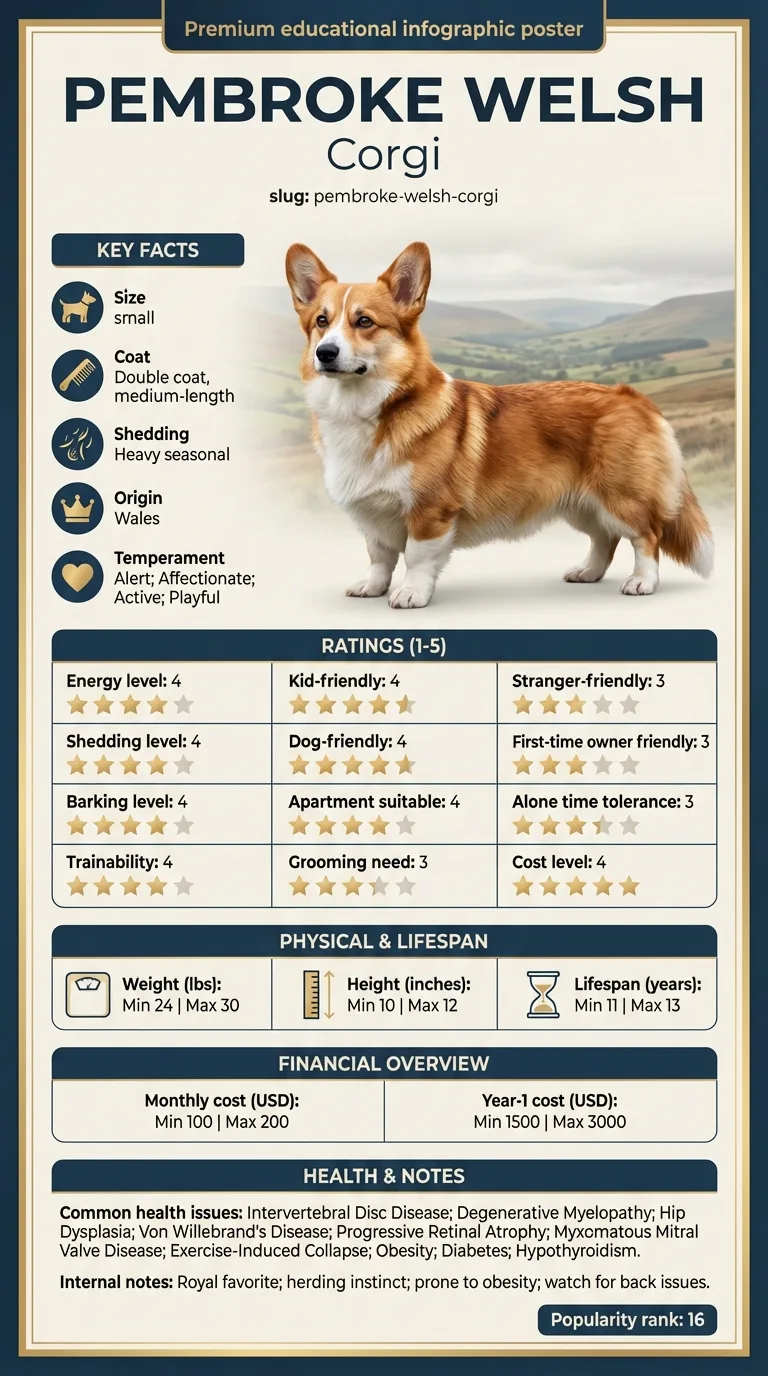
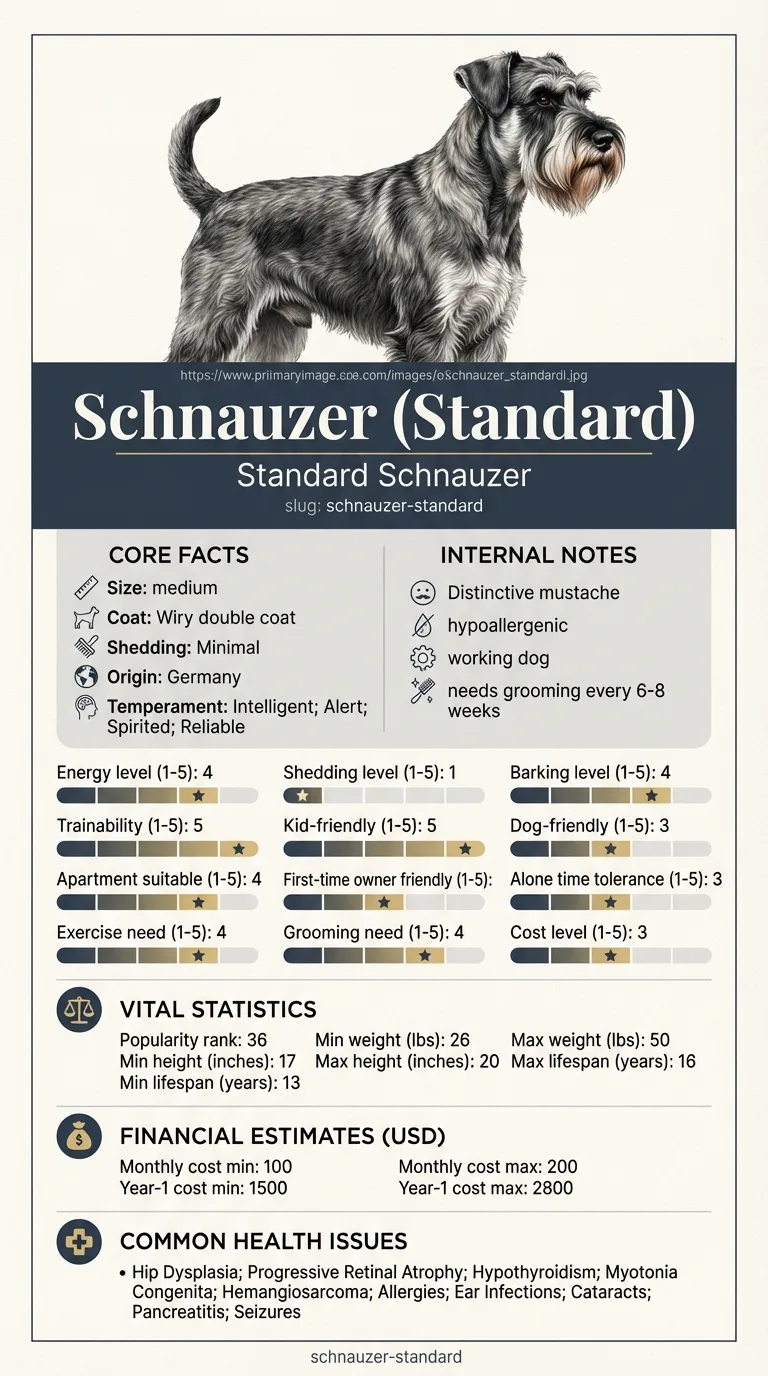
This is for someone already down to Pembroke Welsh Corgi and Schnauzer (Standard) and deciding between them. For this pair the decision usually turns on shedding, so those are covered first and in most detail. Both rate 4/5 for flats, so housing does not settle this one. Breed history is left out; what follows is what you will actually live with.
Between Pembroke Welsh Corgi and Schnauzer (Standard), shedding is what separates them, and Pembroke Welsh Corgi is the lower-effort dog of the two to keep.
Choose Pembroke Welsh Corgi if you do not want a standing grooming appointment, you already have another dog and a smaller dog suits your car, your home or your back.
Choose Schnauzer (Standard) if shedding is a problem in your house, there are young children at home and you want a dog that picks up training quickly.
| Feature | pembroke welsh corgi | schnauzer standard | Winner |
|---|---|---|---|
| Size class | small | medium | Equal |
| Weight | 24–30 lbs | 26–50 lbs | Equal |
| Height | 10–12 in | 17–20 in | Equal |
| Lifespan | 11–13 years | 13–16 years | schnauzer standard |
| Exercise need | High (4/5) | High (4/5) | Equal |
| Grooming need | Moderate (3/5) | High (4/5) | pembroke welsh corgi |
| Shedding | High (4/5) | Very low (1/5) | schnauzer standard |
| Energy level | High (4/5) | High (4/5) | Equal |
| Barking | High (4/5) | High (4/5) | Equal |
| Apartment suitability | High (4/5) | High (4/5) | Equal |
| Good for first-time owners | Moderate (3/5) | Moderate (3/5) | Equal |
| Tolerates being alone | Moderate (3/5) | Moderate (3/5) | Equal |
| Trainability | High (4/5) | Very high (5/5) | schnauzer standard |
| Good with kids | High (4/5) | Very high (5/5) | schnauzer standard |
| Good with other dogs | High (4/5) | Moderate (3/5) | pembroke welsh corgi |
| Friendly to strangers | Moderate (3/5) | Moderate (3/5) | Equal |
| Cost level | High (4/5) | Moderate (3/5) | schnauzer standard |
| Coat | Double coat, medium-length | Wiry double coat | Equal |
| Origin | Wales | Germany | Equal |
| Typical monthly cost | $100–$200 | $100–$200 | Equal |
| Typical first-year cost | $1,500–$3,000 | $1,500–$2,800 | Equal |
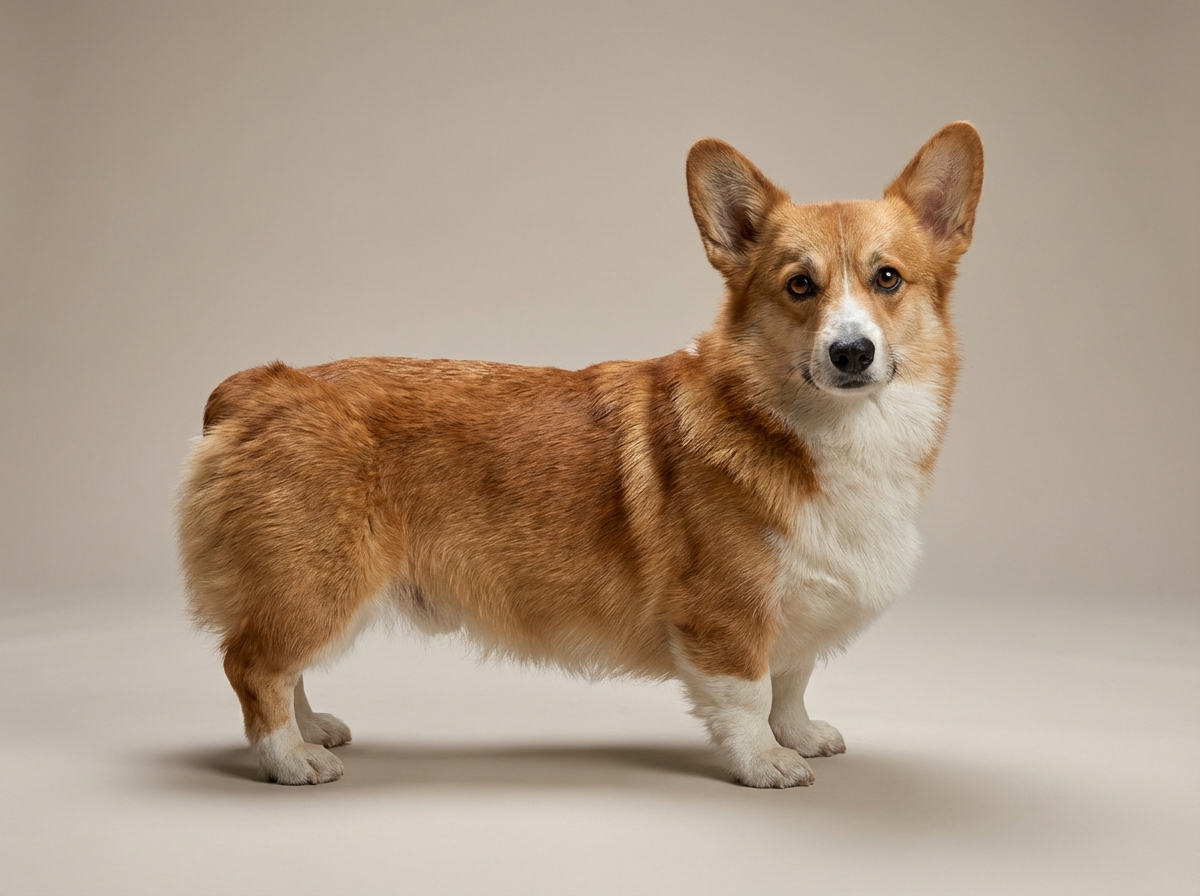
The Corgi is a genuinely small dog: 24 to 30 lbs on a 10-to-12-inch frame, all long back and short legs. The Standard Schnauzer is built on a completely different scale -- 26 to 50 lbs and 17 to 20 inches, nearly double the height at the shoulder. You're choosing between a low, elongated herder and a square, athletic working dog, and that difference shows up in everything from car crates to how each one clears a coffee table.
Both breeds sit at High, 4 out of 5, for exercise need and energy level, so neither is a low-effort pick. The Corgi channels its energy into herding instinct -- it wants to chase, nip at heels, and problem-solve. The Schnauzer's drive reads more like classic working-dog stamina. Either way, plan on real daily exercise, not a lap around the block.
Grooming need is close -- Moderate (3/5) for the Corgi versus High (4/5) for the Schnauzer, whose wiry coat needs hand-stripping or clipping every few months. Shedding is where they split hard: the Corgi rates High (4/5), throwing that thick double coat everywhere twice a year, while the Standard Schnauzer sits at Very low (1/5). If you want the coat texture without the fur on your couch, that gap matters more than the grooming score does.
Both land at High (4/5) for apartment suitability and High (4/5) for barking, so size isn't the issue in a smaller home -- noise is. Neither breed is naturally quiet, and both score Moderate (3/5) on tolerating time alone, so a Corgi or a Standard Schnauzer left solo for long stretches every day is a setup for trouble, not a difference-maker between the two.
The Corgi rates High (4/5) for trainability, the Schnauzer edges it out at Very high (5/5). Both are listed as Moderate (3/5) for first-time owners, meaning neither is a plug-and-play beginner breed -- the Corgi's herding opinions and the Schnauzer's size and drive both ask something of a new owner. Consistent, early training pays off with either dog.
Both score High (4/5) with kids, though the Schnauzer edges to Very high (5/5). With other dogs the Corgi rates High (4/5) against the Schnauzer's Moderate (3/5), so a Corgi is somewhat more likely to get along easily at the dog park. Strangers get a Moderate (3/5) from both -- polite but not instantly friendly to everyone who walks in.
The Corgi's list is long and back-related: Intervertebral Disc Disease and Degenerative Myelopathy sit alongside Hip Dysplasia, Von Willebrand's Disease, and Progressive Retinal Atrophy -- a reminder that the short-legged, long-back build carries real spinal risk. The Schnauzer shares Hip Dysplasia, PRA, and Hypothyroidism but adds Hemangiosarcoma and Myotonia Congenita. Lifespan favors the Schnauzer at 13 to 16 years against the Corgi's 11 to 13.
Cost level is rated High (4/5) for the Corgi and Moderate (3/5) for the Schnauzer, though monthly spend lands in the same $100-$200 band for both. First-year costs run close too -- $1,500-$3,000 for the Corgi versus $1,500-$2,800 for the Schnauzer -- so the real budget gap is smaller than the cost rating alone suggests.
Pembroke Welsh Corgi weighs 24–30 lbs and lives 11–13 years; Schnauzer (Standard) weighs 26–50 lbs and lives 13–16 years. The two diverge most on shedding. They are level on tolerates being alone, apartment suitability and barking, so those cannot decide it. The comparison marks an easier option only where one exists. Facts like weight and country of origin are not scored. Both dogs are rated from the same dataset, which is what makes the numbers comparable with each other even though any individual dog sits somewhere inside its breed's range.

Noticeably bigger. The Corgi weighs 24-30 lbs at 10-12 inches tall, while the Standard Schnauzer runs 26-50 lbs at 17-20 inches -- nearly double the height and often heavier too.
The Standard Schnauzer, by a wide margin. It rates Very low (1/5) for shedding against the Corgi's High (4/5), even though the Schnauzer actually needs more grooming upkeep to maintain that wiry coat.
Both are rated Moderate (3/5), so neither is a natural beginner pick. The Corgi's strong herding instincts and the Schnauzer's size and drive both call for owners ready to train consistently from day one.
Yes -- both score High (4/5) for apartment suitability. The bigger issue indoors is noise: both rate High (4/5) for barking, so thin walls are the real concern, not square footage.
The Schnauzer edges it on the cost rating (Moderate vs High), but the dollar ranges are close -- monthly costs for both sit at $100-$200, and first-year costs are within a few hundred dollars of each other.
Yes, three conditions overlap: Hip Dysplasia, Progressive Retinal Atrophy, and Hypothyroidism. Beyond that, the Corgi's risks lean toward spinal issues like IVDD, while the Schnauzer's list includes Hemangiosarcoma and Myotonia Congenita.
If shedding is a dealbreaker, go Schnauzer -- it rates Very low (1/5) versus the Corgi's High (4/5), and it also trains a notch easier at Very high (5/5).
Essentially the same for both: $100-$200 a month, covering food, routine vet care, and grooming.
Both rate High (4/5) for exercise need -- expect real daily activity, not a short leash walk, from either breed.
The Standard Schnauzer, typically 13-16 years versus the Corgi's 11-13 years.
Secure checkout on Stripe. We never see your card.
7-day money-back guarantee. Instant access.
Health information here is general and is not veterinary advice. If your dog shows pain, sudden behaviour change, or worsening symptoms, consult a licensed veterinarian.
Some links on this site are affiliate links. We may earn a commission at no extra cost to you, and we only suggest products we believe are helpful for dog owners.
We research and check what we publish, but we do not warrant that any figure, date, price, or statement is accurate, complete, or current, and we accept no liability for any loss, cost, injury, or other harm arising from the use of this site. Use it as one reference among several. You remain responsible for your own decisions and for your dog's care - confirm anything that matters with a licensed veterinarian or another qualified professional before you act on it. Full disclaimer.
Match your lifestyle to the right dog.
Take quizNot sure which breed is right for you? Take our 2-minute quiz to find out.
Take the quiz