Living
Which should I choose overall?
Both need serious daily exercise, so pick based on space and noise tolerance -- the Corgi fits smaller homes better but barks more.

Quick answer
Which should I choose overall?
Both need serious daily exercise, so pick based on space and noise tolerance -- the Corgi fits smaller homes better but barks more.
French Spaniel or Pembroke Welsh Corgi? On paper they differ most on apartment suitability, and on the scales French Spaniel is the heavier at 45–60 lbs. Here is how the two compare on everything that shapes an ordinary week.
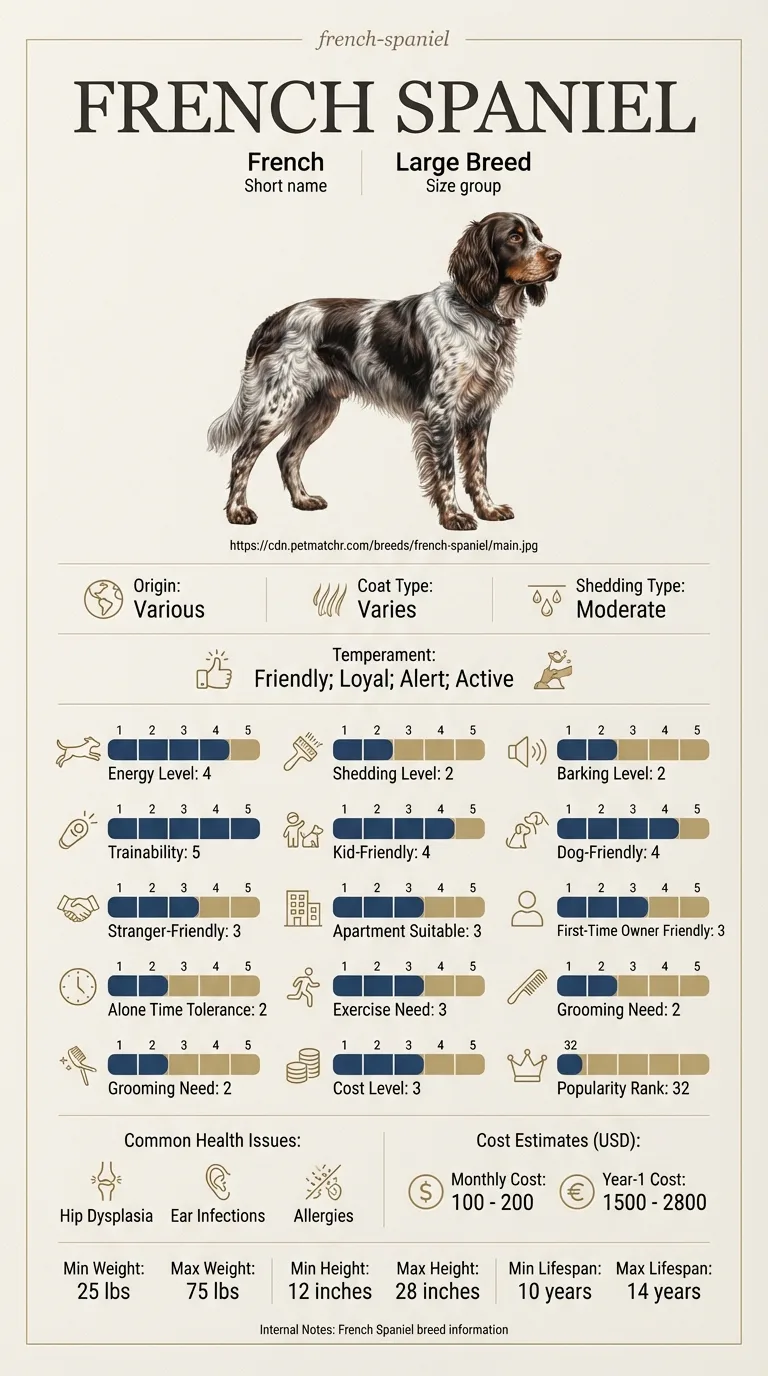
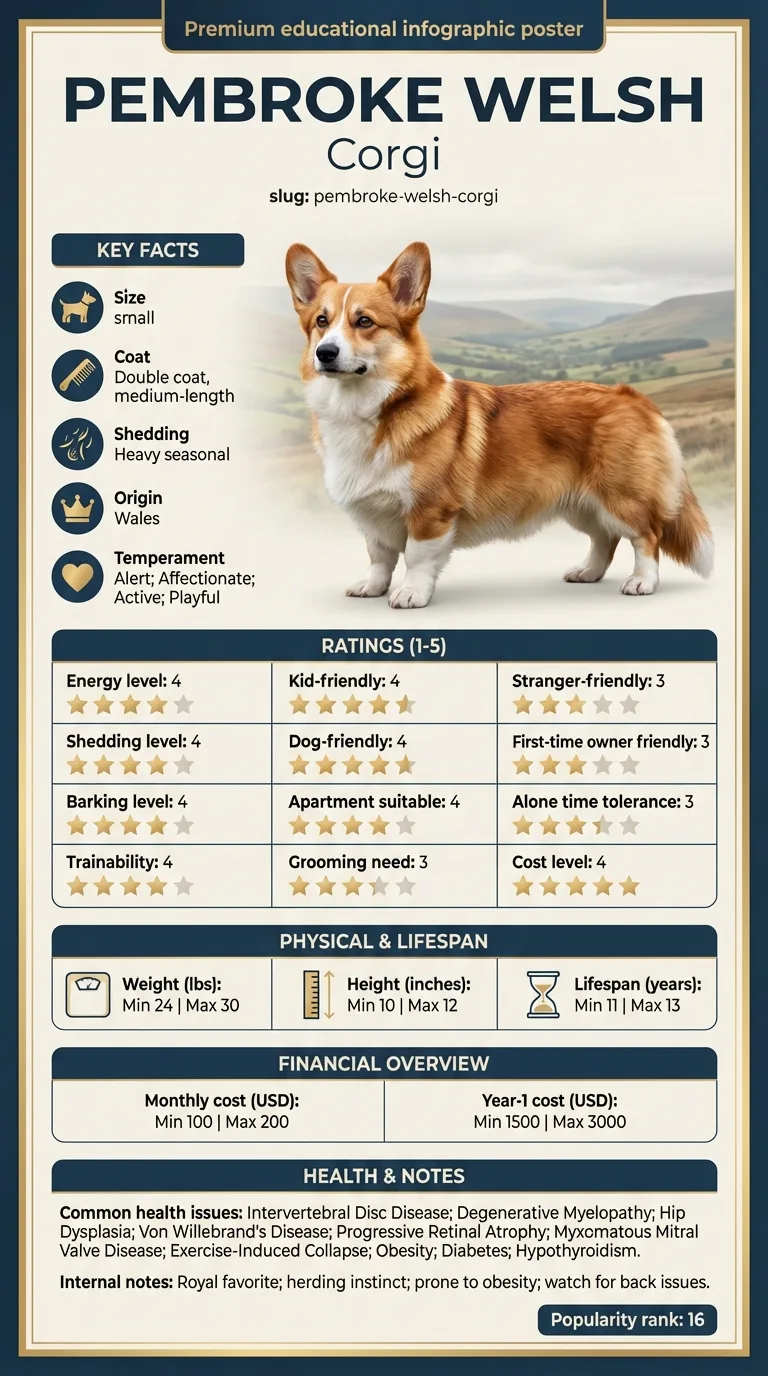
This is for someone already down to French Spaniel and Pembroke Welsh Corgi and deciding between them. For this pair the decision usually turns on apartment suitability and barking, so those are covered first and in most detail. Anyone choosing from a flat has a clear answer here: Pembroke Welsh Corgi rates 4/5 against 2/5. Breed history is left out; what follows is what you will actually live with.
Between French Spaniel and Pembroke Welsh Corgi, apartment suitability is what separates them, and Pembroke Welsh Corgi is the lower-effort dog of the two to keep.
Choose French Spaniel if shedding is a problem in your house and you want a dog that can keep up with an active routine.
Choose Pembroke Welsh Corgi if you are in a flat or a smaller home, your walking routine is modest and the dog will be alone during the working day.
| Feature | french spaniel | pembroke welsh corgi | Winner |
|---|---|---|---|
| Size class | medium | small | Equal |
| Weight | 45–60 lbs | 24–30 lbs | Equal |
| Height | 21–24 in | 10–12 in | Equal |
| Lifespan | 10–12 years | 11–13 years | pembroke welsh corgi |
| Exercise need | Very high (5/5) | High (4/5) | pembroke welsh corgi |
| Grooming need | Moderate (3/5) | Moderate (3/5) | Equal |
| Shedding | Moderate (3/5) | High (4/5) | french spaniel |
| Energy level | High (4/5) | High (4/5) | Equal |
| Barking | Low (2/5) | High (4/5) | french spaniel |
| Apartment suitability | Low (2/5) | High (4/5) | pembroke welsh corgi |
| Good for first-time owners | Moderate (3/5) | Moderate (3/5) | Equal |
| Tolerates being alone | Low (2/5) | Moderate (3/5) | pembroke welsh corgi |
| Trainability | High (4/5) | High (4/5) | Equal |
| Good with kids | High (4/5) | High (4/5) | Equal |
| Good with other dogs | High (4/5) | High (4/5) | Equal |
| Friendly to strangers | High (4/5) | Moderate (3/5) | french spaniel |
| Cost level | Moderate (3/5) | High (4/5) | french spaniel |
| Coat | Medium, flat and feathered | Double coat, medium-length | Equal |
| Origin | Various | Wales | Equal |
| Typical monthly cost | $100–$200 | $100–$200 | Equal |
| Typical first-year cost | $1,400–$2,900 | $1,500–$3,000 | Equal |
The Pembroke Welsh Corgi is short but not exactly small -- 24 to 30 pounds packed into a 10-to-12-inch frame, versus the French Spaniel's 45-to-60-pound, 21-to-24-inch build. That long-body, short-leg shape is the Corgi's defining trait, and it's part of why its health list below includes spinal conditions that a proportionally-built breed like the French Spaniel doesn't share.
These two are closer in drive than most pairs on this site -- the French Spaniel rates very high (5/5) for exercise need, the Corgi high (4/5), and both tie on energy level at high (4/5). A Corgi was bred to herd cattle all day, so don't mistake its short legs for low stamina; it wants nearly as much activity as the French Spaniel does.
Grooming need ties at moderate (3/5) for both, but shedding tips toward the French Spaniel being the lighter shedder -- moderate (3/5) against the Corgi's high (4/5). Corgis are known for blowing their double coat seasonally, which can mean a couple of weeks a year that feel like much more than a 4-out-of-5 rating suggests.
The Corgi is rated high (4/5) for apartment suitability against the French Spaniel's low (2/5), but it's also the noisier of the two -- high (4/5) barking versus low (2/5). Herding breeds tend to vocalize, and the Corgi is no exception. It also tolerates being alone slightly better (moderate 3/5 versus low 2/5), useful if your schedule isn't fully flexible.
Trainability ties at high (4/5), and first-time-owner suitability ties too, both moderate (3/5) -- genuinely one of the closest matchups in this comparison on the training front. The real differentiator is exercise tolerance: a new owner needs to be honest about whether they can deliver near-daily vigorous activity, since both breeds expect it. Corgis in particular are prone to boredom-driven barking and nipping at heels if that activity need goes unmet.
Good-with-kids ties at high (4/5), as does good-with-other-dogs at high (4/5). Friendliness to strangers favors the French Spaniel, high (4/5) against the Corgi's moderate (3/5) -- Corgis, bred to watch livestock, tend to be a bit more reserved with people they don't know, which can read as alert rather than standoffish. That watchfulness is generally a feature, not a flaw, if you want a dog that notices when someone's at the door.
The Corgi's biggest health concern is structural -- its long spine and short legs put it at real risk of intervertebral disc disease and degenerative myelopathy, conditions the French Spaniel's list doesn't include. Both share hip dysplasia, but the Corgi's list of ten conditions also flags obesity, diabetes, and a heart condition (myxomatous mitral valve disease), against the French Spaniel's five. Lifespan slightly favors the Corgi, 11 to 13 years against 10 to 12.
Monthly costs tie exactly at $100 to $200 for both breeds, but the Corgi's overall cost rating runs higher -- high (4/5) against the French Spaniel's moderate (3/5) -- and its first-year range is wider too, $1,500 to $3,000 versus $1,400 to $2,900. That gap likely reflects a Corgi's tendency toward orthopedic issues that come with vet bills attached.
French Spaniel weighs 45–60 lbs and lives 10–12 years; Pembroke Welsh Corgi weighs 24–30 lbs and lives 11–13 years. The two diverge most on apartment suitability and barking. They are level on good with other dogs, energy level and good for first-time owners, so those cannot decide it. The comparison marks an easier option only where one exists. Facts like weight and country of origin are not scored. Both dogs are rated from the same dataset, which is what makes the numbers comparable with each other even though any individual dog sits somewhere inside its breed's range.

Both need a lot -- the French Spaniel rates very high (5/5), the Corgi high (4/5) -- closer than most breed comparisons on this measure.
The Corgi, high (4/5) against the French Spaniel's low (2/5) -- typical of a herding breed bred to vocalize.
It ties with the French Spaniel at moderate (3/5). Both expect a real daily exercise commitment from a new owner.
Its long spine and short legs put it at risk of intervertebral disc disease and degenerative myelopathy -- conditions not flagged for the French Spaniel.
Both land at $100 to $200 a month, though the Corgi's overall cost rating and first-year range run slightly higher.
The Corgi, slightly -- 11 to 13 years against the French Spaniel's 10 to 12.
The Corgi, rated high (4/5) against the French Spaniel's low (2/5), though its higher barking rating is worth weighing against that.
Both need serious daily exercise, so pick based on space and noise tolerance -- the Corgi fits smaller homes better but barks more.
Both land at $100-$200 a month, though the Corgi's first-year costs run a bit higher.
Both need a lot -- the French Spaniel rates 5/5, the Corgi 4/5. Neither is a low-activity breed.
The Corgi, slightly -- 11-13 years versus the French Spaniel's 10-12.
Secure checkout on Stripe. We never see your card.
7-day money-back guarantee. Instant access.

Health information here is general and is not veterinary advice. If your dog shows pain, sudden behaviour change, or worsening symptoms, consult a licensed veterinarian.
Some links on this site are affiliate links. We may earn a commission at no extra cost to you, and we only suggest products we believe are helpful for dog owners.
We research and check what we publish, but we do not warrant that any figure, date, price, or statement is accurate, complete, or current, and we accept no liability for any loss, cost, injury, or other harm arising from the use of this site. Use it as one reference among several. You remain responsible for your own decisions and for your dog's care - confirm anything that matters with a licensed veterinarian or another qualified professional before you act on it. Full disclaimer.
Match your lifestyle to the right dog.
Take quizNot sure which breed is right for you? Take our 2-minute quiz to find out.
Take the quiz