Behavior
Which is more protective?
The Rottweiler, reflected in its low 2/5 friendly-to-strangers score against the Springer's high 4/5.

Quick answer
Which is more protective?
The Rottweiler, reflected in its low 2/5 friendly-to-strangers score against the Springer's high 4/5.
English Springer Spaniel or Rottweiler? On paper they differ most on grooming need, and on the scales Rottweiler is the heavier at 80–135 lbs. Here is how the two compare on everything that shapes an ordinary week.
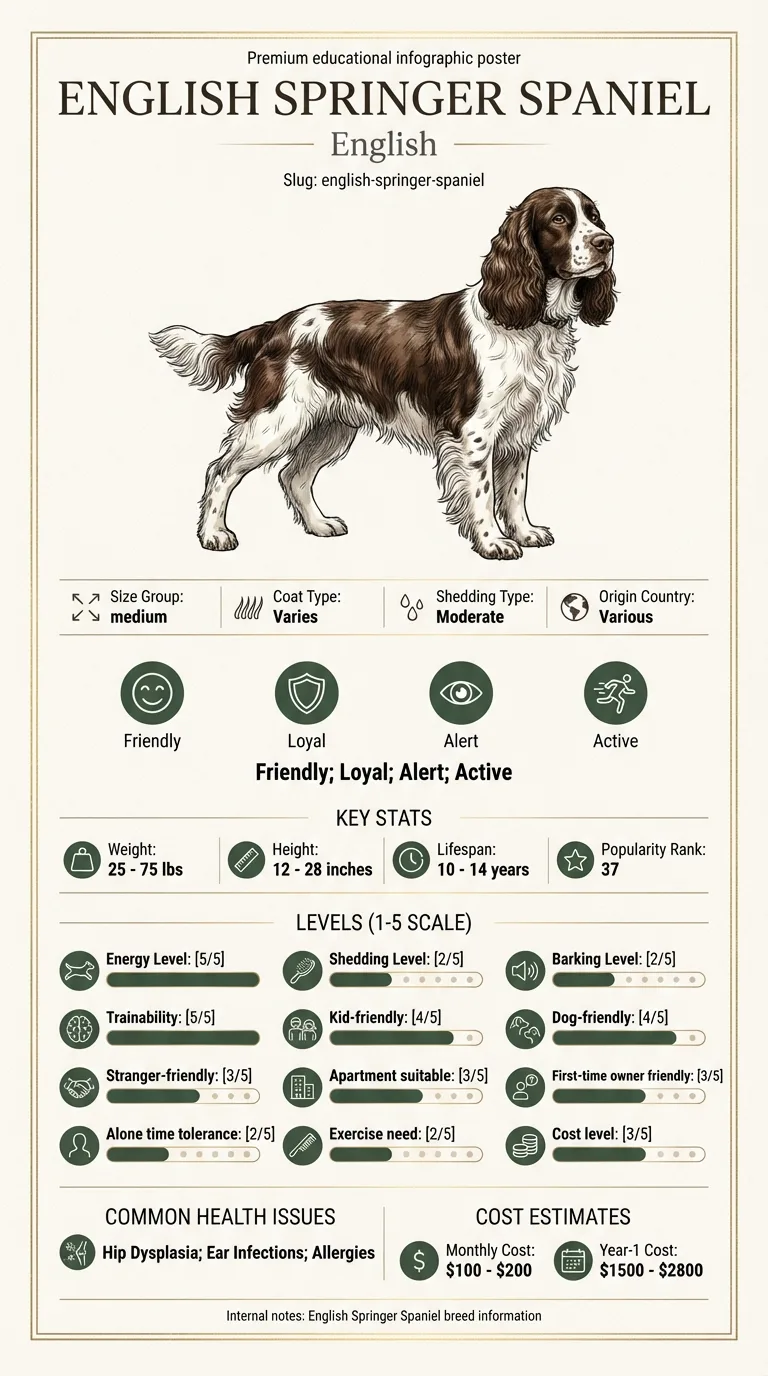
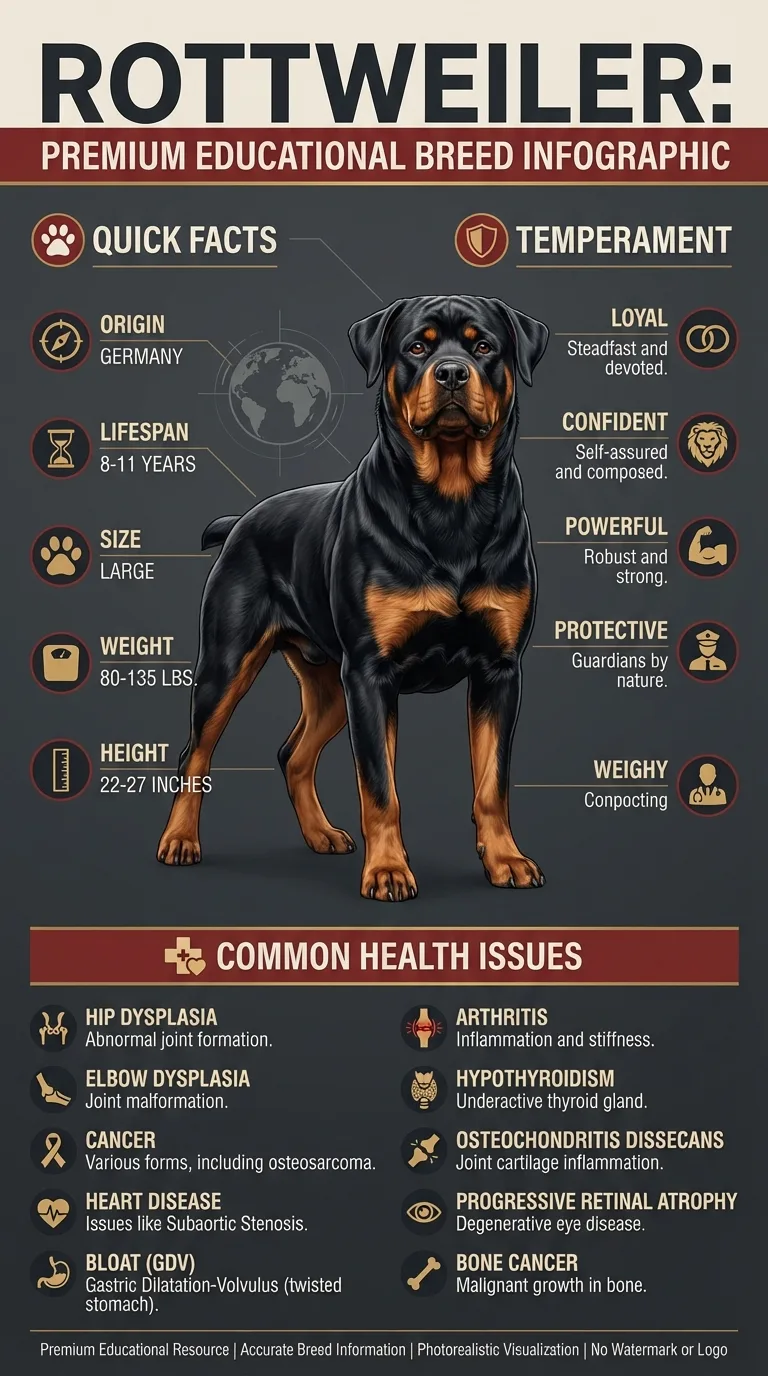
This is for someone already down to English Springer Spaniel and Rottweiler and deciding between them. For this pair the decision usually turns on grooming need and friendly to strangers, so those are covered first and in most detail. Both rate 2/5 for flats, so housing does not settle this one. Breed history is left out; what follows is what you will actually live with.
Between English Springer Spaniel and Rottweiler, grooming need is what separates them, and Rottweiler is the lower-effort dog of the two to keep.
Choose English Springer Spaniel if this is your first dog, shedding is a problem in your house and there are young children at home.
Choose Rottweiler if you do not want a standing grooming appointment, your walking routine is modest and you want a dog that is more watchful with visitors.
| Feature | english springer spaniel | rottweiler | Winner |
|---|---|---|---|
| Size class | medium | large | Equal |
| Weight | 40–50 lbs | 80–135 lbs | Equal |
| Height | 19–20 in | 22–27 in | Equal |
| Lifespan | 12–14 years | 8–11 years | english springer spaniel |
| Exercise need | Very high (5/5) | High (4/5) | rottweiler |
| Grooming need | High (4/5) | Low (2/5) | rottweiler |
| Shedding | Moderate (3/5) | High (4/5) | english springer spaniel |
| Energy level | Very high (5/5) | High (4/5) | Equal |
| Barking | Moderate (3/5) | Moderate (3/5) | Equal |
| Apartment suitability | Low (2/5) | Low (2/5) | Equal |
| Good for first-time owners | Moderate (3/5) | Low (2/5) | english springer spaniel |
| Tolerates being alone | Low (2/5) | Low (2/5) | Equal |
| Trainability | Very high (5/5) | High (4/5) | english springer spaniel |
| Good with kids | Very high (5/5) | High (4/5) | english springer spaniel |
| Good with other dogs | High (4/5) | Moderate (3/5) | english springer spaniel |
| Friendly to strangers | High (4/5) | Low (2/5) | english springer spaniel |
| Cost level | Moderate (3/5) | High (4/5) | english springer spaniel |
| Coat | Medium, feathered double coat | Double coat, short | Equal |
| Origin | Various | Germany | Equal |
| Typical monthly cost | $100–$200 | $125–$250 | Equal |
| Typical first-year cost | $1,400–$2,900 | $2,000–$3,500 | Equal |
A Rottweiler can weigh up to 135 pounds and stand 27 inches at the shoulder — roughly two and a half times an English Springer Spaniel's 50-pound ceiling and a good seven inches taller. Both breeds share German origins in part, the Rottweiler fully, the Springer only via its varied lineage, but the resemblance stops there. A Rottweiler is built for power — a double coat over a dense, muscular frame historically used for herding and cart-pulling — while the Springer's lighter, feathered-coat build reflects its job flushing birds across open fields rather than hauling weight.
The Springer edges out the Rottweiler on paper for exercise need, very high 5/5 against high 4/5, and energy level ties at very high 5/5 for the Springer against high 4/5 for the Rottweiler — a genuinely high-drive breed in its own right, just a notch below the Springer's field-dog intensity. Neither is a low-activity breed; a Rottweiler's power-oriented build means its exercise should include structured activity like obedience or weight-pulling work, not just distance, while a Springer's needs are more purely about volume — long walks, runs, and retrieving games.
Grooming flips the size expectation: the Springer rates high, 4/5, against the Rottweiler's low, 2/5, thanks to the Springer's feathered double coat needing regular brushing that the Rottweiler's short double coat doesn't. Shedding runs the opposite direction, though — high, 4/5, for the Rottweiler against moderate, 3/5, for the Springer — so a Rottweiler owner deals with more loose hair around the house despite spending less time actively grooming the dog. "Low grooming need" doesn't mean "low hair," a distinction easy to miss reading the table quickly.
Apartment suitability ties at low, 2/5, for both breeds — neither is naturally suited to small-space living, for different reasons: the Springer's very high exercise drive and the Rottweiler's sheer size and strength. Barking ties too, at moderate 3/5 each. Both also tolerate time alone poorly, low 2/5 for each, so neither breed suits an owner regularly away for long stretches, regardless of home size. A Rottweiler in particular benefits from consistent socialization time given its more reserved default temperament toward strangers.
Trainability favors the Springer, very high 5/5 against the Rottweiler's high 4/5, and first-time-owner suitability shows a wider gap — moderate 3/5 for the Springer against low 2/5 for the Rottweiler. A Rottweiler's loyal, confident, protective temperament makes it highly capable in the right hands, but that protectiveness means training and socialization carry higher stakes for a novice owner than they do with a Springer's more universally biddable nature. Rottweiler ownership is generally recommended for owners with prior large-breed experience specifically because of this gap.
The Springer outperforms the Rottweiler across every social measure in the table: good with kids, very high 5/5 against high 4/5; good with other dogs, high 4/5 against moderate 3/5; friendly to strangers, high 4/5 against low 2/5. That last gap is the starkest — a Rottweiler's protective instinct, useful as a guardian trait, means it's naturally more reserved and watchful around unfamiliar people, a fact any household expecting frequent visitors should weigh heavily before choosing between these two.
Lifespan strongly favors the Springer, 12 to 14 years against the Rottweiler's 8 to 11 — a meaningful gap even accounting for typical large-breed shorter lifespans. The Rottweiler's ten-condition health list is also the more serious of the two, listing cancer twice — general cancer and bone cancer specifically — alongside heart disease, bloat, and arthritis, reflecting known elevated cancer risk in the breed. The Springer's shorter, five-condition list centers on joint and eye issues plus phosphofructokinase deficiency, but nothing on the scale of the Rottweiler's cancer risk.
Cost level rates moderate, 3/5, for the Springer against high, 4/5, for the Rottweiler, with first-year figures of $1,400–$2,900 versus $2,000–$3,500 confirming the gap. Monthly costs are closer, $100–$200 against $125–$250, but a Rottweiler's larger size and the veterinary attention its cancer-heavy health list may eventually require — regular screenings are a common recommendation for the breed — make the true lifetime cost gap likely wider than the first-year figures alone suggest.
English Springer Spaniel weighs 40–50 lbs and lives 12–14 years; Rottweiler weighs 80–135 lbs and lives 8–11 years. The two diverge most on grooming need and friendly to strangers. They are level on tolerates being alone, apartment suitability and barking, so those cannot decide it. The comparison marks an easier option only where one exists. Facts like weight and country of origin are not scored. Both dogs are rated from the same dataset, which is what makes the numbers comparable with each other even though any individual dog sits somewhere inside its breed's range.

Not really recommended — it rates low, 2/5, for first-time-owner suitability, versus the Springer's moderate 3/5, largely due to its protective temperament requiring experienced handling.
The English Springer Spaniel, rated high 4/5, well ahead of the Rottweiler's low 2/5 — a reflection of the Rottweiler's naturally protective, watchful nature.
The Springer Spaniel, 12–14 years, notably ahead of the Rottweiler's 8–11 years.
More than its low 2/5 grooming need might suggest — it rates high, 4/5, for shedding, despite needing comparatively little brushing.
The Rottweiler, whose health list includes both cancer and bone cancer specifically, a known elevated risk in the breed, versus no cancer listing for the Springer.
The Springer, rated very high 5/5 against the Rottweiler's high 4/5 — both are high-energy, but the Springer edges ahead.
The Springer Spaniel, at $1,400–$2,900, versus $2,000–$3,500 for the Rottweiler.
The Rottweiler, reflected in its low 2/5 friendly-to-strangers score against the Springer's high 4/5.
The English Springer Spaniel, rated high 4/5 versus the Rottweiler's moderate 3/5.
The Springer Spaniel, very high 5/5, against the Rottweiler's high 4/5.
The Springer Spaniel, 12–14 years, versus the Rottweiler's 8–11 years.
Secure checkout on Stripe. We never see your card.
7-day money-back guarantee. Instant access.
Health information here is general and is not veterinary advice. If your dog shows pain, sudden behaviour change, or worsening symptoms, consult a licensed veterinarian.
Some links on this site are affiliate links. We may earn a commission at no extra cost to you, and we only suggest products we believe are helpful for dog owners.
We research and check what we publish, but we do not warrant that any figure, date, price, or statement is accurate, complete, or current, and we accept no liability for any loss, cost, injury, or other harm arising from the use of this site. Use it as one reference among several. You remain responsible for your own decisions and for your dog's care - confirm anything that matters with a licensed veterinarian or another qualified professional before you act on it. Full disclaimer.
Match your lifestyle to the right dog.
Take quizNot sure which breed is right for you? Take our 2-minute quiz to find out.
Take the quiz