Doberman Pinscher vs English Springer Spaniel: Which Suits Your Home?
Quick answer
Doberman or English Springer Spaniel — which should you get?
The Springer is the friendlier, easier all-around family dog. The Doberman suits an experienced owner who wants a more protective, guarding-oriented dog and can handle its size and cost.
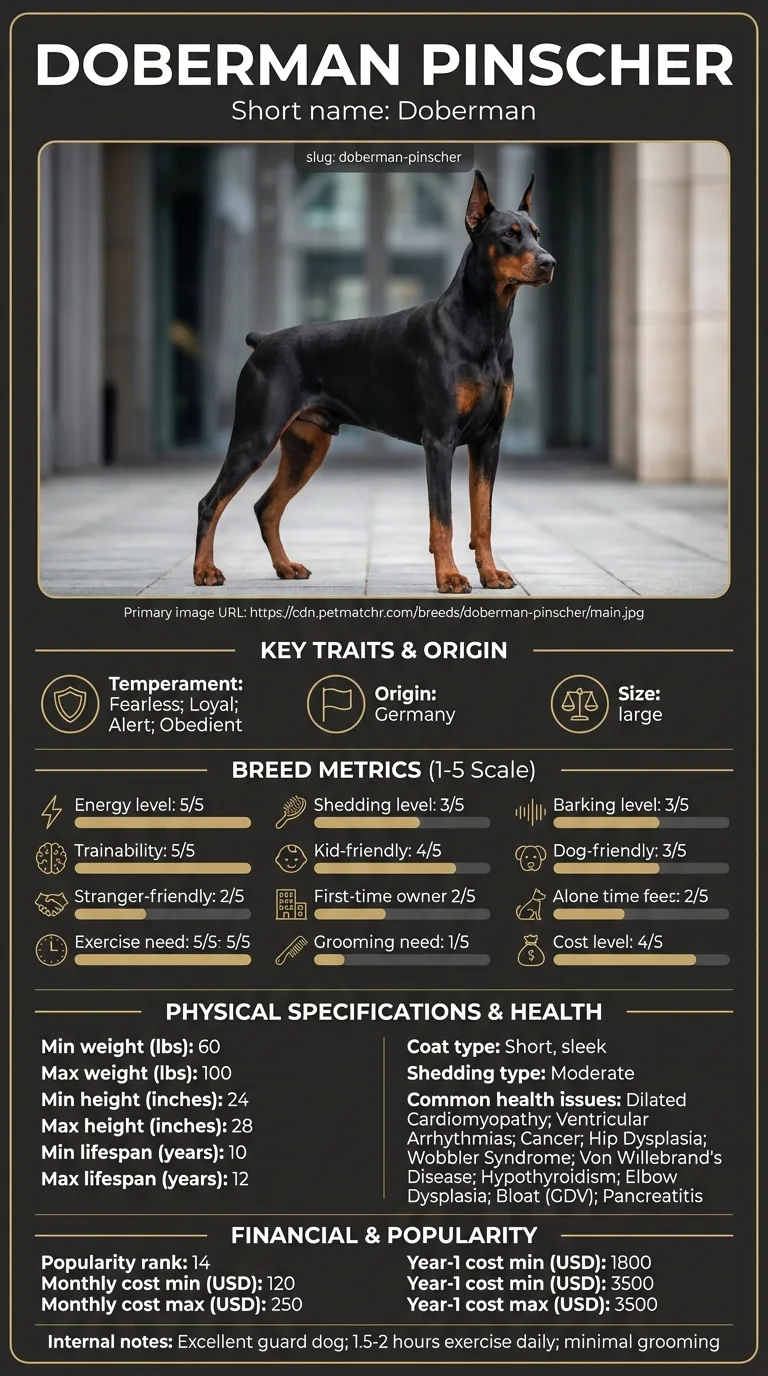
Doberman Pinscher or English Springer Spaniel? On paper they differ most on grooming need, and on the scales Doberman Pinscher is the heavier at 60–100 lbs. Here is how the two compare on everything that shapes an ordinary week.
This is for someone already down to Doberman Pinscher and English Springer Spaniel and deciding between them. For this pair the decision usually turns on grooming need and friendly to strangers, so those are covered first and in most detail. Both rate 2/5 for flats, so housing does not settle this one. It is written for the decision rather than the breed history.
Quick verdict
Between Doberman Pinscher and English Springer Spaniel, grooming need is what separates them, and Doberman Pinscher is the lower-effort dog of the two to keep.
Choose doberman pinscher if...
Choose Doberman Pinscher if you do not want a standing grooming appointment and you want a dog that is more watchful with visitors.
Choose english springer spaniel if...
Choose English Springer Spaniel if this is your first dog, there are young children at home and you already have another dog.
Head-to-head comparison
Feature
doberman pinscher
english springer spaniel
Winner
Size class
large
medium
Equal
Weight
60–100 lbs
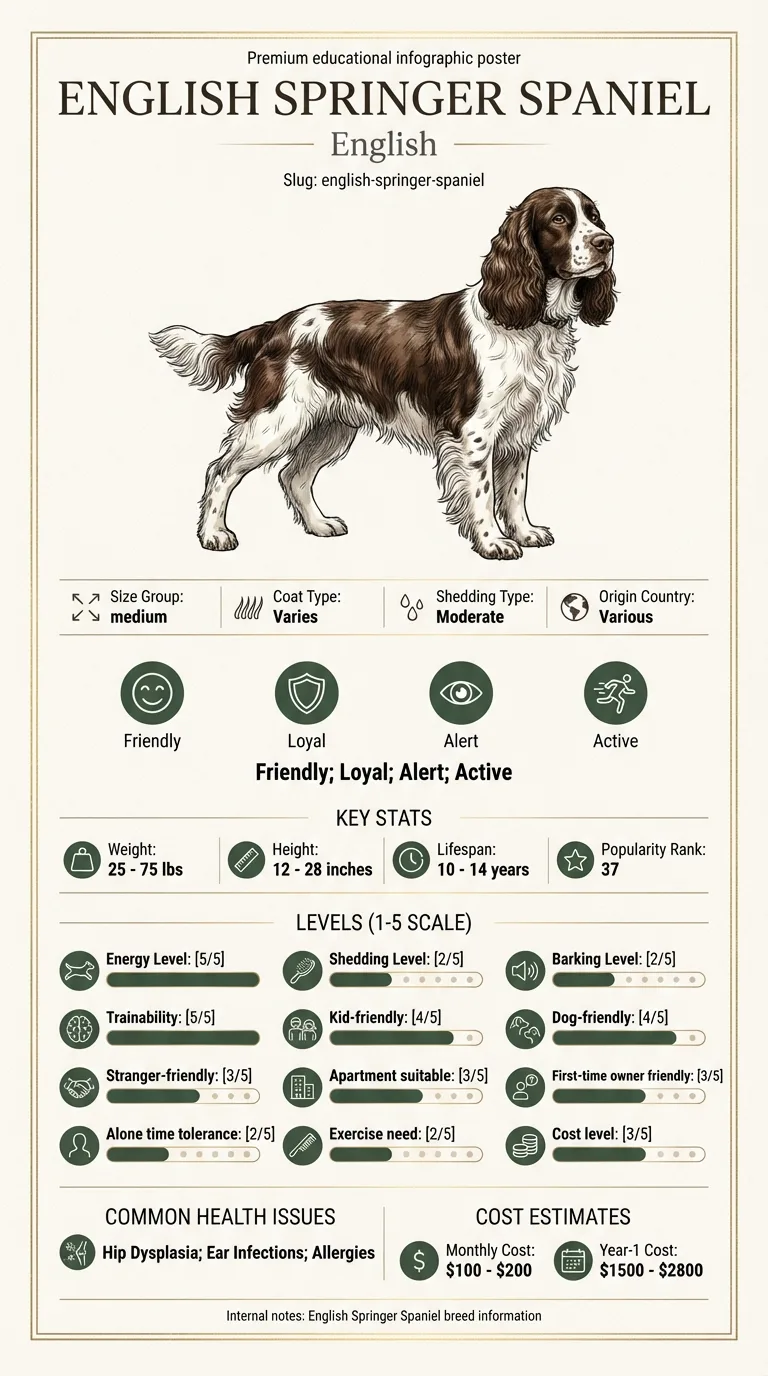
40–50 lbs
Equal
Height
24–28 in
19–20 in
Equal
Lifespan
10–12 years
12–14 years
english springer spaniel
Exercise need
Very high (5/5)
Very high (5/5)
Equal
Grooming need
Very low (1/5)
High (4/5)
doberman pinscher
Shedding
Moderate (3/5)
Moderate (3/5)
Equal
Energy level
Very high (5/5)
Very high (5/5)
Equal
Barking
Moderate (3/5)
Moderate (3/5)
Equal
Apartment suitability
Low (2/5)
Low (2/5)
Equal
Good for first-time owners
Low (2/5)
Moderate (3/5)
english springer spaniel
Tolerates being alone
Low (2/5)
Low (2/5)
Equal
Trainability
Very high (5/5)
Very high (5/5)
Equal
Good with kids
High (4/5)
Very high (5/5)
english springer spaniel
Good with other dogs
Moderate (3/5)
High (4/5)
english springer spaniel
Friendly to strangers
Low (2/5)
High (4/5)
english springer spaniel
Cost level
High (4/5)
Moderate (3/5)
english springer spaniel
Coat
Short, sleek
Medium, feathered double coat
Equal
Origin
Germany
Various
Equal
Typical monthly cost
$120–$250
$100–$200
Equal
Typical first-year cost
$1,800–$3,500
$1,400–$2,900
Equal
Deep dive
Size and build
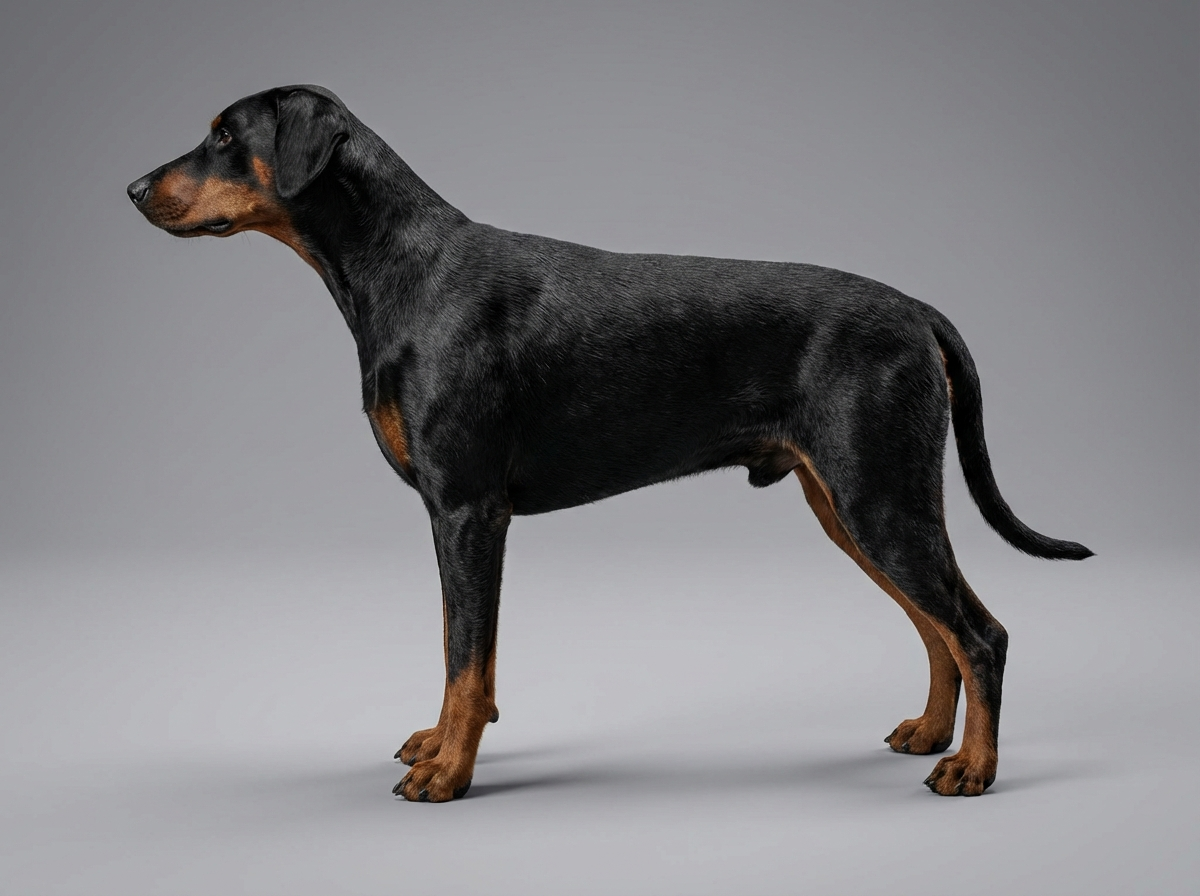
The English Springer Spaniel is mid-sized — 40-50 lbs, 19-20 inches — smaller than the Doberman's 60-100 lbs and 24-28 inches but not nearly as small as some spaniels get. Think roughly half the Doberman's weight, built stockier and closer to the ground for fieldwork rather than the Doberman's tall, lean frame.
Energy and exercise
Both breeds tie at very high (5/5) for exercise need and energy level, which is unusual for a comparison this size-mismatched — the Springer was bred to work all day flushing birds, and it shows. If you're choosing based on activity level alone, this pairing doesn't give you much of an easy option in either direction.
Grooming and shedding
The Doberman's coat wins on convenience, rated very low (1/5) for grooming against the Springer's high (4/5) — that feathered double coat needs regular brushing and trimming to avoid mats. Shedding ties at moderate (3/5) for both, so the Springer's extra grooming time goes toward coat maintenance rather than reducing loose fur.
Apartment living, noise and time alone
Both breeds tie at low (2/5) for apartment suitability and moderate (3/5) for barking, and alone-time tolerance ties too, at low (2/5). Neither is a great fit for small-space living or long solo days regardless of which one you pick — this is one of the few categories where the two land in almost the same place.
Training and owner experience
Trainability ties at very high (5/5) for both breeds — both take to obedience work readily. Where they split is first-time-owner suitability: moderate (3/5) for the Springer against low (2/5) for the Doberman. Trainability alone doesn't make a dog easy to own; the Doberman's size and protective instincts still make it the harder breed for a beginner.
Kids, other dogs and visitors
The Springer is friendlier across the board — very high (5/5) with kids against the Doberman's high (4/5), high (4/5) with other dogs against moderate (3/5), and high (4/5) with strangers against the Doberman's low (2/5). Springers are bred to work alongside hunters and other dogs, which tends to produce a more sociable temperament than a breed selected for guarding.
Health and lifespan
The Springer lives a bit longer, 12-14 years against the Doberman's 10-12, and its health list stays lighter on serious systemic conditions — ear infections, PRA, elbow dysplasia, and the breed-specific phosphofructokinase deficiency. The Doberman's list carries more weight, including dilated cardiomyopathy and ventricular arrhythmias, conditions the Springer's list doesn't include. Hip dysplasia is shared by both.
Cost to keep
The Doberman costs more to keep, rated high (4/5) on cost level against the Springer's moderate (3/5) — $120-250 a month versus $100-200, and $1,800-3,500 in the first year against $1,400-2,900. The gap tracks mostly with the Doberman's larger size and food needs rather than any dramatic difference in routine care.
Doberman Pinscher vs English Springer Spaniel at a glance
Doberman Pinscher weighs 60–100 lbs and lives 10–12 years; English Springer Spaniel weighs 40–50 lbs and lives 12–14 years. The two diverge most on grooming need and friendly to strangers. They are level on tolerates being alone, apartment suitability and barking, so those cannot decide it. In the table, a "winner" means easier for an ordinary household — not better. Size, coat and origin are recorded without a verdict. Because both breeds are scored the same way, the gaps are reliable even where the absolute numbers are rough.
Doberman Pinscher vs English Springer Spaniel: Which Suits Your Home? - Doberman Pinscher vs English Springer Spaniel at a glance
Frequently asked questions
How different in size are these two breeds?
Meaningfully — the Doberman weighs 60-100 lbs and stands 24-28 inches, while the English Springer Spaniel weighs 40-50 lbs and stands 19-20 inches. The Doberman is roughly 50 percent heavier at the high end.
Which needs more grooming?
The Springer, clearly — high (4/5) against the Doberman's very low (1/5), thanks to its feathered double coat. Shedding itself ties at moderate (3/5) for both.
Is either a good first dog?
The Springer edges it, moderate (3/5) against the Doberman's low (2/5), even though both breeds train equally well (tied at very high, 5/5). Size and guarding instinct still make the Doberman the tougher breed for a beginner.
How do they handle apartment living?
About the same, and not great — both tie at low (2/5) for apartment suitability and moderate (3/5) for barking. Neither breed is a natural fit for small-space living.
What's the typical monthly cost?
$120-250 for the Doberman versus $100-200 for the Springer, with first-year costs of $1,800-3,500 and $1,400-2,900 respectively.
Do their health risks overlap?
Hip dysplasia is shared. Beyond that the Doberman's list leans cardiac and orthopedic — dilated cardiomyopathy, wobbler syndrome, bloat — while the Springer's runs to ears, eyes and a breed-specific enzyme deficiency.
Which is friendlier with kids and other dogs?
The Springer, rated very high (5/5) with kids and high (4/5) with other dogs, both ahead of the Doberman's high (4/5) and moderate (3/5).
Doberman or English Springer Spaniel — which should you get?
The Springer is the friendlier, easier all-around family dog. The Doberman suits an experienced owner who wants a more protective, guarding-oriented dog and can handle its size and cost.
Costs
What's the monthly cost difference?
The Doberman runs $120-250 versus the Springer's $100-200 — about $20-50 more a month at either end of the range.
Behavior
Which needs more exercise?
Neither has an edge — exercise need ties at very high (5/5) for both breeds, so expect serious daily activity regardless of which one you choose.
Health
Which lives longer?
The Springer, 12-14 years against the Doberman's 10-12, partly reflecting the Doberman's cardiac health risks.
Related DogBreedCompass guides
Doberman Pinscher breed guide – Readers comparing the two usually want the full profile of Doberman Pinscher before deciding.
Health information here is general and is not veterinary advice. If your dog shows pain, sudden behaviour change, or worsening symptoms, consult a licensed veterinarian.
Some links on this site are affiliate links. We may earn a commission at no extra cost to you, and we only suggest products we believe are helpful for dog owners.
We research and check what we publish, but we do not warrant that any figure, date, price, or statement is accurate, complete, or current, and we accept no liability for any loss, cost, injury, or other harm arising from the use of this site. Use it as one reference among several. You remain responsible for your own decisions and for your dog's care - confirm anything that matters with a licensed veterinarian or another qualified professional before you act on it. Full disclaimer.