Living
Which should you pick overall?
If cost and quieter alone-time matter more, lean Rottweiler mix; if you want a slightly longer-lived, more intense guardian, lean Corso - most other categories are a tie.

Quick answer
Which should you pick overall?
If cost and quieter alone-time matter more, lean Rottweiler mix; if you want a slightly longer-lived, more intense guardian, lean Corso - most other categories are a tie.
Cane Corso or Rottweiler Mix? On paper they differ most on energy level, and on the scales Rottweiler Mix is the heavier at 80–135 lbs. Here is how the two compare on everything that shapes an ordinary week.
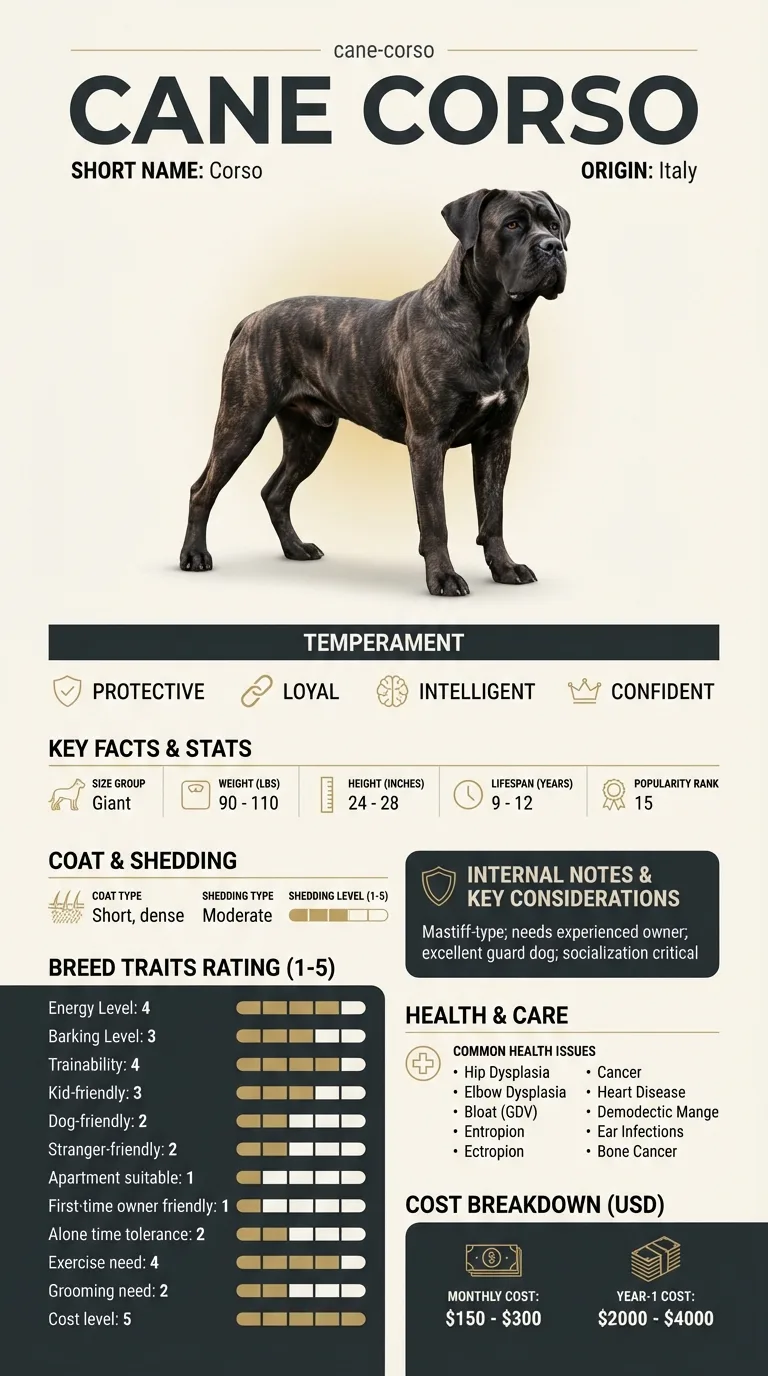
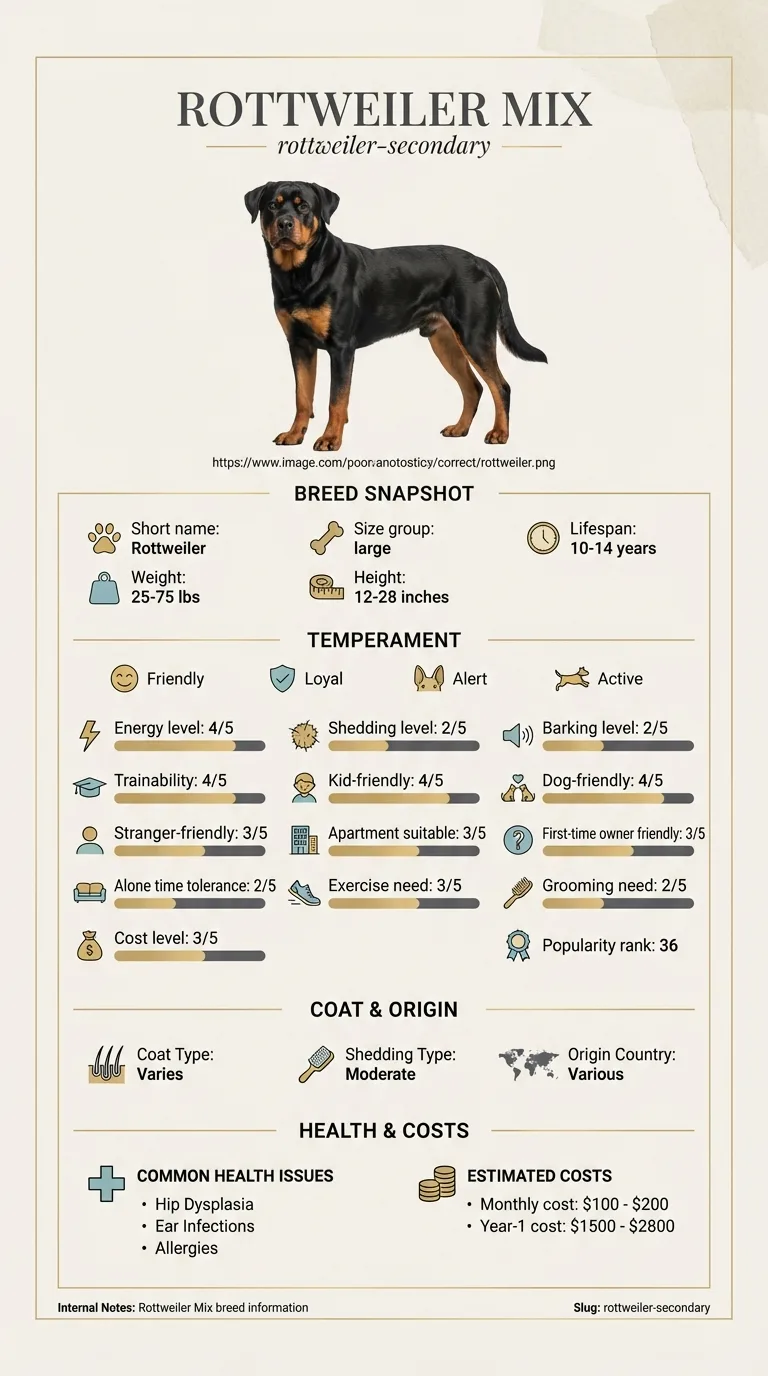
This is for someone already down to Cane Corso and Rottweiler Mix and deciding between them. Because the two are so evenly matched, the page works through every axis rather than leading with one. Anyone choosing from a flat has a clear answer here: Rottweiler Mix rates 2/5 against 1/5. The focus throughout is on daily consequences rather than breed background.
Between Cane Corso and Rottweiler Mix, they are closer than most pairings, and the choice comes down to temperament, and Rottweiler Mix is the lower-effort dog of the two to keep.
Choose Cane Corso if a smaller dog suits your car, your home or your back.
Choose Rottweiler Mix if the dog will be alone during the working day.
| Feature | cane corso | rottweiler secondary | Winner |
|---|---|---|---|
| Size class | giant | large | Equal |
| Weight | 90–110 lbs | 80–135 lbs | Equal |
| Height | 24–28 in | 22–27 in | Equal |
| Lifespan | 9–12 years | 9–10 years | cane corso |
| Exercise need | High (4/5) | High (4/5) | Equal |
| Grooming need | Low (2/5) | Low (2/5) | Equal |
| Shedding | Moderate (3/5) | Moderate (3/5) | Equal |
| Energy level | High (4/5) | Moderate (3/5) | Equal |
| Barking | Moderate (3/5) | Low (2/5) | rottweiler secondary |
| Apartment suitability | Very low (1/5) | Low (2/5) | rottweiler secondary |
| Good for first-time owners | Very low (1/5) | Low (2/5) | rottweiler secondary |
| Tolerates being alone | Low (2/5) | Moderate (3/5) | rottweiler secondary |
| Trainability | High (4/5) | High (4/5) | Equal |
| Good with kids | Moderate (3/5) | Moderate (3/5) | Equal |
| Good with other dogs | Low (2/5) | Low (2/5) | Equal |
| Friendly to strangers | Low (2/5) | Low (2/5) | Equal |
| Cost level | Very high (5/5) | High (4/5) | rottweiler secondary |
| Coat | Short, dense | Short, dense double coat | Equal |
| Origin | Italy | Various | Equal |
| Typical monthly cost | $150–$300 | $110–$240 | Equal |
| Typical first-year cost | $2,000–$4,000 | $1,700–$3,200 | Equal |
Both dogs land in the same practical weight class, though the numbers tell it differently. The Corso runs 90-110 lbs and 24-28 inches at the shoulder, a fairly consistent giant-breed build. The Rottweiler mix has a wider swing, 80-135 lbs and 22-27 inches, since a mix pulls in more genetic variation - you could end up with a dog close to Corso size or noticeably bigger. Ask about the parent dogs if precise size matters to you.
The Corso rates high energy (4/5) with a matching high exercise need (4/5). The Rottweiler mix sits a notch lower at moderate energy (3/5) but still carries a high exercise need (4/5) on paper. In practice both want daily structured activity - long walks, secure off-leash time - rather than an occasional stroll around the block.
Grooming is a non-issue for either dog - both score low (2/5) thanks to short, dense coats that need little more than a weekly brush. Shedding runs moderate (3/5) for both too, so expect a steady year-round coat of hair on furniture rather than one dramatic seasonal blowout. Neither is a good pick if a hair-free house is the goal.
Neither is an apartment dog, but the Rottweiler mix (2/5) edges out the Corso (1/5) for suitability. Barking tells a similar story - the Corso barks moderately (3/5) while the mix stays quieter (2/5). Alone time favors the mix too: it tolerates being left moderate (3/5) versus the Corso's low (2/5), which matters if your schedule keeps you out of the house often.
Both breeds score high (4/5) on trainability, so neither is difficult to teach once you're consistent. Where they split is suitability for first-time owners - the Corso rates very low (1/5) and the mix only slightly better at low (2/5). Either way, this is really a conversation for an experienced owner, not a first dog.
Both dogs land at moderate (3/5) with kids, low (2/5) with other dogs, and low (2/5) with strangers - a matched pair here, not a decision-tipping category. Early socialization matters more than breed in this comparison. Supervise interactions with kids and other pets regardless of which one you pick.
The Corso's lifespan runs 9-12 years against the mix's tighter 9-10 year window. Both share hip and elbow dysplasia risk. The Corso's list runs longer on paper - bloat, entropion, ectropion, cancer, heart disease, demodectic mange, ear infections, and bone cancer - while the mix's other known risks are osteosarcoma, subaortic stenosis, and cruciate ligament tears.
The Corso sits at very high cost (5/5) against the mix's high (4/5), and the dollar figures back that up: $150-$300 monthly for the Corso versus $110-$240 for the mix. First-year costs follow the same pattern - $2,000-$4,000 versus $1,700-$3,200. Budget the difference toward food volume and any breed-specific insurance premiums.
Cane Corso weighs 90–110 lbs and lives 9–12 years; Rottweiler Mix weighs 80–135 lbs and lives 9–10 years. No rated axis separates them by more than a single point, which makes this one of the closer pairings on the site. They are level on good with other dogs, exercise need and grooming need, so those cannot decide it. The table below marks a winner only where one breed is genuinely easier for a typical owner; size and origin are facts rather than merits and stay level. Ratings come from one source applied to both breeds, so they are meaningful against each other rather than as absolute scores.

They're close on paper - the Corso runs 90-110 lbs and 24-28 inches, the Rottweiler mix 80-135 lbs and 22-27 inches. The mix's wider weight range just reflects that it's a mixed breed rather than a fixed standard, so ask about the parent dogs if exact size matters to you.
Neither - both rate moderate (3/5) for shedding, and both have short, dense coats that need low grooming (2/5). Expect a similar amount of hair around the house from either dog.
Not really. The Corso rates very low (1/5) for first-time owners and the Rottweiler mix only slightly better at low (2/5). Both need an owner who already understands structure, socialization, and a large, strong dog.
No. The Corso scores very low (1/5) for apartment suitability and the mix only low (2/5) - both do better with a house and yard.
The Corso, at very high cost (5/5) versus the mix's high (4/5). Monthly costs run $150-$300 for the Corso against $110-$240 for the mix, with a similar gap in first-year totals.
Yes - both carry hip and elbow dysplasia risk. The Corso's list runs considerably longer, adding bloat, entropion, ectropion, cancer, heart disease, demodectic mange, ear infections, and bone cancer, while the mix's other listed risks are osteosarcoma, subaortic stenosis, and cruciate ligament tears.
The Corso is described as protective, loyal, intelligent, and confident. The Rottweiler mix leans confident, loyal, watchful, and steady - similar territory, with the mix reading as slightly calmer day to day.
If cost and quieter alone-time matter more, lean Rottweiler mix; if you want a slightly longer-lived, more intense guardian, lean Corso - most other categories are a tie.
$150-$300 for the Corso, $110-$240 for the Rottweiler mix.
Both rate high exercise need (4/5) - daily structured activity is required for either dog.
The Corso, typically 9-12 years versus the Rottweiler mix's tighter 9-10 year range.
Secure checkout on Stripe. We never see your card.
7-day money-back guarantee. Instant access.
Health information here is general and is not veterinary advice. If your dog shows pain, sudden behaviour change, or worsening symptoms, consult a licensed veterinarian.
Some links on this site are affiliate links. We may earn a commission at no extra cost to you, and we only suggest products we believe are helpful for dog owners.
We research and check what we publish, but we do not warrant that any figure, date, price, or statement is accurate, complete, or current, and we accept no liability for any loss, cost, injury, or other harm arising from the use of this site. Use it as one reference among several. You remain responsible for your own decisions and for your dog's care - confirm anything that matters with a licensed veterinarian or another qualified professional before you act on it. Full disclaimer.
Match your lifestyle to the right dog.
Take quizNot sure which breed is right for you? Take our 2-minute quiz to find out.
Take the quiz